In Their Words - an Interview with Sibelan Forrester

In Their Words is a monthly feature where Steve Delia and Mike Cohen interview poets from the Mad Poets Society and beyond to get their perspective on art, life and poetry.

ForresterFall2019+2.jpg

On July 25th, 2019 Steve and Mike sat down with poet, dancer, singer, and professor of Russian literature Sibelan Forrester. In the first part of the interview, Sibelan talks about the influence of Russian poetry on her own work, as well as the importance of desire and honesty in writing.

Click here to see Part 1 of the interview. For the full interview in 4 parts, visit Mike Cohen’s Youtube channel.

Sibelan Forrester is a poet and translator who has published renditions of fiction, poetry, scholarly prose and songs from Croatian, Russian and Serbian. She hosts the Mad Poets Society's First Wednesday reading series at the Community Arts Center in Wallingford, PA. Her book, /Second-Hand Fates/, was published in 2016. In her day job she is professor of Russian language and literature at Swarthmore College.
Delia+and+Cohen.jpg

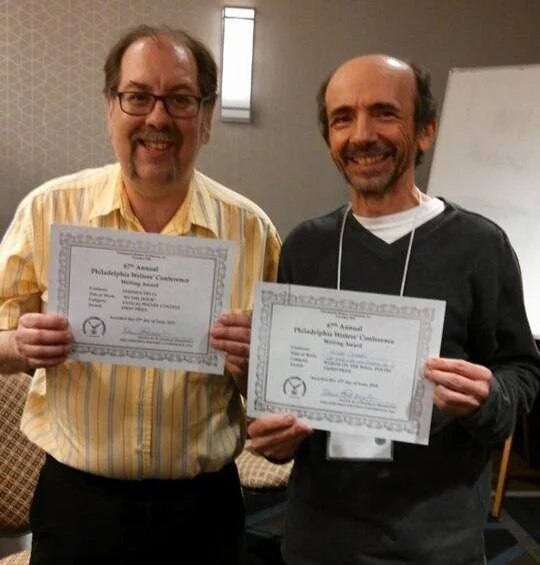
Steve Delia and Mike Cohen have worked collaboratively and independently as poets and supporters of the arts in the Greater Philadelphia area. Mike Cohen helps to run the Poetry Aloud and Alive series at the Big Blue Marble Bookstore, and has had his fingers in many poetic ventures over the years. Steve Delia is the author of 6 chapbooks of poetry, and has read in a variety of venues, including the Philadelphia Writers Conference and on WXPN. Steve and Mike have also appeared throughout the Philadelphia area as the Dueling Poets.

POeT SHOTS - Columbarium by David Moolten

POeT SHOTS is a monthly feature published on the first Monday of the month. It features work by established writers followed by commentary and insight by Ray Greenblatt

POeT SHOTS #2, Series C

image.jpg

COLUMBARIUM

Legend says doves saved the Altneu synagogue

In Prague in 1558, really

Angels in disguise who hovered cooing

Along the roof while the ghetto burned.

You can imagine the faint creak as their wings fanned

The flames away from Europe’s oldest shul

The obdurate roost of tradition

After each purge, but not why children

Never felt the same blessed shuddering

When the Germans stoked their kilns in Terezin.

The ancient poor called themselves lucky

In Rome to have if not an ornate tomb

For the body then a small hole in the wall

For its residue in a row of such holes,

In a stack of such rows, like the better off

For their birds. In 1944 those children

Not yet ash stood as in a fire line and passed

Box after box from the shed with the arched doors

And tired brick, a spur track to the river,

The Russian tanks getting close. Perhaps

There never was a way to contain such truth.

Though as they scattered handfuls of gray silt

To cloud and clot the current they must

Have fluttered a little, carried in the wind

As when a flock is released and wheels

With calm restraint over a city’s spires and eaves

Before returning to its niches. The humble

In the ancient temple sacrificed pigeons

Instead of lambs on the altar, all

They could afford for their burnt offering,

Their holocaust, Greek from Hebrew, the word olah

Meaning that which goes up. Perhaps when you stand

In the synagogue on a Friday night

Once the crowds disperse, listening to the past

Quietly murmured in a dead language

You are that small opening, that repository

Of memory, which is its own homing

Crossing the impossible distance like a dove.

A columbarium is a room where funeral urns are stored. This poem traces centuries of Jewish hardship culminating in the most devastating event that could befall anyone. These strong lines strike nerves and reverberate: “The obdurate roost of tradition.” “To cloud and clot the current they must/have fluttered a little.” “Once the crowds disperse, listening to the past/quietly murmured in a dead language/you are the small opening, that repository/of memory.” Dust becomes birds becomes soul becomes, perhaps, hope.

greenblatt.jpeg

Ray Greenblatt has been a poet for forty years and an English teacher longer than that. He was an editor of General Eclectic, a board member of the Philadelphia Writers Conference, and is presently on the staff of the Schuylkill Valley Journal. He has won the Full Moon Poetry Contest, the Mad Poets Annual Contest, and twice won the Anthony Byrne Annual Contest for Irish Poetry sponsored by The Irish Edition. His poetry has been translated into Gaelic, Polish, Greek and Japanese.

Local Lyrics featuring James Feichthaler

Local Lyrics hosted by Amber Renee appears on the 3rd Monday of each month. In it, Amber features the work and musings of a local poet.

Give me a cold can of beer, the jukebox playing loudly on a Friday night, and an old toothless couple arguing over the tab, and therein lies poetry...

Don’t cry over spilt beer by James Feichthaler


My Pabst Blue Ribbon spills out on the table

And runs a little while, until it slows

And oozes toward the corners of a mat,

Which I soak up with napkins. How life flows

Is not dissimilar from this, in that

We slow down when we're forced to, or we're able,

Under the spell of long commutes and days

That keep us looking down at blinking phones,

From phones to roads, to phones then back again,

While random texts distract us from our plans

Of getting out alive while we still can;

Of starting over, moving on by choice

And not by way of circumstantial severing,

Knowing full well that 'how' we'll leave means everything.


Q&A...


1. Give us one poet, dead or alive, you'd want to get together & spill a couple beers with.


Bukowski. We'd both be spilling beers accidentally, then pouring out 40s purposely for the dead poetry critics who gave us nothing but snobbery and muck through the centuries. We'd probably toast a few old friends too, then come to fisticuffs over who has the better last name.


2. Listening to anything lately that's been speaking to your soul, musically?


Of late (back in summer that is), it's been Nas' "Lost Tapes 2." Super-hyped that a new Gang Starr album is out, which I've heard a few tracks off and can't wait to cop in full. Elliott Smith is always my go-to; dude's a poet on wax. Red Hot Chili Peppers, The Beatles, and way too many hip-hop artists to name. Depends on my mood really.


3. Let's get broad: Where do you think poetry fits in the world?


'Everywhere' would, in short, be my answer. Poetry shouldn't adhere to any one society of thinking or rule of excellence; it's the word, alive on the page; the poet penning verses while the world is crashing down around him/her like a meteor shower. Poetry serves those best who don't give one fig for fitting in anywhere. Give me a cold can of beer, the jukebox playing loudly on a Friday night, and an old toothless couple arguing over the tab, and therein lies poetry; or on the flipside, let my eyes gaze on the bluest ocean, with gulls bobbing up and down on the waves, and a sunset that takes its color from every shade of red imaginable, and whatever the moment whispers to me will be enough. Poetry fits into this world because it is this world; it's the truest reflection of the human experience conveyed through words. How cool is that?


4. Okay, your adoring fans are listening: What do you want the people to know about you?


I once challenged Shakespeare to a rap battle in a dream...he won of course. When I read poetry in public, the temperature of the room must be exactly 70 degrees Fahrenheit and a bowl of Wawa hoagies must be present, with all the meat and vegetables taken out so that the rolls remain like empty husks of yeasty goodness. I write poetry i write poetry i write poetry. A book or 5 is on the way. I also rap. Check out this guy Taliesin aka Big Tal if you like hip-hop; I heard he's pretty good.

Feichthaler.png

James Feichthaler's poetry has appeared in print and online journals in both the US and UK, most recently in Toho Journal and E-Verse Radio. The self-proclaimed 'forrealist poet' is the host of The Dead Bards of Philadelphia, a poetry reading series that occurs every 4th Thursday of the month at The Venice Island Performing Arts Center in Manayunk, PA. You can follow James on Twitter @forrealist_poet and find The Dead Bards of Philadelphia on Instagram and Facebook.

 
Renee.jpg

AMBER RENEE, she/her, 26, writes from her home in suburban Bucks County, Pennsylvania. A fool hopelessly in love with the pursuit of psychic knowledge, she often writes autobiographically; though without sacrificing her distinctive off-rhythm canter. 'Thoughts on This Most Recent Episode' was her 2016 full length collection of self-published poetry ruminating on her thoughts & illnesses. Currently she is working on a musical album of poetry.

POeT SHOTS

POeT SHOTS is a monthly feature published on the first Monday of the month. It features work by established writers followed by commentary and insight by Ray Greenblatt

POeT SHOTS #1, Series C

PLUNDER by A.R. Ammons

I have appropriated the windy twittering of aspen leaves
into language, stealing something from reality like a
silverness: drop-scapes of ice from peak sheers:

much of the rise in brooks over slow-roiled glacial stones:
the loop of reeds over the shallow’s edge when birds
feed on the rafts of algae: I have taken right out of the

air the clear streaks of bird music and held them in my
head like shafts of sculptured glint: I have sent language
through the mud roils of a raccoon’s paws like a net,

netting the roils: made my own use of a downwind’s
urgency on a downward stream: held with a large scape
of numbness the black distance upstream to the mountains

flashing and bursting: meanwhile everything else, frog,
fish, bear, gnat has turned in its provinces and made off
with its uses: my mind’s indicted by all I’ve taken.


A poet’s poem—it sings symphonically! Fresh language: “drop-scapes of ice from peak sheers,” “shifts of sculptured glint,” “mud roils of a raccoon’s paws.” Just chew and slosh around those phrases in your mouth—best tasting dark chocolate! The many continual colons allow the poem to roll on like a mighty river. A sequence like ”frog, fish, bear, gnat” underscores the power of our English language to use its many monosyllabic words.


greenblatt.jpg

Ray Greenblatt has been a poet for forty years and an English teacher longer than that. He was an editor of General Eclectic, a board member of the Philadelphia Writers Conference, and is presently on the staff of the Schuylkill Valley Journal. He has won the Full Moon Poetry Contest, the Mad Poets Annual Contest, and twice won the Anthony Byrne Annual Contest for Irish Poetry sponsored by The Irish Edition. His poetry has been translated into Gaelic, Polish, Greek and Japanese.

It's Baaaack!

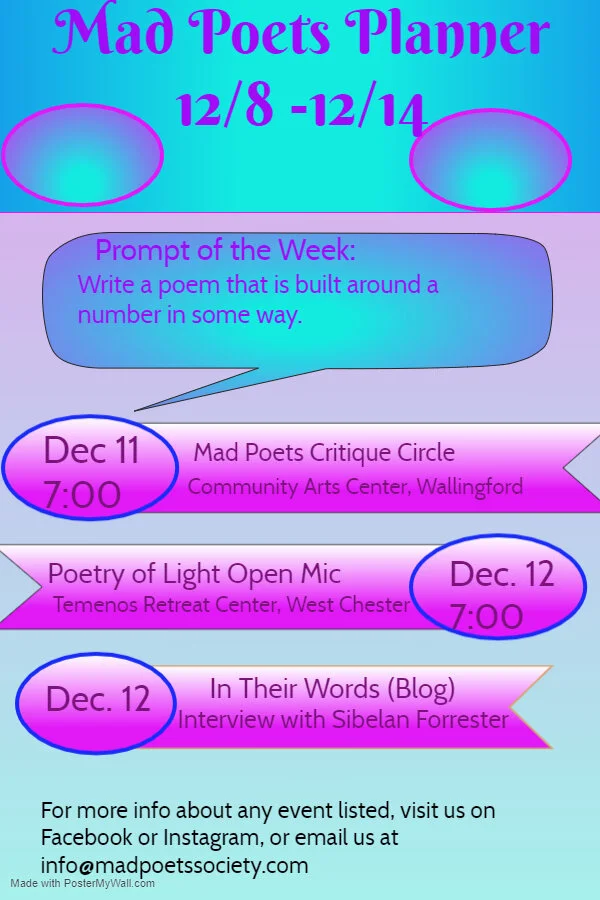
After several dormant years, the Mad Poets Blog is making a return. Welcome both to those of you who enjoyed the blog before, and to those of you visiting the blog for the first time. We aim to make this blog a place where you can get information about The Mad Poets Society, see work by local and established poets, and find inspiration for poets and enjoyers of poetry alike.

Here’s what to expect from the blog in November:

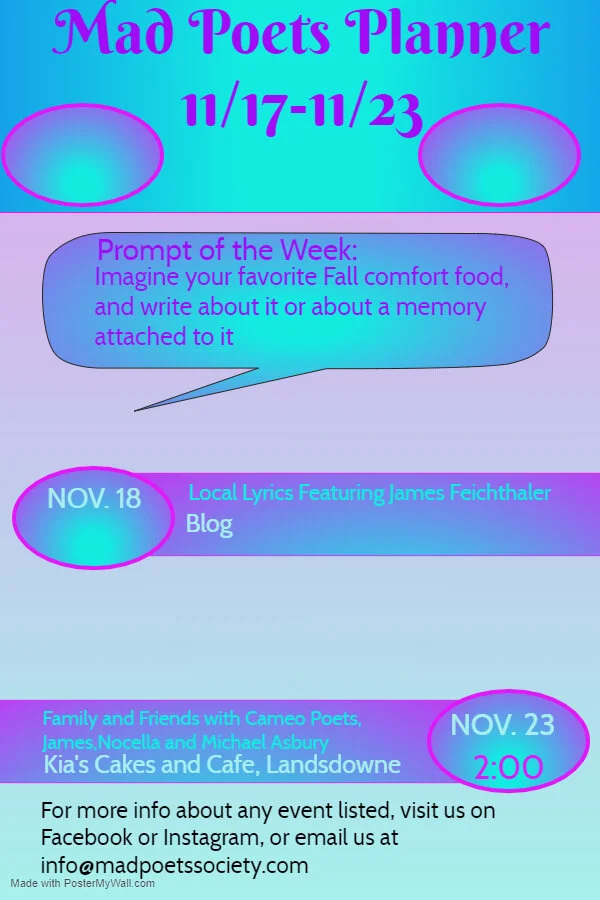
  • Mad Poets Planner - A weekly (every Friday) post that brings you information about the Mad Poets events, coming up in the following week.

  • POeT SHOTS - Poems by established writers accompanied by commentary from Ray Greenblatt - Nov. 4th.

  • A monthly feature of work by local poets curated by Amber Renee - Nov. 17th

  • Starting in December: Video of interviews with local writers conducted by Mike Cohen and Steve Delia

To your right is the Planner for the week starting on Sunday, November 3rd. Be sure to subscribe to get emails about the newest content we post!

Nov. 1 Planner.jpg

POeT SHOTS # 6 (Series B) - Ray Greenblatt

LOVE IS NOT ALL     by Edna Millay

Love is not all: it is not meat nor drink
Nor slumber nor a roof against the rain;
Nor yet a floating spar to men that sink
And rise and sink and rise and sink again;
Love can not fill the thickened lung with breath,
Nor clean the blood, nor set the fractured bone;
Yet many a man is making friends with death
Even as I speak, for lack of love alone.
It well may be that in a difficult hour,
Pinned down by pain and moaning for release,
Or nagged by want past resolution's power,
I might be driven to sell your love for peace,
Or trade the memory of this night for food.
It well may be. I do not think I would.

 Sonnet is an Elizabethan poetic form; but this one uses contemporary language and sensibility. The theme of love is tested by forms of possible death--starvation, exposure to the elements, drowning, TB, contaminated blood, broken bones . . .What may be a worse trial is directed toward the soul when "a man is making friends with death . . . for lack of love alone." Yet the poet reaffirms her belief in love: "I do not think I would."
 

POeT SHOTS # 5 (Series B) - Ray Greenblatt

HELEN OF TROY DOES COUNTERTOP DANCING,      by Margaret Atwood

The world is full of women
who'd tell me I should be ashamed of myself
if they had the chance. Quit dancing.
Get some self-respect
and a day job.
Right. And minimum wage,
and varicose veins, just standing
in one place for eight hours
behind a glass counter
bundled up to the neck, instead of
naked as a meat sandwich.
Selling gloves, or something.
Instead of what I do sell.
You have to have talent
to peddle a thing so nebulous
and without material form.
Exploited, they'd say. Yes, any way
you cut it, but I've a choice
of how, and I'll take the money.

I do give value.
Like preachers, I sell vision,
like perfume ads, desire
or its facsimile. Like jokes
or war, it's all in the timing.
I sell men back their worse suspicions:
that everything's for sale,
and piecemeal. They gaze at me and see
a chain-saw murder just before it happens,
when thigh, ass, inkblot, crevice, tit and nipple
are still connected.
Such hatred leaps in them,
my beery worshippers! That, or a bleary
hopeless love. Seeing the rows of heads
and upturned eyes, imploring
but ready to snap at my ankles,
I understand floods and earthquakes, and the urge
to step on ants. I keep the beat
and dance for them because
they can't. The music smells like foxes,
crisp as heated metal
searing the nostrils
or humid as August, hazy and languorous
as a looted city the day after,
when all the rape's been done
already, and the killing,
and the survivors wander around
looking for garbage
to eat, and there's only a bleak exhaustion.
Speaking of which, it's the smiling
tiresme out the most.
This, and the pretense
that I can't hear them.
And I can't, because I'm after all
a foreigner to them.
The speech here is all warty gutturals,
obvious as a slab of ham,
but I come from the province of the gods
where meanings are lilting and oblique.
I don't let on to everyone,
but lean close, and I'll whisper:
My mother was raped by a holy swan.
You believe that? You can take me out to dinner.
That's what we tell all the husbands.
There sure are a lot of dangerous birds around.

Not that anyone here
but you would understand.
The rest of them would like to watch me
and feel nothing. Reduce me to components
as in a clock factory or abattoir.
Crush out the mystery.
Wall me up alive
in my own body.
They'd like to see through me,
but nothing is more opaque
than absolute transparency.
Look--my feet don't hit the marble!
Like breath or a balloon, I'm rising,
I hover six inches in the air
in my blazing swan-egg of light.
You think I'm not a goddess?
Try me.
This is a torch song.
Touch me and you'll burn.


          Modern--"Not that anyone here/but you would understand" she says directly to the reader.
          Mythic--"I come from the province of the gods/where meanings are lilting and oblique."
          Shocking--"Humid as August, hazy and languorous/as a looted city the day after."
          Men beware: "They gaze at me and see/a chain-saw murder just before it happens."
          Why should beauty, tenderness, vulnerability be destroyed?

POeT SHOTS # 4 - (Series B) -Ray Greenblatt

             QUARANTINE by Eavan Boland

n the worst hour of the worst season
          of the worst year of a whole people
a man set out from the workhouse with his wife.
He was walking--they were walking--north.

She was sick with famine fever and could not keep up.
          He lifted her and put her on his back.
He walked like that west and west and north.
Until at nightfall under freezing stars they arrived.

In the morning they were both found dead.
          Of cold. Of hunger. Of the toxins of a whole history.
But her feet were held against his breastbone.
The last heat of his flesh was his last gift to her.

Let no love poem ever come to this threshold.
          There is no place here for the inexact
praise of the easy graces and sensuality of the body.
There is only time for this merciless inventory:

Their death together in the winter of 1847.
          Also what they suffered. How they lived
And what there is between a man and woman.
And in which darkness it can best be proved.


The couple's tortuous trek: "walking, walking, west, west, and, and, last, last, worst, worst." Fragments capture the fits and starts of dying. "Of cold. Of hunger. Of the toxins of a whole history." Yet their loving sacrifice for each other endures in history.


POeT SHOTS #3 (SERIES "B") BY RAY GREENBLATT

POET SHOTS # 3 (SERIES B)   by Ray Greenblatt

Pasiphae, by Joanne Hayhurst

From the leathery leaves of olive trees nearby
an open window, a winter rain's been weeping

while her blood is slowly seeping onto
sheepskin where she lies in silence

of the birthing room. As if she's half
asleep or dreaming in the rain light

of a cave, where shadows without margins
merge and shift and sounds sometimes confuse,

there seems to be a whimpering from somewhere.
Rising, dreading, drawn beyond her will,

she shudders as blood trickles down her thighs--
she comes closer, sees the swaddling clothes,

the small stirring in the cradle. Time swallows
time: she's flung, fragmented, into

dark, through whirling worlds, free-falling--
as though her womb had filled with dross or stone,

she settles to the floor beside the cradle.
Beyond her will, fierce trembling hands unbind,

unwind the rags, the endless swathing--
naked now, exposed--a small thing, limp,

and wet, unfolding the old darkness
of a dream. A moan--his, or hers?--

Smother it or back away or leave it
here to dry and wither, disappear.

The small thing turns his head: dark eyes open,
seeking hers; in them wells the sharing

of their sorrow: his delicate long lashes,
the flesh, the downy hide, the muscular

perfection, the cord, the velvet flanks,
the fetlocks, hooves, a fine and graceful tail.

The baby's fingers tighten at her touch--
nails, thin as skin of grapes, pale as water--

his infant fist closes on her finger;
she brings him to her: hot familiar breath

upon her neck, his smell of rising yeast
or forest floors in summer. She rests her face

upon his face, on two furred nubs that will
become the terrifying horns. The queen

begins a heavy humming: old sounds
of the Aegean Sea and winter rains--

Maybe she expected it: the door's
flung wide and, oh, the animal howling.


A mother's love knows no boundaries--not even for something unearthly: "the downy hide, the muscular/perfection, the cord, the velvet flanks,/the fetlocks, hooves, a fine and graceful tail." Although a queen she has suffered so much, as he will: "in them well the sharing/of their sorrow."

POeT SHOT # 2 (SERIES "B") BY RAY GREENBLATT

POET SHOTS # 2 (SERIES B)   by Ray Greenblatt


ON THE BALCONY by Emily Grosholz

We understood at last the native tongue
of the candle struggling to maintain
its story on the balcony, in the wind,
set opposite the quiet moon.
We felt ourselves grow darker with the wine
and an increasing reticence
that waited near us like the sleeping children.

Perhaps it was the music playing
deep inside the rooms behind the wall,
blues from south Chicago with no words
but those the flame supplied,
curved and falling like the wind in veils
or flights of stairways down,
a failure and advancement, always down.

Perhaps it was the blind wall with its traces
of ivy, advertisements, empty rooms,
pattern of our two dark heads by moonlight
broken by the candle's shifting tongue.
All our talk became a listening
and echoed from the wall
in letters and the seams of vanished stairs.

The moon, the candle, answered to each other;
we heard the small one gutter
in imitation. loving and unstable,
mocking and shaking, of the silent moon.
We listened till we half believed
it was the language of the dead,
their strange flat hands like ivy on the wall.

So distracted by the task of living,
we must turn for wisdom to the ones
who wear the past upon their faces
as the walls of houses do,
as the moon reveals itself in phases
moving from a scored white vacancy
into the baleful silhouette of fire.

We watched the flame embrace the wax,
the crumbling wall surrender to the touch
of ivy, sinking deeper in its scars.
Close behind, the music played,
the children slept enfolded in a dream,
their respiration like a lower
run of minor notes, descending scales.

Later the flame dropped off, so suddenly
we wondered, drunk and silent as we were,
why our light companion fled
and left us to our old abandonments.
Your darkened face, just after, lit
to features I could understand;
I read it with my mouth and hands
because my eyes were full of night.


The night is alive for lovers. All things become sentient--"candle," "moon,"  the voice of "music."
          "All our talk became a listening
          and echoed from the wall
          in letters and the seams of vanished stairs."

          "as the moon reveals itself in phases
          moving fromscored white vacancy
          into the baleful silhouette of fire."

POeT SHOT #1 (SERIES "B") BY RAY GREENBLATT

POeT SHOTS #1 (Series B)  - by Ray Greenblatt


TRYING TO RAISE THE DEAD by Dorianne Laux

Look at me. I'm standing on a deck
in the middle of Oregon. There are
people inside the house. It's not my
house, you don't know them.
They're drinking and singing
and playing guitars. You love
this song. Remember? "Ophelia."
Boards on the windows, mail
by the door. I'm whispering
so they won't think I'm crazy.
They don't know me that well.
Where are you now? I feel stupid.
I'm talking to trees, to leaves
swarming on the black air, stars
blinking in and out of heart-
shaped shadows, to the moon, half-
lit and barren, stuck like an ax
between the branches. What are you
now? Air? Mist? Dust? Light?
What? Give me something. I have
to know where to send my voice.
A direction. An object. My love, it needs
a place to rest. Say anything. I'm listening.
I'm ready to believe. Even lies, I don't care.
Say, burning bush. Say, stone.  They've
stopped singing now and I really should go.
So tell me, quickly. It's April. I'm
on Spring Street. That's my gray car
in the driveway. They're laughing
and dancing. Someone's bound
to show up soon. I'm waving.
Give me a sign if you can see me.
I'm the only one here on my knees.


"Stars/blinking in and out of heart-/shaped shadows, to the moon, half-/lit and barren, stuck like an ax/between the branches." Simple words. Complex thoughts. Her lost love. Dead love. She is the lost Ophelia in so much anguish.

Ray Greenblatt   (rgreenblatt71@comcast.net)

THERESE HALSCHEID TO READ ON SEPTEMBER 7, 2016 AT COMMUNITY ART CENTER

Therése Halscheid


will read her poetry and share her visual art

Wednesday September 7

7:00 p.m.

at the Community Arts Center

414 Plush Mill Road

Wallingford, PA19086

Open Mic will follow

The First Wednesday reading series at the CAC is sponsored by the Mad Poets Society. For more information see the web page (www.madpoetssociety.com) or contact First Wednesday series host Sibelan Forrester (610-328-8162, sforres1@swarthmore.edu)

POeT SHOT # 11 Blog Post by Ray Greenblatt - On Greenblatt

POeT SHOT #11


                                         BACK FROM THE DEAD by Ray Greenblatt

Renzie came back from the dead

really back from hell

literally he was dead and

was sent back. I believe him

his honesty is compelling

as well as his honest anger

he has nothing to hide.

He slouches over there

in filthy clothes and flesh

pockets jammed with swatches

of newspaper he picks out

of trash cans and gutters

--dirty is nothing compared to hell—

pretending to read as cover

pace a few steps then back

he tells me he is thrilled

to be here. Bored? Never

of course being really dead

he doesn’t have to sleep

but he pretends to

for the sake of others

especially the cops

who would confine him.

He loves hanging out

in this underground station

where people come and go

all the time—he laughs—

a little like hell.

He begs money to

sometimes buy food to

pretend he must eat

yet he does like some tastes

--not like during life

it was almost compulsion—

he also likes some odors

garbage at its rottenest

doesn’t offend him.

I could go on, as he does

but I have to continue

my real life as he his death.

I see Renzie standing there

in his great bulk

--in hell you don’t wither—

eyes shifting in their sockets

empty gums contorted

cursing the invisible

waving a dirty piece of paper

like a fatal summons

people swirling all around

used to his odorous presence

his eccentric reality.


We have seen many ghosts wandering through the year of poems above. Ghosts of the past, ghosts of our hopes, ghosts of our hurts. Renzie claims he has returned from the dead. We see men and women who seem to be caught between life and a living death. How did they deserve such a fate?

POeT SHOTS # 10 BLOG POST BY RAY GREENBLATT

                            TOAST ON A SUMMER AFTERNOON

- Eileen M. D’Angelo

I ordered a Guinness and thought of you,

on the deck of The Inn at Jim Thorpe. It is August,

and the wind sighs a hint of fall. The scent of sage

drifts down the mountains, over stone mansions,

to the Switch Back Railroad on the hill.


Here in Mahoning Valley at the bottom of a bowl of trees,

Sunday falls gently on my shoulders like late summer light,

here where the Mauch Chunk Creek secretly runs

below the streets, rushing all the way to the Lehigh River.


Somewhere in the woods I know the first curled leaf

is beginning to change. It has taken every ray of white sun it can,

and will take no more:  it has held on for this very afternoon.

When autumn’s first chill steals down the valley, it will let go.


The afternoon light shifts on the wooden floor of the pub,

where men walked a hundred years ago, me with dark hair

and light eyes like yours, hearts burning hope

in a new land, hands full of black diamonds, lungs full of coal dust.


Maybe your ancestors and mine, these mining Molly Maguires,

their very lives owned by the Philadelphia & Reading Coal

& Iron Company. Innocents hanged for crimes invented by rich men,

lies spun to hold Irish mineworkers, to chain them to the land.


Their spirits haunt the old stone jail: Walk now, where their bodies

once swung before a crowd. Strange: the sound of bagpipes on the air.

Whispering voices rise from the dark earth, cry out from dungeon cells,

from collapsed tunnels far below. Their scattered bones

ache between coal veinsand underground streams.


Today, I raise my glass to all of them.  To you.

The Guinness is dark and strong.  The froth soft upon my lips.

Sunlight warms my pale cheek, as the old clock tower,

in the center of town, tolls the hour.

(Previously published in Philadelphia Stories)

                                                                *                     *                    *

We each have a history. History is where we live. Sometimes we must move to a new setting for complex reasons. Often unjust, often haunted, always mixed with emotions. Our memories, our memories of those we know and love flow like rivers, like the seasons.

                                                -Ray Greenblatt