Review of Brandon Blake's When All Is Lost

Like a successful surgical procedure, Blake’s work may hurt at first, but it can also be a first step towards healing, a new state of emotional wellness.
Blake.JPG

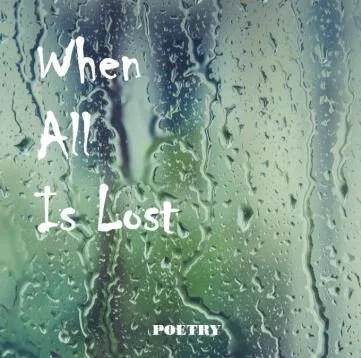
When All Is Lost by Brandon Blake

Self-published $5.00

Click Here to purchase a copy

Reviewed by Sean Hanrahan


Some poets find their voice in, and respond to, historic and cataclysmic times or events. Other poets find their voice in, and respond to, the precise, poetic details to be found in everyday life. Brandon Blake’s newest, self-published chapbook, When All Is Lost, offers the reader nuanced and insightful poems that speak to the specific details of the narrator’s post-breakup existence as well as gross injustices occurring in Philadelphia. It is a slim collection (13 pages), but this work contains multitudes and has lingered in my mind longer than its length may immediately suggest.

In his poem, “The Day After,” Blake’s narrator describes a first thought in the first morning after a breakup:

Switching the alarm off
Before it detonates &
Interrupts melancholy states.

He continues to expand upon the emptiness of daily rituals without his partner, without someone to snuggle or shower with—

The shower’s heat doesn’t hold so well
This morning.

His commute has even changed and “lost its vibrancy.” This poem provides the reader with commandingly specific details that the narrator’s heartache becomes palpable, corporeal. The reader, then, is led to recall the details, the rawness of their own dissolved relationships. It is a testament to Blake’s wordsmith skills that he grants himself poetic space to express an intensity of feeling and grants readers the space to work towards their own catharses. Like a successful surgical procedure, Blake’s work may hurt at first, but it can also be a first step towards healing, a new state of emotional wellness.

Blake’s narrator uses his hobbies, as we all do, to distract from his pain, explored in the complex and devastating poem, “My Addiction with Origami.”

I found my fix
deep within the folds as
paper cuts and calloused fingers
provided needed distraction

He finds a place “to tuck away pride and ego” in his folding. He cannot totally escape from his current emotional state as his origami attempts begin to resemble his relationship. This poem resounds with the truth that art can be a way to mitigate our pain, but it is also the place where we confront it. I have rarely found a poem that expresses this fact with as much clarity and beauty as I have found in this poem, my favorite in this collection.

Blake ends this powerful chapbook with poems that move beyond the personal and enter the Philadelphia political arena. With the poem, “Hey Yo, Adriane,” he invokes the cinematic Rocky legend to relay the experience of a woman with a

Scrawny handwritten sign announcing
“Too ugly to prostitute.”

Whether through astute observation, intuitive imagination, or both, Blake gives a voice to this “Adriane to anyone’s Rocky,” a woman that many city-dwellers would choose to ignore. If only this poem was as well-known as the Rocky statue, we could see real change in Philadelphian society.

As a native Philadelphian, Blake also calls for us to remember the MOVE bombing of 1985 in the powerful closing poem, “Attention MOVE…This is America.” Blake paints a clear picture of that morning of devastation with the lines:

Eastern light
accentuating adrenaline-fueled veins
dissipating
in sweat behind blue collars
barely restraining the hounds of justice.

The tension and the sorrow build as all local readers know how this poem must end, although in a better and more humane world the MOVE bombing would not have taken place. But in 1985 and in America, it unfortunately did. Blake closes this vital chapbook with the image of,

dreadlocked cherubs
breaking free from the licks of fiery shackles
escaping Puritan purgatory
vanishing in the Philly skyline.

No poet, or pugilist for that matter, packs a punch like Brandon Blake.


Hanrahan headshot.jpg

Sean Hanrahan is a Philadelphian poet originally hailing from Dale City, Virginia. He is the author of the full-length collection Safer Behind Popcorn (2019 Cajun Mutt Press) and the chapbooks Hardened Eyes on the Scan (2018 Moonstone Press) and Gay Cake (2020 Toho). He is currently at work on several literary projects as well as teaching a chapbook class this spring. He currently serves on the Moonstone Press Editorial Board, as head poetry editor for Toho, and workshop instructor for Green Street Poetry.


Local Lyrics featuring Stephanie Cawley

Local Lyrics hosted by John Wojtowicz appears on the 3rd Monday of each month. In it, John features the work and musings of a local poet.


“I’m finding myself most wanting the company of many poets I already know and who, in ordinary times, it would be no miracle to spend time with … I’d honestly trade a chance to lay in a meadow with Emily Dickinson for it.”

Stephanie Cawley

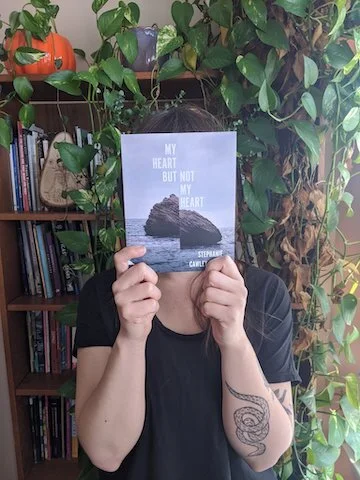
from My Heart But Not My Heart

Does your mouth go wreath
when you want warmth?
Do you say fallen instead of
fallow? Does your tongue get stuck
in the gap between is and was?
There is an actual shrinking.
List all the animals you can.
Echo back these fifteen words.
You are a thin glass of water.
You are a cold wind and a field.
Don’t make them a story.

Q and A

How would you describe your poetic aesthetic?

I aspire to being a poet who is not loyal to any singular aesthetic, style, form, or mode of writing. I hope to continually reinvent myself, to find the forms and modes that a given subject or project requires and to always remain interested in trying something new with my work. I guess that is a kind of aesthetic or tendency in and of itself, though! And all that said, I recognize that I’ve been pretty dedicated to the prose poem and to poetry/prose hybrid forms for quite some time now. My first book My Heart But Not My Heart is an extended sequence that is mostly prose; I have a chapbook A Wilderness that is almost all prose poems; and my second book Animal Mineral will contain prose poems, a kind of lyric essay, and a long poem that rewrites a short story by Clarice Lispector, in addition to some standalone poems.


If you could spend the afternoon with one poet living or dead, who would it be and how would you spend your afternoon?

I haven’t spent an afternoon with any person other than my partner in about two months now, so I’m finding myself most wanting the company of many poets I already know and who, in ordinary times, it would be no miracle to spend time with. I’d love to spend an afternoon with my poet friends, maybe writing together, or reading poems to each other, or maybe just sitting outside having a drink. Right now, I’d honestly trade a chance to lay in a meadow with Emily Dickinson for it.


Is there anything unique about your process? Do you have any advice for writers struggling to find their voice?

I don’t know if it’s unique, but my writing process relies a lot on intuition. I generate work by dropping in to a space where I’m as unconscious about what’s happening on the page as possible, freewriting, writing while looking out the window, sometimes incorporating elements of chance or outside inspiration (eavesdropping, observation, grabbing bits of text from another book, drawing a tarot card). Then I come back later (sometimes much later) and read and shape and refine and rearrange and remix and apply structure. I am trying not to think of that second step as “cleaning up,” but as a process of reflecting on and bringing more intention into a work.


In your new book, My Heart But Not My Heart, you write about your experience with grief. Did you have a specific strategy when traversing the line between the personal and universal?

Writing the book began with a need to document and make space for my personal experiences of grief in the aftermath of my dad’s sudden death. It feels like American culture is pretty uncomfortable with death and with real grief, so writing this book became a way to make space for thoughts and feelings that felt unspeakable and unbearable in my daily life. I don’t really believe in universality or in striving towards it, but I did find myself curious about how my individual experiences connected to others’ experiences and connected to other bodies of knowledge. I wanted to try to understand what was happening to me, so I found myself turning to philosophy, neuroscience, and other cultural texts about grief and depression, which then made their way into the writing.


In this book, you seamlessly move between prose and poetry. Can you tell us a little about the decision not to box yourself into one form?

The book began with the sections that are in prose, which I started writing around the one year mark after my dad died. For that first year after he died, I was in graduate school, and I muscled through continuing to write kind of musical, lyrical poems, but it felt like I was going through the motions. Then, eventually, it felt like I couldn’t bear to write like that at all anymore, like I couldn’t approach my actual experiences with that kind of writing. So, after a while of not really writing at all, I started writing into a Word document in prose. I didn’t think what I was doing there was “real writing,” writing that would become anything or that anyone else would ever read, but it was the first time I felt able to actually arrive on the page. I wrote into that document every day for about a month, and then showed a bit of it to my teacher and mentor Dawn Lundy Martin who told me this was my book and that I had to keep writing it.

When I began to shape the book manuscript, I knew that by then I did also have some more “poem”-type pieces that were in conversation with the prose, so I spent a long time playing with order and structure before arriving at a kind of architecture that holds all these pieces together. It felt right, for a book about an experience of grief, for there to be aspects of the form that felt disorienting (the shifts between poetry and prose, the fragmentation, the pieces that occupy different parts of the page) and aspects that evoked an enduring sameness (the long prose sequences).


Where can readers find more of your work? Where can we buy your books?

You can get My Heart But Not My Heart right from my publisher Slope Editions (slopeeditions.org), from Small Press Distribution (spdbooks.org), or from Bookshop.org. You can also buy it from Amazon, but you shouldn’t! Even setting aside Amazon’s horrific labor practices, for small press books like mine, if you buy from the press or from indie retailers, more of your dollars will go back to support the press, which runs on a shoestring budget and volunteer labor. I also have a chapbook A Wilderness which you can get from Gazing Grain Press (gazinggrainpress.com). I also have work in various print and online journals which you can find links to on my website stephaniecawley.com.

Cawley.jpg

Stephanie Cawley is a poet from southern New Jersey and the Director of Murphy Writing of Stockton University. She is the author of My Heart But Not My Heart, which won the Slope Book Prize chosen by Solmaz Sharif, and the chapbook A Wilderness from Gazing Grain Press. Her poems and other writing appear in DIAGRAMThe FanzineTYPOThe Boston Review, and West Branch, among other places. Her next book Animal Mineral will be out from YesYes Books in 2022. Learn more at stephaniecawley.com.


wojto.jpg

Catfish” John Wojtowicz grew up working on his family’s azalea and rhododendron nursery in the backwoods of what Ginsberg dubbed “nowhere Zen New Jersey.” Currently, he serves his community as a licensed social worker and adjunct professor.  He has been featured in the Philadelphia based Moonstone Poetry series, West-Chester based Livin’ on Luck series, and Rowan University’s Writer’s Roundtable on 89.7 WGLS-FM. Catfish John has been nominated 3x for the Pushcart Prize. He has been a workshop facilitator for Stockton University’s Tour of Poetry at the Otto Bruyns Public Library of Northfield and will be facilitating a haiku workshop at Beardfest Arts & Music Festival at the end of August. Recent publications include: Jelly Bucket, Tule Review, The Patterson Literary Review, Glassworks, Driftwood, Constellations, The Poeming Pigeon, and Schuylkill Valley Journal. Find out more at: www.catfishjohnpoetry.com

In Their Words - An Interview with Steve Delia

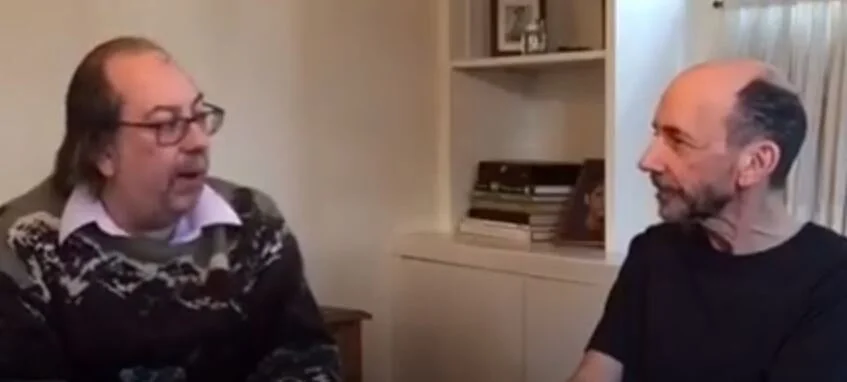
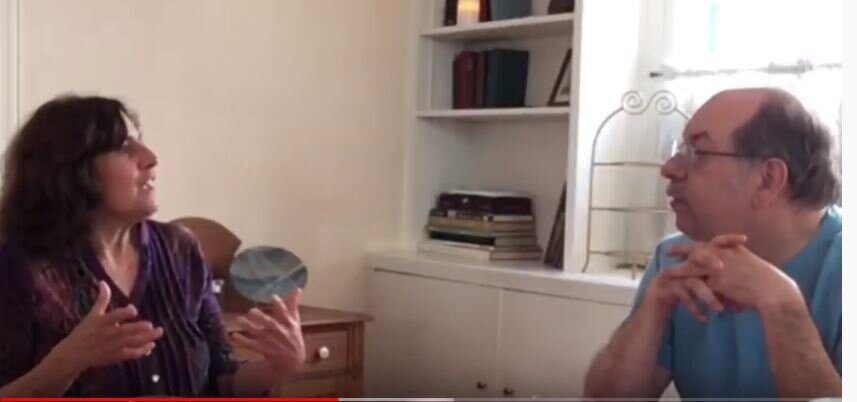
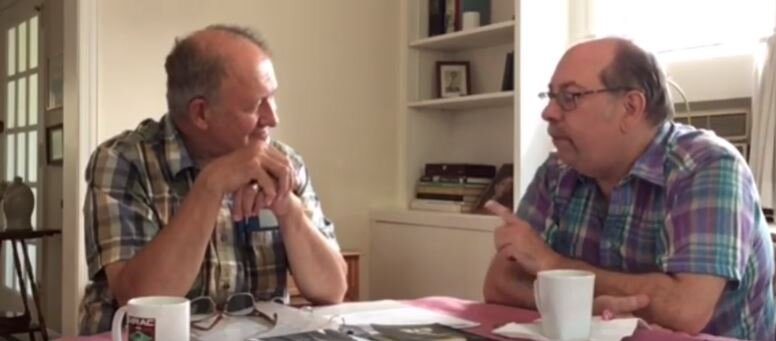
This month, we go all the way back to 2017, when Mike Cohen interviewed his partner in crime, Steve Delia. In this section of the interview they talk about the importance of performance in poetry, as well as the importance of identifying yourself as a poet. Click the image for the interview.

For the full interview, along with others, click here to check out Mike Cohen’s YouTube channel.


Delia+and+Cohen.jpg

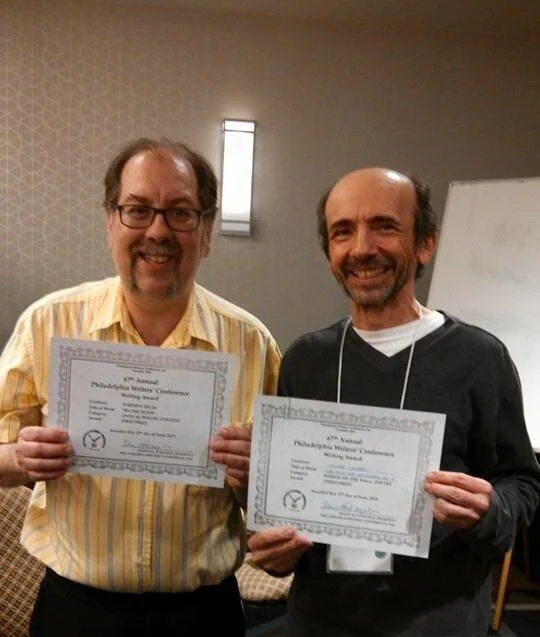
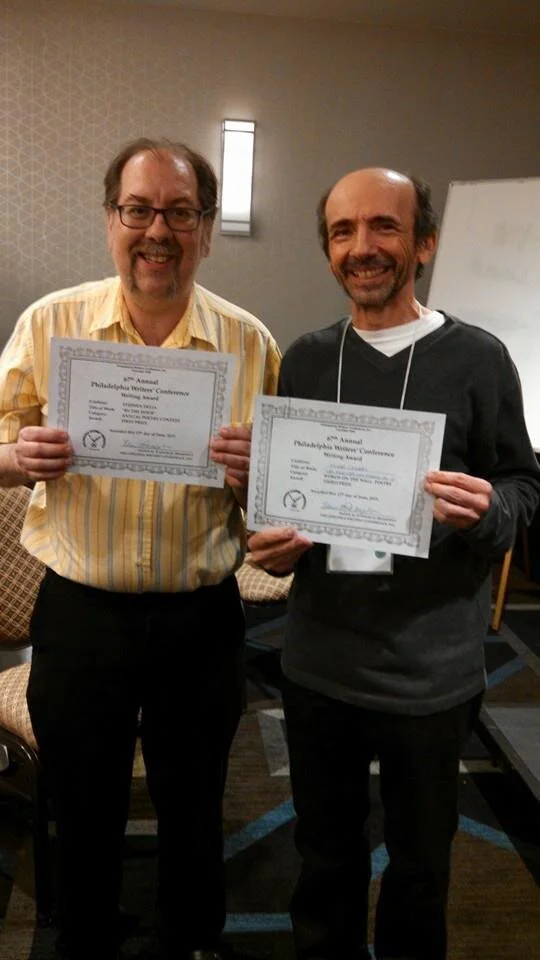
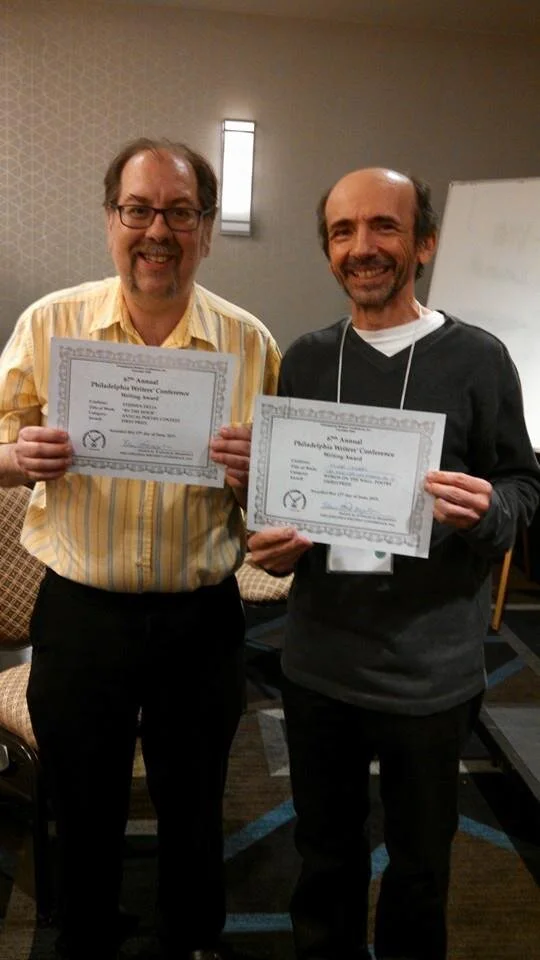
Steve Delia and Mike Cohen have worked collaboratively and independently as poets and supporters of the arts in the Greater Philadelphia area. Mike Cohen helps to run the Poetry Aloud and Alive series at the Big Blue Marble Bookstore, and has had his fingers in many poetic ventures over the years. Steve Delia is the author of 6 chapbooks of poetry, and has read in a variety of venues, including the Philadelphia Writers Conference and on WXPN. Steve and Mike have also appeared throughout the Philadelphia area as the Dueling Poets.

Review of Ann E. Michael's Barefoot Girls

The book is filled with long roads, small towns, big dreams, self doubt and intense desires.
Michael.jpg

Barefoot Girls by Ann E. Michael

Prolific Press

$8.95

Click HERE to purchase a copy


Reviewed by Phil Dykhouse


If you pay the price

she’ll let you deep inside

but there’s a secret garden she hides.

Bruce Springsteen, “Secret Garden


In the dedication that opens Ann E. Michael’s Barefoot Girls, she professes that her chapbook is “Indebted to the music of Bruce Springsteen',” and as you begin to delve into the 24 poems of the collection, it’s hard not to notice. The book is filled with long roads, small towns, big dreams, self doubt and intense desires. However, even with its poetry being so closely inspired by one music’s greatest storytellers, Barefoot Girls excels in carving its own unique path through it’s tales of being young and growing up in South Jersey. 

 With its first few poems, Barefoot Girls begins building both its physical and emotional landscape. The streets are empty and boredom is commonplace. Like most teenagers, the subjects in these poems are quite aware of their unfulfilling positions in life. There’s an angst here that comes across as completely natural. 

“You sought somewhere sultry and new to you: winding, dense. Dangerous”
from “Coastal Plains”


The streets were dead ends mostly, as the tracks
followed the feeder creek, and there was nothing
to get to on the other side except
trouble…

from “Dares”

A little further into the book the poems find the girls stepping out into the world beyond their monotonous surroundings. It’s here that they begin to search for who they are, who they want to be. You’ll find them discovering their love of music from a certain rock star and contending with puberty at the roller skating rink.  

“Some boy from north Jersey strummed our stories on his guitar…I would never have seen how the music sustains them, those dancers and lovers carried off by the back beat…”
from “Rock Concerts”

...me in my Keds with an extra 50 cents to rent the largest women’s size or a boys’ pair…you and I at fourteen, putting our whole selves in.”
from “Roller Rink”

As you progress further, in what seems so true to life, we find the girls suddenly coming face to face with self perception. Ann does an amazing job subtly introducing it into Barefoot Girls. When I arrived at this part of the book, it came back to me how quickly we as children are thrust in such a confusing time. Competition with each other begins to replace the more innocent relationships we’ve known. We begin to not only question others, but also ourselves. 

“...she watches the boys elbow one another trying to pretend they’re not out to impress…”
from “Barefoot Girl”

“Something about them spoke of competition and staying tough. Something about them said the ones who stay benched lose.”
from “Bleacher Season”

After that, love and sex begin to play an important role in the book. For the first time in their lives, the girls are experiencing desire from within themselves, as well as boys. It’s in these poems they are confronted with the repercussions of lust, shame, confusion, and especially pregnancy.   

“Love was desire mostly, we’d no other name for it, not at 15.”
from “Boys”

“She felt his heart beat in her ribs, a tunnel through her girlhood.”
from “Little Joanie”

“...your sister’s confession she was carrying the child of that boy she’d been caught screwing in
the high school auditorium back row…”
from “Normal Day”

Towards the end of the book, you’ll find that the poems have evolved into a slightly more reflective tone. The speaker is a little older. She’s experienced things that have changed her. She seems to be looking forward while still having one foot stuck in the past. It's quite similar to the angst that we come upon in the beginning of the book. It's as if she sees that after all her and her friends have been through, they’re still stuck where they were when it started.

“We were young and easily influenced, convinced the future was something constructed around us…”
from “Building for Us”

“She’s young but she’s sure she’s left girlhood behind on the swingset…”
from “Against Whatever Holds You Down-”


As I finished Barefoot Girls, I found that Ann’s ability to frame a story with a voice that isn’t at the center of it is one of the book’s highlights. It allows you to feel as though you are part of this group of friends. You feel as though you are with them in their intimate moments. Interestingly enough, I also came of age in South Jersey, so I am quite familiar with its trappings. I’ve experienced many of the same situations and feelings that are the focus of most of these poems. I must say that as a male I was a little intimidated to relive them through a female's perspective. I felt as if I was looking in on something that had been hidden from me my entire life. However, through its layers of honest and evolving poetry, Barefoot Girls reveals itself to be so encompassingly human that the differences in gender become only part of the story instead of its whole. It sings like a song you’re familiar with, even if you’re hearing it for the first time. A song you’ll want to listen to over and over again. 


Phil - headshot.jpg

Philip Dykhouse lives in Philadelphia. His chapbook Bury Me Here was published and released by Toho Publishing in early 2020. His work has appeared in Toho Journal, Moonstone Press, everseradio.com, and Spiral Poetry. He was the featured reader for the Dead Bards of Philadelphia at the 2018 Philadelphia Poetry Festival.

POeT SHOTS - "Ex Basketball Player" by John Updike

POeT SHOTS is a monthly series published on the first Monday of the month. It features work by established writers followed by commentary and insight by Ray Greenblatt. POeT SHOTS #7, Series C


EX-BASKETBALL PLAYER

Pearl Avenue runs past the high-school lot,
Bends with the trolley tracks, and stops, cut off
Before it has a chance to go two blocks,
At Colonel McComsky Plaza. Berth’s Garage
Is on the corner facing west, and there,
Most days, you’ll find Flick Webb, who helps Berth out.

Flick stands tall among the idiot pumps—
Five on a side, the old bubble-head style,
Their rubber elbows hanging loose and low.
One’s nostrils are two S’s, and his eyes
An E and O. And one is squat, without
A head at all—more of a football type.

Once Flick played for the high-school team, the Wizards.
He was good: in fact, the best. In ‘46
He bucketed three hundred ninety points,
A county record still. The ball loved Flick.
I saw him rack up thirty-eight or forty
In one home game. His hands were like wild birds.

He never learned a trade., he just sells gas,
Checks oil, and changes flats. Once in a while,
As a gag, he dribbles an inner tube,
But most of us remember anyway.
His hands are fine and nervous on the lug wrench.
It makes no difference to the lug wrench, though.

Off work, he hangs around Mae’s Luncheonette.
Grease-gray and kind of coiled, he plays pinball,
Smokes those thin cigars, nurses lemon phosphates.
Flick seldom says a word to Mae, just nods
Beyond her face toward bright applauding tiers
Of Necco Wafers, Nibs, and Juju Beads.


Master of fiction and essay Updike has brought Rabbit into a poem disguised as Flick, also a great ex-basketball player: “The ball loved Flick.” “His hands were like wild birds.” “Grease-gray and kind of coiled.” Even the gas pumps where he worked were like him: “Rubber elbows hanging loose and low.”


greenblatt.jpeg

Ray Greenblatt has been a poet for forty years and an English teacher longer than that. He was an editor of General Eclectic, a board member of the Philadelphia Writers Conference, and is presently on the staff of the Schuylkill Valley Journal. He has won the Full Moon Poetry Contest, the Mad Poets Annual Contest, and twice won the Anthony Byrne Annual Contest for Irish Poetry sponsored by The Irish Edition. His poetry has been translated into Gaelic, Polish, Greek and Japanese.

Review of Brooke Palma's Conversations Unfinished

The poet expertly navigates around memories, the dead, and ghosts, but she also has something to say about the present.
cover the brooke.jpg

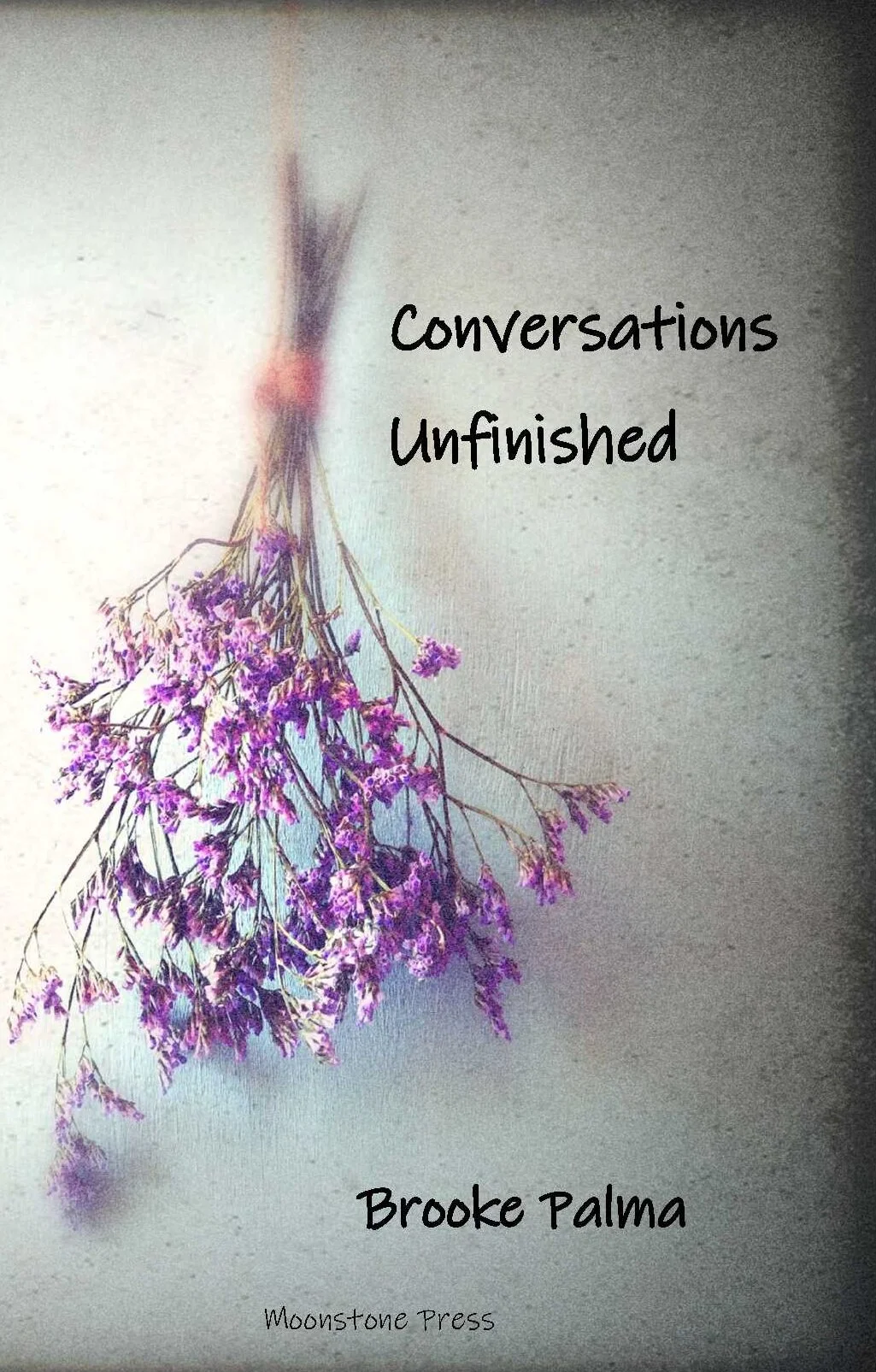
Conversations Unfinished by Brooke Palma

Moonstone Press

$11.00 (includes shipping)

  • Click Here to buy a copy!

Reviewed by Chris Kaiser

In Conversations Unfinished, a moving and poignant first book of poetry, Brooke Palma grabs our heartstrings from the outset and refuses to let go. The opening poem, “Apology for a Broken Ending,” begins like this:

I’m sorry I can’t tell the end of your story.
It isn’t fair that I’m leaving it tattered
and unfinished.

There is a psychic weight the poet is carrying, and she asks us, the readers, to help her carry it. And we are happy to oblige because the poems gently invite us into this world of loss.

Palma’s language is straightforward, even if inadequate — in her mind — to give true expression to her grief. In the same opening poem, she laments:

 I’ll drop these words
like stones in the twilight hour
in the Arno river…

We slowly learn little bits of the background narrative as each poem unfolds. Someone close to the poet has died…but the death was kept from her…it was a woman…an immigrant…from Italy. Each poem in the first half of the book delivers an emotional payoff while also keeping us at bay.

It’s not until the sixth poem, “Requiem,” that we learn Palma is longing for her grandmother, her nonna. “Requiem” begins as the retelling of a dream, but imperceptibly morphs into something straddling memories and reality. Palma herself admits the difficulty of holding onto memories of her nonna, afraid they will turn “moldy” like cut flowers “in the humid, Sicilian air.”

The poet expertly navigates around memories, the dead, and ghosts, but she also has something to say about the present. The poem “Consigli (Advice)” is a font of practical advice passed down to the poet from her nonna. For example: “men are hard; you’ll want one, trust me, but don’t marry anyone from Southern Italy…”, “if you have female troubles, brew chamomile tea…”, and “don’t fight with your mother; she’s always been this way.”

The connections to her nonna that Palma shares include with flowers, food, and various stages of womanhood. For example, in the poem “Eggplant,” she adroitly combines food and her sense of self.

Nature’s sensuality lives
in the eggplant,
whose fluid curves remind me of my own shape.

The poem is grounded by Palma’s memories of cooking eggplant with her grandmother for Sunday dinner.

Nonna was old school and perhaps wouldn’t have approved of these family secrets being aired out, as Palma told me in an interview. And it wasn’t always so easy for the poet to bare her soul.

One of her inspirations while writing the book was Bruce Springsteen’s Broadway show, specifically, his ability to tell the truth, in vignettes, without telling the whole story.  She also was inspired by local poet Shan-Tay Mercedes Watson’s book Audacity, which often explores shame, things that are covered up. “When I read Audacity, I knew I needed to tell my story,” Palma said. “We’ve kept these things hidden for too long.”

The collection of poems in Conversations Unfinished is best read in one sitting. Afterward, each poem could then be read individually, and at one’s leisure.

The poems are made all the more poignant because of the way Palma’s grandmother disappeared from her life. We sense the poet is not yet finished writing about her nonna. In the concluding poem “Translation,” she writes:

I will pull your story from the ether
to end the silence.

One can only hope our future silence will be broken by more poems from this talented writer.


Kaiser pic 2.jpeg

Chris Kaiser’s poetry explores many topics including familial bonds, aging, and existential angst. It has appeared or is forthcoming in Eastern Iowa Review, Better Than Starbucks, and The Scriblerus. It also was featured in Action Moves People United, a music and spoken word project partnered with the United Nations. He’s won awards for journalism and erotic writing, holds an MA in theatre, and lives in suburban Philadelphia.

In Their Words - an Interview with David Kozinski

In Their Words is a monthly feature where Steve Delia and Mike Cohen interview poets from the Mad Poets Society and beyond to get their perspective on art, poetry, and life.

Back in 2018, Steve, Mike, and Connie sat down to interview poet and visual artist David Kozinski. They talk about ekphrastic poetry, abstract art, and inspiration. Click picture to view.

For the full interview go to Mike Cohen’s YouTube channel by clicking here.


koz.jpg

David P. Kozinski was the 2018 Delaware Division of the Arts Established Professional Poetry Fellow. Publications include Tripping Over Memorial Day (Kelsay Books) and Loopholes (Broadkill Press). Kozinski was Expressive Path’s 2018 Mentor of the Year and serves on the board of the Manayunk-Roxborough Art Center and the editorial board of Philadelphia Stories. He is Art Editor of the Schuylkill Valley Journal.


Delia and Cohen.jpg

Steve Delia and Mike Cohen have worked collaboratively and independently as poets and supporters of the arts in the Greater Philadelphia area. Mike Cohen helps to run the Poetry Aloud and Alive series at the Big Blue Marble Bookstore, and has had his fingers in many poetic ventures over the years. Steve Delia is the author of 6 chapbooks of poetry, and has read in a variety of venues, including the Philadelphia Writers Conference and on WXPN. Steve and Mike have also appeared throughout the Philadelphia area as the Dueling Poets.

POeT SHOTS - 'AT THE CORNER OF OIL AND BEEF' by John Reibetanz

POeT SHOTS is a monthly series published on the first Monday of the month. It features work by established writers followed by commentary and insight by Ray Greenblatt

POeT SHOTS #6, Series C

AT THE CORNER OF OIL AND BEEF
Sturgid Motorcycle Rally, Sturgis, South Dakota

More than magenta tattoos    that flicker action films of flame-snorting dragons or sea serpents across once muscled chests    shoulders    forearms    more than massive rhinestone

 encrusted buckles    studding barrel-waisted demons with ersatz Mayan bling     their headgear blazes longings to return to a more fabled age    Viking helmets

some horned    some winged with stripes or lightning bolts    golden clasped bandanas    starred midnight or blood red silks that might have fringed the brow of Blackbeard or Long John Silver    and most

 of all    the towering broad-brimmed Stetsons    mesas on the move    their shadows sweeping once-vast plains under wheeled riders’ great horsepowered mounts    mythology of man

 versus steer    as potent as the frescoed bull-leapers on Cretan walls    and here on Sturgis Main Street    near One- Eyed Jack’s Saloon    where curbed Electra Glides and Road Kings

idle under Texas Beef Brisket    Deep Fried Sirloin Tips    and ribs ribs ribs    mingling fumes    where no one reckons the sixteen pounds of grain gone up in smoke for each pound

 of meat    or the ninety tons of antique plant matter hecatombed in every gallon of gas    I long to satisfy these cowboys’ longings a million times o-

 ver    send them back way beyond Minoan rodeos beyond the first taming of cattle    the first sowing of grain that fed them    beyond the first rooted earthlife

 to pirate-free ancient seas beneath the plains    before titanic heat gods spirited oil    from the micro- scopic remains of floating protoplankton    before

 each diatom and dinoflagellate burned sunshine to carbon    send these steersmen back    hands whisked from throttle- grips    haunches from hand-tooled leather saddles    back beyond

 the blinding glitter of their gas-fed longhorns’ chrome flanks in mythic ascension    to untracked starry passes where light glides    flameless    smokeless    tinged only with promise

A flood of imagery! From “protoplankton,” “diatom,” dinoflagellate,” to “Texas Beef Brisket  Deep Fried Sirloin/Tips.” What do some people want: “longings/to return to a more fabled age.” What does the poet want for them: “Send these steersmen back [...] to untracked starry passes/where light glides     flameless smokeless     tinged only with promise.”

greenblatt.jpeg

Ray Greenblatt has been a poet for forty years and an English teacher longer than that. He was an editor of General Eclectic, a board member of the Philadelphia Writers Conference, and is presently on the staff of the Schuylkill Valley Journal. He has won the Full Moon Poetry Contest, the Mad Poets Annual Contest, and twice won the Anthony Byrne Annual Contest for Irish Poetry sponsored by The Irish Edition. His poetry has been translated into Gaelic, Polish, Greek and Japanese.

Review of Sam Fischer's Short Cycles

Sam’s ability to focus a sense of balance within [the book’s] themes is truly impressive.
Fischer.jpg

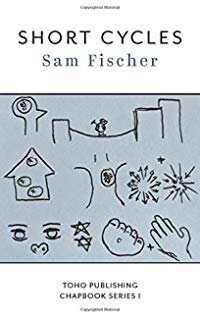
Short Cycles by Sam Fischer

Toho Publishing $9.99

Click here to buy a copy now!

Reviewed by Philip Dykhouse

When I read poetry, I’m searching for connection. I long to see myself in its mirror. I want to run my fingers along the seams of what the author is sowing. So, I was quite fortunate when I picked up Sam Fischer’s debut chapbook Short Cycles. It completely drew me into its world with its smart and thoughtful collection of moments, feelings, and observations that band together to create poetry that is both familiar and unique.

Short Cycles is true to its title. The book is broken up into several small chapters, or cycles as you will. These cycles subtly examine such themes as love, death, acceptance, failure, memories, and spirituality, among others. Each cycle has its own title and hand drawn art to accompany it. By separating the poems this way, I found the structure of the book to be one of its greatest strengths.

The first thing I noticed about Short Cycles is its creative use of the physical, non-human world to convey its themes. For example, the cycle “Do Birds Dream of Falling” consists of three short poems that use the lives of birds as a metaphor for our struggles, with lines like,

“It must be hard to always have to move your wings just to stay alive.”

In another cycle, there’s a dog that finds it isn’t fulfilled by finally catching its prey,

…howling for the earth to give them the dream they want to chase again.”

I also found that Sam’s description of colors and shapes plays a major part in building the world that he is trying to show us:

…running his hand through the graying hair of his wife, thinking of the sharp
red memories, and how like ash it is, these moving living lives we touch.”

Notwithstanding, even with its inventive use of nature to outline its language, the undeniable heart of Short Cycles is its breadth of human emotions. With the cycle “Julia”, Sam crafts two narratives of desire that feel all too real. In one poem, a man stares out the window of a trolley, listening to a song that reminds him of a woman,

…the empty center from which we lean away toward raindrops sliding toward headphones nestled in.

With the next piece, a person is transporting bread to someone they proclaim to love and comes to see the similarities between the two,

…we hold each other, warm and thick, with space and nothingness, rising…”

The cycle “David” revolves around the titular David and how he copes with death and depression. In these poems, I find David observing what is happening instead of simply lamenting it.

David let his fingers gently hold each other and watched the sinking white twilight behind the trees. The
same thing must have been happening to the letters on the headstone, which had all but disappeared.”

While the theme of these pieces appear dark, Sam is sure to paint rays of light within them.

Buttoning up he was thankful for not making his body hold wet paper heavy with ink.

When beginning Short Cycles, you are presented with meditations on how complex and sometimes unfair life can be,

There’s a painful narrowness to being held between things.

Still, by the end, there appears to be a steadiness in what it wants you to know,

“…so if you find yourself
alone in the water
know there is a thin cord you tied
keeping what you need close to you
and there is someone coming
who will find you.

That’s what this book does so well. Sam’s ability to focus a sense of balance within its themes is truly impressive. His concise, powerful poetry is beautifully written and well-paced. With every poem, I felt an instant bond. There are lines throughout the book that convey feelings I have never been fully able to express myself. It’s rare to find a voice as fresh and yet, as wise as Sam’s. Much like the cycles of our lives, I’m sure that this book will find its way back to me soon.


Phil - headshot.jpg

Philip Dykhouse lives in Philadelphia. His chapbook Bury Me Here was published and released by Toho Publishing in early 2020. His work has appeared in Toho Journal, Moonstone Press, everseradio.com, and Spiral Poetry. He was the featured reader for the Dead Bards of Philadelphia at the 2018 Philadelphia Poetry Festival.


Poetry Reviews on the Mad Poets Blog!

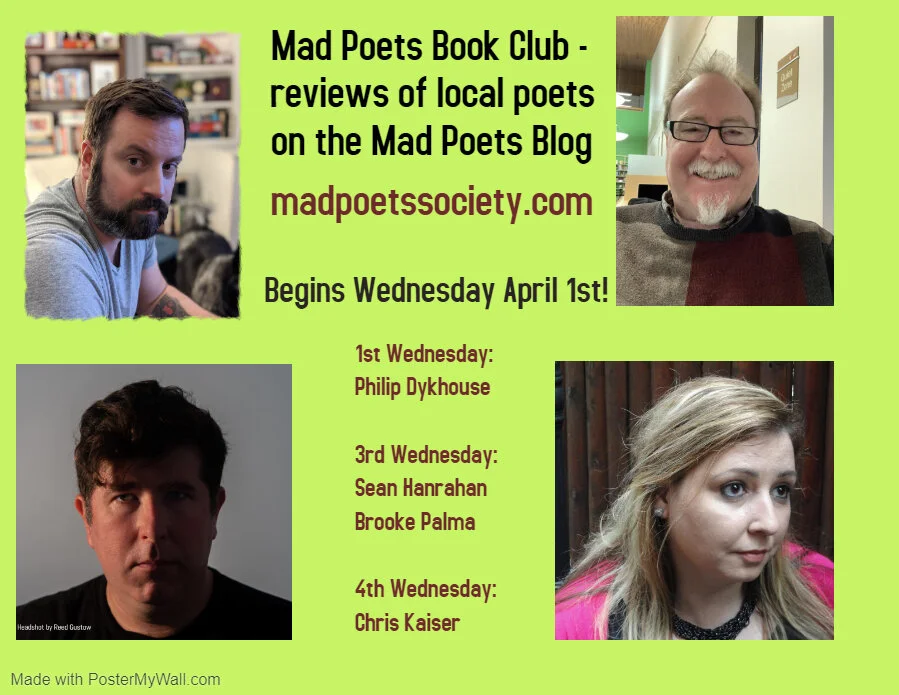
We are proud to announce that, starting in April, the Mad Poets Society Blog is going to introduce a new feature. The Mad Poets Book Club will feature reviews of books and chapbooks by local poets. The reviews will be written by some of the most exciting voices in the Greater Philadelphia Poetry Scene: Philip Dykhouse, Sean Hanrahan, Chris Kaiser, and Brooke Palma.

A new review will go up on the 1st,  3rd, and 4th Wednesday of each month. April 1st will be the first review, where Philip Dykhouse reviews poet Sam Fischer’s collection “Short Cycles”.

See the flyer below for details. Be sure to subscribe to the blog to get notifications about new posts. 

To subscribe to the blog:
1. Click the title of any blog post.
2. At the bottom right of the post, select "subscribe via e-mail."

Mad Poets Book Club flyer.jpg

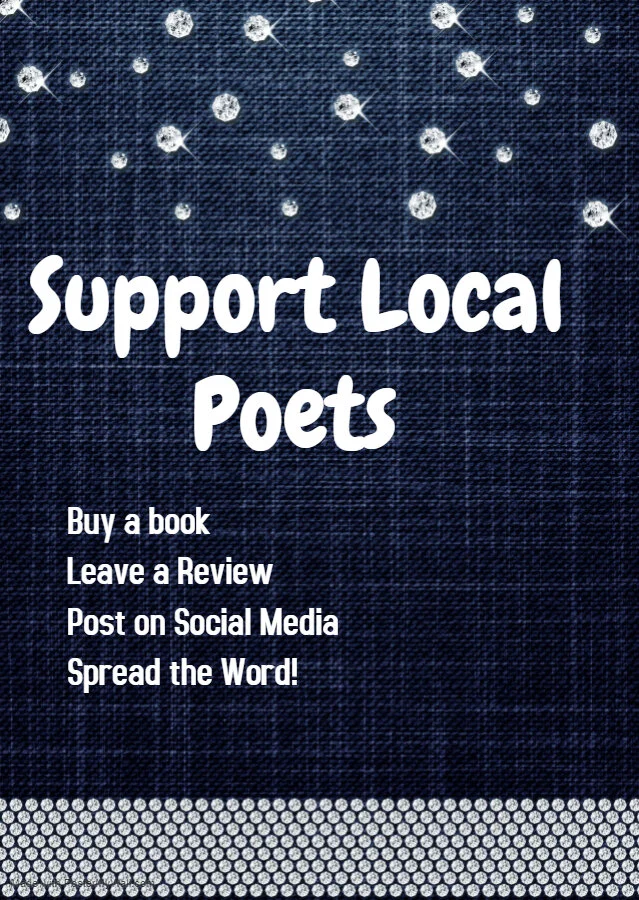
Supporting Local Poets

Support Local Poets.jpg

Due to events being canceled as a result of the Covid-19 virus, many poets have lost opportunities to share their work and be heard. This is particularly unfortunate because many poets rely on these events to help them sell copies of their books and chapbooks. As a result, they are relying on us, the readers, more than ever.

To help support local writers, consider buying copies of their book online, through online bookstores, the author’s own website, or elsewhere.

If you are unable to purchase a copy, or if you already have a copy, there are other ways you can help: write a review of their book, leave a review on the store website (especially Amazon), spread the word about their book to friends and family, or even offer them support through words of encouragement.

Anything that you can do, no matter how small, helps!

Mad Poets Events Canceled Through the End of April

ALL APRIL EVENTS CANCELED

The Mad Poets Society has decided that in addition to the March cancellations, all of our April events are also canceled. We encourage people to follow the advice given by experts to stay safe and healthy during this time. We will continue to offer content through the blog.

Thank you for your patience and support. We hope you stay connected with us and come join us when events restart after April.

Keep writing! We are excited to see what new work you all have to share when we come out on the other side of this

Local Lyrics featuring Courtney Gambrell

Local Lyrics hosted by Amber Renee appears on the 3rd Monday of each month. In it, Amber features the work and musings of a local poet.


Survivor’s Manifesto

Wanderlust Another word for flight risk Meaning I will not stay Where I do not belong

Meaning I was born in one place

& my soul in another Meaning all you gotta do is Make me question everything

all at once

and I’m out!

Let’s call it survival Let’s call it self-care Let’s call this

All in a day’s work Black Woman

Let’s call me Harriet’s granddaughter without The shot gun

II

Let’s consider the reality that I am not a runner Perhaps I am just the one that got away…

I choose to fly like a kite, I learned the difference Between escapism and escape

Fight? Flight? Freeze? or Appease? I chose the option that made me question God less

I swallowed my grief like an afternoon shot of whiskey Once I realized that the sting eventually wears off

You wanna fly? You gotta give up the shit that weighs you down

I suppose this is a poem about the ways that I will fly in the face of adversity and triumph

A poem about how the game Hide and Go Seek Is not just for children

I found myself broken and alone So, I turned the pieces of myself into a beautiful mosaic

See? Sometimes I wish there more was no more air in my lungs But I want someone to witness me for the first time and say

“Damn you can’t ignore that kind of passion” Because, “Damn you can’t ignore this kind of passion!”

Bitch, I will show you a motherfucker with passion But you gotta be willing to look up   

the sun might be in your eyes            

Courtney Gambrell: 

Survivor’s Manifesto is a poem that I enjoyed writing because it was not easy to deliver and similarly, survival is not guaranteed to be an easy task. This poem is a testament to how I have chosen to confront adverse experiences. Survivor’s Manifesto highlights the necessity of finding safety even when getting to those safe places requires movement. With this in mind, I am elated that this poem wanted to honor Harriet Tubman, whose famous last words, “I have come to prepare a place for you,” are a perfect epigraph. (This quote is originally referenced in John 14:3). The magical part about this reality is that Mother Harriet and many ancestors like her have prepared these places for me and they have taught me how to be visible within such places. I am proud of how this poem channels the legacies of black women including Toni Morrison whose character states, “You wanna fly? You gotta give up the shit that weighs you down.” In every way, this poem begs us to acknowledge that survival is radical, necessary and beautiful.


gambrell.jpg

Courtney is a West Philadelphia native who has continued to progress in the art of poetics since 2014. Her poem, "Black Matter," received an Honorable Mention from the Mad Poets Society poetry contest in 2015. As a poet, she is most concerned with self-healing which is her catalyst for writing.  Courtney enjoys the organic nature of sharing experiences with her audience and using her creativity for advocacy.  Her work has appeared in APIARY Magazine, As/Us Journal, For Harriet, Rag Queen Periodical, Whirlwind Magazine and elsewhere.


AMBER RENEE, she/her, 26, writes from her home in suburban Bucks County, Pennsylvania. A fool hopelessly in love with the pursuit of psychic knowledge, she often writes autobiographically; though without sacrificing her distinctive off-rhythm canter. 'Thoughts on This Most Recent Episode' was her 2016 full length collection of self-published poetry ruminating on her thoughts & illnesses. Currently she is working on a musical album of poetry.

Renee.jpg

In Their Words - an Interview with Lisa DeVuono

In Their Words is a monthly feature where Steve Delia and Mike Cohen interview poets from the Mad Poets Society and beyond to get their perspective on art, poetry, and life.


Back in June of 2019, Steve and Mike sat down with Lisa DeVuono to discuss poetry, philosophy, and inspiration. Click picture to see part 2 of that interview.

To see the full interview, visit Mike Cohen’s Youtube channel

 
DeVuono.jpg

Lisa DeVuono (www.lisadevuono.com) is a poet living in the Philadelphia area where she has facilitated creativity and poetry workshops at conferences, retreats, and hospitals. She has also worked with teenagers in recovery, ALS and cancer patients and their families. Her peer-based poetry curriculum “Poetry as a Tool for Recovery” for individuals living with mental health challenges has been implemented through a partner program with the Institute for Poetic Medicine at both Austin and Cleveland Clubhouses. She has produced several multi-media shows incorporating song, music, poetry, and dance.

Her chapbook is entitled “Poems from the Playground of Risk” and she also performs the poetry of Rumi, with musician and songwriter Michael London.


Delia and Cohen.jpg

Steve Delia and Mike Cohen have worked collaboratively and independently as poets and supporters of the arts in the Greater Philadelphia area. Mike Cohen helps to run the Poetry Aloud and Alive series at the Big Blue Marble Bookstore, and has had his fingers in many poetic ventures over the years. Steve Delia is the author of 6 chapbooks of poetry, and has read in a variety of venues, including the Philadelphia Writers Conference and on WXPN. Steve and Mike have also appeared throughout the Philadelphia area as the Dueling Poets.

POeT SHOTS - 'The Fly' by Miroslav Holub

POeT SHOTS is a monthly series published on the first Monday of the month. It features work by established writers followed by commentary and insight by Ray Greenblatt

POeT SHOTS #5, Series C

The Fly

She sat on a willow-trunk

watching

part of the battle of Crecy,

the shouts,

the gasps,

the groans,

the tramping and the tumbling.

During the fourteenth charge

of the French cavalry

she mated

with a brown-eyed male fly

from Vadincourt.

She rubbed her legs together

as she sat on a disemboweled horse

meditating

on the immortality of flies.

With relief she alighted

on the blue tongue

of the Duke of Clervaux.

When silence settled

and only the whisper of decay

softly circled the bodies

and only

a few arms and legs

still twitched jerkily under the trees,

she began to lay her eggs

on the single eye

of Johann Uhr,

the Royal Armourer.

And thus it was

that she was eaten by a swift

fleeing

from the fires of Estrees.

It would take a Czech to know European history. And an immunologist to focus on a tiny fly. Striking gruesome humor: “She sat on a disemboweled horse/meditating/on the immortality of flies.” “She alighted/on the blue tongue/of the Duke of Clervaux.” “She began to lay her eggs/on the single eye/of Johann Uhr.”

greenblatt.jpg

Ray Greenblatt has been a poet for forty years and an English teacher longer than that. He was an editor of General Eclectic, a board member of the Philadelphia Writers Conference, and is presently on the staff of the Schuylkill Valley Journal. He has won the Full Moon Poetry Contest, the Mad Poets Annual Contest, and twice won the Anthony Byrne Annual Contest for Irish Poetry sponsored by The Irish Edition. His poetry has been translated into Gaelic, Polish, Greek and Japanese.

Local Lyrics featuring Stephanie B

Local Lyrics hosted by Amber Renee appears on the 3rd Monday of each month. In it, Amber features the work and musings of a local poet.

Plant Companions and Personal Storytelling
A Poetic Essay by Stephanie B.


What does a relationship with a plant ask one to do?

Slow down

Engage

Dream

Unfold

There are many methods inwards to ignite the recognition of an invitation to work with, care for and be cared for, and learn with a plant. Many use the term “plant ally” to describe the beginnings of a relationship with a plant. I find this useful, but useful in the sense of transmitting information, as the term for me does not describe fully what is happening. Discovering and cultivating a relationship with a plant is an open invitation to connect with the part of ourselves that speaks in Earth's language- metaphor, myth, the sensual, spiritual, intangibly tangible, to name a few. In my practice, I refrain from hoping that a plant will do anything for me, and maintain that what is happening is co-creational and based on a relationship. Getting to know a particular plant and Its spirit is like being with a Friend, and in my feeling, best to go in without expectations.

The method that I am sharing with you today was one that connected me with a lifelong relationship with Flax (Linum usitatissimum translated from the Latin: “the most useful flax” there's enough story in that description of Flax alone, LOL). Some people estimate that Flax has been with People for 40,000 years, so the memories and stories that Flax carries with It span a broad imagination, including pre-agricultural time-markers. Flax's depth and humility resonated with me, and being with Flax this year through the entirety of Its lifecycle, and now into spinning the planting into linen has been incredibly transformative in my feeling and way of being with the World, that I felt inspired to share with you briefly, and only partially, how this happened.

In this current phase of my life, I am in service to Laima, Baltic Goddess of Fate, Midwifery, Weaving, Bathhouses, Linden Trees, Young Mothers, Cuckoo birds. She is from my Father's Ancestral Thread, and brought Flax to Me partially to be liberated from nationalist narratives of identity, and to discover and deepen mySelf as a Weaver.

At this time, much of the lens through which Flax is refracted is from a prism of a relationship with one group of my Ancestors. I am saying this because I can not begin to assume any authority of Flax's whole story, yet I can offer to you what Flax and the Earth of my ancestors has shared with me so far.

This method is experimental, and happening by the seat of my pants starting when transiting Saturn touched my natal Saturn at 0 degrees Capricorn (Tropical) in December 2017 CE. I hope that in sharing, there are some things that resonate with You that help You in making a connection if that is what You wish! If it does not resonate with You, there are many other ways to engage this process. Thank You for reading, and holding space for this method.

If You would like the following blessing, please take it with You.

May the Story of Your life and World unfold, and may the wonder of existence inhabit You fully. And so it is.

Point of Initiation

Point of Entry

-Come upon and draw into the scrying well of a deep question.

Ex.

Was there ever a time in your life where you felt as if you had absolutely no Human relation to turn to, connect with, seek guidance from or counsel with? (This question was my point of initiation; different questions may be different points for different personal storylines)

-Create a circle of safety and reflection for the following exercise.

-Re-member that time. Safely invite the emotions to return, though they may be painful. Let the feelings inhabit you to the point of re-invoking the circumstances in the landscape of Your memories, and if You wish, in Your body. Explore them. Create a landscape in Your imagination where the feelings and memories morph and take form into creatures, into mountains, streams, wells, lava fires, air deities, magical beans, birds, trees, worms, waters, volcanoes, whatever it is that they suddenly seemingly naturally become. Keep this landscape in Your psychic and meditative spaces as a place to return to and work with the Land as a place to return to and interact with as the Story unfolds and develops.

[[[At times, deep pains and pleasures, are points of entry into the liminal spaces that mythology inhabits. Much of society does not recognize these points of contact, and many times, the results are further isolation and alienation. However, in loving kindness to Ourselves, these points of entry can be powerful kilns wherein the magic of the animated world come through to Us to speak. You can even turn this point of entry into an ancient Tree, into a mountain, to travel into the soils and the skies of Your and the World's Soul.

-Invite the guidance and presence of Spirits, Ancestors, Guides. Make a pact that You will be open to receiving communications from them, whenever and however that may be.

-Are there any Deities, Earth energies, Archetypes that preside over the themes with which You were struggling? Any from (one of) Your ancestral thread(s)?

-Journal about these times and begin dialogue. Explore what comes up, especially metaphors, that is things or events that literally happen(ed) that are deeply, synchronistically symbolic.

-(Shortcut) Are there particular Plants associated with these Gods/Goddesses/Deities/Ancestors? Are these Plants the Spirits and Deities Themselves?

-If so, do any of these Plants particularly resonate with You in the very core of Your being?*** (meditate on what the feeling of the very core of Your being is, or reflect on times when It was singing tunes of resonance on high harmonic throttle that You just KNEW something)

-If so, what are the folklores and mythologies, and stories surrounding this Plant? Ask the internet. Ask the library. Ask photo albums. Ask a Garden. Ask Sky. Ask a Seed. Ask Your Friends and Family. Ask Your Ancestors, all of Them. Ask Birds and Soil.

-Go looking for this Plant. Be exhaustive and thorough in Your adventuring. Sometimes, They are in previously unexpected or unseen places and with You all along. If You are positive You can not find it, You may be being asked to come upon the seeds and grow Yourself. Any and all information is relevant, even if at first it may make no sense. In this process, cultivate practices that engage and develop Your intuition. Meditations, dreamwork, journaling, solar plexus, third eye exercises, clearing, cleaning, organizing, to name but a few. You will over time, develop a very unique series of special rituals that are in Your Landscape's Language! Be open to ways in which symbols or events in dreams or meditations come about or spring up in day to day instances, and try to record them as often as possible, whatever Your preferred medium(s) may be. And if not record, acknowledge them when they happen, or when it occurs to you that it may be happening.

-Find a place where You can regularly be with this Plant. Simply be. Each time You visit, bring all of Yourself to the space, wherever and however You may be being. If it is in the wild, visit this place. Observe and speak with the Plant for a whole year, and be with it through all changes of season. Observe Its lifecycle and process of Its story from seed to flower to fruit to seed. If it is a perennial like a tree, listen and watch for how it wakes up and fall back to sleep. Each time You visit, bring with You a gift or offering- an object, another Plant, a tasty treat, a song, a piece of Your hair, (biodegradable) cloth, an intimacy. Get familiar with Plants and Creatures and Spirits sharing in the space, the soil, the light, the weather. Come from the space of Your heart. Interact with each of Your senses during these times. Give Your ears all of Your focus and listen. Give Your touch all of Your focus and listen with Your hands or arm hairs. Give Your eyes all of Your focus and listen to the light and shadow. Give Your nose all of Your focus and listen to the smells. Give Your tongue all of Your focus and listen with Your tastebuds (obligatory precaution: always be sure that whatever You're tasting is ingestible). In developing these listening senses, all sorts of “words” come through. If You already do this, You know what I'm getting at, and if You don't, You will.

If You are growing and stewarding the Plant, do the same, yet visit more often, especially if the Plant is not familiar with the area (in its story with Earth). If You harvest, ask permission first, and offer an exchange. Wait for an answer, sometimes They do say no. When asking permission, it can be done with Your heart or with words, yet let the Plant know so it has time to prepare.

It is also worthwhile to hold constantly in reflection and practice in these processes that We are living on occupied Land during a mass extinction. There is much to hold in One's heart and reflect on and grow with and from. In mindful awareness, please be sure of the status of the Plant, and if endangered, or sacred, do not harvest from the wild, try cultivating it, or receiving Its medicine and wisdom through Its presence alone.

-Save the seeds

-Share the story

The main takeaway that I would like to share with You is that Plants are like People in that while They may have broad personalities like astrological sun signs, every relationship They have is unique. The conversations You will have with the Plant are deeply personal, yet also universal. Your way of being in relationship with Them will bring forth different medicine, healing, storytelling, which adds to the overall tapestry of Its, and Our story.

People may follow the same recipe, using the same cooking implements and ingredients from the same places, but the resultant dishes will be different because of the magic each Person brings to the alchemies of transformation of the food. That is very sacred, and very beautiful to Me, and I feel similar goes with plant relationships. In relationship with Flax, I've learned something incredible about life, resilience, My place in creation, and deepened my love for this planet and the Life that is here. The world is living and speaking and I truly feel it misses Us.


Q&A

1. Your essay touches on some deep topics, with ideas such as universal symbols, meditation, & even spellwork. What's your inspiration for this? Meaning, who or what took your interest to dive down this path?

I would like to thank the bean seeds that kept showing up everywhere in December 2017 CE. When they first started falling on my head and showing up on the ground, they alerted me to a part of life I had been ignoring for a couple of years--- intution, synchronicity and their logic. At that time, I was full on in the humiliating and humbling lesson that I was not checking myself, and consequently, wrecking myself. I felt at the time that everything was falling apart, bit by excruciating bit, and in the collapses, I chose to remember or align with a faith in the Universe that I could participate in and be in relationship with.

The beans helped me recall a time when I worked at an ecovillage in 2015 CE- I got a card reading in a group regarding companion plants and spirituality. I pulled the Bean, whose extolled attributes in that deck were fertility and regeneration.

I didn't think much of it at the time, yet Beans have this means of pollinating themselves before their flowers open, so in a type of essence, Beans will be true to themSelves, which has an interesting "utility" if One wants to save their seeds. I felt they asked me to remember and recreate who I am and step into that ever-shifting process with more awareness of engaging the Self with the understanding of the ebb and flow of relationship. I am myself, sure whatever that means, yet I am also an interplay that is not static or unchanging of everyThing and everyOne I am a part of. So I tried to engage remembering how to play- with myth, story, symbol, relationship, and all manner of experiences broader than what I understood to be myself.

I remembered being "younger" that living time of youth that is alive and ready to visit, before being labelled insane, crazy, random, wild, before any of those terms held a type of relevance in a way of being with Life. I journeyed to what was organically calling my attention- myth, storytelling, magick, Earth, and reconnect with it- humbly, curiously, personally. I made the choice to take the premise of the transit of the Saturn Return as seriously as possible, yet also play.

Since 2010, I've worked with Earth and People in many varieties of context- farming, gardening, activism, herbalism, spirituality, astrology, the occult and esoteric, and felt called to actively combine the experiences and lessons into a lifestyle. I chose a seasonal endeavor that I could channel current observational and relational capacities into and experience what happened. I quit being an alcoholic and substituted the habit with crochet to experiment with untangling the structures of consciousness and experience. What happened in that multidimensional process, I uncovered what originally drew me to relating to Earth and the elements. With crocheting, I wanted to go further, what are seeds and threads and what is that process of spinning thread?

I let go, with an amount of kicking and screaming that is humorous now that I'm here, of semblances of goals and normalcy and followed where current consciousness would allow to go and enrolled in an Intuitive Plant Medicine Course. The course, from Beltane to Summer Solstice, was mostly comprised of exercises to reengage trust with Intuition, and to also develop that trust each and every day. It reminded me that all aspects of experience from dreams to boiling a pot of water have the potential of gravity and relevance with intention, and a dose of skepticism where dogma is concerned.

The results of this piece from an amalgamation of all of those engagements, of being in play with my conceptions of reality, and challenging forms that calcify, and many teachers and relations, soil human bird ancestor wind plant that joined me along the way. Myth and story is not static, and in certains ways, asks for methods of engagement to be with Them, so that They in turn move and breath abd live within and morph living in different contexts. And that to me is relational, so this piece is about how I candidly tried to do that, in hopes that parts of it, or much of it, or some of it, or however whatever of it haha, would engage that sense in someOne who reads, and could be inspired in solidarity to do similarly, however it may be for Them.


2. Can you talk about your thought behind your use of capitalization in this essay? (For example: "mySelf")

i took Reiki II course at the beginning of my attempt to change my relationship with alcohol at Space 2033. The class was great, and fellow practitioner, and Artist on many dimensions, Arazel ( instagram: @thedevaarazel), shared this style of capitalization i used in this piece. Arazel brought to my awareness something profound. it hadn't occured to me how capitalization of addressing pronouns happens. Why does the "I" always get capitalized, and every noun otherwise not? Then i want to digress into the dimension of how the individualistic aspects of largely white western existence make themselves apparent in such subtle, pervasive avenues as to become an ingrained afterthought, yet it's pretty profound by way of what neurons and subtle emotional body picks up on...

In formulating this piece, i wanted to engage the parts and all of ourSelves inherently sacred and address from that space, and the character/personality/side of me that is laima's apprentice inhabits and speaks from this space, though that part of me is still largely unintegrated, so it's obvious where the inconsistencies are where the automatic writing is concerned. Yet i'm stoked to continue with this practice and way of relating with the read-interface word. Much of what i'm familiar regarding performance and words is live and personal, so the aspect of capitalization once the words become solidified on a page or a byte or internet page becomes immediately, to me, impersonal, which has the potential to isolate. I want to speak with the divine in each, "individually", and i'm also curious and passionate about how that "aspect" connects to cosmic and universal experiences, and there are so many ways to play.

Stephanie B. (she/her) enjoys rain, cooking, warm soil. she bites nails, twirls hair, falls asleep anywhere between 9 p.m. and 5 a.m., and is going to the mountains to grow with chestnut trees. She practices toward, yearns for, and occasionally experiences a world that loves and cares for all of itself-learning more about it with each yea

Stephanie B.JPG

Renee.jpg

AMBER RENEE, she/her, 26, writes from her home in suburban Bucks County, Pennsylvania. A fool hopelessly in love with the pursuit of psychic knowledge, she often writes autobiographically; though without sacrificing her distinctive off-rhythm canter. 'Thoughts on This Most Recent Episode' was her 2016 full length collection of self-published poetry ruminating on her thoughts & illnesses. Currently she is working on a musical album of poetry.
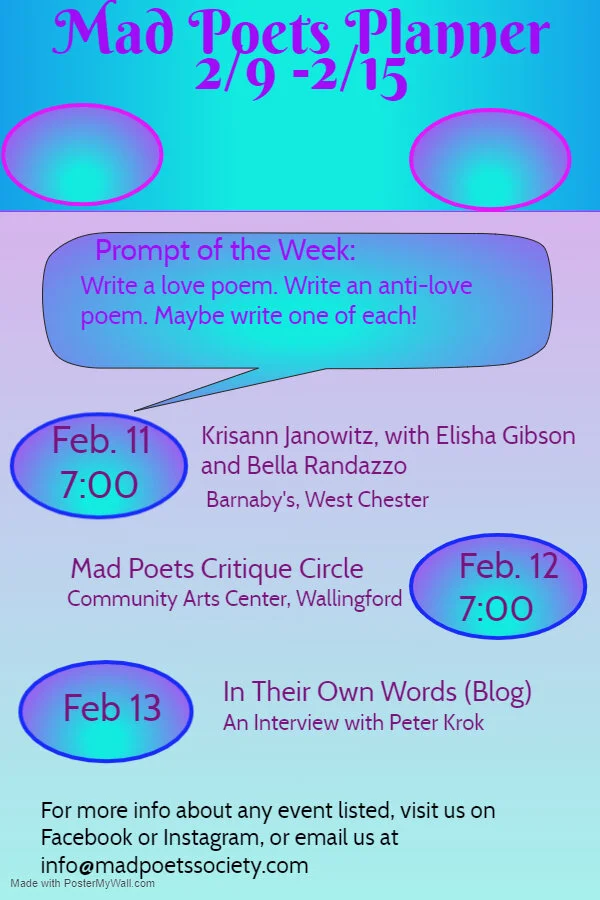
In Their Words - an Interview with Peter Krok

In Their Words is a monthly feature where Steve Delia and Mike Cohen interview poets from the Mad Poets Society and beyond to get their perspective on art, poetry, and life.

On August 29th of 2018, Steve and Mike sat down with the legendary Peter Krok. In this, the first part of the interview, they discuss the enrichment that a poet’s biography can bring when reading their work. Along the way, they reminisce about The North Star Bar, The Painted Bride, and the evolution of the Schuylkill Valley Journal. Click the picture to see Part 1.

For the full interview, go to Mike Cohen’s YouTube channel.

krok.jpg

Peter Krok has been the Editor-in-Chief of the Schuylkill Valley Journal since 2001. The journal was founded in 1990. He also serves as the humanities/poetry director of the Manayunk Roxborough Art Center where he has coordinated a literary series since 1990. Because of his identification with row house and red brick Philadelphia, he is often referred to as “the red brick poet.” His poems have appeared in the Yearbook of American Poetry, America, Mid-America Poetry Review, Midwest Quarterly, Poet Lore, Potomac Review, Blue Unicorn and numerous other print and online journals. In 2005 his poem “10 PM At a Philadelphia Recreation Center” was included in Common Wealth: Contemporary Poets on Pennsylvania (published by Penn State University).  His book, Looking For An Eye, was published by Foothills Press in 2008.


Delia and Cohen.jpg

Steve Delia and Mike Cohen have worked collaboratively and independently as poets and supporters of the arts in the Greater Philadelphia area. Mike Cohen helps to run the Poetry Aloud and Alive series at the Big Blue Marble Bookstore, and has had his fingers in many poetic ventures over the years. Steve Delia is the author of 6 chapbooks of poetry, and has read in a variety of venues, including the Philadelphia Writers Conference and on WXPN. Steve and Mike have also appeared throughout the Philadelphia area as the Dueling Poets.