Review of Steve Delia's Poetry Time

Review of Steve Delia’s Poetry Time

October 21, 2020
poetry time.PNG

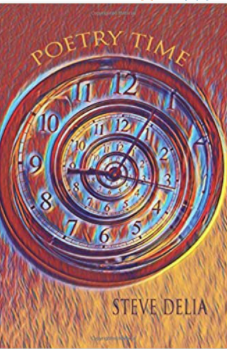
Poetry Time

Parnilis Media

$12.95

You can buy the book here.

Reviewed by Brooke Palma


Steve Delia’s Poetry Time is so full of poetic turns and topics that fitting them all into one review has proved challenging. This collection of poems from the prolific Philadelphia writer spans themes from wry observations on daily life, joyful memories, and crushing loss. The book also employs an interesting thematic structure, wherein each chapter is organized by topic and is preceded by brief memoir-style essays. Poetry Time’s structure keeps Delia’s diverse poetical journeys focused so that we as readers can experience the wonderful verse contained.

The opening poem, “Ghost Box,” sets us up for what is coming: autobiographical poems full of vivid memory. On opening this metaphorical box, the speaker finds “immediately the air changed my spine.” This collection is full of moments like these – visceral words that compel the reader to feel the physical and emotional sensations the poems describe.

 As “Ghost Box” continues, the speaker decides to leave the box open, but he remains uncertain if this is a good idea:

I leave the box open
not sure if spirits sleep
or return to their own world
not knowing if the box
is castle or coffin

Opening the box is what these poems do best, but this first poem lets us know that such an action is not without risk.

I enjoyed the collection as a whole, but I found that each section stood up on its own — almost like a mini-chapbook exploring a particular theme. My favorite of these sections was Section IV: Sandy, which expounds on the relationship Delia shared with Sandy Becker, a fellow poet who was a great friend and influence before her untimely death. In “Suicide,” we find the speaker confronting the tragic moment leading up to her death. Pondering those last moments, Delia describes the terrible sound of the gunshot that ended Sandy’s life:

Such a loud sound
for one so soft
such a violent act
for one so gentle

This section reminds me of the famous Hemingway quote that advises us to “write hard and clear about what hurts.” The poems in Section IV certainly do that. It attempts to say goodbye to someone who was as “elegant as a flame,” while admitting to not “know[ing] what’s on the other side.”

While Poetry Time recognizes the pathos of great loss, it is also not without humor and wit. This is especially true of “Poem on the Run,” which finds the speaker struggling with a poem “short on patience,” and who “gives revision the finger.” We find this poem “high on caffeine,”

              …a revved up engine
                as it yells eat my dust
                see you later adverbs

This ill-behaved poem provides a moment of levity, but we also see how its hectic creation causes it to be both “instantly born, instantly vintage.” “Poem on the Run” is perhaps the most fun ars poetica I’ve read, and it was a joy to follow its wild ride.

Poetry Time shows us that poetry makes time for all of life’s emotions and experiences. This is a tall order for one book, but its concise structure and compelling choice of words and themes keeps the reader coming back for more. In this wonderful collection, Steve Delia invites us in to experience the big moments of his life through the use of autobiographical details and quick wit. This collection is brave enough to face the difficult moments while keeping us laughing in between.

Brooke Palma-headshot (2).jpg

Brooke Palma grew up in Philadelphia and currently lives in West Chester, Pennsylvania. Many of her poems focus on the connections between culture and identity and finding beauty in the everyday. Her work has been published in The Mad Poets’ Review, Moonstone Arts, Toho Journal, and E-Verse Radio (online), and work is forthcoming in Unbearables: A Global Anthology (to be released on November 2, 2020).  Her chapbook, Conversations Unfinished, was published by Moonstone Press in August 2019. She hosts the Livin’ on Luck Poetry Series at Barnaby’s West Chester.  
Local Lyrics - Featuring Mant¿s

Local Lyrics hosted by John Wojtowicz appears on the 3rd Monday of each month. In it, John features the work and musings of a local poet.

“I think that my poetic aesthetic is highly influenced by the Black Arts Movement (ntozake shange, Nikki Giovanni, James Baldwin, etc), but I am also highly influenced by hip hop & slam. I love poetry collections from folks that bring skills & conversations from outside of the poetry bubble to the table. “

For Black Kids from the Around the Way Who Considered a Degree when the Funeral Dirge Wasn’t Enuf
By Mant¿s

At one point, someone will try to teach you/ that your home don’t got
trees. Don’t let them/ twist
that lie on their tongue/ like scorched roots
because they can’t fathom how your hair stands
up like branches. If they got
a rainforest/ growing on their head like you do, /
they may have forgotten how a village holds
its heartbeat on a grassland, but don’t let them/ tell you the hood don’t got
trees. When you walk into a lecture, / someone will try
to teach you/ that your house lives between
a pit bull’s tooth and a sharp place/ they will try
to teach you the only space for your head/ is hanging
off of tennis shoes on the telephone wire, but don’t
let them/ tell you that a concrete jungle don’t got
trees. How else would you breathe? / How else
would you have a pulse pushing precious
craft, creativity unmatched, / underpaid, / underappreciated
but isolated on a pedestal of commercial
Blackness? / These false prophets and teachers will try
to tell you that you grew up in a desert/ as if you weren’t the oasis.
That means they would have to face you/ as an original.
That means you’d have to embrace your dual realities/ and your right to carry
dual talents. Don’t let them/ tell you that the hood don’t got
trees and claim a drill sound/ about pushing pounds/ and counting
green in their next breath. / Ask them if the hood don’t got
trees, then how the hell can you breathe? / The next time they try
to teach you/ the hood don’t got trees, tell them
you’re taking Johnny Coltrane out their canon.
The next time they try
to teach you/ the slums can’t talk right, / tell them
they got no right to speak August Wilson’s name. The next they try
to teach you/ that the way the block moves is too sketchy/ tell them
they can’t keep up with Judith Jamison’s feet. / The next time they try
to teach you/ that the sidewalk can’t glitter gold, show them
how Pepper LeBeija built a beautiful house. / Don’t be fooled
by the textbook tricks and realtor rewrites of history. / It will kill you
faster than any bullet can, that method of miseducation/ is worse
than murder and surviving it/ makes you more
immortal than the names you raise, because when I say nephs /
it’s a prayer/ and a call/ and a memory growing
deeper than roots. / You don’t have to be a martyr, / nor married
to a struggle you didn’t ask for, / you don’t have to be an icon,
but do you know/ how much ground you’ve already
broke/ by simply/ being/ here?

Photo Credit: Angel IG : @no.silhouette

Photo Credit: Angel IG : @no.silhouette

We are going to talk about you as a writer but who are you when you are not writing?
I learn to heal. I’m currently a part of a year-long cohort of Elemental Health Coaches in training with House of Umi, where I learn to offer holistic preventative health care in the ways that my ancestors did. I’m a nurturer, a music lover, a womanist, an evolving spirit,  an astrology nerd, an animation geek, & I really love finding new plant based recipes, because I’m a foodie. I also am a self-taught web designer!

How would you describe your poetic aesthetic? 
Definitely concerned with image and voice. I think that my poetic aesthetic is highly influenced by the Black Arts Movement (ntozake shange, Nikki Giovanni, James Baldwin, etc), but I also am highly influenced by hip hop & slam. I love poetry collections from folks that bring skills & conversations from outside of the poetry bubble to the table. So that’s Tupac, ntozake shange, James Baldwin’s ONE poetry collection, Gil Scot Heron, William Carlos Williams, and so many more. I even see TV shows like Random Acts of Flyness functioning as poems.

My poetic aesthetic is preparing language for healing as you would prepare plant matter for healing.

Your work is infused with topics relating to contemporary culture and empowerment. How is the current state of the world influencing your writing?
In the midst of a global pandemic and international uprising during late stage capitalism...I thought it'd be a good time to make my writing internal. I’ve got plenty of poetry about how I’m a Black femme that’s impacted or striking back at the systems of the world, but the poetry I’m writing for a full-length collection (since I’m currently shopping a chapbook manuscript as we speak) is a lot more fleshy. By that I mean I’m less concerned with rhetoric and more interested in letting the reader play with my goggles. I’ve always written honestly but I feel less like “nobody’s talking about this so I will” and more like “nobody is going to talk about this like I will.”  

How does social media play a role in your identity as a writer and as a vehicle to promote your writing?
Social media is how I make my announcements honestly Instagram is for updates and inviting people to the process of anything I’m creating (whether it is simply my day-to-day life). Twitter is where I let my excess thoughts shake off and I keep an eye on what’s happening in the literary community, with opportunities and such. Sometimes what I see on Twitter will turn to a poem or a blog post or a little rant. TikTok is a platform that I honestly learn and laugh a lot, and as an older Gen Z-er, I’m amazed at how the youth are becoming better storytellers. It’s truly interesting.  

I’m finishing my site though, because I recognize that the platforms do not belong to me. They can disappear with code errors or the government continuing to sign digital fascism into law. It could happen with one keystroke or the stroke of a pen.

 What does your process look like when that all-possible-blank-page is in front of you?
Usually poems come to me and I refine them. But when I’ve been commissioned for work or assigned work, I’ll freewrite or start connecting something I’ve been researching to what I want to express in the poem. I love jam sessions as well, it’s something that I’ve had trouble with going to during a pandemic and a part of the process I do miss. I definitely listen to music to focus, especially if I’m borrowing some lyrical techniques.

Where can readers find more of your work?
I have a forthcoming fiction piece in Issue Two of Stanchion Zine, available for pre-order. I have forthcoming poetry in Genre Urban Arts’ anthology, Femme Literati! For past blog posts, until I’m done with the site, you can visit my Patreon, which is in the linktree in my Instagram bio, @mantiswrites. Also, I’ll be reading at a virtual event held through The Frick Pittsburgh, hosted by Deesha Philyaw and Vanessa German, the editors of the tender anthology (where you can also find my work)! It takes place October 27th, and you can register at thefrickpittsburgh.org.


Mantis 2.jpg

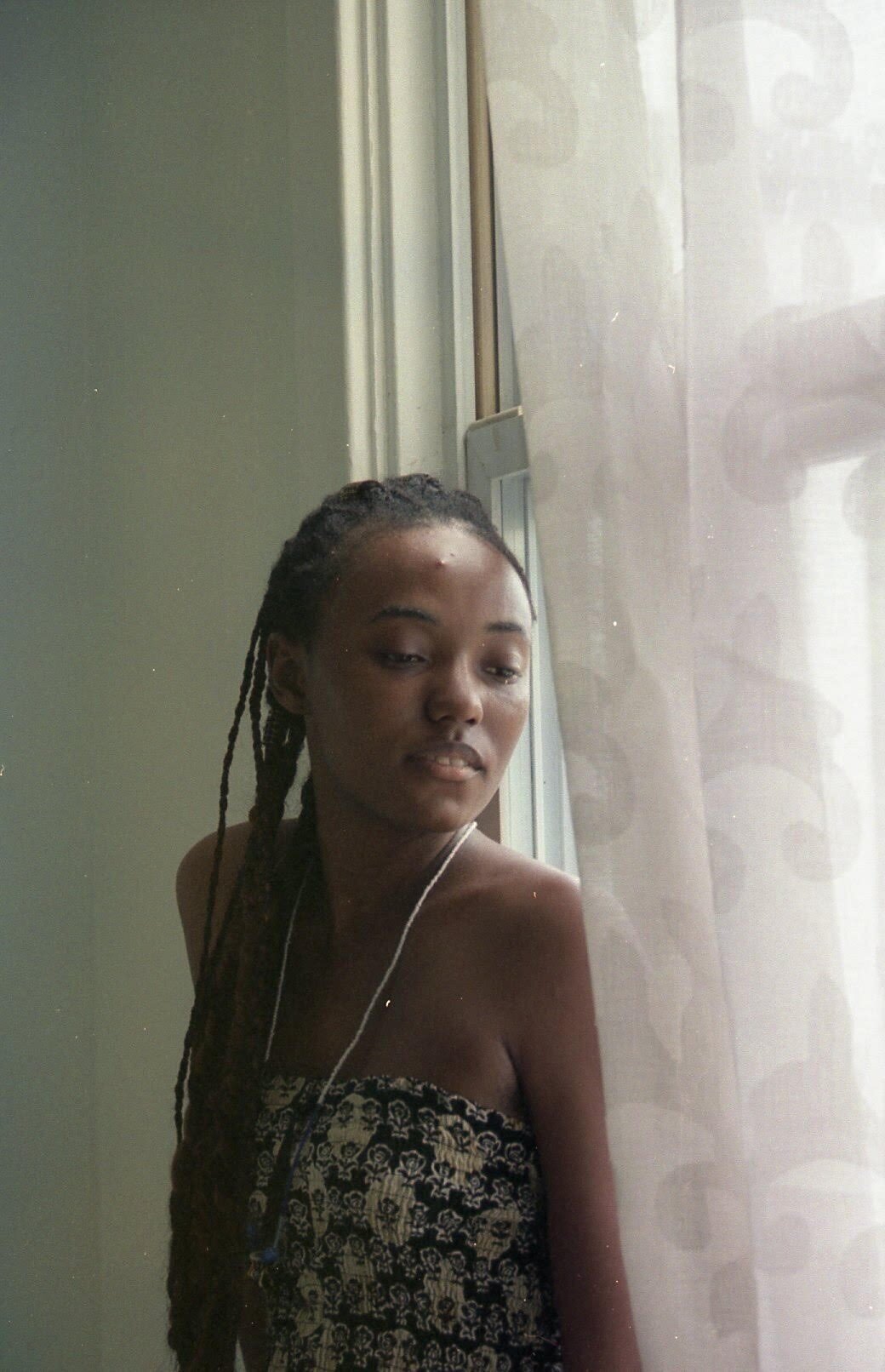
Mant¿s is a visionary poet who writes for personal and community wellness. A Black queer femme who is Pittsburgh born, and Hill District raised, Mant¿s is currently the artist-in-residence at the Arthouse in Homewood, where she is focusing on developing her bodies of work, freelancing career, and education as a holistic wellness coach through House of Umi’s year-long incubator program. To follow her work, bookmark www.mantiswrites.com as she updates her site, or visit her on Instagram @mantiswrites.


wojto.jpg

“Catfish” John Wojtowicz grew up working on his family’s azalea and rhododendron nursery in the backwoods of what Ginsberg dubbed “nowhere Zen New Jersey.” Currently, he works as a licensed social worker and adjunct professor. He has been featured in the Philadelphia based Moonstone Poetry series, West-Chester based Livin’ on Luck, Mad Poets Society, and Rowan University’s Writer’s Roundtable on 89.7 WGLS-FM. Find out more at: www.catfishjohnpoetry.com

POeT SHOTS - 'THE PESSIMIST PREPARES FOR WHAT MIGHT HAPPEN NEXT' by ANDY MACERAS

POeT SHOTS is a monthly series published on the first Monday of the month. It features work by established writers followed by commentary and insight by Ray Greenblatt.

POeT SHOTS #12, Series C

image.jpg

THE PESSIMIST PREPARES FOR WHAT MIGHT HAPPEN NEXT

He already knows what will happen,
staring into the misty crystal ball of his mind.
The last shot spinning off the rim.
The winning field goal drifting wide to the right.
A grounder rolling between the first baseman’s legs.
Why ask an attractive woman at a party?
She’ll just deliver no on the grenade of a giggle,
the warhead of a loud laugh.
He’s not fooled by the weatherman’s patter.
Maps. Pressure. Radar.
The sleight of hand sunshine.
There’s a tornado in his tie. A hurricane in his hat.
Every numbered door conceals
a goat, a donkey, a junk car.
The wheel of fortune manipulates its momentum
until the flipper finds the black wedge of
BANKRUPT.
Most days he doesn’t bother to get out of bed.
The TV on.
Children crying. Angry adults demanding answers.
They never saw it coming.
They want to scream, This should be happening to someone else.
To you or you or you.
The stars just stare, shrugging their bright shoulders.
Watching the widescreen he feels as if he is floating above.
A young boy leaning over a promenade window
on the Hindenburg, marveling
at the sight of Manhattan. The enormous
Empire State Building.
The world calm and smooth.
Turning quietly.
Holding a cold glass of cola like a promise,
sweaty and half-empty.

Each unique image modifies the title: “She’ll just deliver no on the grenade of a giggle,/the warhead of a loud laugh.” “The sleight of hand sunshine.” “There’s a tornado in his tie. A hurricane in his hat.”  “The stars just stare, shrugging their bright shoulders.” “A young boy leaning over a promenade window/on the Hindenburg, marveling.” 

greenblatt.jpeg

Ray Greenblatt has been a poet for forty years and an English teacher longer than that. He was an editor of General Eclectic, a board member of the Philadelphia Writers Conference, and is presently on the staff of the Schuylkill Valley Journal. He has won the Full Moon Poetry Contest, the Mad Poets Annual Contest, and twice won the Anthony Byrne Annual Contest for Irish Poetry sponsored by The Irish Edition. His poetry has been translated into Gaelic, Polish, Greek and Japanese.

Mad Poets Festival Group #8 Videos (J.C. Todd, B. Van Buskirk, T. Halscheid, D. Ahmed, A. Askenase, and R. O’Bern)

Welcome to the 2020 Mad Poets Festival! We’re taking the show on the virtual road this year because COVID-19 couldn’t keep us from sharing these phenomenal poets and their works with the world. So, sit back, grab a drink, and prepare to be inspired!

View the Group #8 performances here.

Group #8 Bios

J.C Todd’s recent work focuses on the trauma of war. Books include Beyond Repair (Able Muse Press, 2021), The Damages of Morning (an Eric Hoffer Award finalist), and artist book collaborations. Winner of the 2016 Rita Dove Prize in Poetry, she holds fellowships from the Pew Center for Arts and Heritage, Pennsylvania Council on the Arts and many residency programs. Click here to purchase The Damages of Morning.

Bill Van Buskirk lives in Bryn Mawr Pennsylvania. His poems have appeared in The Comstock Review, The Paterson Literary Review, LIPS, The Schuykill Valley Journal, Parting Gifts ,The Mad Poets’ Review, and many others. His chapbook, Everything that’s Fragile is Important, received an honorable mention in the Jesse Bryce Niles Chapbook contest (2007). His book, This Wild Joy that Thrills Outside the Law, won the Joie de vivre contest sponsored by the Mad Poets’ Review (2010).

Therese Halscheid’s latest poetry collection Frozen Latitudes (Press 53), received an Eric Hoffer Book Award. Her poems have appeared in numerous magazines. She has spent many years as an itinerant writer, by way of house-sitting. Her photography chronicles her journey, and has appeared in juried exhibitions. She teaches for Atlantic Cape Community College.

Dilruba Ahmed is the author of Bring Now the Angels (University of Pittsburgh) and Dhaka Dust (Graywolf). Her poems have appeared in Kenyon Review, New England Review, Ploughshares, and Best American Poetry 2019. She teaches creative writing with Chatham University’s MFA program and The Writing Lab: https://www.dilrubaahmed.com/writing-lab. You can order her new book at https://bookshop.org/books/bring-now-the-angels-poems/9780822966074 

Alicia Askenase is the author of four chapbooks, including The Luxury of Pathos (Texture Press) and Shirley Shirley (sonaweb), as well as a just completed full-length manuscript. She reads a poem from the most recent Painted Bride Quarterly 100, “Travel Light,” in her video for Mad Poets.

Rebecca O’Bern has been published in Connecticut Review, Blue Monday Review, South 85 JournalHartskill Review, and other journals. A recipient of the Leslie Leeds Poetry Prize, she holds an MFA in creative writing and currently reads for Mud Season Review and The Southampton Review. Follow her on Twitter @rebeccaobern.

Mad Poets Festival Group #7 Videos (N. Lutwyche, Marion Deutsche Cohen, and A. Konopka, F. Sholevar, and B.P. Brown)

Welcome to the 2020 Mad Poets Festival! We’re taking the show on the virtual road this year because COVID-19 couldn’t keep us from sharing these phenomenal poets and their works with the world. So, sit back, grab a drink, and prepare to be inspired!

View the Group #7 performances here.

Group #7 Bios

Autumn Konopka is a the current President of the Philadelphia Writers' Conference and a former poet laureate of Montgomery County.

Nick Lutwyche spent twenty-five years in the Royal Navy. An actor in community theatre since his teens, an aerospace engineer, and a published poet in the UK and in the US for over twenty-five years, his work appears in Mad Poets Review, Fuze, Tamafyr Review, Falklands War Poetry, and many others.

Marion Deutsche Cohen' s 32nd book is "Not Erma Bombeck: Diary of a Feminist 70s Mother" (Alien Buddha Press). She is also the author of memoirs about late pregnancy loss, and spousal chronic illness. Her poetry book, Crossing the Equal Sign (Plain View Press), is about the experience of and her passion for math.

Fereshteh Sholevar, the Iranian -American writer immigrated to Germany and later to USA in 1978. She got her Master’s degree in Creative Writing at the University of Iowa and Rosemont College, Pa. She writes in four language. She has won several awards. Her new bilingual poetry book, Of Dust And Chocolate, (English-French) is available at Amazon.

Beth Phillips Brown carries her Welsh ancestors’ oral traditions through two languages, English and Welsh. She aspires to the calling of cyfarwydd translated as bard and tradition-bearer. She was a co-founder of the Delaware County Poets’ Cooperative, which became Mad Poets Society. She now lives in the Santa Cruz Mountains of California.

Mad Poets Festival Group #6 Videos (A. Hicks, M. Kanter, L. Lutwyche, and M. Rizzo)

Welcome to the 2020 Mad Poets Festival! We’re taking the show on the virtual road this year because COVID-19 couldn’t keep us from sharing these phenomenal poets and their works with the world. So, sit back, grab a drink, and prepare to be inspired!

View the Group #6 performances here.

Group #6 Bios

Alison Hicks is author of poetry collections You Who Took the Boat Out and Kiss, a chapbook Falling Dreams, a novella Love: A Story of Images, and co-editor of an anthology, Prompted.Her work has appeared in Eclipse, Gargoyle, PermafrostPoet Lore, and has been nominated for a Pushcart Prize by Green Hills Literary Lantern. She is founder of Greater Philadelphia Wordshop Studio, which offers community-based writing workshops.

Melinda Rizzo loves language. A freelance reporter since 1998 and life-long poet, words hold surprise, revelation and fascination. Her first book Late Snow & Hellebore is available from Aldrich Press, a Kelsay Books imprint. Always on the hunt for a good story – in word counts or tercets – visit her website at https://melindarizzopoet.wixsite.com/mysite.  Animations by Abbey Clark.

Lisa Lutwyche received her creative writing MFA from Goddard College, Vermont. Poet, author, artist, produced playwright, and actor, her work has appeared in literary magazines across the US and the UK. Her full-length poetry collection, A Difficult Animal, came out in 2016. Lisa was nominated for Pushcarts in 2000, and in 2015.

Marjorie Kanter writes, installs site specific words, leads interventions/participant performances and gives creativity writing workshops. Her short literary pieces, poem-like, sparked from real life experience, often highlight issues of in/communication. She is author of I displace the Air as I Walk, Small Talk and Field Notes/Notas de Campo (Spanish/English). To learn more, visit www.marjoriekanter.com.

Mad Poets Festival Group #5 Videos (L. DeVuono, K. Pitts, C. Kaiser, C. Nocella, and B. Palma)

Welcome to the 2020 Mad Poets Festival! We’re taking the show on the virtual road this year because COVID-19 couldn’t keep us from sharing these phenomenal poets and their works with the world. So, sit back, grab a drink, and prepare to be inspired!

View the Group #5 performances here.

Group #5 Bios

Lisa DeVuono has produced several multi-media shows using music, poetry, and dance. She wrote the curriculum Poetry as a Tool for Recovery: An Easy-to-Use Guide in Eight Sessions facilitating workshops with individuals living with mental health challenges, cancer patients, and teens in recovery. Her book is entitled Poems from the Playground of Risk.

Born and raised in Philadelphia, Khaliah D. Pitts is a writer, culinary artist and curator. a lifelong creative and griot, she is continuously engaging in new forms of expression and storytelling. Khaliah dedicates her work to preserving culture + documenting stories of the African diaspora, crafting spaces of liberation and joy. 

Chris Kaiser’s poetry has been published in Eastern Iowa Review, Better Than Starbucks, and The Scriblerus. It appeared in Action Moves People United, a music and spoken word project partnered with the United Nations. He’s won awards for journalism and lives in suburban Philadelphia.

Camelia Nocella, author of poetic autobiography, it has been a long time since, is published in Pegasus, Schuylkill Valley Journal, Mad Poets Review and currently Art Through The Eyes Of Mad Poets. Today’s presentation she thanks her husband Joseph accompanying her words as an on going performing collaboration, Rhyme Rhythm and Reason.

Brooke Palma grew up in Philadelphia and currently lives in West Chester, Pennsylvania. Many of her poems focus on the connections between culture and identity and finding beauty in the everyday. Her work has been published in The Mad Poets’ Review, Moonstone Arts, Toho Journal, and E-Verse Radio (online), and work is forthcoming in Unbearables: A Global Anthology (to be released on November 2, 2020).  Her chapbook, Conversations Unfinished, was published by Moonstone Press in August 2019. She hosts the Livin’ on Luck Poetry Series at Barnaby’s West Chester.  For more information, please visit www.brookepalma.com.
Mad Poets Festival Group #4 Videos (S. Hanrahan, S, Forrester, R. Vohra, J. Myers, and K. Garges)

Welcome to the 2020 Mad Poets Festival! We’re taking the show on the virtual road this year because COVID-19 couldn’t keep us from sharing these phenomenal poets and their works with the world. So, sit back, grab a drink, and prepare to be inspired!

View the Group #4 performances here.

Group #4 Bios

Sean Hanrahan is the author of the full-length collection Safer Behind Popcorn (2019 Cajun Mutt Press) and the chapbooks Hardened Eyes on the Scan (2018 Moonstone Press) and Gay Cake (2020 Toho). He also serves as the head poetry editor for Toho Journal.

Sibelan Forrester has been writing poetry for over fifty years. Her book of poetry, Second-Hand Fate, was published by Parnilis Media in 2016; she has also published translations of poetry from Croatian, Russian and Serbian. Her poems have appeared in Apiary, Cardinal Points, and the Schuylkill Valley Journal. In her day job she teaches at Swarthmore College.

Rachna Vohra is a Montreal-born poet and spoken word artist of South Asian descent, who has performed at poetry and spoken word venues across North America. She uses her writing to create a path that others may find their own healing. Her goal is to leave her audience softer, more contemplative, and more grounded after having interacted with her work.

Joseph Myers has been unable to refuse his poetic muse ever since he was 14. Now 41, he has fallen prey to said inspiration hundreds of times and looks forward to being similarly powerless for years to come. He is an award-winning journalist who teaches within the Archdiocese of Philadelphia's elementary school division.

Katherine S. Garges writes poetry, screenplays, fiction, and a monthly blog on artificial intelligence. In her Time Capsule performance poems, townspeople speak about the items they are contributing to the town time capsule, and also reveal their secrets in their unspoken thoughts. See Garges's posts on Twitter @KathyGarges.

Mad Poets Festival Group #3 Videos (M. Masington, Mike Cohen, M. Grotz, S. Delia, and R. Adams)

Welcome to the 2020 Mad Poets Festival! We’re taking the show on the virtual road this year because COVID-19 couldn’t keep us from sharing these phenomenal poets and their works with the world. So, sit back, grab a drink, and prepare to be inspired!

View the Group #3 performances here.

Group #3 Bios

Maria Masington is a poet, author, and spoken word artist from Wilmington, Delaware.  Her poetry has appeared in over a dozen publications including AdannaThe News Journal, The Broadkill Review, and Earth’s Daughters. She has also had seven short stories published by local and international presses.  Maria is a member of The Mad Poets Society and is an emcee and featured poet on the local art scene.  She has been a guest on WVUD ArtSounds and a three-time Delaware Division of the Arts fellow for poetry and prose retreats.  .

Mike Cohen helps to run the Poetry Aloud and Alive series at the Mt. Airy Nexus and has had his fingers in many poetic ventures over the years. Mike has also appeared as one half of the dueling poets (with Steve Delia) throughout the Philadelphia area.

Missy Grotz graduated with a BA in English Writing from Penn State, then took the gypsy jaunt through careers from fast food to retail therapy to industrial engineering.  Her last stop was in civil service,  but she baled for health. Now she keeps company with dogs and cats until she she expires or Jim  wins the lottery.

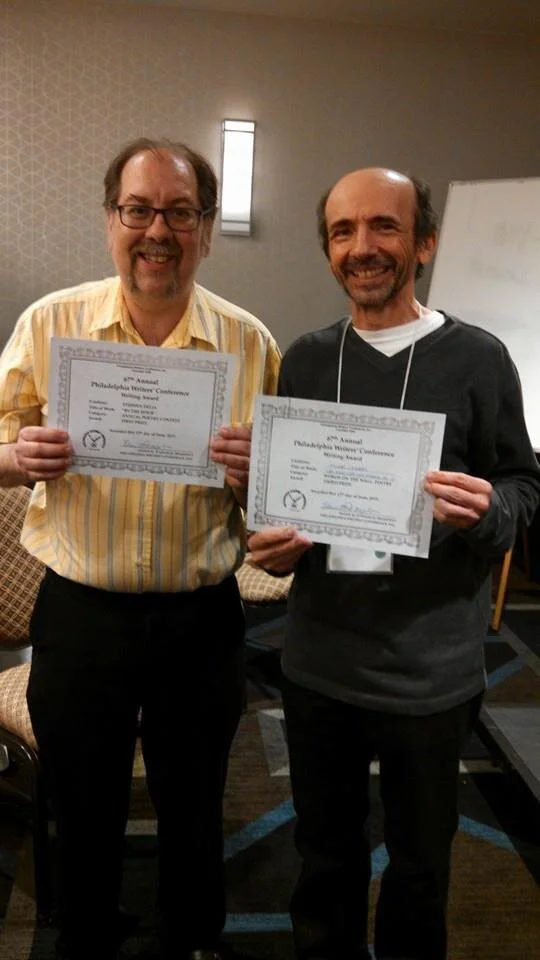
Steve Delia has been writing for 43 years and started writing memoirs about 5 years ago. He has recently been exploring essays. He won 1st prize at the PWC in 2015 and has a new book out called Poetry Time. He is one half of the dueling poets with Mike Cohen. The pandemic has halted his interview series that he and Mike Cohen had been conducting, which can be seen on Youtube. 

River Adams grew up in the USSR and now lives in Massachusetts. They are a pianist, a religion scholar, a caregiver, and a story-teller. They hold an MFA in creative writing from Emerson College, and their work appears in The Common, The Mad Poets Review, The Bellevue Literary Review, and many other journals.

Mad Poets Festival Group #2 Videos (E. Martin, A. Porter, E. Krizek, B. Crooker, and D. Kozinski)

Welcome to the 2020 Mad Poets Festival! We’re taking the show on the virtual road this year because COVID-19 couldn’t keep us from sharing these phenomenal poets and their works with the world. So, sit back, grab a drink, and prepare to be inspired!

View the Group #2 performances here.

**View a special encore performance from Emiliano Martin performing a dramatic reading of Simon & Garfunkel’s “The Sound of Silence” here. **

Group #2 Bios

Emiliano Martin is a local poet who always enjoys sharing the spoken word of his own as well as others.

Abbey J. Porter writes poetry and memoir about people, relationships, and life struggles. She holds an MFA in creative writing from Queens University of Charlotte, an MA in liberal studies from Villanova University, and a BA in English from Gettysburg College. Abbey works in communications and lives in Cheltenham, Pa., with her two dogs.

Ed Krizek holds a BA and MS from University of Pennsylvania, and an MBA and MPH from Columbia University.  For over twenty years, Ed has been studying and writing poetry.  He is the author of four books of poetry. His most recent book, The Pure Land, is available from Finishing Line Press and Amazon. Ed writes for the reader who is not necessarily an initiate into the poetry community.  He likes to connect with his readers on a personal level.For more info, visit www.edkrizekwriting.com

Barbara Crooker is the author of nine books of poetry; Some Glad Morning (Pitt Poetry Series) is her latest. Her work has appeared in many anthologies, including The Bedford Introduction to Literature, Commonwealth: Contemporary Poets on Pennsylvania, The Poetry of Presence, and Healing the Divide: Poems of Kinship and Compassion.

David P. Kozinski received a poetry fellowship from the Delaware Division of the Arts and was named 2018’s Mentor of the Year by Expressive Path, which facilitates participation in the arts for underserved youth. His full-length book of poems, Tripping Over Memorial Day, was published by Kelsay Books. He received the Dogfish Head Poetry Prize, including publication of his chapbook, Loopholes (Broadkill Press). He serves on the Board of the Manayunk- Roxborough Art Center and the Editorial Board of Philadelphia Stories and is Art Editor of Schuylkill Valley Journal.

Mad Poets Festival Group #1 Videos (A. Renee, N. Anderson, S. Concert, P. Prabhu, and C. Wall)

Welcome to the 2020 Mad Poets Festival! We’re taking the show on the virtual road this year because COVID-19 couldn’t keep us from sharing these phenomenal poets and their works with the world. So, sit back, grab a drink, and prepare to be inspired!

View the Group #1 performances here.

Group #1 Bios

Amber Renee, she/her, writes from her home in suburban Bucks County, PA. A fool hopelessly in love with the pursuit of psycheverse knowledge, she often writes autobiographically. Thoughts on This Most Recent Episode was her 2016 full length collection of self-published poetry ruminating on her thoughts & illnesses. As recently as January 2020 she published a Poetry Picture book i feel like i’m nothing available online. Find her on social media @amberreneepoet. The music in Amber’s second poem, "Metronome Mood," is by @ndotreed.)

Nathalie Anderson’s books of poetry include Following Fred Astaire, Crawlers, Quiver, Stain, and Held and Firmly Bound. She received a Pew Fellowship in 1993, and serves as a Professor in the Department of English Literature at Swarthmore College, where she directs the Program in Creative Writing.

At a very young age and against his will, Steven Concert was transplanted from upstate New York to northeast Pennsylvania. He is a three-time featured poet for Mad Poets' series and a regular participant at their annual festival. He currently serves as 4th Vice-President for NFSPS, and Treasurer for PPS.

Prabha Nayak Prabhu, a native of India is a retired language teacher.  Her poems have been published in Mad Poets Review,  Philadelphia Poets,  Schuylkill Valley Journal, The Fox Chase Review,  Poetry Ink,  Ethnic Voices and the Anthology, Selfhood: Varieties of Experience. Her chapbook Layers was published by Finishing Line Press in 2019.

Cleveland Wall is a poet, editor, and teaching artist from Bethlehem, PA. She is one half of the poetry-guitar duo The Starry Eyes and a founding member of the poetry improv group No River Twice. Her debut collection, Let X=X (Kelsay Books, 2019), is really good. You should definitely buy it.

Local Lyrics - Featuring MaryLisa DeDomenicis

Local Lyrics hosted by John Wojtowicz appears on the 3rd Monday of each month. In it, John features the work and musings of a local poet.

It’s a lot of fun to think of poems as puzzles, but there’s also a musicality created by language which carries equal, and sometimes more weight than images, because music evokes emotion.

GREEN

I do not choose to find myself
alone below the moon in a quiet place - but here I am. I try not to imagine you where you are - belly down on her bed or propped on an arm - but I feel
it is green, and sloping, and fertile -
the way she is with you - I sense her re-birthing you - the way you have her

hair in your hands, clumped like earth for rooting - I feel you spreading -
a thick hedge to church her - fluid
to fill her - parting like water

to accept you - absolutely - uttering.
I try not to imagine you. I am sorry.
I do. When I kneel in the mud
of the tight-lipped azaleas - when I dig

to plant irises at night in silence
I am sorry for every wisp of air
between my thighs while inside her
you bloom. I could hate her for this.
When I think I am hungry, when I think
I am cold - I could hate us. Understand:
One song I had was your adoration.
One song I had was the sound of your hands -

plunging my earth completely -
the sound of us rushing with something like laughter, pleasingly startled
by the warmth and the give of our bodies at night below an icy moon. I imagine and imagine you. I have everything
but you, and our tomorrow and tomorrow. I hope it is cold. Where you are

I hope it is so cold she never knows

childbirth - quickly I wish this - and then take it back - I wasn't born vicious.
Just wanting. Forgive me.
What happens is I think I have forgotten. When I finally sit down I find

I remember. When I finally sit down I find I remember it all.

thumbnail_MaryLisa. with violin, 2.jpg

I’m going to start with your recent publication in Rattle. How does it feel?
Thrilling? I’ve submitted to them a few times, and I’ve followed them since their inception, 25 years ago. I thought I knew when I submitted how difficult an acceptance would be, but it wasn’t until after they accepted my poem and I read their stats that it really sunk in. It takes discipline and work, so it’s a great honor, and I’m grateful whenever any poem I’ve written is published by a serious journal or editors I admire and respect.

What does your process look like when that all-possible-blank-page is in front of you?
I don’t think it’s ever blank. I constantly stop to write down little snippets, and if I’m lucky, an entire poem will come out in one sitting, needing only revisions. I have too many questions to ask, stories to tell, notes, and half-finished poems to have an empty page. When I don’t feel inspired, I go back and revise one of the hundreds of pages that I’ve begun.

How have writing workshops influenced your progression as a writer? What advice would you give writers looking to engage with a community?
Workshops and community are essential elements in my progression as a poet. In high school, friends would ask me to write poems to their boyfriends for them. They were my community, and community can be an engine. After high school graduation I discovered the Wilkes-Barre Poetry Society and became their secretary

When I moved to South Jersey, my son was only 10 months old and I didn’t know anyone. We were here for only a few weeks when my then husband discovered an article in the local paper about ATI (The Artists- Teachers Institute), a workshop taught by one of my favorite poets, Stephen Dunn. I also met Peter Murphy there, who co-taught the workshop, and with whom I continue to workshop (and be mentored by) to this day. In 1992, I was part of another small group of SJ poets, Afterimage, where I learned to edit and produce journals. Now I’m part of the Murphy Writing Community, as well as a member of the SJ Poet Collective, which works with the Atlantic City Arts Commission and Stockton State University.

As for guidance, I’d say some examples of excellent workshops are those in which not everyone agrees, where people can respond, respectfully, seeing from different perspectives, and where everyone feels safe enough to express themselves freely. I’d also advise any writer who asks for feedback to grow a thick skin; to separate themselves from their work, if they haven’t already, so that they can accept constructive criticism.

If you workshop one poem with a group of five people, you’re not only receiving feedback from four editors on your work, you’re also helping to edit the work of four others. Editing other’s work brings a clarity to one’s own work because it’s easier for us to see the faults in their work than in ours.

How does being in the restaurant industry influence your poetry?
Well, I’m out of it now, and I’ve also had other jobs. I taught grade and middle school students for six years, and I’ve been facilitating poetry workshops and hosting readings for the past 25 or so years.

But to answer your question, one of the reasons I wanted a restaurant was so that I’d have a poetry venue. And the restaurant industry has influenced my poetry in every way, just like everything else that seeps in, only to be released later through writing. You meet every kind of person: Travelers passing through, librarians, priests, drug dealers, teachers, police officers and other emergency workers, artists, nurses, students, babies, elderly folks, differently-abled people. And you see all sides of them: Hungry, sated. bored, overwhelmed. You watch transformation constantly - patterns, tones of voice, the impact of the way others speak, or the lack of, the gestures and the word choices they make. I think the industry gave me a broader perspective and a deeper compassion for others.

How would you describe your poetic aesthetic?
Eclectic. Definitely. Writing a formal poem is like putting together a puzzle without an image to guide you, and free-verse is like taking a blurred puzzle apart so that only the images that matter remain. It’s a lot of fun to think of poems as puzzles, but there’s also a musicality created by language which carries equal, and sometimes more weight than images, because music evokes emotion. Some poems can seem to make no sense, that is, they may not be narrative, but the lyrical qualities that create tone and rhythm draw you in anyway. I love to look for patterns in poems, as well. Those can be found in the repetitions of sounds, silences, interjections, the keeping or breaking of grammatical rules, turns, the reappearance of words or ideas, et al. The best poems, though, are those that find a way to surprise me. All of these combinations make both the reading and writing of poetry an almost limitless expedition.

Where can readers find more of your work?
I’m @MaryLisaD on Twitter, and  on Facebook where I often announce poetry events to the public: https://www.facebook.com/notherpoet/ . The following are some links to online poems, and to journals and anthologies in which my poems appear:

theamericanjournalofpoetry.com/v7-dedomenicis.html

https://www.rattle.com/print/60s/i69/ jerseyworks.com/mlpage.html

https://www.diodeeditions.com/product-page/more-challenges-for-the-delusional

https://www.amazon.com/Women-Write-Resistance-Resist-Violence/dp/0615772781

https://www.amazon.com/Rabbit-Ears-Poems-Joel-Allegretti/dp/1630450154

https://www.amazon.com/Knocking-at-Door-Approaching-Other/dp/193590499X/ref=sr_1_6? s=books&ie=UTF8&qid=1301409832&sr=1-6


Not His Shirt,  ML, 2.jpg

MaryLisa DeDomenicis is a Pushcart nominee and holds a BA in Humanities. A recipient of the Toni Brown Memorial Scholarship Award, her latest poems appear in Rattle, The American Journal of Poetry, More Challenges For the Delusional (Diode), Instant of Turbulence (Moonstone Press), Tribute to Peter Murphy (Moonstone), Bared: Contemporary Poetry and Art on Bras and Breasts (Les Femme Folles Books), Knocking At TheDoor (Birch Bench Press), and Rabbit Ears (NYQ Books). Drawing an Equation, a Ginsberg finalist, was later performed at the Ritz Theater in Philadelphia (hosted by NJSCA), and her chapbook Almost All Red (nominated for a Pushcart Prize by Stephen Dunn) was a winner in the Stillwaters Press Woman’s Words competition. She currently has a poetry prompt wheat pasted onto a placard accompanying a mural displayed in Atlantic City, sponsored by New Jersey’s annual 48 Blocks summer event. She is a member of the South Jersey Poetry Collective, which hosts monthly readings at Stockton University’s Noyes Museum and sponsors other various events in the South Jersey area.


wojto.jpg

“Catfish” John Wojtowicz grew up working on his family’s azalea and rhododendron nursery in the backwoods of what Ginsberg dubbed “nowhere Zen New Jersey.” Currently, he works as a licensed social worker and adjunct professor. He has been featured in the Philadelphia based Moonstone Poetry series, West-Chester based Livin’ on Luck, Mad Poets Society, and Rowan University’s Writer’s Roundtable on 89.7 WGLS-FM. Find out more at: www.catfishjohnpoetry.com

Review of Hazel the Aura's Next Hood Over

Review of Hazel the Aura's Next Hood Over

September 16, 2020

Capture.PNG

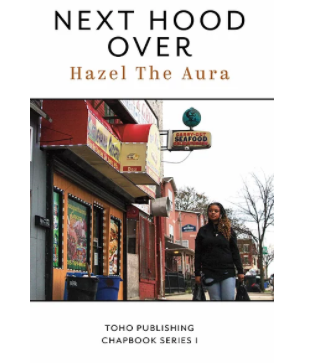
Next Hood Over

Toho Publishing

$9.99

You can buy the book here or Amazon.

Reviewed by Sean Hanrahan


Hazel the Aura’s Next Hood Over is a book that from its opening lines “I be Philly/I be the accent ricocheting 2 1 5” bowled this bibliophile over. As these lines promise and deliver, this debut collection of poems is a celebration of Philadelphia and its citizens, particularly those who according to the dedication “never made it out of the hood.” By vividly describing her life experience in North Philadelphia, she gives a clarion call artistic shoutout to her hood, her family, and her emergence as a sensitive and perceptive artist. Honest, raw, vital are just a few of the words that adequately describe this chapbook.

In the opening poem “Fuck America!,” Hazel the Aura describes who she is utilizing the dynamic backdrop of Philadelphia. This poem calls to mind the verse of Langston Hughes or Walt Whitman in its expansiveness, an expansiveness often curtailed by the specter and erasure of gentrification:

I be closed high school turned rooftop bar
I be belly bubbling for free lunch
I be schoolchildren clogging up trolley rides
I be them puppies in strollers at Rittenhouse.

To conclude this poem, Hazel the Aura does not just stay in the present day of Philadelphia, but links herself to the past with lines “I be slaves shuffling dirt into unfreight’d railroad systems/I be the royalty who never got to be Kings or Queens.” In just one poem, this wickedly talented poet contextualizes herself in humor, sorrow, the current political moment, and the harrowing past of not just Philadelphia, but America itself.

“My Pit Bull’s Dad” is a poem whose power sneaks up on you and speaks to the current moment where, as a nation, we are grappling with the magnitude of police brutality. The lines “My Pit Bull’s Dad got shot by Philadelphia police./They kill our animals the same way they do us.” With two succinct, yet loaded, lines Hazel the Aura powerfully states that police violence spares neither humans nor their pets. At a young age, the poet learned a powerful truth: “That day I learned the news outlets lie/for the biggest headline./Larry’s brother was never a kingpin.” This powerful poem is not just an elegy for a dog; it is also an intricately worded political statement. “My Pit Bull’s Dad” ends with the staggering couplet: “My pit bull never got to meet her dad. Fathers are a prized possession in the hood.” I think this poem serves as a testament to the necessity of Hazel the Aura’s voice, and her ability to enrage you against the evils of systematic racism one moment and break your heart with lyrical tenderness in the next.

Family is another important thematic element in this chapbook. One poem is titled “Grandma Dottie’s Grocery List.” She follows this poem with “Corner Store,” a touching tribute to childhood errands that morph into special memories as time changes your view.

                Sometimes I would fake sleep to avoid the store
                having gone every day, sometimes 3 times.
                But in the wake of mourning
                I’d give all my dollars and silver coins
                to travel 2 corners
                with Grandma Dottie’s grocery list.

With this poem and Grandma Dottie’s own grocery list, the reader feels they know Hazel’s grandmother and are also given the poetic space to reconnect with their own grandmothers and trips down to their own corner stores.

Hazel the Aura also takes the time to settle a debate well-known to most Philadelphians and even tourists—where does one get the best cheesesteak. With her poem, “I Want a Cheesesteak,” she lets us know.

I ain’t talkin bout Geno’s or Pat’s.
Take me to the hood
where I can cop a platta
with saltpepperketchup on the fries.

This poem is more than just an ode to the glory of cheesesteaks; it also serves as an ode to her hood.

and the brotha outside delivers his siren tune:
IncenseBodyOilsCdsDVDSocksTurtles
and the pastor sends a sermon
to the people waiting for Septa.

Her love for Philadelphia is evident in this poem. You can see the sights, hear the sounds, smell the smells, and even taste the food. That is how evocative these poems are in this chapbook.

Not just this poem, but all the poems in Next Hood Over are gemstones. They shimmer, reflect, and sparkle; they contain hidden facets; they are precious and rare. She has bestowed on Philadelphia a precious and loving gift. I have had the pleasure of reading this chapbook several times. Each time I read this collection I experience that joyful feeling of seeing such a talented poet at the start of her career with so much to say already. I, for one, cannot wait to read what Hazel the Aura writes next.

Hanrahan+headshot.jpg

Sean Hanrahan is a Philadelphian poet originally hailing from Dale City, Virginia. He is the author of the full-length collection Safer Behind Popcorn (read review here) (2019 Cajun Mutt Press) and the chapbooks Hardened Eyes on the Scan (2018 Moonstone Press) and Gay Cake (2020 Toho). He is currently at work on several literary projects as well as teaching a chapbook class. He currently serves on the Moonstone Press Editorial Board, is head poetry editor for Toho, and is workshop instructor for Green Street Poetry.

POeT SHOTS - 'NOVEMBER SURF' by ROBINSON JEFFERS

POeT SHOTS is a monthly series published on the first Monday of the month. It features work by established writers followed by commentary and insight by Ray Greenblatt.

POeT SHOTS #11, Series C

NOVEMBER SURF

Some lucky day each November great waves awake and are drawn
Like smoking mountains bright from the west
And come and cover the cliff with white violent cleanness: then suddenly
The old granite forgets half a year’s filth:
The orange-peel, eggshells, pieces of clothing, the clots
Of dung in the corners of the rock, and used
Sheaths that make light love safe in the evenings: all the droppings of the summer
Idlers washed off in a winter ecstasy:
I think this cumbered continent envies its cliff then . . . But all seasons
The earth, in her childlike prophetic sleep,
Keeps dreaming of the bath of a storm that prepares up the long coast
Of the future to scour more than her sea-lines:
The cities gone down, the people fewer and the hawks more numerous,
The rivers mouth to source pure; when the two-footed
Mammal, being someways one of the nobler animals, regains

California coast, early 20th century. High surf washes the sea cliffs. “great waves awake and are drawn like smoking mountains”…”cover the cliff with white violent cleanness”…”old granite forgets half a year’s filth”…Idlers washed off in a winter ecstasy”…”this cumbered continent envies its cliff.”

greenblatt.jpeg

Ray Greenblatt has been a poet for forty years and an English teacher longer than that. He was an editor of General Eclectic, a board member of the Philadelphia Writers Conference, and is presently on the staff of the Schuylkill Valley Journal. He has won the Full Moon Poetry Contest, the Mad Poets Annual Contest, and twice won the Anthony Byrne Annual Contest for Irish Poetry sponsored by The Irish Edition. His poetry has been translated into Gaelic, Polish, Greek and Japanese.

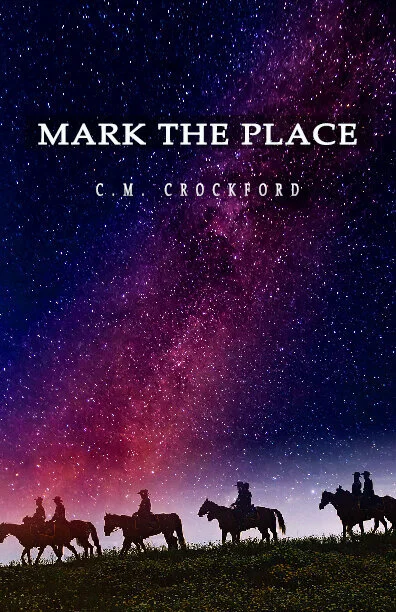
Review of C.M. Crockford’s Mark the Place

crockford.jpg

Mark The Place

Thirty West Publishing House

$11.99 

You can buy the book here.


“The poem “Declaration” reminds me of what “Song of Myself” would be like if it were written by a millennial.”


Three poems in C.M. Crockford’s new chapbook Mark The Place took me immediately to Walt Whitman’s “Song of Myself” in Leaves of Grass:

I celebrate myself, and sing myself,
And what I assume you shall assume,
For every atom belonging to me as good belongs to you.

Whereas Whitman’s poem is generally positive throughout, Crockford’s poetry balances the scales between wonderment and doom. In the opening poem “Declaration,” the poet announces his presence to the world: “I howled out my love on the rooftop / begging all to hear the words.”

Even though the poet is “howling” from the rooftop, there is still some hesitation as the words come “stumbling from his mouth.” Crockford writes that he cannot “catch his breath” yet the “exaltation” he feels “crashed / and died with such a beautiful smile / next to fear”.

The joie de vivre in “Declaration” is tinged with a somber realization that no one out there really cares. The poet looks to the moon for a sign, but “[i]t did not speak.” And in the end, he surrenders to a worldly existential angst, saying of the moon’s mute response: “That was enough.” 

The poem “Battle Cry,” which appears near the end of the chapbook, harkens back to “Declaration” in both its intensity and its use of the word howl in its opening lines: “Born howling / I claw through empire / carved from the remains / of a lost Kingdom.”

Crockford is 28 years old, and this poem, along with “Declaration,” reminds me of what “Song of Myself” would be like if it were written by a millennial. The poet states that despite the challenges of life — “the struggle for breath / the burst of pain / the raw affliction of the heart/” — he will choose “to fight again”.

Millennials are taking on a lot of fear and anxiety about the plight of the world and what might be in store for them as they age: the environment, social security, Medicare, etc. “If you’re paying attention at all, especially in America, you’re pretty scared,” Crockford told me in an interview.

In the third poem that has a hint of Whitman, titled “Birthright,” the poet again wants to assert his voice, or more accurately, his right to have a voice. I again think of Whitman, tinged with Jean-Paul Sartre, as Crockford says: “Here I stand / a halting voice. /Senses awake / in disorder.”

Part of Crockford’s “disorder” no doubt is due to his being on the autism spectrum, a fact he states in his biography. In the poem “Sensory,” he describes for us what it’s like inside his brain:

The clapping hands
(cannon fire)
thousands of them
battering his skull—
sharp sickening shocks—

Year ago, I read a book by Temple Grandin, PhD, the grande dame of autism, and she described her inability to control sensory input as like having a thousand locomotives come at you at once. I would think that Crockford’s interesting stanza structure and spacing of words has something to do with how he hears the language.

Here’s an example of word spacing from “Hush falls…”

but not the birds    no.
the nuthatches    chickadees
who    fly    flock    feed
among the dreaming

Crockford’s skills of poetic observation are everywhere. In the poem “Run,” he uses the song “Born to Run” by Bruce Springsteen as a springboard to ask where should “trumps” like him run: “the ones who can’t find a job, can’t drive / bred for the age of hate and desperation?”

In “Agonizing Love,” the poet describes the pain he feels at his inability to help those less fortunate than him.

The raw faces at subway stations
whose hands I want to hold while
asking, “are you alright?”

Crockford was born and raised in New Hampshire (“I’m always aware of nature.”) He’s lived on the West Coast, and has been in Philadelphia since 2017. He makes his living as a writer. This is his second published chapbook, and his poems have appeared in several journals. He cohosts a podcast, and writes pop culture criticism and fiction.

Some of the poets who have influenced him include William Blake, e.e. cummings, Edgar Allan Poe, Sharon Olds, Whitman, William Butler Yeats, John Keats, and Pablo Neruda.

Crockford begins the chapbook with a quote from Blake’s “Jerusalem”:

I must Create a System, or be enslave’d by another Man’s
I will not Reason & Compare: my business is to Create

He ends the chapbook with a poem influenced by Blake called “Summer Rising.” This poem, in four parts, recounts in lovely language different aspects of summer. It also contains my favorite phrase: joy free of hesitation. It’s an ecstatic, transcendental moment. Crockford remembers diving off cliffs in New Hampshire as a boy. “years later /returned / he wonders if God / was there / disguised as / the cliffs / the streams / the Green / or if it wasn’t just    joy /     free of hesitation.

Mark The Place contains the poetic observations of a man who is restless, discontent, and searching for answers. We get a sense that he has found some peace of mind in the poem “Standard Man,” where Crockford lists all the ways he’s begun to settle down. We can only hope that he continues to offer us his unique interpretation of the world, wherever his restlessness may take him.


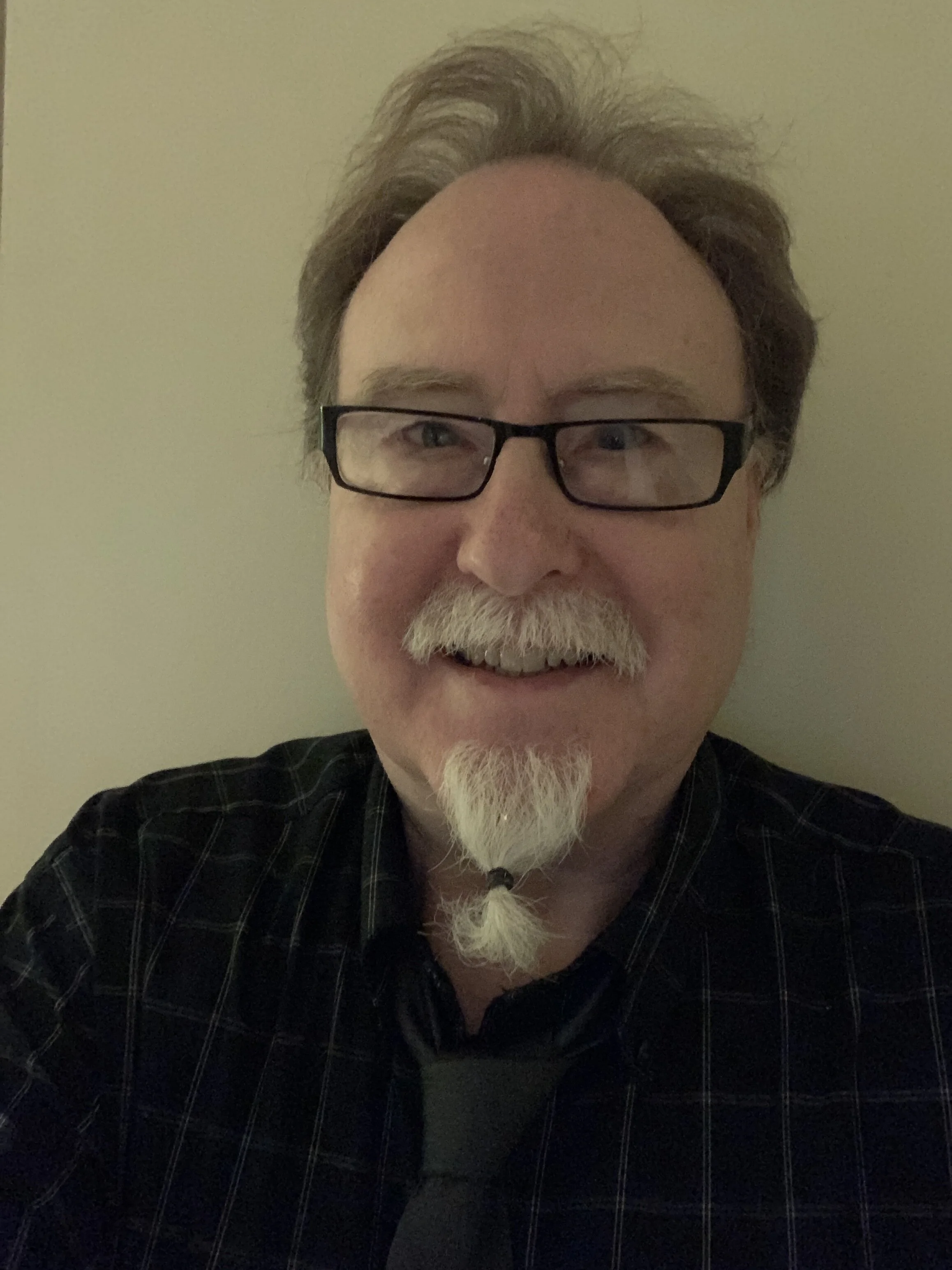
Chris bio image 2.JPG

Chris Kaiser’s poetry has been published in Eastern Iowa Review, Better Than Starbucks, and The Scriblerus. It appeared in Action Moves People United, a music and spoken word project partnered with the United Nations, as well as in the DaVinci Art Alliance’s Artist, Reader, Writer exhibit, which pairs visual art with the written word. He’s won awards for journalism and erotic writing, holds an MA in theatre, and lives in suburban Philadelphia.

Local Lyrics featuring Belinda Manning

Local Lyrics hosted by John Wojtowicz appears on the 3rd Monday of each month. In it, John features the work and musings of a local poet.


“I wrote my first poem for a high school English class. That was almost 55 years ago. It was also during a period of unrest. It was the first time I actually heard myself. Writing for me is a spiritual practice. It grounds me. It allows me access.”

Belinda Manning

Finding Our Way

It is the  elders who understand
the correlation between the life’s lyrical melody
and the beat of the drum that calls us so perfectly
into existence. 

Almost effortlessly they walk to the front
of the battlefield of justice
…alone...
Refusing to beckon us to follow. 

But the children of tomorrow
Have heard the melody and
felt the beat of the drum
and been bathed in truth. 

And they take their place.
Knowing the way forward
Because it belongs to them
It is in that space… in that moment

Where the past bows to the present moment
laying truth on the ground;
the evolution will begin
and our hearts will be changed forever.

finding our way.png

Q and A

How would you describe your poetic aesthetic?

My writing is a part of my spiritual practice, so there is a spiritual element to it.

Do you find the place you live reflected in your work?

The place that I currently live is where I have lived for at least 50 non-consecutive years of my life. So, more than any other place, it rests in my bones. Even when I am not intentional about including some physical element in my work, it finds its way there. For me, every place that I allow myself to be fully present informs who I am and how I express myself and interact with the world. My relationship with my physical environment is as important as the relationships I have with individuals. Although I have lived briefly in a number of places, they don’t hold the same imprint as this place I call home. Even where I travel in my imagination and dreams, they usually have some of the same energetic similarities with my current environment, and when they don’t, I know it is an experience I will have—soon. The other thing I should mention is that having continuity of place gives me a vantage point from which to observe the dynamics of change and how communities respond to it. How things come together and fall apart only to re-form. There is a sense of art to it all.

In addition to poetry, I enjoy the art of storytelling. As a result, some of my poetry lends itself more to spoken word. For me where I live holds my origin story. It served as home to my grandparents—where my great grandparents would visit—and my parents. So there is generational memory that my body holds. When I am most fortunate it will reveal itself and allow me to place it on paper, or in some other form of art.


Is the current climate of our nation impacting your writing? 

During this period of global unrest, I find myself retooling for the road ahead. I constantly question: What are the things that nourish me? What keeps me whole and helps me to operate at my higher self? What are those life-giving skills I need to practice and how do I give them personal definition so that they have meaning for me? I wrote my first poem for a high school English class. That was almost 55 years ago. It was also during a period of unrest. It was the first time I actually heard myself. Writing for me is a spiritual practice. It grounds me. It allows me access. Over the past few months my writing has defied the “butt in the seat” discipline required to produce a product. It sometimes has no intention other than to appear on a piece of paper. There are thousands of them, and notebooks too. One day I may take the time to go through and organize them. They are in piles all around my house. Everywhere. The value of writing most of it is not to produce anything, but to just put the words on paper where they can breathe, so I can breathe. Words that I need to see, written in a way that I can hear myself, unobstructed by the chaos and noise of the world surrounding me.

You are both a practitioner and wonderful instructor of Yin Yoga. How does your practice influence or flow into your poetry?

As I said earlier, writing for me is a spiritual practice, Yin and contemplation are two other spiritual practices for me. Many of my Yin classes are a manifestation of what comes up for me in contemplation. Remember those notebooks and pieces of paper I talked about laying around my house? Some of them become points of contemplation and then find their way into the poetry of my classes. They offer a point of focus for me, my students and our practice together.  For me there exists an agreement of mutualism between the three practices.

Covid-19 has created a challenge for taking part in the arts but you have really embraced the virtual platforms available. What was this transition like for you?

This challenge has not been majorly difficult. After I allowed myself permission to grieve what I had lost and was losing, I began to discover what I had gained. I lost access to much of the human touch and socialization that I live for and, I am learning to lean in to other ways of developing and maintaining relationships and intimacy with other human beings. One major gain for me has been access. I have attended classes up and down the West Coast and places in between. I have attended conferences that would never have been accessible to me had it not been for the virtual world. I have seen performances of Opera at the Met and the Jacob’s Pillow Dance Festival without leaving my home, which at times has presented physical hardships. I was also able to participate in 48 Blocks AC, attend many of the offerings and actually taught a class in Memory Doll Making. I intend to expand my use of the technology by offering free Zoom classes in Yoga, Doll Making and whatever else I am able to come up with. I am also going to reactivate my Blogs. I actually discovered that these platforms were designed for people like me: curious, social, unfinished, physically challenged seniors who recognize they have more to give and a responsibility to give it away. 

Where can we find more of your work or participate in your practice?

Currently, I teach Yin Yoga live on Monday evenings at 7pm on the Leadership Studio’s Facebook Page.

Instagram: @belindamanning6355

Blogs: Phoenix Rising & Conversations... with Dad

Click bold text for links!)

belinda manning.jpg

I spent most of my “working” life in the corporate world and as a volunteer in the non-profit sector. After my retirement, I found myself bathing in the healing power of art. In addition to writing, I have worked with hot glass, fusing and lampwork.  I have cycled my way through the art of bookmaking, polymer clay and doll making.  Both my photographic and mixed media arts have received awards.—Belinda Manning


wojto.jpg

Catfish” John Wojtowicz grew up working on his family’s azalea and rhododendron nursery in the backwoods of what Ginsberg dubbed “nowhere Zen New Jersey.” Currently, he serves his community as a licensed social worker and adjunct professor.  He has been featured in the Philadelphia based Moonstone Poetry series, West-Chester based Livin’ on Luck series, and Rowan University’s Writer’s Roundtable on 89.7 WGLS-FM. Catfish John has been nominated 3x for the Pushcart Prize. He has been a workshop facilitator for Stockton University’s Tour of Poetry at the Otto Bruyns Public Library of Northfield and will be facilitating a haiku workshop at Beardfest Arts & Music Festival at the end of August. Recent publications include: Jelly Bucket, Tule Review, The Patterson Literary Review, Glassworks, Driftwood, Constellations, The Poeming Pigeon, and Schuylkill Valley Journal. Find out more at: www.catfishjohnpoetry.com

Review of Laura Cesarco Eglin's Life, One Not Attached to Conditionals

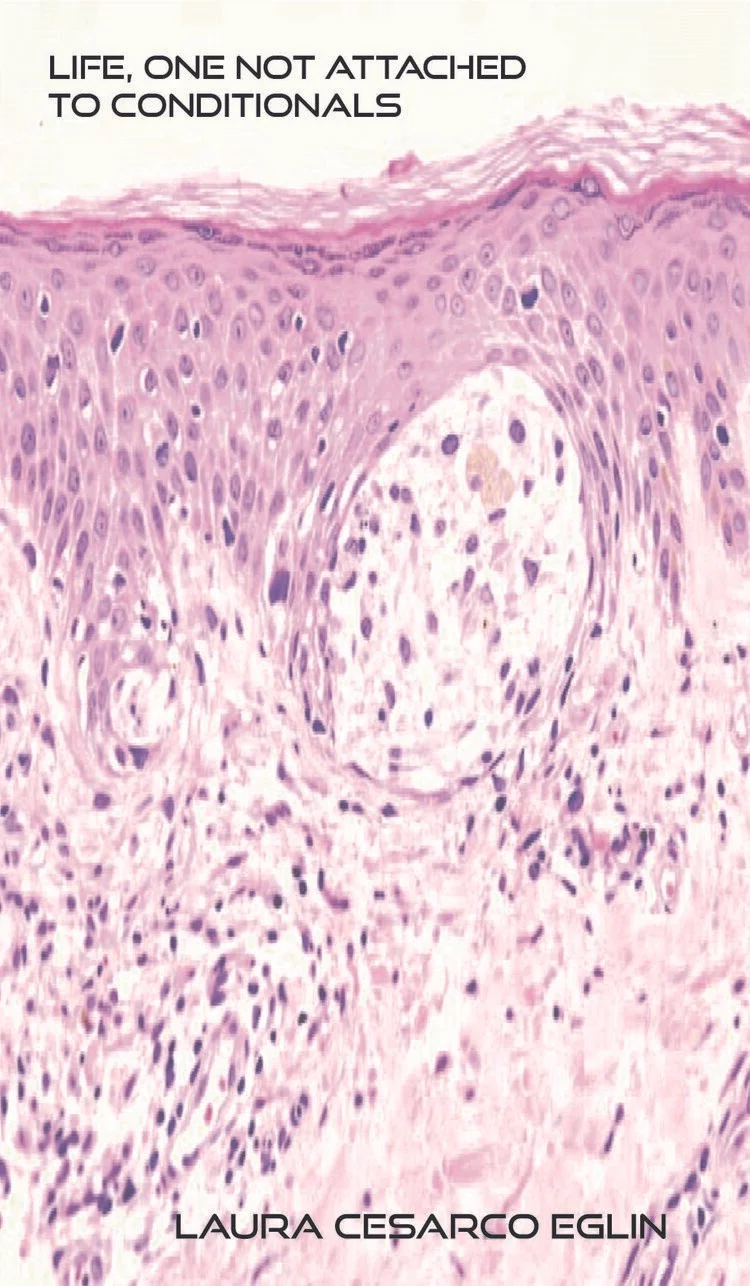
Lifeonenotattachedtoconditionals_Cover_Final.jpg

Life, One Not Attached to Conditionals

Thirty West Publishing House

$11.99

You can buy the book here.

Reviewed by Brooke Palma


In Life, One Not Attached to Conditionals, Laura Cesarco Eglin shows the reader that tragedy can give birth to beauty. This moving testimony chronicles Eglin’s multiple bouts of melanoma through impactful poems. Each poem confronts the messy beauty of life and explores the ways that the sublime is connected to the body itself.

The connection between language and the experiences of the body is a theme that echoes throughout this chapbook. The second poem in this collection, “Melanoma’s Lines” masterfully elaborates on this connection. As Eglin writes in this poem’s final stanza, 

One scar, then another;
that's two lines already:
a couplet written in five months,
a couplet that promises
to be the beginning of a lifetime
of poetry.

Eglin uses her experience of illness to go beyond the merely emotional. Her illness drives her poetry, and more so than that, through this book, it becomes poetry. In the hands of a lesser writer, this could become a trite attempt to draw sympathy from the reader, but Eglin’s writing is raw and visceral. She does not shy away from the hard truths of the experience, and that is what makes these poems so beautiful and so compelling. She lets us in to the difficult truths about “a tongue’s job in poetry, letting the body participate” and to the fact that “[t]here’s so much in being silent” …to “touch the stitches with your hands.” By facing the pain head-on without anesthetic for herself or us as readers, she transforms the negative experience of chronic illness into something brutal and beautiful.

Eglin not only captures the physical aspects of illness, but she writes honestly of the emotional difficulties as well, specifically the anxiety of waiting and uncertainty. In “Journeys,” she describes “the anxiety of about to.” She tells us that melanoma has a similar rhythm to the subway’s impending arrival described in this poem: … “biopsy, surgery, biopsy, surgery, biopsy, surgery. It’s always coming — always somewhere …” In “Perspective,” she writes of a past when she imagined “cancer as a broken promise.” The poem that perhaps best captures this uncertainty is “Waiting for Biopsy Results.” She explains,

…Murmur is what has been unfolding
already existing by the time I notice it,
already moving towards ungraspable, already
inside and growing.
Murmur is not quite late,
but almost.  Murmur is a diagnosis
away from surgery, away from being
vigilant all the time…

The sound pattern in the repetition of the word “murmur” mirrors the whispered worry, the constant anxiety brewing just below the surface. In this poem, Elgin brings us along to wait and worry alongside her.

Laura Cesarco Eglin’s Life, One Not Attached to Conditionals, births beauty out of tragedy and poetry out of struggle. This chapbook explores the body’s connection to language. The hard-hitting images show the difficult emotional and physical impacts of the author’s melanoma diagnosis; this in turn helps disrupt our certainty in everyday life. At the same time, these same images remind us that there is poetry in suffering, and Eglin works to turn the ugly into the beautiful.  

Brooke Palma headshot.jpg

Brooke Palma grew up in Philadelphia and currently lives in West Chester, Pennsylvania. Many of her poems focus on the connections between culture and identity and finding beauty in the everyday. Her work has been published in The Mad Poets’ Review, Moonstone Arts, Toho Journal, and E-Verse Radio (online), and work is forthcoming in Unbearables: A Global Anthology (to be released on November 2, 2020).  Her chapbook, Conversations Unfinished, was published by Moonstone Press in August 2019. She hosts the Livin’ on Luck Poetry Series at Barnaby’s West Chester.  
In Their Words - an Interview with Mike Cohen

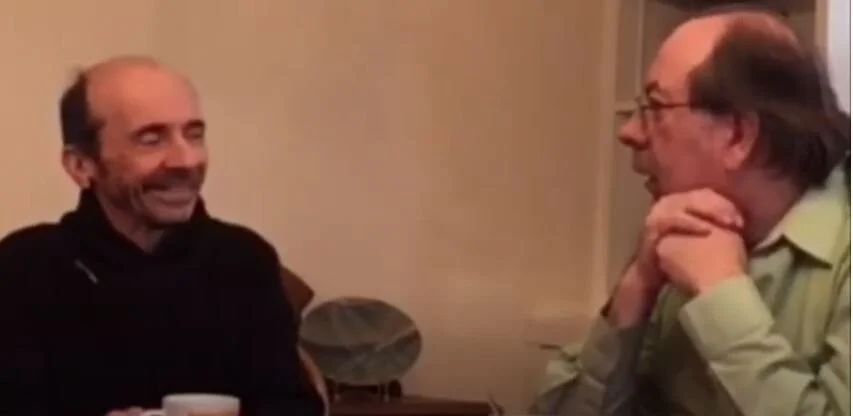
A few months back, we featured the interview where Mike Cohen interviewed his co-host, Steve Delia. Today, we feature the time where Steve returns the favor and interviews Mike. in a heartfelt interview, they discuss poetry and what it means to be a poet, as well as many other things!

Click the picture to view the interview.

For the full interview, as well as others, go to Mike Cohen’s Youtube Channel.


Delia and Cohen.jpg

Steve Delia and Mike Cohen have worked collaboratively and independently as poets and supporters of the arts in the Greater Philadelphia area. Mike Cohen helps to run the Poetry Aloud and Alive series at the Big Blue Marble Bookstore, and has had his fingers in many poetic ventures over the years. Steve Delia is the author of 6 chapbooks of poetry, and has read in a variety of venues, including the Philadelphia Writers Conference and on WXPN. Steve and Mike have also appeared throughout the Philadelphia area as the Dueling Poets.

Review of Josh Martin's Vapor

vapor crop.png

Vapor

Toho Press

$9.99

You can buy the book here.

Reviewed by Phil Dykhouse

Pain is universal. Despite its harrowing nature, pain is meant to protect us, to teach us, to heal us even. Josh Martin’s Vapor unveils a brutal yet beautiful portrait of the author trying to come to grips with overwhelming pain and its effects. The poetry within this chapbook drifts somewhere between the surreal and the all too real; a dreamscape inhabited by unfulfilled expectations and heartbreak. Throughout the book’s 19 poems, we find Martin confronting these themes head-on as he reflects on precise moments that caused so much distress. There is no denying that there is an underlying melancholy to Martin’s ruminations, yet he does not simply dwell sorrowfully about the state he finds himself in. Rather, Martin’s work seeks to understand how and why he got to this painful state. The theme at the heart of Vapor is Martin's attempt to learn a lesson that his pain was unable to teach him. 

Martin’s steady hand and lyrical gifts have crafted a fascinating narration for his journey. One of Martin’s most creative techniques is connecting the emotions of the poems to basic elements and actions of our physical world. He uses this to not only distort those emotions, but to emphasize them as well. By tying such overbearing emotions into common non-living things, Martin is able to ground them in a world the reader can relate to. For example, his feelings in the first poem “Not Knocking” are reinforced by temperature. Martin is frozen with regret but cannot bring himself to go after the warmth he so strongly desires:

….I was standing
wanting to knock but never

wanting to be heard or seen again
by anyone or you or to touch
warm skin because the cold
was numbing enough to stop me

from knocking…

 …knowing you would let me in again
if I told you I was frozen
if I showed you I was broken
enough that if you let me go

I’d die out in the cold.

The reader can relate to the pain in this piece because it is connected to a coldness they have felt before. Vapor can make you feel every emotion it wants you to without ever mentioning it by name. You can feel a punch to the gut that is represented by an arrow in “Groan”. You can feel the shame of unrequited love when Martin looks around the room in “Slow Dance”. You can feel the unrest from the heat in “Night Sweats”. You can feel his uncertainty as he grapples with how he presents himself in “Watercolor Eye”.

This brings us to an especially important example of this manifestation that you will find throughout Vapor: water. From start to finish the book references oceans, tears, waves, sweat, and rain. These forms of water often allude to Martin’s state of mind as it ebbs and flows through each piece. For example, you will find vastness and instability in the last lines of the poem “Overcast”:

you can’t kill the void with something liquid
can’t drown out the empty
by swallowing the rain.

Yet, you can also find a burgeoning optimism within “Indian Beach-September 7”:

So I sat upon a stone
tired bones pulsing with the Pacific

tickled by Poseidon’s dainty whims
I grinned

By using water and other metaphors to reshape his reality, Martin is able to draw the reader into the same fluid space that he himself embodies within Vapor. He wants to show you his deepest pain, but he does not want you to drown in it.

As I mentioned earlier, Martin imbues Vapor with touches of surrealness that allows him to create some respite from the emotional toll the pieces carry. In these moments, Martin’s language lifts his poems above simple emoting. Take for instance these lines from “Imperfect Blue”. While the yearning in this piece is palpable, the dreamlike imagery twists its feelings into a rhythmic poetry that allows the reader not to be overcome by it:

shriveling at the wrists while
conducting a quiet choir, listening
for hypnotic knocks of water drop-

                                 lets oozing past
the blue stained glass and I 
have something to be missing.

I ache
for saturation.

 As much as Vapor is awash with Martin’s pain and his apprehension of it, by the end of the book the poems begin to strike a more forgiving and confessional tone. “Petrichor” allows Martin to release his pain as if it were a breath he had been holding in. “Stone” finds him skipping a stone across a creek in a cathartic letting go of his past. It is as if Martin has awakened from his dreams (or nightmares) and is learning how to not only live with his pain, but to conquer it. After so much time adrift, he is finally finding solid ground to stand on. In the last poem “Parts”, it appears Martin has arrived at an understanding, maybe even a peace:

The truth is that when we break
no matter where we are
what pieces we pick up
to take with us
it’s the parts we put together
that make us
that define us on our way
to finally making sense
of something.

Through talking with Martin, I learned that the poems collected in Vapor are older pieces that were written during a difficult period in his life. He was not quite sure if they were representative of both the writer and the person he is today. Yet, he also had an extremely deep connection with the poems that he just could not shake. He realized that if he wanted to move on personally and professionally, he needed to learn the lesson his pain was trying to teach him. While Vapor can be an arduous journey through Martin’s subconscious, it is also a deft and pulsating collection of poetry that strives to connect with its reader instead of alienating them. Its intensity might guide you to the edge of the abyss from which these poems  came, but Martin’s creative verse and underlying humanity will be there to make sure you do not fall in. 

Phil - headshot.jpg

Philip Dykhouse lives in Philadelphia. His chapbook Bury Me Here was published and released by Toho Publishing in early 2020. His work has appeared in Toho Journal, Moonstone Press, everseradio.com, and Spiral Poetry. He was the featured reader for the Dead Bards of Philadelphia at the 2018 Philadelphia Poetry Festival.

POeT SHOTS - 'THE THOUGHT-FOX' by TED HUGHES

POeT SHOTS is a monthly series published on the first Monday of the month. It features work by established writers followed by commentary and insight by Ray Greenblatt.

POeT SHOTS #10, Series C

THE THOUGHT-FOX

I imagine this midnight moment’s forest:
Something else is alive
Beside the clock’s loneliness
And this blank page where my fingers move.

Through the window I see no star:
Something more near
Though deeper within darkness
Is entering the loneliness:

Cold, delicately as the dark snow
A fox’s nose touches twig, leaf;
Two eyes serve a movement, that now
And again now, and now, and now

Set neat prints into the snow
Between trees, and warily a lame
Shadow lags by stump and in hollow
Of a body that is bold to come

Across clearings, an eye,
A widening deepening greenness,
Brilliantly, concentratedly,
Coming about its own business 

Till, with a sudden sharp hot stink of fox
It enters the dark hole of the head
The window is starless still; the clock ticks,
The page is printed.

Getting an idea is like a fox approaching. “Warily a lame/Shadow lags by stump and in hollow/Of a body.”… “Coming about its own business.”… “It enters the dark hole of the head.” Adorned in brilliant poetic language.

greenblatt.jpeg

Ray Greenblatt has been a poet for forty years and an English teacher longer than that. He was an editor of General Eclectic, a board member of the Philadelphia Writers Conference, and is presently on the staff of the Schuylkill Valley Journal. He has won the Full Moon Poetry Contest, the Mad Poets Annual Contest, and twice won the Anthony Byrne Annual Contest for Irish Poetry sponsored by The Irish Edition. His poetry has been translated into Gaelic, Polish, Greek and Japanese.