POeT SHOTS - "Introduction to Poetry" by Billy Collins


POeT SHOTS is a monthly series published on the first Monday of the month. It features work by established writers followed by commentary and insight by The Mad Blogger, a mysterious figure who is in love with poetry and the power of the written word.

photo-1495640452828-3df6795cf69b (1).jpg

Introduction to Poetry

by Billy Collins

I ask them to take a poem
and hold it up to the light
like a color slide

or press an ear against its hive.

I say drop a mouse into a poem
and watch him probe his way out,

or walk inside the poem’s room
and feel the walls for a light switch.

I want them to waterski
across the surface of a poem
waving at the author’s name on the shore.

But all they want to do
is tie the poem to a chair with rope
and torture a confession out of it.

They begin beating it with a hose
to find out what it really means.


Happy National Poetry Month!

This masterful poem from Billy Collins asks the question of us as writers and readers of poetry, “Why do we write; why do we read?”. The language here is gorgeous and active – Collins asks his readers (or more likely, students) to read a poem by “pressing an ear against its hive,” holding it “up to the light like a color slide,” and “waterskiing across the surface.”

It’s the violent turn in the last line of this poem that clinches it for me. Instead of appreciating the beauty and simple pleasure of reading the poem for its own sake, we “begin beating it with a hose to find out what it really means.” We start sharpening the knives to dissect the meaning. We pull the poem apart like a watchmaker to see just what makes it tick, with gears and pins strewn across our notebooks and laptops.

Maybe there’s a middle road. Instead of searching for the elusive and all-encompassing meaning of a poem, perhaps we should strive instead to appreciate the sounds that make up the words, the words that form the images, the images that create the lines, the lines that hold together the stanzas, and finally, the stanzas that define the poems.  This Mad Blogger is planning to slow down and enjoy the break from our current reality that poetry grants us and hopes that you do the same.


The Mad Blogger is dedicated to showing that poetry is not some mystery. There are no right or wrong ways to read poetry; it is for everyone to read, understand and enjoy. The Mad Blogger is all of us and none of us. As long as people still believe in the power of the written word, The Mad Blogger will be there, providing insight, perspective, and (hopefully) inspiration.

Review of Jonathan Koven's Palm Lines

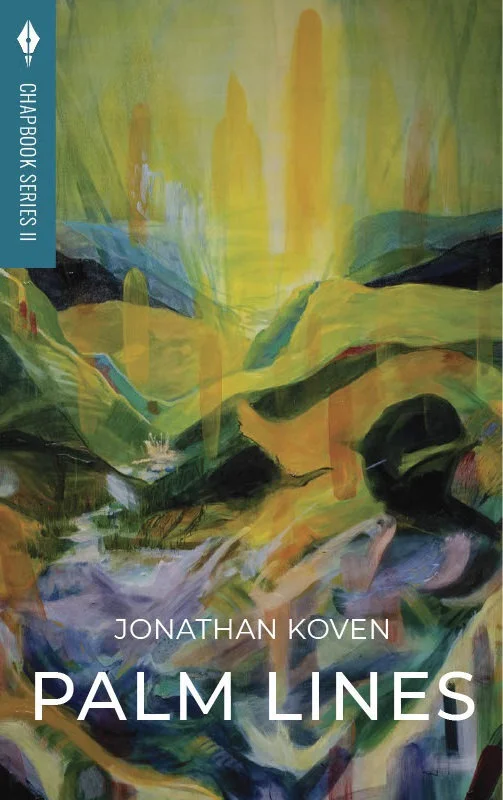
Review of Jonathan Koven’s Palm Lines

March 31, 2021

final cover.jpg

Palm Lines

Toho Publishing

$12.00

You can purchase a copy from Toho Publishing or Amazon.

Reviewed by Chris Kaiser


“I want to do with you what spring does with the cherry trees.”

– Pablo Neruda, “Every Day You Play”


When I read Pablo Neruda, especially his love poems, I’m swept up by his beautiful imagistic language, his personifications, his metaphors, and his musicality. I feel the same when reading Jonathan Koven.  

Koven’s rookie chapbook Palm Lines is filled with many beautiful lines that force the reader to stop and take a breath, such as this paean to love from “WE WON’T SHARE THE WISH WE MAKE”:

I’m drunk but not enough
to confess
your open mouth is a comet
I often wish upon

 And this meditative line from “THE STACKS”: “To receive both shades of the sky, to love / what I’ll never understand; to be cradled / by hands I can’t see, to confess weakness.”

And here, the ecstasy of the search, from “EXHALATIONS”:

I’ll lighthouse
for something surfing
heaven’s rip and find
something other
than rage.

I admire a poet’s verbal dexterity and Koven shows a lot of skill in choosing just the right words. In the last example above, notice how he uses the word “lighthouse” as a verb. He employs this technique a few times, and he will also utilize to good effect words that are seldom used as verbs. Here are a few examples:

“ Over the man-made world, / a sparrow talons away with my heart / into blue reverb” (from “THE SHOT THAT ECHOES FOREVER”)

“Window glass abstracts the shape of self into more people.” (“ELEGY FOR THE COMPLETE SOUL”).

“My arms raft all / of you (pain, hope, wisdom), and we float / to the words’ truest meaning; or how we feel / truest love, and crest over the shortfall of language.” (“TO HOLD EVERY FLYING AND FALLING AT ONCE”). Notice the pun in “crest over the shortfall of language.” It’s brilliant!

Also, the layout of the text of the beautiful and sensual “TO HOLD EVERY FLYING AND FALLING AT ONCE” suggests a rhythmic breathing, a rising and falling of the ocean’s waves, which match the poet’s message of love, one he seems to be unable to clearly define or contain:

I have told you that I love you, though its
meaning severs far beyond the words,
as rapids might burst open tightest
banks; less like a leak and more
like tide, love’s endless body
overflows, engulfing
all our days, free
and finally
unwritten.

Palm Lines consists of 22 poems and is divided into three sections: “Life Lines” (in palmistry, this represents one’s journey), “Heart Lines” (one’s relationships), and “Head Lines” (one’s knowledge and mentality). Although one doesn’t necessarily feel a hard distinction between poems in each section, it’s not any fault of the poet’s. His work, no matter the topic—family, friends, love, insecurity, gratitude—digs deep into his emotional wellspring to find the “concord of terror and beauty,” to “feel the ground tremor across flesh,” to discover that which is “too deep to revisit” (“THE SHOT THAT ECHOES FOREVER”).

 Koven’s poems are steeped in astronomical and earthly imagery: the moon, sun, stars, sky, oceans, trees, wind, family, birds, and insects. They are also grounded by familiar scenes and objects such as concrete cracks, riverbanks, an ankle tattoo, wheat fields, oaks and sycamores, and streetlamps.

 Koven’s poetic voice has a dreamlike quality to it. It’s almost as if he’s writing from underwater; there’s a hazy transformative aspect, a vague timeless quality, a romantic longing for surrender, but Koven also has a keen eye for concrete details as well. You can sense the young poet’s sincerity (he’s in his 20s). He’s not jaded, but he perceives a kind of emotional imbalance in the world. His voice is soft and hard and wild and smooth and always inviting.

The poem “DROWNED IN THE EYE OF THE EQUINOX,” for example, seems to use the change of seasons as an extended metaphor for sadness or depression. But the poet does not bludgeon us with dark scenes of foreboding. Rather he lightly suggests something is amiss.

 The moon opens. My eyes rotate
to reproach my insides.
The pith’s fumes sing, Reduce me,
with their sour breaths.  

Given this introduction, when the narrator says, in the second stanza, “More shadow has spilled over / from dawn. Cold rain covers / everything until tomorrow”, we are inclined to believe he is referring to something more personal.

As ominous as the third and last stanza seems to be, there is also a ray of hope in the final line, only because a “seed” holds promise of new beginnings:

The season dies a rabid animal,
hiccupping, seizing, Remember me,
I cannot be careful tonight,
my fire extinguished:
a crying child,
a seed.

A companion poem to the one above might be “BRAMBLES AND BRAMBLES.” In this piece, the poet tells us that when he’s lonely, “I go to verdantly green spaces.” He holds back sharing these moods with his partner to his own detriment. “Each passing year, I think / there’s another world waiting, but it’s here.” Finally, he says to her: “You love the waters whooshing / beneath, so I promise / I’ll listen.”

In the poem “THE CACOPHONY,” we find Koven at his best in terms of phrasing, sentiment, and metaphor. This is a poem asking us to be still and listen to that which we don’t often hear. But Koven asks us in his unique poetic voice:

 With your ears,
have you ever sanded down the street’s speech,
to focus
on the freakish orchestra, a dancing & complex
inner vacancy,
harmonizing with what you once heard as hush?

I love his use of the phrases “sanded down” and “street’s speech” and “once heard as hush.” The rest of the poem is as impressive, and I would love to quote it in its entirety, but I won’t (you’ll have to buy the book).

 Based on the fact that certain names in the dedication show up in poems, we can assume that Koven is the narrator of many, if not all, of the poems. Many pieces lean toward confessional but are not maudlin. And many are romantic, reminding the reader of Charles Baudelaire or Percy Bysshe Shelley or Walt Whitman.

 Like a true romantic, Koven wants to scream from joy or burst at the seams in many poems. Here is a poet so enraptured by his surroundings, be they people or nature, that he simply can’t contain himself. Take this example from “THE STACKS”:

I wanted to scream at them, I don’t know what.
Wordless, humongous. This beauty, everything
I’ve ever cared about—eternally, rhythmically,

 eventually disproportionately.

Here, in “THE CACOPHONY,” Koven is talking about the stillness he hears after tuning his ears to it: “It is too loud, / the conversation both terrifying & beautiful.”

 In “THE SKY RINSES MY HANDS,” the poet writes about driving with his brother in the dark: “and I might scream my laughter—and you might scream to keep from laughing.”

 And in “PRECIPICE,” the closing poem, Koven exclaims: “I’m finding myself, finding myself dying. I promise to feel everything before I go.”

I’ll end with a mention of two poems. “EIGHTEEN” is a marvelous look at that awkward age where we’re adults yet still adolescents (Alice Cooper has got nothing on Koven!). Like most poems in this collection, “EIGHTEEN” deserves to be read more than once. It’s filled with many memorable lines, such as: “Try hard to remember to /…/ inject caffeine from night vespers / your solitude a syringe” and “Don’t forget to stay near / where fantasy is easy /…/ and stare together into the fuel / of all your wretched secrets”.

The second poem, and my favorite in the collection, is titled “PHOTOGRAPH OF VISIBLE LIGHT.” It’s a short poem and I don’t think I can do it justice by quoting a line or two. Suffice it to say, it is a beautiful, poignant poem, whose simplicity is deceiving. Its quiet sadness is heart wrenching and the ending, a punch to the gut. But the best part, the most brilliant part, is the title. When I view the title alongside the poem, I envision a three-dimensional hologram that contains infinite possibilities, but none of them directly connecting the title to the poem. It’s an implicit connecting. I also think that Koven is throwing us off the trail, that what he really has done is aimed an X-ray beam at this “small family.”

One last note. Original paintings by Tyler Lentini appear alongside the section breaks, as well as on the cover. Koven viewed Lentini’s body of work and chose the pieces he felt best fit the aesthetic and conceptual direction of the book. These are beautiful, colorful abstract works that nicely complement the poetry. Also, the editor for this Chapbook Series II was Sean Hanrahan, whose reviews you can read on the Mad Poets Society Blog.

Koven, a Long Island native, is a poet (and writer of poetic fiction) who we should keep our eyes on. His poems are accessible yet multilayered. His language is simple but not simplistic. He questions the world but expresses gratitude for the way it is. He employs vivid imagery and often leaves the reader with a haunting, yearning feeling, which one doesn’t necessarily want to immediately relieve, but can be satiated later by another reading of this wonderful collection. I look forward to following the career of this poet as he leans into maturity and as his subject matter reflects the tensions inherent with living a purposeful life.
Chris Kaiser.jpg

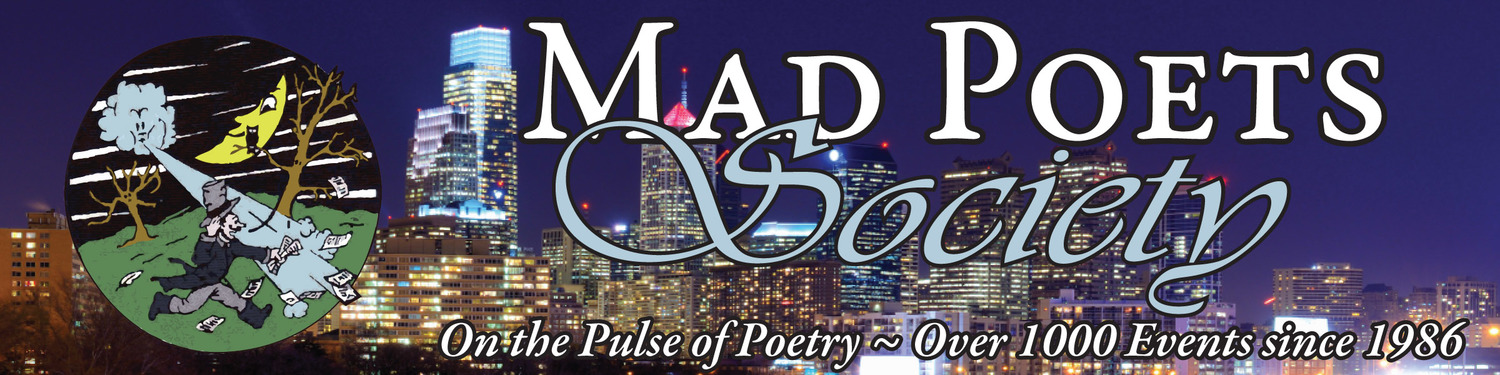
Chris Kaiser’s poetry has been published in four anthologies by Moonstone Press, including a tribute to Lawrence Ferlinghetti (2021), as well as in Eastern Iowa Review, The Scriblerus, and Better Than Starbucks, including “Black Bamboo: Better Than Starbucks Haiku Anthology 2020.” His poetry has also appeared in Action Moves People United, a music and spoken word project partnered with the United Nations. He’s won awards for journalism and erotic writing, holds an MA in theatre, and lives in suburban Philadelphia.

Mad Poet of the Year - Ray Greenblatt (March 2021)

The Mad Poet of the Year blog posts share the poetry of a long-time Mad Poet. This year-long appointment provides readers with a deep dive of the writer’s work and thoughts on poetry. We are thrilled to have Ray Greenblatt serve as the inaugural Mad Poet of the Year for 2021.


unsplash-image-BiZ-_6kNjbI.jpg
 

CHILDHOOD GAMES

 by Ray Greenblatt

I

At the birthday party
Find-the-penny is
an enthralling game
like feasting eyes
on an open treasure chest,
it seems so easy.
A shiny penny at the foot of a chair,
a penny at the base of  a wall,
one cuddled in the moss,
one sitting baldly on a flagstone
like a golden frog on a lily pad.
You see no one else, so intent,
tiny blazing suns
in a universe of lawn,
among the ivy
between tree roots.
In these scourings you even turn up
a dull cent you know was not placed there
to be found and flick it away.
A penny by a napkin on the picnic table
so obvious you might miss it
so ripe to be picked,
did a grown up leave it by mistake.
Easy riches
fists glutted
oozing copper effulgence
which you might never have again,
but to your advantage
you don’t know it yet.

II

To play Follow-the-string
you must pull on the rein
but there must be a snag
on this telephone wire,
this filament which spins out
of a transparent spider,
with a surprise at the very end.
Through the bars of the banister
around a paneled room in the gloom
a table top gleaming has dusty feet,
lean when going parallel
to someone else’s path,
learn the etiquette of pausing
when faced with an oncoming body.
Knee-high like a fence wire
you don’t know how long it is
winding its way through zones of light.
Until a shape with hue and weight
appears in the distance
growing nearer, larger,
as if dangling mid-air
wrapped in pale tissue
of blue or pink or yellow
delicate as a duckling.
But once undone you realize
what was most important—
to follow the trail
evade the traps
gain whatever the prize.


In our suburban neighborhood, one family threw fancy birthday parties with lavish food and drink for their child. It must have taken many hours to plan and prepare games for invited children to play. The games outside and inside were detailed and challenging. It wasn’t until years later that I realized these games could symbolize aspects of adult life.


Ray Greenblatt.jpeg

Ray Greenblatt has been a poet for forty years and an English teacher longer than that. He was an editor of General Eclectic, a board member of the Philadelphia Writers Conference, and is presently on the staff of the Schuylkill Valley Journal. He has won the Full Moon Poetry Contest, the Mad Poets Annual Contest, and twice won the Anthony Byrne Annual Contest for Irish Poetry sponsored by The Irish Edition. His poetry has been translated into Gaelic, Polish, Greek and Japanese.

Review of We Want It All: An Anthology of Radical Trans Poetics (edited by Andrea Abi-Karam and Kay Gabriel)

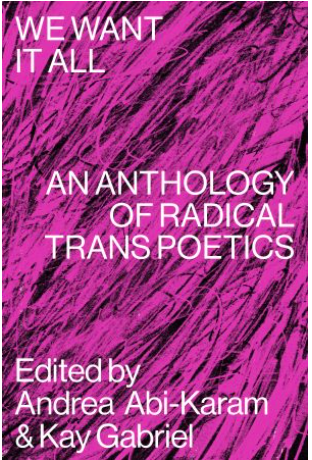
Review of We Want It All: An Anthology of Radical Trans Poetics

(Andrea Abi-Karam and Kay Gabriel, Editors)

March 17, 2021

We Want It All.PNG

We Want It All: An Anthology of Radical Trans Poetics

Nightboat Books

$22.95

You can purchase a copy here.

Reviewed by Sean Hanrahan


Poets of a certain age (the ones who can remember the ‘90s) will be well familiar with Aloud: Voices from the Nuyorican Poets Café and the impact it made and continues to make. I believe in its way We Want it All: An Anthology of Radical Trans Poetics edited by Andrea Abi-Karam and Kay Gabriel will be the anthology that speaks to and speaks for this decade. In their introduction to this anthology of diverse transgender voices “writing against capital and empire”, Abi-Karam and Gabriel seek “to piece together these multiple points of overlap between the subjective, interpersonal, and everyday modes of trans life, and the internationalist horizons of the fights we are already engaged in.” This impressive collection contains the works of approximately 70 writers, including prose pieces by Leslie Feinberg (Stone Butch Blues) and legendary trans activist, Sylvia Rivera. For this review, I have decided to single out four poets with ties to Philadelphia.

Faye Chevalier’s three poems in this anthology explore her relationship with characters played by the iconic Keanu Reeves in three of his early films: River’s Edge, My Own Private Idaho¸ and Permanent Record. In the powerful poem “Feral & Not Masc Enough for a Shoulder Tattoo,” she explores the verisimilitude of her university experience with the character Keanu played in River’s Edge. She hides her tattoos, a form of self-expression, by “wearing/ long sleeves in the summertime.” In this film, Keanu Reeves’ character, Matt, and his friends grapple with whether to report the murder of their friend’s girlfriend to the police. Matt is one of the few characters to feel some compunction to tell the authorities. In the last stanza, Chevalier pens the powerful lines: “young Keanu Reeves is posited/as both spectator & performer/of the act of rotting.” This poem along with the other two Keanu-inspired works are examples of ekphrastic poetry at its best, using finely-crafted verse to achieve art both cinematic and magical. This poem is one of several in the collection that examines the relationship between a poet and their body.

In “By the Gayborhood Shake Shack I Sat Down and Wept,” Holly Raymond writes an explosive piece whose soundscape and impeccable diction supply it with a pulsating, undeniable energy. Raymond paints a poetic picture of the tribulations faced by a trans academic:

I explain to 80,000 totally asleep-style swains
the way things are going to be
I am stomping on the head of my own vocation
they are staring impolitely at my alchemy tits
and forgetting what my name is

With the rage and anguish in the poem, she uses here well-honed skills to meld razor-sharp wit with heartbreak: “I may be mostly vegetarian/but here I am, weeping, with my fist inside the carrion.” She ends this poem with trademark eloquence: “I will not die in this town without/some other mammal’s hot blood/in my mouth.” One of the joys of anthologies, and I want to thank Abi-Karam and Gabriel for this, is the discovery of a new-to-you poet. I look forward to reading more of Holly Raymond’s work.

If you are familiar with Levi Bentley’s multi-layered poetry, you are well aware of their love of language. In the tradition of the best of the language poets, Bentley allows the reader to view language in new and surprising ways. Their poem “Slender Oat Rehearse” contains language redefining lines such as,

they put a fence up a line
of social text that keeps in capital, keeps out need
see, around the vegetable garden there
is a hole at the center
of the garden as deep as a grave

Their relationship with language is questioned, re-imagined into new configurations: “ and entering/ a kind of guerilla gardening i fall in and out of love with/language.” This poem requires and rewards multiple re-readings. This poem is an exhilarating work from a successfully ambitious poet.

Raquel Salas Rivera, the fourth Philadelphia Poet Laureate, evokes a hot day in Philadelphia in the summer of 2018. “Hot so/you dip your face in icecream pools/lap up the cracks.” Through the spell of Rivera’s craft, a hot summer’s day becomes more than a hot summer’s day. The poem morphs into a clarion call for environmental and social justice:

icebergs melt into things we can eat
or drink or dribble as if talking
but really what is say is soon we’ll be people again
and no one is listening from however we aren’t
ice arrests the usual calling making it matter hot
in cages

The thrill in this poem is how it keeps on changing, coursing along the impassioned, logical rhetoric of their mind. Even when the poem stops, it seems to keep on going. You hold conversations with it in your mind. That is the hallmark of a great poem written by a great poet.

We Want It All is the perfect anthology for readers who want to hold conversations with poems in their minds, to look at the world from a different lens, an intersectional lens of transgender, anti-capitalist, anti-colonialist, environmental, and racial identities. It forces the reader to confront the complexities of being transgender and of being human in the twenty-first century. Reading this anthology will expand your worldview. I firmly believe this anthology will be a resource for people looking for a way forward through the next century, as Aloud did and still does today.


Hanrahan+headshot.jpg

Sean Hanrahan is a Philadelphian poet originally hailing from Dale City, Virginia. He is the author of the full-length collection Safer Behind Popcorn (read review here) (2019 Cajun Mutt Press) and the chapbooks Hardened Eyes on the Scan (2018 Moonstone Press) and Gay Cake (2020 Toho). He is currently at work on several literary projects as well as teaching a chapbook class. He currently serves on the Moonstone Press Editorial Board, is head poetry editor for Toho, and is workshop instructor for Green Street Poetry.

Local Lyrics - Featuring Josh Dale

josh headshot 2020.jpg

To the Ferraro Rocher Box in the Trash
By Josh Dale

You protrude a diagonal diamond 
in a circle hole of eternity plastic
Orion’s Belt is the same overhead 
as it was since its death erupted
the cold gust on my face 
ethanol gasoline filling tank
sheering off more fossils by the mL
tearing up my eyes 
artic howl as if 
I was missing some variable 
that included your name in my phone
in full because I'm that type of person
to insert your name as when I was first
acquainted with you.

Yes, sir, I am crying, ok? Please let me be
to watch the stupid gas pump tv station
thing in peace. Look, Jimmy Kimmel is speaking to me
and me alone. He keeps calling for
me but only in the 2nd person. So, maybe
when I'm done, I’ll be rude and walk inside
and buy a 3-pk Ferraro Rocher and proceed to
split it three ways: one for me, one for Jimmy,
and one for you,
the trashcan, of course.


What draws you to poetry as an art form? How would you describe your poetic aesthetic?
To me, poetry is the lack of words. Where in prose, you have articles, prepositions, etc., in poetry you can forego nearly all of that. It is also more malleable like clay or glass. It can be a specific form (or lack thereof), talk about basically anything and anyone the poet wishes to discuss. When I need a break from a narrative and complex characters, I indulge in poetry collections & chapbooks as a palette cleanser. It is a way to appreciate unbound, unregulated art.

How did you get involved with publishing? What are you hoping to promote as a publisher?
I started Thirty West Publishing when I was an undergrad at Temple. In the early years, I was roaming around the woods. No mentor, no guide, no aesthetic (if there ever is one). Spent a lot of money from my pocket to make little impact on anything. Almost called it quits in 2018 but was able to push onward into more enlivened aspirations. I’ve always been a fan of chapbooks, seeing how you can just pick it up and ingest it in a short time. Maybe revisit it a few more times, too. That was the initial drive. However, as TW gets older and increases outreach, I’m starting to see the value of full-length books and the potential it brings. I can’t speak for others on the masthead about their subjective tastes, but I wish to publish more fiction. Novels, short story collections, and even flash fiction are really what I enjoy reading. And there are scores of interesting writers really nailing it right now that I could only dream to publish. Fresh, new theory and perspectives that I could never account for would be perfect to diversify TW even more. The same goes with poetry. We will always have a home for poets. TW has become a platform for the voice of a lot of first-time authors, and I can’t ask for more than that.

Lawrence Ferlinghetti passed away on February 22nd at 101. Has your work as a publisher been influenced by Ferlinghetti?
When I visited City Lights for the first time in 2019, it felt like a pilgrimage (both geographically and prophetically). I signed his 100th birthday card, walked around the building, and took some time to read and buy books. I felt like I was meant to go there at some point. And I’m glad I did. My condolences go to his family for losing such a phenom.

But to answer your question, I think Ferlinghetti influences all of us (small press publishers). I’ve printed chapbooks on refuse paper. Was able to haggle for an obsolete inkjet printer from a shipping store. It’s all about the DIY aesthetic. And to prove how approachable and affordable publishing was, City Lights made a home for radical and marginalized artists of the time. I know how the work he published with the Beat poets has stirred many controversies, criticisms, and celebrations. Like how metal musicians of today seem to always trace back to Black Sabbath, Ferlinghetti/City Lights was a catalyst for people who wanted to publish the written word. I guess if someone was to stir it up, I’m glad he did.

Ferlinghetti was not only a fiercely independent publisher but also an advocate for his work through City Lights. How do you balance being a publisher and an advocate for your work?
That’s the closest possible thread I share with Lawrence. My initial intent was to ‘label’ myself under a press so that I could build a ‘brand’ for myself as a writer. Granted, what I did a mere 4-5 years ago is nothing like what I create now, but at the same time, it was necessary to bring TW into the public eye. Some people expressed interest later and before you know it, the submissions began to come in. I think it was the broadside contest in 2016 that really ‘kickstarted’ the press, followed by a handful of out-of-print chapbooks.

As for me, I’m just doing what I can by submitting to literary mags/journals and, once I’m finished with this novel I’m working on, will be querying to presses. Business as usual. As a writer, I’m on par with every other hard-working, dedicated author & poet, and being a dual-role publisher has not only made me realize the joys of finally getting that desired Acceptance, but it makes me stronger in querying and nurtures creativity by reading so many submissions. Hopefully, I’ll match with an amazing place, as to how some folks who submitted to us have felt.

Does where you live influence your writing?
To be honest, not really. The most I’ve written about my locale is a manuscript of creative nonfiction vignettes about my primary school. There has been a reoccurring theme of small-town and rural living that’s been popping up in my recent stories, but it’s more androgynous than one would believe. I like to withhold landmarks, natural elements, etc. that are specific to a certain city or state because I ultimately want my reader to insert their locale into my work. To become as relatable as possible, since I, too, come from the typical suburbia and have had close access to rural areas most of my life. A friend of mine that grew up in Appalachia once told me, and I’m paraphrasing here, “Small town America is the same anywhere you go.” I like to hold onto that as I travel to different states. More-so when not in global pandemic mode.

Where can readers find more of your work?
My website is a good start. www.joshdale.co It has my CV, some photos, and a blog I’ve been running since last May I believe. Just a little insight into who I am and my personality. For my creative works, I have some stories in Maudlin House, Drunk Monkeys, Rejection Letters, and more. I apologize in advance for the lack of poetry publications. It’s been years. Hope that doesn’t go against your creed. Maybe you’ll find my poem sample more engaging. Thanks for interviewing me!  


josh reading 2019.png

Josh Dale is a graduate student, publisher, and subservient vassal to his Siamese cat. His work has been published in Drunk Monkeys, Breadcrumbs Mag, Maudlin House, Rejection Letters, The Daily Drunk, and a book, Duality Lies Beneath (Thirty West Publishing, 2016). He blogs occasionally at joshdale.co and posts average-ish content on IG & Twitter @jdalewrites. He lives in Pennsylvania


wojto.jpg

Catfish” John Wojtowicz grew up working on his family’s azalea and rhododendron nursery in the backwoods of what Ginsberg dubbed “nowhere Zen New Jersey.” Currently, he works as a licensed social worker and adjunct professor. He has been featured in the Philadelphia based Moonstone Poetry series, West-Chester based Livin’ on Luck, Mad Poets Society, and Rowan University’s Writer’s Roundtable on 89.7 WGLS-FM. Find out more at: www.catfishjohnpoetry.com.


Review of Marion Deutsche Cohen’s Stress Positions

Review of Marion Deutsche Cohen’s Stress Positions

March 10, 2021

thumbnail_StressPositions (1).jpg

Stress Positions

Alien Buddha Press

$10.00

You can purchase a copy here.

Reviewed by Abbey J. Porter


In her recent book, Stress Positions, Marion Deutsche Cohen invites her reader on a journey that is at once both keenly intimate and boundlessly universal: the experience of living with debilitating pain. Through the lens of her own pain, Cohen also explores the larger threats and injuries of the world, in all their frightening forms.

Stress Positions is a collection of poems, short prose, and pieces that fall somewhere in between, divided into two parts. In “Part I: Lessons from The Back Pain Book,” Cohen details her struggle with a painful “nerve/disk” problem in her back that interferes with, well, nearly everything. In “Part II: We Who Merely Know,” the author considers the worst examples of how people treat each other, from the Holocaust to various forms of torture.

In the reality Cohen describes, it seems anything is possible—even one’s body becoming not one’s own, and even one’s worst nightmares coming to life. Or worse.

Cohen introduces this notion with the collection’s opening piece, “Kafkaesque,” which asks, “Why not muscles, in one’s sleep or one’s waking, turning against one? Why not our bodies and our brains betraying us and ours, making us mere variations of human? Why not?”

The author describes her experience in vivid terms in “It Gets Worse”:

I can’t help envisioning my back.
It’s filled with metal, heavy metal.
It’s all one piece, a single stiff board in there, a suit of armor.
It’s no longer my back, it’s somebody else’s back.

In this highly accessible collection, Cohen is open and straightforward as she shares with her reader the components of her ordeal: confusing interactions with doctors, frustrating experiences with medications, grueling struggles with sleep.

Unsurprisingly, the narrator’s condition affects her relationships—perhaps most notably, with husband Jon. In “Jon #2,” she describes how her malady disconnects her from her partner: “I am, now, a separate species … I do my own nights, alone in my body.” And in a piece called “No Sex for Now”: “This thing is isolating. My body must be reclusive, mine and mine alone.” Cohen even questions her relationship to the universe, asking, “Why do the powers want this for me?”   

But the relationship at the heart of this work may be that of the narrator to her body, which seems that of prisoner to captor. “I’m handcuffed to my back,” Cohen says in “Walking.” And she refers, in “Mozart to the Rescue,” to “your own body kidnapping you.”

The effect on the narrator’s sense of identity is profound. In “When the Going Gets Tough, the Tough Go Shopping,” she describes managing her pain well enough to attend a sale at a thrift shop. “I knew I was not quite a citizen,” she says. “I knew I was a mere visitor.” Repeatedly in the book, she refers to wanting to be a citizen again.

Particularly affecting is the poem “The Agony,” which eloquently communicates the degree to which the narrator’s condition comes to dominate her worldview.

There’s no such thing as not having back pain…
Objects have back pain.
The universe has back pain.

In Part II, Cohen writes about phenomena that—if we’re lucky—we merely know about, versus experiencing firsthand. Here, she contemplates a range of horrors, some of which she reads or hears about and some of which are conjured by her own imagination in dreams: holocausts, capital punishment, being buried alive.

In the poem “Never Too Late,” she reflects that it’s not too late for her to live the rest of her life “blind, paralyzed, or in constant pain/or kidnapped off the streets.” She concludes, “It is never too late/for the rest of my life to be too long.”

A standout in this section is “The Heart,” which opens with the lines, “I haven’t the heart to tell you about the newly uncovered modern-day/backwoods abortion clinic.” Cohen notes that many disadvantaged women lost their lives at the facility. The poem ends with:

The newspaper with that article was lying on the kitchen table
and I wish somebody who loves me had been around at the time
somebody who hadn’t the heart to let me read it
to learn more than I already know.

 Stress Positions is an honest and courageous exploration of what it means to be human, and what happens when that humanity is disrupted. In particular, it examines the role of, and our relationships with, our bodies. The book also shines a glaring light on some of the most disturbing ways humans mistreat each other. The result is an engaging, enlightening, and thought-provoking read that will stay with you well after you turn the last page.


abbey.jpg

Abbey J. Porter writes poetry and memoir about people, relationships, and life struggles. She holds an MFA in creative writing from Queens University of Charlotte, an MA in liberal studies from Villanova University, and a BA in English from Gettysburg College. Abbey works in communications and lives in Cheltenham, Pa., with her two dogs.

Source: http://madpoetssociety.com/blog

Profession: Poet

Profession: Poet

March 9, 2021

Profession: Poet is a new monthly blog feature exploring craft and identity in poetry by Hanoch Guy, who writes poems in both English and Hebrew.

A DAY IN THE LIFE OF A POET

My experience is that, in order to write, I need a daily ritual. Think for a moment about your writing rituals. This is my ritual. First, I do stretching exercises, combined with deep breathing. Then, silence. The first steps of sitting down to writing are observation, awareness, and absorption. Every morning, I look for a while at the creek, which changes every day. Today, the banks are snowy and the pine branches are peppered with white flakes. I contemplate and write what emerges. At this time, I do not edit what I wrote.  

 Next, I turn to reading three daily poem sources. I love reading a haiku a day. at Haikuniverse. The three-liners are delightful sparks. Then I read Poem-a-Day from Poets.org., which shows the poem’s text followed by an audio recording. My third poem the daily poem from poems.com. This daily selection offers poems that are written in English and also translations that I like.

While I read the three poems, I have my notebook open in case I am inspired. Now I turn to the main course of the day, which is back to haiku. Twenty years ago, I stumbled into a used book store, where I found a wonderful book, From the Country of Eight Islands, An Anthology of Japanese Poetry. This book gave me intimate insight into haiku and other short poems. Reading the book inspired me to write hundreds of haiku that would become my first haiku book, A Hawk in Midflight, published in 2017. I am continuing to write haiku and have just finished a new manuscript, Dark River in the Woods.  I am working  on it today, editing, adding and deleting poems, and then will be sending it to my editor.

The second manuscript I am working on today, We Pass Each Other on the Road, is a collection of hundreds of haiku and micro poems. I am more and more into writing haiku, especially after reading again and again the work of Nick Virgilio of Camden, a master of the gems of haiku. Dark River was rejected four times so I continue to revisit it, adding poems and resequencing the poems. I realize that the sequence of the poems in a book may determine if it is accepted.

Now it is afternoon and I am getting tired so it is time for my daily walk. Before I go to bed, I have a habit of reading two or three poems of a favorite poet. This evening, I reread Kabir, a vastly popular Indian poet. I enjoy reading a few of his upside-down poems. I’ll write more about Kabir in a future blog.

Good night.


Please share your daily writing rituals in the comments section.


Hanoch+Guy.jpg

Hanoch Guy Ph.D, Ed.D spent his childhood and youth in Israel. He is a bilingual poet in Hebrew and English. Hanoch has taught Jewish Hebrew literature at Temple University and poetry and mentoring at the Muse House Center. He won awards in the Mad Poets Society, Phila Poets, Poetry Super Highway and first prize in the Better than Starbucks haiku contest. His book, Terra Treblinka, is a finalist in the North Book Contest. Hanoch published poems in England, Wales, Israel, the U.S., and Greece. He is the author of nine poetry collections in English and one Hebrew book.

POeT SHOTS - '"Daystar " by Rita Dove

POeT SHOTS is a monthly series published on the first Monday of the month. It features work by established writers followed by commentary and insight by The Mad Blogger, a mysterious figure who is in love with poetry and the power of the written word.

Daystar

by Rita Dove

She wanted a little room for thinking;
but she saw diapers steaming on the line,
a doll slumped behind the door.

So she lugged a chair behind the garage
to sit out the children’s naps.

Sometimes there were things to watch –
the pinched armor of a vanished cricket,
a floating maple leaf. Other days
she stared until she was assured
when she closed her eyes
she’d see only her own vivid blood.

She had an hour, at best, before Liza appeared
pouting from the top of the stairs.
And just what was mother doing
out back with the field mice?  Why,

building a palace. Later
that night when Thomas rolled over and
lurched into her, she would open her eyes
and think of the place that was hers
for an hour – where
she was nothing,
pure nothing, in the middle of the day.


Peace: it is something we all want.

The character in Rita Dove’s poem seeks nothing more than peace, a touch of peace amidst a life of responsibility and disappointment. To her, peace comes in the form of those quiet moments squeezed in between the structures in her life, the needs of her husband and children. She sits watching the “crickets,” or simply staring, enjoying the emptiness of the moment. But it is always a time with an expiration date. Within an hour, others dictate when her peace ends, and her day continues.

It’s funny to think about doing nothing as an art, but that is exactly what it is. We are so conditioned with the necessity of doing things that when we are faced with nothing to do, we don’t know what to do. If you’re anything like this blogger, you spend the time thinking about what you’ll do when the break is over. It’s a world we have created, but it is one that is mentally unsustainable.

I’m sure the character in the poem would feel the same, only for her it is amplified by lack of opportunity. The very things that bring joy to so many - marriage, children - are sucking the life out of this woman. Whatever dreams she had, whatever she wanted to do with her life, are relegated to the “palace” that she creates in her mind as she sits in her yard. Were this character alive today, some would tell her that she should practice self-care, but we forget that self-care is in itself a privilege, one that not everyone is able to enjoy.

What things trap us? What things create the boundaries of our lives? If we are honest, and if we are brave enough to think about these things, the answers may surprise us.


The Mad Blogger is dedicated to showing that poetry is not some mystery. There are no right or wrong ways to read poetry; it is for everyone to read, understand and enjoy. The Mad Blogger is all of us and none of us. As long as people still believe in the power of the written word, The Mad Blogger will be there, providing insight, perspective, and (hopefully) inspiration.

Source: POeT Shots: Daystar

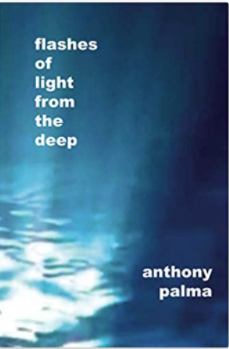
Review of Anthony Palma's flashes of light from the deep

Review of Anthony Palma’s flashes of light from the deep

February 24, 2021

flashes of light from the deep.PNG

flashes of light from the deep

Parnilis Media

$12.95

You can purchase a copy here or at Amazon.

Reviewed by Philip Dykhouse


“Poetry is ultimately mythology, the telling of stories of the soul.”

- Stanley Kunitz

From the moment language first revealed itself to human beings, we have been using it to tell stories. It was with a growing desire for those stories to evoke emotions that poetry began to take shape. From what is believed to be the oldest surviving piece of literature, The Epic of Gilgamesh, to the vast array of modern day writings, poetry can be found carved into stone and printed into millions of books - all in an attempt to connect with one another and better understand the world around us. If it is anything, poetry truly is the language of our souls. And with Anthony Palma’s flashes of light from the deep, you’ll find a poet who has mastered the art of telling stories of the soul. 

Like all great storytellers, Palma has a natural ability to draw you in. I’ve watched him read his poetry at various venues around Pennsylvania for years now and in all that time I can hardly recall him ever reading one of his poems from a piece of paper or phone screen. Whenever he took the stage, he would remove the microphone from its stand, move the stand away from the center, and then turn back to lock eyes with his audience. We would then watch as he would imbue the stage with his confidence. He knew exactly how to tell the story he wanted you to hear. His language was clear. His cadence was concise. You gave attention to every word he spoke. There was no way you couldn’t.

Yet, whenever a poet is as talented at live performance as Palma is, there’s always a slight concern that their work could lose some of its potency once it’s put to page. Can their poetry sustain its impact when it's to be read and not heard? Thankfully, when it comes to flashes of light from the deep, the answer is YES. The poetry within retains all the power and depth found in the artist's verbal renditions because much like Palma himself, the book’s strengths lie in its confidence to tell its stories.

flashes of light from the deep is an engaging collection that devotes its 55 pages to the human experience. The people and places in these poems feel alive. Their words and emotions have meaning. Every detail builds upon one another to create a world that is both believable and fascinating. And at the center of this world is Palma himself. He wants to show you not only what he sees, but how he sees it. His many references to geography and culture allow him to ground the subjects of his poems. He then uses curiosity, wit, and empathy to guide the reader from one moment to the next without letting them get lost. Much like his performances, there are no wasted words. The poems are constructed beautifully and never stray from what they want to say. The collection begins with a single poem entitled “The Information Age” that sets the tone for what's to come with the striking line, “All that’s left of us are voices.” After that, the book splits into four separate, yet intertwined sections 

In the first section, “Striking Shadows'', we find Palma painting pictures of people seeking definition and balance in their lives. In the poem “Revolution in the Family,” Palma describes a scene in which he and a group of older punk rockers sit around in a coffee shop wondering if their chance to revolt has passed them by. He recounts:

The speaker plays “Salad Days” and
I’ve never heard Minor Threat in Starbucks,
have you?
But on the night that Joe Strummer died we drank beers
and listened to “Straight to Hell” with the lights off. 

These poetic portraits continue throughout this section. In “Rumble in the Bronx”, the Jackie Chan movie is used as a metaphor for wanting to fight back against gentrification. With “The City is Grey?”, Palma walks the city pondering why our relationships to each other seem to be seen in only black and white. Other stand-out poems from this section such as “The Economics of Delusion” and “The Bards I’ve Known” further delve into the anger and anxiety that come with our uncertainties. 

The second section, “The Broken Land,” focuses more on the current socio-political landscape of our country as well as the loss of identity. “The Cracked Bell” is a biting political piece that illustrates how tourists want to see the crack in the Liberty Bell, yet they have no desire to look at the cracks in our society. The poet uses the poems “Other” and “Lament” to tell the stories of how two completely different people, his great-grandfather and his friend Khalid, struggled in their own unique way with being immigrants in America. In “A Fire Burns”, Palma himself struggles with the stereotypes of his own Italian heritage:

To you,
all we are is what you see elsewhere,
the goomba,
the guinea,
the guido,
the reject from the Jersey Shore,
wearing tailored suits as we 
kiss rings and make deals
in back rooms.

Palma then goes on to describe how he will use the Tarantella, a traditional Italian dance that was once meant to rid oneself of poison, to cleanse himself of these judgements and “drive them out”. He continues:

Until then,
I will dance ‘til I’m empty,
and until my past is once again mine.

The third section of flashes of light from the deep is titled “Starfire Ground into Dust,” and it's here that the book begins to turn its gaze inward. The pieces in this section present nuanced reflections on life and death. In the poem “The Grave of Horace Pippen,” we find Palma visiting the grave of a long dead hometown artist as he ruminates what his life would be like if he was alive today. With “The Spider in the Closet,” the poet attempts to relate to the life of a spider that has died alone. “Sitting on a Beach as the End Draws Near” asks bold questions about faith and the afterlife. “The Fragile Illusion” examines how we can’t help but fight against the natural way of the world:

Once
we measured the world by 
how often we died. 
We watched the sun
become the moon
become the sun.
We questioned where it went,
and why it came back.
Then we shackled it, placed it
in a round cage,
and named it Time.

The final section, “Flashes of Light from the Deep,” not only supplies the book with its title, but it also bookends this collection with a sense of closure. Yet, as in real life, closure doesn’t always mean a happy ending. It's meant to be used as a stepping stone to move on, and that is exactly what the poems of this section aim to do.  “Independence (Day)” might find Palma more reflective, yet he is no less diligent at examining the meaning of it all. In “Frog Songs,” the poet stands as one with his fellow human beings as we face the world together. The final two poems in flashes of light from the deep offer us two unique paths to what lies ahead. The nature imagery in “Immersion” elicits a sense of cleansing and rebirth that ends with a beautiful proclamation:

For a moment you are part of something
grander than you ever will be.
For once you are perfect.

And when we come to “Flying at Night”, Palma has us suspended in the air, flying into the unknown as we search for answers in the darkness:

Sooner or later,
we all are nothing but empty spaces,
the darkness that brightens future light.

In the end, I found flashes of light from the deep to be an earnest and engrossing story about identity. It explores who we are as people. It not only wants to know what makes us tick, it also wants to know what doesn’t. What begins as a charged observation of our lives, evolves into an introspective search for understanding. Palma’s keen eye for human behavior and a sense of humor allow him to create poetry that speaks directly to our souls. It’s easy to connect with Palma’s work because it's real. It looks you right in the eyes as it talks to you. It has no need to hide itself in the page; it sees no use in standing still. And once flashes of light from the deep gets your attention, it doesn’t let it go.


Phil+-+headshot.jpg

Philip Dykhouse lives in Philadelphia. His chapbook, Bury Me Here, was published and released by Toho Publishing in early 2020. His work has appeared in Toho Journal, Moonstone Press, everseradio.com, and Spiral Poetry. He was the featured reader for the Dead Bards of Philadelphia at the 2018 Philadelphia Poetry Festival. 

Source: Review of Anthony Palma's flashes of ...

Local Lyrics - Featuring Mbarek Sryfi

Mad Poets_Sryfi_Photo.jpeg

Fragments
By Mbarek Sryfi

I 

I laid the end pieces on the old pine dining room table
Graced with a warm patina
And I composed the border of my puzzle—my story

The colors looked so challenging
But I had invested a lot of effort in the process
And I so badly wanted to finish it

II

Tired, bored
I needed a break

 I caught a distant note coming from the kitchen
And The Persistence of Memory filled the room

I turned to my wife
Have I lived up to expectations?
Is it time to let go and move on?

Wearing a look of utter persistence
From where she was standing, it was time to
Think of Dali’s clocks

So, I collected my thoughts and
Found myself remembering
But I have promises to keep and miles to go

And I resumed arranging the fragments
Within the frame I had composed.


How would you describe your poetry aesthetic? What draws you to poetry?
Poetry is a magnificent world of metaphors and it has been part of my everyday life for as long as I can remember. I am appreciative of my surroundings, attuned to the smallest images, details and sounds, even to a word or a sentence I once read or heard. I am conscious of words, endlessly trying to tame, or rather twist them, to suit my storytelling and I am also enchanted by others’ encrypted narratives. Such visual and aural appeals of happenstance are what draws me to poetry and fuels my poetic aesthetic. Metaphors are the fulcrum that anchors my narrative; my poetic experience conjures up images from my past and present and hinges on whether these images amount to something. My writing style is authentic, sincere, and humbling at every stroke of the pen. I have been exposed to a vast array of poetic influences. At an early age, I was introduced to oral poetry and classical Arabic poetry, then French poetry, and took up Anglophone poetry in college and I haven’t stopped since.  Some of my greatest influences, with whom I am in constant dialog, include William Carlos Williams, Pablo Neruda, Wallace Stevens, Yeats, Anna Akhmatova, Mark Strand, Joseph Brodsky, Jack Gilbert, James Baldwin, Charles Simic, and Charles Bukowski.

How does your experience as a first-generation immigrant impact your poetry?
As a first-generation expat, I strive to bring to light what has followed me as well as what I have carried with me and reflect on the present. I am constantly revisiting my upbringing and the ideals of Moroccan culture and tradition I have learned to fill the void. The feeling of in-betweeness makes my life exciting, a unique experience to journey into my different physical and mental spaces, and poetry helps me restore some kind of equilibrium in my life. And poetry turns into a purgative endeavor and shapes me, both as a poet and a person. Constantly searching for clues to my own identity, for instance endlessly mustering spirits, drains me, yet never impedes my yearning to writing. Migrant perception of space and the self, accepting and recognizing absence and disorientation, are some of the themes interrogated, portrayed in my poetry writing.

You are a lecturer in foreign languages as well as a poet. What is your experience using the medium of English to write poetry as opposed to composing in Arabic?
I oscillate between moving and permanent states. And the intersecting cultures and languages I embody are reflected in the act of writing. I am in a constant self-regenerating mode. The fluidity of my internal frontiers contributes to the reinvention of the self. Like a tightrope walker, each time I tread one of my interdependent languages, in some kind of reunion, I find myself continuously in the process of domesticating that language, be it Arabic or English. My writing is backed up and balanced by the languages I speak, the cultures I have been exposed to, and the geographies I have visited. I do compose in Arabic as well and a book of those poems will be coming sometime in October.

What is translating other writers work like? How do you work with words or metaphors that have no direct translation or point of reference?
Translating other writers work is, like Poe’s pendulum, a quest to navigate the realm of two languages in an attempt to be reckoned with, a trudge through a labyrinth of grammatical structures…and metaphors that morph into something new, either through foreignization or domestication, granting the work a life of its own. I find such a challenge more compelling, for the process itself recounts the translator’s investigation into the distrustful contrivance of the recreation of a new text.

Are there themes you see continually emerging in your work? How about themes  that you have not explored but would like to explore?
A preoccupation with the human condition is my main concern, but I also have a penchant for capturing the spirit of celebrated life. The feelings of absence, loss, assimilation and self-regeneration, memory, belonging, exclusion, identity – among othersare all incorporated in my poetry. I don’t like to capitalize on any of these, but rather summon them as motifs for the intricate stage that is my life. Like an endless mustering spirits, it drains you. Anxious intermeshing of incantations of the past are entrusted in me to challenge my own future poetry. I am invested in exploring the most hushed and most difficult subjects in our history as a nation and speak out forcefully against themes of inequality and injustice.

Where can readers find more of your work? Buy your books?
I have published with the University of Arkansas Press, Syracuse University Press, Éditions L'Harmattan, and Moonstone Press. All the books can be found on Amazon.


Mad Poets_Sryfi_Photo.jpg

Mbarek Sryfi is a lecturer in foreign languages and serves as the Arabic language Coordinator at the University of Pennsylvania. He earned a B.A. in English Language and Literature and a M.A. in Education, holds a teacher certification from the Ecole Nationale Superieure, and earned a PhD in Literature from the University of Pennsylvania. His work has been widely published in many journals and magazines, and anthologies including Al-Arabiyya, Banipal, CEELAN Review, Metamorphoses, Middle Eastern Literatures, The Journal of North African Studies, Translation Review, World Literature Today, and has contributed to A New Divan— a lyrical dialogue between East & West, among others. Sryfi has co-authored Perspectives: Arabic Language and Culture in Film (2009), co-translated four books, The Monarch of the Square (2014), The Arabs and the Art of Storytelling (2014), The Elusive Fox (2016), The Blueness of the Evening (2018), and published two poetry collections, The Trace of a Smile (a chapbook that shared first place in a poetry contest in 2018) and City Poems (2020).


wojto.jpg

Catfish” John Wojtowicz grew up working on his family’s azalea and rhododendron nursery in the backwoods of what Ginsberg dubbed “nowhere Zen New Jersey.” Currently, he works as a licensed social worker and adjunct professor. He has been featured in the Philadelphia based Moonstone Poetry series, West-Chester based Livin’ on Luck, Mad Poets Society, and Rowan University’s Writer’s Roundtable on 89.7 WGLS-FM. Find out more at: www.catfishjohnpoetry.com.


Mad Poet of the Year - Ray Greenblatt (February 2021)

The Mad Poet of the Year blog posts share the poetry of a long-time Mad Poet. This year-long appointment provides readers with a deep dive of the writer’s work and thoughts on poetry. We are thrilled to have Ray Greenblatt serve as the inaugural Mad Poet of the Year for 2021.


UPWARD MOBILE

 by Ray Greenblatt

 You pursue spectator sports
          as vigorously.

A professional basketball court
          is a butcher’s block
          upon which you slice
          the most tender sirloin

hockey rink
          where the Zamboni shaves ice
          just like you like in martinis
that baseball sailing over the fence
          a clear answer
that football
          a more oblique one.

Your morning train
          is a direct injection
          into the heart of the city.
You have so many products
you can sell and buy
more numerous than all the saurians
          in the Mesozoic Age
the number of species and tongues
          lost in the 20th century.
Newton’s notations on the stock exchange
          could end up tickertape on the floor
make sure your bright white shirt
          does not become a bloody apron.

At home on rare occasions
          when you sit in shadow of the trees
          and sky turns electric just before dark
do you hear ghostly goose honks go over
intangible in the fog
do you remember
          your children are friendly captives
          your wife willingly signed the contract
do you feel a spectral nurse accompanies you
          everywhere you go?
And from that great mass of earned knowledge
          do words ever flake
agape is nested deep in your heart
caritas tingles on your fingertips.


Americans love to follow sports as a hobby and love to work hard for a living. However, sports can preoccupy our time, and the competition for success in a job can be cutthroat. Have we chosen the work that best fulfills us? And so much needs to be done in the world. With all that physical and mental activity, it is more difficult  to relax, let alone be intimate with family or successfully meditate, which is good for the soul.


Ray Greenblatt.jpeg

Ray Greenblatt has been a poet for forty years and an English teacher longer than that. He was an editor of General Eclectic, a board member of the Philadelphia Writers Conference, and is presently on the staff of the Schuylkill Valley Journal. He has won the Full Moon Poetry Contest, the Mad Poets Annual Contest, and twice won the Anthony Byrne Annual Contest for Irish Poetry sponsored by The Irish Edition. His poetry has been translated into Gaelic, Polish, Greek and Japanese.

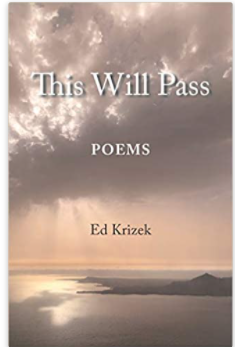
Review of Ed Krizek's This Will Pass by guest blogger Eileen D'Angelo

Review of Ed Krizek’s This Will Pass

February 10, 2021

this will pass.PNG

This Will Pass

Wordrunner Press

$10.00

You can purchase a copy here.

Reviewed by Eileen D’Angelo


“There is only one poem. I have written it many times.
It’s the one where I discuss the miracle of life…”

-Ed Krizek


We are all struggling through turbulent times right now, it is the current, universal human condition. In the midst of a global pandemic and a brewing political firestorm, in a country divided against itself, Ed Krizek has created a collection of poems that casts a light into the darkness. At a time when our very lives are threatened by a mere trip to the supermarket— at a time when growing civil unrest that is spilling from a great divide in this country, Krizek offers clarity in the midst of chaos:

The darkness comforts
my solitude..
The dark not of gloom
but of hope.
I wait for the light
knowing it will come.

Hope wins in these poems. The epigram above, an excerpt from the second stanza of “Sunset Beach,” is a part of the ribbon of philosophy that runs through this book.  In this quote, we find Krizek’s charming wit, insight, and intellect in 21 of his own words. He continues,

Love is the one steady light
in the darkness of the universe
breaking through all barriers
and adding eternal energy to our dust.

Like F. Scott Fitzgerald’s “green light,” that blinks on and off on the faraway dock, a sign of hope, “love is the one steady light.”

The message? Life is a gift – and life is short. Krizek advises us to “[s]avor every sunrise.”

Consider “Yellow Roses,” a poem about his mother’s death. Though fifteen years have passed, his “emotions have had time to/ germinate…”  Sadness overtakes him when “a memory pokes up/ organically as if from the soil itself” and his “loss blooms like a bouquet.”    

Krizek faces his own mortality with wisdom and grace, and often with an understated, subtle humor. Nowhere is that more evident than in “When You are Seventy.” He reminds us that,

you can fall asleep
at parties without
anyone thinking
less of you.

The poem rolls through some light-hearted observations of the advantages of being seventy, such as “a discount at the theatre” and being invited “to the head of the line,” before the turn that comes in the last verse. From his mindful vantage point, he offers an astute observation: “Áll we have is what we experience. Embrace now, pain as well as pleasure.” He shares,

Ýou are able to look
backwards and forwards
with wistful wisdom
and realize that life,
your life
is a gift.

It is the common thread. Between the lines, the words suggest: “Do you know how lucky you are to be alive? Did you hug the one you love this morning?”

These are smart and uplifting poems.  Each one whispers carpe diem” in its own way, through an unspoken sense of gratitude.  This is no more apparent than in his love poem, “Evening at Home,” which begins: “[s}he is constant as the ocean” and he is waiting for her to return.  The poet is gratefully “baffled by my good fortune.” The anxiousness is palpable as,

[t]he fire burns.
I wait
knowing she will appear
before the light has gone, the fire out…

 Tension builds as he hears her key turn in the front door, “while the moon is hidden/ by a nighttime cloud/ and the fire burns/bright.”  That small moment “elevates the ordinary to the sacred.”

 In his poem, “This Light Will Fade,” Krizek’s desire for immortality and to be remembered is balanced against a Zen-like contentment, as he savors moments made more precious by their heartbreaking beauty, sensuality and brevity: He notes,

[t]he sweetness of raisins in milk
lingers on my tongue. A thought drifts
a breeze shifts
on the sunlit surface
of the ocean.

Remarkable in their richness and depth, each of these poems have layers like an onion for the reader to peel away; coupled with lush language and use of assonance. Take, “Smoke,” for example, a poem that breathes of sentimental longing:  “I thought of you again/ today, after many years,/ and I became a poem. ”  The reader is committed from the first sentence. The poem has the feel of a journal entry, and we have become voyeurs.  It’s as if the reader is looking over his shoulder (and as Hemingway once said about writing) watching himbleed on the page.” Krizek continues: “I mailed myself to your office/ in a package marked/ Personal.”

The romance in those lines is unmistakable. We watch as the poet struggles, remembering an old lover. The stanza break is all you need, a caesura, to emphasize the impact of the next line: “Then I went to lie with my wife.”  What a double entendre. We follow as he sees the difference between what is true, what is real-- and what is a nostalgic yearning for the past. The narrative poem concludes when he realizes he never wanted or needed anyone but his wife.  

 This book is remarkable for its sheer honesty.  More striking is Krizek’s masterful ability to turn each epiphany into healing words, even when they rise from great trauma.  These poems seek the silver lining, celebrate life and the living, the natural world and those he loves. While Hemingway describes the writing process as bleeding on the page, Krizek responds as “the mind strains/ in it’s straight-jacket of anguished rumbling…”  No less a heart-wrenching process. Krizek has a keen intellect and thoughtful insight and in these poems, he contemplates life’s mysteries and our ephemeral existence.  He is skilled at letting the poem dictate the form. He crafts his poems to be accessible, but they are more complex than at first glance, and there is much more going on between the lines.  They possess more than thought-provoking metaphors, they reveal secrets, double meanings, that could be missed by a less than careful reader.  

Take it from me, a romantic optimist. Someone who understands that shadows come only in the presence of light. This book is full of shadows and lessons, hard-won by the author in a lifetime journey, an exploration into the heart’s dark core. Whoever you are— you need this book. It soothes the soul.


Eileen resize.jpg

 Eileen M. D’Angelo is Founder/Executive Director of the Mad Poets Society, and Founder/Managing Editor of the literary magazine, Mad Poets Review (1990-2010). Since 1987, she produced over 1,500 special events, including readings, slams, conferences, workshops, bonfires and literary festivals in the Delaware Valley.  In 2018, she was the subject of an anthology and tribute by Philadelphia’s Moonstone Arts Center.  Twice nominated for a PA Governor’s Award in the Arts, D’Angelo received two Pushcart Prize nominations from Verse Magazine and Schuylkill Valley Journal.  Poetry, op-eds, and book reviews have been published or forthcoming in The Philadelphia Inquirer, News of Delaware County, Rattle, and other publications.

Profession: Poet

Profession: Poet

February 9, 2021

Profession: Poet is a new monthly blog feature exploring craft and identity in poetry by Hanoch Guy, who writes poems in both English and Hebrew.

SUBMISSIONS, REJECTIONS

Take a moment to think about your submissions process.

What do you think and feel about poetry submissions?

A waste of time.

Intimidating.

Slim chance of acceptance.

Worth a try.

Where do I start?

 Throughout my career, I have been convinced that submission of my work is essential to me as a poet.

 There is no great benefit to pursue a consistent submission stream.

 *

 I’d like to offer my own experience.

 On July 1, 2016, I had the crazy idea of giving myself a challenge to send 100 submissions  in 100 days.

 I completed it.

 Here are the results:

  •  42 rejections

  • 35 acceptances

  • 23 no responses

 At the end of the challenge, I was exhausted. During the experiment, I was not able to do anything else.

 When I expressed my disappointment to a fellow poet, he assured me that that was a very good outcome.

 My rules for submissions are:

  •  I aim to send to magazines that respond within 3–4 months.

  •  I read poems in recent issues of magazines I am interested in to get an idea of what they publish.

  •  I only submit to magazines online that may have a print issue.

  •  I usually submit to calls for a group of themed poems.

  •  When I get a rejection, I send the poem to another magazine the same day.

 *

 Consider that most magazines have a staff of only two or three people, so expect a short form letter and don’t expect feedback.

 In all the years I’ve been sending out poetry, I have received only two letters of positive feedback and two negative ones.

 Bottom line: How should you submit?

It is clear that submitting is hard work and very time-consuming.

If you do online searches, you will find out, as I did, that it can be a long and drawn-out process.

In general, you should look for places that publish poets you admire. It is a good guideline to submit to places that align with your type of poetry, with your style and aesthetic, and places where you think your poems would be at home.

Here are some of the resources that may make your submission process more efficient and focused, although these will also be time-consuming and take some dedicated research.

Poet’s Market is like Old Faithful and has been published for about thirty years. It is the most trusted guide to publishing poetry. Want to get your poetry published? There’s no better tool for making it happen than Poet’s Market, which includes hundreds of publishing opportunities specifically for poets, including listings for book publishers, publications, contests, and submission preferences.  

Poet’s Market also has articles devoted to the craft and business of poetry, featuring advice on the art of finishing a poem, advice for putting together a book of a poetry, promotions, and more. You’ll also gain access to a one-year subscription to the poetry-related information and listings on WritersMarket.com, lists of conferences, workshops, organizations, and grants, and a free digital download of Writer’s Yearbook, featuring exclusive access to the webinar “Creative Ways to Promote Your Poetry.”

Another good resource is Poetry Markets, where you can find places to submit whether you are a beginner or a seasoned poet.

Another source for poetry information is Poetry Super Highway.

My favorite local place to submit is Philadelphia Poets, edited by Rosemary Cappello, who is very generous with her feedback and hosts an annual reading that follows the yearly publication of the print issue.

An instructor once told me, “Unless your floor is littered with submissions and rejections, you did not do the job.”

What do you think?     

I wish you good luck in your submissions.

Please share your experiences of submissions and rejections in the comments section.


Hanoch+Guy.jpg

Hanoch Guy Ph.D, Ed.D spent his childhood and youth in Israel. He is a bilingual poet in Hebrew and English. Hanoch has taught Jewish Hebrew literature at Temple University and poetry and mentoring at the Muse House Center. He won awards in the Mad Poets Society, Phila Poets, Poetry Super Highway and first prize in the Better than Starbucks haiku contest. His book, Terra Treblinka, is a finalist in the North Book Contest. Hanoch published poems in England, Wales, Israel, the U.S., and Greece. He is the author of nine poetry collections in English and one Hebrew book.

POeT SHOTS - '"The Rose that Grew from Concrete " by Tupac Shakur

POeT SHOTS is a monthly series published on the first Monday of the month. It features work by established writers followed by commentary and insight by The Mad Blogger, a mysterious figure who is in love with poetry and the power of the written word.

Image credit: Philip Dykhouse

Image credit: Philip Dykhouse

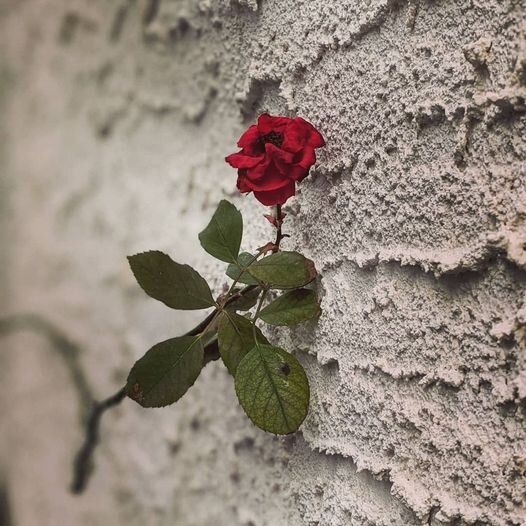
The Rose that Grew from Concrete

by Tupac Shakur

Did you hear about the rose that grew
from a crack in the concrete?
Proving nature's law is wrong it
learned to walk without having feet.
Funny it seems, but by keeping its dreams,
it learned to breathe fresh air.
Long live the rose that grew from concrete
when no one else ever cared.


On January 20th, at the presidential inauguration, we all saw the true power of poetry. It has the power to bring us together, to inspire us to be better than we were, and it can show us that, despite all the odds and adversity, we can be great. There has been a long tradition of poetry written to help people see their own worth and potential. One such poem is “The Rose that Grew From Concrete,” the title poem from Tupac Shakur’s post-humous collection of his poetry. In this poem we see Shakur’s belief that everyone is capable of making something of themselves.

The poem itself is delicately crafted, so much so that removing a single line or image would make the whole thing shatter. Without ever mentioning them, the poem addresses racism, poverty, and Shakur’s own personal struggles. In lines like, “[p]roving nature’s law is wrong,” and, “when no one else ever cared,” we see the oppression and inequality, but also indifference, a world that doesn’t care about Shakur because of who he is and where he is from. But ultimately, despite these odds, the rose, “learned to walk with out having feet,” and, never forgetting its dreams, “learned to breathe the fresh air.” The word never mentioned here is hope, but it is everywhere in this poem, the hope of a better future, and of rising above the limits society places on us.

 Poems like this challenge us. They force us to look inward. As readers and lovers of poetry, it makes us question why we read it. But as writers, it forces us to ask ourselves, “why do we write?” Do we write merely for the validation that comes from being published? Do we write so that we can be critically praised and honored? Or do we write to change people’s lives? Do we write to help others see the beauty of hope around us, no matter how ugly the world gets? Words have power. Poetry has power. How do we intend to use it?           

What does this poem say to you? How does it inspire you? Let us know in the comments.


The Mad Blogger is dedicated to showing that poetry is not some mystery. There are no right or wrong ways to read poetry; it is for everyone to read, understand and enjoy. The Mad Blogger is all of us and none of us. As long as people still believe in the power of the written word, The Mad Blogger will be there, providing insight, perspective, and (hopefully) inspiration.

Source: POeT Shots: The Rose that Grew from ...

Review of Ben Saff's minor league all american dance club

Review of Ben Saff's minor league all american dance club

January 27, 2021

minor league all american dance club.PNG

minor league all american dance club

Toho Publishing

$9.99

You can purchase a copy from Toho Publishing or Amazon.

Reviewed by Chris Kaiser


“Perhaps I know best why man is the only animal that laughs: he alone suffers so excruciatingly that he was compelled to invent laughter.”

Frederick Nietzsche


Is it any wonder millennials are attracted to the absurd? They are told to go to college, which saddles them with debt and offers few job prospects, forcing them into the tenuous gig economy that proffers no healthcare insurance, no paid vacation, and no job security. In the meantime, they are fed a steady diet of American optimism by the powers that be. They are told the country is in good shape because the stock market is performing well, while unemployment is at an all-time high. They are told the military is the best in the world even though the U.S. lost in Korea and Vietnam, and has been mired in conflict in Afghanistan and Iraq since 2002. And they were told that the novel coronavirus would disappear like a miracle.

 Albert Camus asked the question: “How does a rational being confront the idea that his existence might not be rational but rather absurd? The answer,” he said, “is simply to laugh.”

 Absurdist humor relies on the illogical, the incongruous and it is alive and well among the young adult demographic. It helps to express the disillusionment felt by many millennials.

Yet, the absurdist humor in millennial Ben Saff’s new chapbook, minor league all american dance club, isn’t so much about disillusionment, as it is about having fun. And fun is what I want right now, given recent political events.

Absurdist humor breaks rules and Saff does that with talking alligators, observant parking meters, and passengers tip-toeing on the wings of airplanes. The opening poem, “the alligators,” seems to be a simple tale of alligators strutting around the city like “they were born here,” enjoying themselves at comedy clubs, and smoking in cafes. But like all good poetry, Saff leaves a lot of room for the reader to ask questions and fill in the blanks. Where did the alligators come from? Why did they travel north? Did they not feel as powerful in their previous geography like they do in their new environs? Why is it important we know what makes these alligators laugh? The poem is less than 20 lines long, yet packs an emotional punch that is both unassuming and potent.

I am familiar with the conspiracy theory that purports a secret cabal of reptilian shape-shifters controls the world. Is Saff playing with this idea? I don’t want to give away the poem, but I will repeat the warning of the poet: “don’t ask what’s in their briefcase.”

Another poem titled “roommate” plays with our absurd sensibilities. The narrator encounters death, who “drums a rhythm / on the wall” with his scythe, and also plays air guitar on it. But this is not the first time our narrator has seen death. We are told that death loves the trick of “passing / through the locked apartment door,” but that it’s “getting old”. I can just imagine the grim reaper trying to get a laugh from his bored roommate.

Death makes himself at home, talking about his foray into yoga (he “won’t shut up about it”) and smiling at the suggestion to “order dominoes”. The whole scenario is bizarre and absurd, but somehow believable within the context of the world Saff creates, told in a simple, readable fashion.

I recently attended a graveside service for a 40-year-old man who died of a drug overdose. During the ritual, I sort of had my own conversation with death, thinking about how I should perhaps prepare for his arrival. I might have been better served psychologically if I had entertained the notion of death more absurdly, like Saff. After all, no one escapes the final breath. Why not room with death, get to know his annoying habits, and discover what makes him happy?

Humans have an inherent longing for certainty, which can manifest in many ways, some of them harmful like authoritarian cults or fascist governments, some of them harmless like marriage and ritualistic routines. Humor is one way to combat uncertainty and the poet shares the stage with the philosopher and the comedian in helping us share in the laughter rather than fight in the despair.

In the poem “angel gabriel,” Saff again challenges our funny bone by having “angel gabriel … shop at target.” As Saff has done with just about all the poems in this collection of 19, he leaves lots of room for the reader to travel within the poem to find several layers of meaning. At first, the reader might think this poem is about the Angel Gabriel, the one who foretold the birth of John the Baptist and Jesus. But there is some wiggle room in that interpretation. Saff never uses the definite article “the” before the name angel gabriel. It could actually be the name of an Hispanic character. Another clue to the latter interpretation is the use of the Spanish phrase, “piso mojado” (wet floor) on a “a bright yellow sign” that angel gabriel passes.

Just when the reader thinks he or she might have the poem figured out, or at least manageable, Saff tells us that angel gabriel stopped himself from buying a succulent plant when “he remembers the fifth / commandment.” That line just turned my world upside-down. It was so unexpected and it gives the poem extra layers for interpretation (or just enjoyment).

I’m aware of the irony of trying to explain these works when absurdity is the compulsion to go looking for meaning that simply isn’t there.

Some of the poems in this collection — and especially “miata” — remind me of the poem, “A True Account of Talking to the Sun at Fire Island,” by Frank O'Hara, which just so happens to be one of Saff’s favorite poems. “This poem has so much of what I enjoy about poetry: it's lawless, imaginative, playful, absurd, authentic, and just a little bit enlightening,” Saff told me in an email.

And those are all the qualities you’ll find in the poems in this marvelous chapbook. You will laugh, you will be surprised, you will want more.

Chris Kaiser.jpg

Chris Kaiser’s poetry has been published in Eastern Iowa Review, Better Than Starbucks, and The Scriblerus. It appeared in Action Moves People United, a music and spoken word project partnered with the United Nations, as well as in the DaVinci Art Alliance’s Artist, Reader, Writer exhibit, which pairs visual art with the written word. He’s won awards for journalism and erotic writing, holds an MA in theatre, and lives in suburban Philadelphia.

Mad Poet of the Year - Ray Greenblatt (January 2021)

The Mad Poet of the Year blog posts share the poetry of a long-time Mad Poet. This year-long appointment provides readers with a deep dive of the writer’s work and thoughts on poetry. We are thrilled to have Ray Greenblatt serve as the inaugural Mad Poet of the Year for 2021.


VENICE SUBMERGED

 by Ray Greenblatt

Only the tourists care now
donning scuba gear to sink into
to sink back into this womb of a world
into waters where pollution has been swept away
by this whirling locus of West meeting East;
though the manifold portraits in palazzos are gone
their spirits have been set free
by the purifying waters;
past the arcades and screens of the Doge’s palace
gilt altarpieces now shipwrecks gathering barnacles
over and under bridges they flutter
coral resembling lemon and olive trees
canals so many racing lanes;
they swim like the naked cherubs in the still spouting fountains
float over the gleaming dome of Saint Marks
and a winged lion perched on a pole
the pigeons transformed into sole.

The scuba men pass Harry’s Bar
where Hemingway in perennial safari outfit
swaps conceits with scarlet-lipped Baron Corvo;
they can still hear arias of gondoliers
and Browning at his toccata;
past Byron swimming tipsily home
and Diaghilev jetting by
past Thomas Mann who still imagines
he is judging the boy with tightest well-turned rump
and penis non-threateningly petit
past priests their black cassocks spread like manta rays;
some divers search for a legendary air pocket
in which a coifed harlot might lie;
humans can not breathe in water, we are told,
but if they could sidestroke this one minor rule
they could inhale, indeed could ingest the living past.


Venice is an ancient, beautiful, mysterious city. It has always had flooding problems. What if it was completely inundated, like Atlantis! Since this is a poem, I also wanted to include other authors who have had connections with this magical city.


Ray Greenblatt.jpeg

Ray Greenblatt has been a poet for forty years and an English teacher longer than that. He was an editor of General Eclectic, a board member of the Philadelphia Writers Conference, and is presently on the staff of the Schuylkill Valley Journal. He has won the Full Moon Poetry Contest, the Mad Poets Annual Contest, and twice won the Anthony Byrne Annual Contest for Irish Poetry sponsored by The Irish Edition. His poetry has been translated into Gaelic, Polish, Greek and Japanese.

Review of Erica Abbott's Self Portrait as a Sinking Ship

Review of Erica Abbott’s Self-Portrait as a Sinking Ship

January 20, 2021

Self-Portrait as a Sinking Ship.PNG

Self-Portrait as a Sinking Ship

Toho Publishing

$12.00

You can purchase a copy here.

Reviewed by Sean Hanrahan


Every poetry reader can remember the rare moments when they were struck by unrelenting honesty in verse, especially when it is paired with lyrical imagery and thoughtful flashes of insight and wit. I believe when a poetry reader picks up Erica Abbott’s Self-Portrait as a Sinking Ship they will have several of those moments.

Abbott shows remarkable honesty early on in her debut chapbook with the poem, “10 Things You Should Know About Mental Illness.” She writes “Don’t stand too close/ because even though I won’t mean to hurt you,/ I will. You must learn to look past the sparkle.” This poem, featured in the half of the book aptly titled “Darkness,” pulls no punches as the narrator describes to her loved ones her struggles, her fears, her experience with mental illness. In the vein of successful confessional and lyric poets, Abbott deftly interweaves nature imagery to serve as a landscape for the narrator’s emotions:

It crashes into me like a wave, knocking me down
and threatening to drown me if I’m not careful.
But I didn’t know I was standing in the ocean,
even as it foamed at my feet. The salt no longer
stings the wounds; it just makes them bleed more. I
don’t notice the seas redden.

Nature imagery recurs quite frequently in this chapbook. In the closing poem contained in the second half of the book titled “Hope,” Abbott instructs us “How to Stargaze Through the Light Pollution.” At first, it appears we can only see the stars through artificial means: downloading a “star finder app” or “phosphorescent star stickers.” Frustrated at light pollution, like so many of us stargazers, she exclaims we should “[t]urn off every light in this city. No—/ to hell with that—make it the world.” After that event, “[b]illions of people will…cry as the cosmos opens up before them.” Like all true poets, Abbott knows that there is at least one more thing important than nature, and that is love. In her fifth and final instruction, she writes

Gaze into the eyes
of your lover. Lose yourself
in every shooting star and supernova
lighting up your face. This is how
you rediscover the universe.

Abbott deploys strategic flashes of insight and wit in the poem, “St. Ends, Patron Saint of Endings.” In this narrative poem, she writes about a broken friendship and “Best Friends” necklace where “the side I kept reads: st ends.” The narrator relays the universal and painful experience of friends drifting apart after attending different schools where they never find that same true friendship again. She writes, “[w']e walk into different rooms where the only/ people who know our names are those with an/ attendance sheet.” She chides herself for not reaching out to her distant friend:

.And I think how very fitting it is to be the patron
saint of endings.
Why can’t I just pick up the phone, say hello—
how have you been?

Relationships are a central theme in Self-Portrait as a Sinking Ship. In perhaps the most luminous poem from the “Hope” section, Abbott compares her romantic relationship to “Light in the Fog:”

I’ve always loved the way the light
interacts with fog—
the way it filters through like
moonlight on a cobweb.

This tender poem uses lush language to express her love and helps to give this sterling chapbook a welcome roundness of darkness and hope, of pain and love. Whether reading it silently or aloud, by yourself or with a loved one, Self-Portrait as a Sinking Ship will break your heart and mend it again. It will blow you away with its poignancy and grace. Abbott shows wisdom and lyrical grace that belies the fact that this is her debut work. Expect more to come from this dedicated, already very talented, poet.


Hanrahan+headshot.jpg

Sean Hanrahan is a Philadelphian poet originally hailing from Dale City, Virginia. He is the author of the full-length collection Safer Behind Popcorn (read review here) (2019 Cajun Mutt Press) and the chapbooks Hardened Eyes on the Scan (2018 Moonstone Press) and Gay Cake (2020 Toho). He is currently at work on several literary projects as well as teaching a chapbook class. He currently serves on the Moonstone Press Editorial Board, is head poetry editor for Toho, and is workshop instructor for Green Street Poetry.

Local Lyrics - Featuring Alison Lubar

alison lubar.jpg

Conservation of Matter
By Alison Lubar

(first published in Apiary Magazine, Issue 11)

No carbon decomposes. I recycle [not-love,
repurpose] crumbling brick to garden path,
replace pious copper pipe Cowith plastic. [Which
of twelve steps compels benedictions?] Spackle
holey walls’ fist-divot, cover couch in navy velvet
and linen pillows, banish tobacco tins and empty
fifths of whiskey [hidden behind cookbooks
or bedside table]. The next era built with Good
Will and wish: resourceful as neighborhood
pigeon who [nests with fishing line, dental floss,
paper straw wrapper, matted spiral of white hair]
makes home from nothing [everything].


You are a teacher as well as a poet. Does teaching influence your writing or perceptions of writing? You are also a yoga instructor. Do poetry and yoga intersect for you?

Teaching has definitely influenced my perception of writing-- as a student, school was the first place where I really started to share my writing. I won a poetry contest in first grade and read my entry on the morning announcements. I always loved reading poetry, and found teaching it just as wonderful. In the best of times, I feel like a poetry clinician for my students. Heartbreak? I’ve got a poem for that. Rough day? Have one for that too! Teenage blues? Oh there are so many to recommend… And for those of my kiddos who hate poetry, I challenge myself (and them) to find something that they dislike the least.

 As an adult, I really started seriously writing after completing a yoga teacher training for a kids’ yoga program. At the end of the program, we were asked to write words on post-its that made us think of the other participants, and someone put “poet” on my left shoulder. I spent the next several months in a longer YTT program, and that just helped open the figurative heart valve. They’re definitely connected, because they both involve the whole self, in both whatever and every ontology one might ascribe to.

It’s a small thing but I love that you effectively utilize square brackets in your poetry. How do they inform your poetic voice?

Thank you! My drafting style is [incredibly] voluminous. I really work to pare down long lists of images and words, and some find their way into brackets. I always wrote with parentheses (even in high school papers), and the use of such insertions/mini-digressions really speaks to the way that I think.

From what I have read of your work, your poems are often driven by fresh and surprising images. What’s your strategy for cultivating poetic imagery that both startles and satisfies?

Startles and satisfies! I love that. When I’m trying to describe a thought/experience/thing, I attempt to hold it up to different lights, palm it, and turn it in my hand. I think of Rita Dove’s finesse in “Flirtation,” or when I’m driving, I’ll try to come up with different ways to explain what I see. Could telephone poles be eyelashes? Can double yellow lines be luminous? I love playing with sounds and pure phonetics, then try to make some sense out of what’s emerged-- syntax first sometimes, then semantics. 

Virtual poetry readings and journal launches have emerged out of necessity due to the current pandemic. What has your experience been like engaging with poetry virtually?

Oh, I have found such an incredibly talented and loving community. Multiple communities, really. I’m stranded in NJ right now and had every intention of moving to Philadelphia, BC (Before Covid). I attend weekly sit & writes and have connected with so many other writers in Philadelphia and beyond. Where I wouldn’t normally be able to attend an event or workshop because of location, I now can. I think it’s an important time for poetry, but really, the time is always right, right? I love seeing familiar faces at readings and have really made some important connections & friendships over the virtual verse universe.

 Where can readers find more of your work? Buy your book?

I’m working on a second chap while my first is (still) out for submission! My website is www.alisonlubar.com, and you can find me on Twitter and IG @theoriginalison. I’ve recently had work in Apiary Magazine and antonym lit. Both are beautiful, digital issues. And I’ll hopefully send you some chap or collection news soon!


bwbeach.jpg

Alison Lubar teaches high school English by day and yoga by night. They are a queer femme of color whose life work (aside from wordsmithing) has evolved into bringing mindfulness practices, and sometimes even poetry, to young people.  Most recently, their work has been published by or appeared in Rowan University’s Glassworks, Giovanni’s Room anthology queerbook, Fearsome Critters' Quaranzine, Apiary Magazine, and antonym lit.


wojto.jpg

Catfish” John Wojtowicz grew up working on his family’s azalea and rhododendron nursery in the backwoods of what Ginsberg dubbed “nowhere Zen New Jersey.” Currently, he works as a licensed social worker and adjunct professor. He has been featured in the Philadelphia based Moonstone Poetry series, West-Chester based Livin’ on Luck, Mad Poets Society, and Rowan University’s Writer’s Roundtable on 89.7 WGLS-FM. Find out more at: www.catfishjohnpoetry.com.


Review of Leonard Gontarek’s The Paris Poems Of Jim Morrison

Review of Leonard Gontarek’s The Paris Poems Of Jim Morrison

January 13, 2021

thumbnail_Paris Poems Cover.png

The Paris Poems Of Jim Morrison

Moonstone Press

$10.00

You can purchase a copy here.

Reviewed by Abbey J. Porter


Noted Philadelphia poet Leonard Gontarek summons the spirit of the iconic front man of the 1960s rock band The Doors with his recently published book, The Paris Poems Of Jim Morrison. This collection—theoretically, the poems Morrison might have written if he hadn’t died in Paris in 1971—draws the reader into a fragmented dreamland in which the narrator struggles to know himself and his surroundings, in which there is “[m]ore there than it seems.”

The Doors began recording and performing in the mid-1960s. Jim Morrison, the band’s lead singer and songwriter, was heralded as both sex symbol and countercultural icon. But he was also something else: a poet. Morrison’s collection of poetry, An American Prayer, was published in 1970.

By 1971, Morrison was in a bad way. He’d been convicted of profanity and indecent exposure for his behavior during a concert and was facing jail time. And he’d developed a serious alcohol dependence. In March of that year, Morrison joined longtime girlfriend Pamela Courson in Paris, hoping to find an escape from his troubles and a chance to write. But several months later, on July 3, he died there at age 27 under dubious circumstances. Courson reportedly found him dead in their hotel room’s bathtub. The official cause of his death was listed as heart failure, but no autopsy was performed, and rumors surfaced of a possible heroin overdose. The cause of his demise remains a topic of speculation.

Morrison’s troubled nature is highlighted in Gontarek’s poems. In 43 pages of untitled free verse, in which it’s sometimes hard to tell where one poem ends and another begins, one perceives Gontarek’s Morrison to be lost in a landscape in which “[t]he signs are blank.” He seems to be at odds with his surroundings, as in the opening poem:

I never dress for the weather
I believe I am in hell
I am in Paris
I turn my collar up
I sip from my flask

The collection’s opening verses also give the impression of a narrator who is diminished: “I have failed, one wing hangs down.” And, as he muses later: “Could I ever see into things? There was a time I thought I could.”

The landscape here at times seem impenetrable. The narrator struggles to make sense of it—to find his way into it, or perhaps out. And words, instead of communicating, contribute to the fog: “The language here softens, everything, out of focus.” We glimpse an incoherent picture, much like the one the narrator describes as “[b]ad reception. Feeding back flickering images of a room.”

In some cases, Gontarek tosses disembodied words, images, and thoughts to the reader, giving the impression of poems that are perhaps incomplete, perhaps struggling to emerge: “Wouldn’t want. / Never. Knew. Want. The ship. Burning.”

This is a shifting, multilayered reality in which “what is behind things still waits behind things” and “[w]hat is revealed is revealed. What is hidden remains, small cold blue flames.” Gontarek’s narrator continues: “Everywhere I turn is something I don’t understand becoming a part of something else, combusting.”

The narrator seems to try to discern the truth in a world in which all is untrustworthy and appearances can be deceiving.

Passion and anger resemble each other…
Overcast days remind one of autumn
In reality, it is otherwise.

Within this unknowable landscape, the narrator is likewise unknowable and questions his own identity. He struggles to understand his own consciousness and asks, “What hand, opening and strange, comes out of these clothes.”

Seeking assurance of his own existence, Gontarek’s Morrison finds a welcome, orienting power even in his own name: “The scent is unmistakable. Jim.” And “Morrison. It holds me here holds me.”

Gontarek’s poems are rife with references to the natural world: flowers, birds, trees, grass, bodies of water. However, instead of being pure or trustworthy sources of salvation, Nature seems as suspect as everything else. Gontarek refers to an “old pond smell” … “The odor of river” … “The crow that scars the sky.”

The narrator is like an explorer who reports the rich findings of his senses, whether sight, scent or sensation.

Often, too, he refers to sadness. But running as a counterpoint to that sadness is his desire, which perhaps constitutes the heartbeat of the book—the desire to understand himself and his surroundings, to find his way. At times, the desire manifests as sexual.

Are you home now?
The earth is lonely.
Are you hungry for me?

Also hovering throughout the book is the topic of death, which emerges and re-emerges. Early on, the narrator reflects: “I don’t write too much about death. / I don’t write enough about it.” He suggests a positive view of death when he says, “All avenues lead to where pain ends.” 

Gontarek’s Morrison acknowledges himself as an imperfect narrator, and perhaps an imperfect poet, when he tells readers, 

I can only lead you to the cliff.
I’ll hobble behind swinging a lantern.
Pissing off a rock. Passing off shit as poetry
and god.

The Paris Poems Of Jim Morrison will be especially enjoyable to those familiar with Morrison and his story, as well as anyone interested in joining Gontarek’s Morrison in what could have—might have—been part of this legendary figure’s final journey.


abbey.jpg

Abbey J. Porter writes poetry and memoir about people, relationships, and life struggles. She holds an MFA in creative writing from Queens University of Charlotte, an MA in liberal studies from Villanova University, and a BA in English from Gettysburg College. Abbey works in communications and lives in Cheltenham, Pa., with her two dogs.

Source: http://madpoetssociety.com/blog

Profession: Poet

Profession: Poet

January 5, 2021

Profession: Poet is a new monthly blog feature exploring craft and identity in poetry by Hanoch Guy, who writes poems in both English and Hebrew.

Welcome to my first poetry blog entry. Thank you for reading. What I am going to share with you here is personal, and I hope what I write will evoke a lively back and forth between us.

When I am making small talk with somebody I have just met, and they ask what I do, I respond: “I am a poet.” Usually, people just say, “Oh,” or they laugh or shrug, waiting for me to say something else.

Why do I say I am a poet?

It is my need to be precise. As others do, I could say I am a writer or an author, but that does not satisfy my need for precision.

To answer that I am an author or writer may lead to more conversation-making questions or an interesting discussion. In stating that I am a poet, I affirm my being.

Sometimes, people ask what kind of poetry I write, and I doubt, though I am a professional poet and I devote most of my time to the different aspects of a poetic career, whether they are interested or if I can deliver the goods in one sentence.

What I have learned for myself, over a long interval of time, is that poetry is more like a high-risk investment rather than a steady money-making enterprise. I intend in the future to develop the monetary aspect of being a poet.

I realized that poetry, and being a poet, is much more than my profession. It is an integral and essential part of my whole being. It is my alter-ego.

It is my twin in the mirror who reflects at different times different aspects of myself.

Without poetry I am lacking something essential for my soul, its raison d'etre.

Let me tell you how poetry became integral and indispensable to my life. When I was twelve years old in Israel, our English teacher introduced us to a few poems. Listening to Shakespeare and Goethe, I felt something stir in me. I did not understand a word of German, but Goethe’s poem moved me.

Throughout my adolescence, its numbness and depression, I was disinterested and bored in school, but I made an effort to keep up with English and Hebrew literature. A vague feeling grew in me that I wanted to write. I was not sure of how to and of what to write about, but I filled notebooks with rambling writings.

I was lucky and grateful that a high school teacher met with me every weekend and, without judging what I wrote, encouraged me to continue writing. Throughout these high school years, I wrote poetry almost without any editing. A farmer across the road was an avid reader and bought stacks of books for me. Every book that he finished reading, he would give to me to read. We would discuss each book after I finished it. I was introduced to Tolstoy, Dostoevsky, Turgenev, Flaubert, Stendhal, and others in Hebrew translation. I started reading the romantic poets, Shelley, Byron, and Wordsworth, also in Hebrew translation.

By the time I came to Jerusalem to get my degree in literature, poetry had grown in me to become more and more demanding of my time and concentration. During this time, the work and challenges of a heavy course load, as well as a full-time job and my loneliness, the life of poetry and writing grew within my inner being; it comforted and affirmed me.

I tried to publish by first sending out a few poems that were rejected, and on two occasions my own person was rejected when I was thrown out of editors' offices. Once, I was upset because the literary magazine Akhshav (Now) rejected my submission, and I rushed to the editor’s office on Allenby Street in Jerusalem. It was raining hard. I opened the door and a short man with thick glasses barked, “What do you want?”. I explained. He screamed, “Get out! You’re dripping on the floor!”.

In January 1970, something changed in my poetry writing when I was at a friend’s home. I went to the bathroom, sat on the floor, and wrote a poem in English with a red crayon.

A decade followed of writing mainly in English, of submitting poems and, with a few exceptions, of having them rejected. But now I had within me a twin being of Hebrew and English poetry, each one independent, distinct, and demanding to be nurtured and cultivated. Then I experienced a long period of silence in which I was aware of my twins but was unable to take care of and respond to them because of my decision to try a new career, teaching full-time. I was so occupied and exhausted by my two parallel careers, poetry was repressed, and I felt I was unable to write or even read poetry.

I was not able to write at all.

It was fifteen years until I was able to return to my poetry-twins with more devotion, commitment, and concentration than ever. I had decided to end working as a wellness consultant, and I felt much lighter. My return to poetry was easy, joyful, and brought the warmth of coming home.

I’d like to end by offering a haiku from my book, A Hawk in Midflight, which can be purchased here.

Poetry is the
shortest distance
between tears


Hanoch+Guy.jpg

Hanoch Guy Ph.D, Ed.D spent his childhood and youth in Israel. He is a bilingual poet in Hebrew and English. Hanoch has taught Jewish Hebrew literature at Temple University and poetry and mentoring at the Muse House Center. He won awards in the Mad Poets Society, Phila Poets, Poetry Super Highway and first prize in the Better than Starbucks haiku contest. His book, Terra Treblinka, is a finalist in the North Book Contest. Hanoch published poems in England, Wales, Israel, the U.S., and Greece. He is the author of nine poetry collections in English and one Hebrew book.