Mad Poet of the Year - R. G. Evans (May 2022)

The Mad Poet of the Year blog posts share the poetry of a long-time Mad Poet. This year-long appointment provides readers with a deep dive of the writer’s work and thoughts on poetry. We are thrilled to have R. G. Evans serve as the Mad Poet of the Year for 2022.


FALLOUT
 by R.G. Evans

Beside the crucifix in the Catholic school lunchroom
hung a black and yellow fallout shelter sign.
We’d cross ourselves for Grace, but instead of praying

 I’d think of fallout, imagine it as snow-like flakes,
gray and silent, floating down to cover and burn
everything they touched. Born too late for air raid drills,

 we had no rituals to teach us how to fear the atom
like the ones that showed us how to fear our Lord.
Nuns taught us geometry and about the triune God,

but I studied the yellow trinity of triangles
inside that priestblack disk. One for the Father,
one for the Son, and one for the Holy Ghost

who moved across creation as a dove, a breath--
or as tongues of flame that descended upon the Apostles
at Pentecost. Christ’s isosceles wounds watched over us

as we ate lunch amid the mysteries of our faith,
sheltered from any fire that might fall out of the sky.


This poem, originally published by Teresa Mei Chuc in Shabda Press’s powerful anthology Nuclear Impact, felt like a nostalgia piece when I wrote it (“we had no rituals to teach us how to fear the atom”)—I wish it still did.


R.G. Evans’s books include Overtipping the Ferryman (Aldrich Poetry Press Prize), The Holy Both, and Imagine Sisyphus Happy. His original songs were featured in the poetry documentaries All That Lies Between Us and Unburying Malcolm Miller, and his collection of original songs, Sweet Old Life, is available on most streaming platforms. Evans teaches creative writing at Rowan University. Website: www.rgevanswriter.com

Review of A Matter of Timing by Michael Minassian

A Matter of Timing (Winner of the 2021 Poetry Society of Texas, Catherine Case Lubbe Prize)

Independently published

$20.00

You can purchase a copy here.

Reviewed by Emiliano Martín


This is a collection of original poems truly deserving the recognition of its author. It is not just a set of well-written poems, it is a wide-open window to satisfy the curiosity of the reader, Besides being down to Earth poetry, it displays a view of a broad landscape of poetic observations, and heartfelt feelings from a poet exhibiting a language easily understood. A Matter of Timing is an honest revelation of a world in front of the author’s eyes. Just like the poet says in one of his poems:

Perhaps it is just rain
blurring the numbers,
worn smooth and illegible
by wind and time.

The poems contained in the book go beyond personal or experimental poetry, This book is a winner, it clearly remains its well-deserved first prize poetry award and Michael Minassian is to be proud of his accomplishment. The book will not disappoint anyone and it is available on Amazon. For more information, visit: http://michaelminassian.com.


Emiliano Martín, Spanish-born and longtime resident of Bucks County, PA., is the founder and former director of Philadelphia Poetry Forum and past president of the Latin American Guild for the Arts. Currently and since 2018, he is president of Pennsylvania Poetry Society. He has authored over a dozen titles of poetry (and prose), besides having been published in Mad Poets Review, Philadelphia Poets, The Lite Fuuse, S.V. Journal, US 1, The Swarthmorean, and other Spanish language publications in Spain, such as Mizares and Marejadas. He is the author of Footprints of Spain in Philadelphia (2020), and his latest book of poems is Caught Between Layers.

POeT SHOTS - '"Bali Hai Calls Mama" by Marilyn Nelson

POeT SHOTS is a monthly series published on the third Tuesday of the month. It features work by established writers followed by commentary and insight by Ed Krizek.

Bali Hai Calls Mama

by Marilyn Nelson

As I was putting away the groceries
I'd spent the morning buying
for the week's meals I'd planned
around things the baby could eat,
things my husband would eat,
and things I should eat
because they aren't too fattening,
late on a Saturday afternoon
after flinging my coat on a chair
and wiping the baby's nose
while asking my husband
what he'd fed it for lunch
and whether
the medicine I'd brought for him
had made his cough improve,
wiping the baby's nose again,
checking its diaper,
stepping over the baby
who was reeling to and from
the bottom kitchen drawer
with pots, pans, and plastic cups,
occasionally clutching the hem of my skirt
and whining to be held,
I was half listening for the phone
which never rings for me
to ring for me
and someone's voice to say that
I could forget about handing back
my students' exams which I'd had for a week,
that I was right about The Waste Land,
that I'd been given a raise,
all the time wondering
how my sister was doing,
whatever happened to my old lover(s),
and why my husband wanted
a certain brand of toilet paper;
and wished I hadn't, but I'd bought
another fashion magazine that promised
to make me beautiful by Christmas,
and there wasn't room for the creamed corn
and every time I opened the refrigerator door
the baby rushed to grab whatever was on the bottom shelf
which meant I constantly had to wrestle
jars of its mushy food out of its sticky hands
and I stepped on the baby's hand and the baby was screaming
and I dropped the bag of cake flour I'd bought to make cookies with
and my husband rushed in to find out what was wrong because the baby
was drowning out the sound of the touchdown although I had scooped
it up and was holding it in my arms so its crying was inside
my head like an echo in a barrel and I was running cold water
on its hand while somewhere in the back of my mind wondering what
to say about The Waste Land and whether I could get away with putting
broccoli in a meatloaf when
suddenly through the window
came the wild cry of geese.


Marilyn Nelson was the Poet Laureate of Connecticut from 2001-2006.  In this poem she uses a sort of stream of consciousness to develop a mood the reader can feel.  Her choice of images and words give a lyric tone to the poem.   Putting away groceries is a sort of mundane task but here Nelson shows us how difficult it can be with a baby whining to be held/ and having to plan /around things the baby could eat and /things my husband would eat/.   We have all had days when things just seem to go awry.  During these times occasionally our thoughts drift to other things (/that I was right about The Waste Land/…wondering/ how my sister was doing/).

The poem on the surface is not that complex.  It is a rant about the travails of daily life. But then Nelson switches up and /suddenly through the window/ came the cry of wild geese./.  The reader is stopped in her tracks and forced (guided) to think about nature and the spirit of life that runs through all loving beings.  This is what poetry can do.  A poem can make us think about the world and those things which are greater than ourselves.


Ed Krizek holds a BA and MS from University of Pennsylvania, and an MBA and MPH from Columbia University.  For over twenty years Ed has been studying and writing poetry.  He is the author of six books of poetry:  Threshold, Longwood Poems, What Lies Ahead, Swimming With Words, The Pure Land, and This Will Pass. All are available on Amazon.  Ed writes for the reader who is not necessarily an initiate into the poetry community.  He likes to connect with his readers on a personal level.

Source: POeT Shots:For Calling the Spirit Back ...

Local Lyrics - Featuring Shannon Frost Greenstein

Jan Brady Syndrome Is a THING, and Also, No One Likes Me
by Shannon Frost Greenstein

Growing up
an impressionable mass (mess?) of opinions and dreams
lodged solidly between sisters with big breasts and big
feelings,
my little breasts and smaller feelings
never seemed to measure up.

The second of three girls
practically identical in so many ways
all my accomplishments paling in comparison
to the sibling who accomplished them first;
my (invisible?) struggles hardly comparable
to those of the one who came after.

In a natural environment
of finite resources and conditional love
we battled for affection; for attention; for affirmation;
we battled for worth.
Neither the earliest nor the last,
I feel like I’ve been fighting (forever?) the longest.

Birth order dictated
which children would be the favorites
and the future played out accordingly;
until undiagnosed mental illness
neglected all this time
finally shined a light on a middle child
after a night of alcohol and (too many) pills.

Bad attention is still attention.

And now, nearly 40, I am once again 11
desperately seeking notice
starving for validation
as I am excluded from Christmas plans
and (deliberately?) neglected in group texts.

And now, nearly 40, I am still convinced
no one likes me best (they don’t)
and I am never enough (I’m not)
just like no one ever liked me best
and I was never enough.

Because who really cares about (Shannon) Jan Brady
when there are Marcias and Cindys around?


Do you have a specific process? How do you generate new work?
My writing is very feast-or-famine. When I am in the right headspace, I will get lost in the computer for hours and forget to eat. If I am not feeling motivated, however, or if reality has narrowed my bandwidth to the point where writing is a chore, I cannot put two coherent sentences together. My process, by necessity, has evolved to work around this obstacle. For me – if I’m paying enough attention – the world is a constant source of inspiration for stories or poems; I generate most of my work from my own lived experience. I therefore collect these ideas for weeks in a haphazard system of post-its and iPhone notes and Word Documents consisting of disjointed sentence fragments until I am driven to flesh out any of these concepts further.

 Many of your poems are both emotionally heavy and humorous. How do you achieve this balance?
I have been very open in writing about my struggles with mental illness and childhood trauma. After a lifetime of internalizing shame for a number of mental health conditions, I finally accepted that I am no more broken than a diabetic who requires insulin to function. Since that point, I have attempted to speak candidly and honestly about my mental health, in order to combat the stigma and further the conversation about life with mental illness. I believe an important part of that discussion has to be embracing the humor and absurdity and irony and schadenfreude and laughter that lie right alongside the darkness and the suffering and the angst…or else there is only the darkness and the suffering and the angst. At the end of the day, I am grateful to be alive – even though life really sucks sometimes – and I try to express that through my writing.

You have a background in studying philosophy (specifically Nietzschean Continental Philosophy). Does this influence or make its way into your poetry?
Studying Philosophy irrevocably changed how I think and how I view the world, so it is impossible to separate that influence from my body of creative work. I spent an unfathomable amount of money studying a whiny existentialist in an attempt to find personal happiness and professional success. Although that plan crashed and burned, it did teach me to think and write in a way that taps into many of our communal human experiences. Nietzsche wrote, “If we affirm one single moment, we thus affirm not only ourselves but all existence…and in this single moment of affirmation, all eternity is called good, redeemed, justified, and affirmed.” My writing is informed by this sentiment, in which all the bad shit we’ve experienced in the past is the reason we can feel joy in the present.

 What is important to you as a writer? What do you hope your work achieves?
I spent a great deal of time immersed in metaphorical darkness, and thus I hope my work serves as a source of comfort for those in a similar position. If there is any redemption to be found in my own trauma, it is that sharing my experiences might impact someone lost in a similar haze. I also hope to highlight all the joy amidst the mundane and all the gratitude amidst the sorrow, because the only choice we really have in this world is how we react to the circumstances we are given.

 As a fellow-parent of young kids, I know the roles of parent and poet don’t always work in tandem.  How do you make time for or merge these identities?
I am, thus far, wholly unsuccessful in merging these two identities. When I am writing, I feel guilty for not parenting. When I am with my children, I feel guilty for not writing. There is never enough time to attend to each activity, and there are never enough opportunities to succeed at both. But at the same time, the children are still flourishing; at the same time, the poems are still being written. And at the same time, I am happy and fulfilled. To be both a mother and a writer is to be constantly in flux, to be perpetually behind, to be doing your best and still never be enough. And once in a while…when the stars align, when the writing is going well, when your child is awarded the Student of the Month…it feels, for the briefest of moments, like you’re actually doing ok with everything after all.

 Where can readers find more of your work/buy your books?

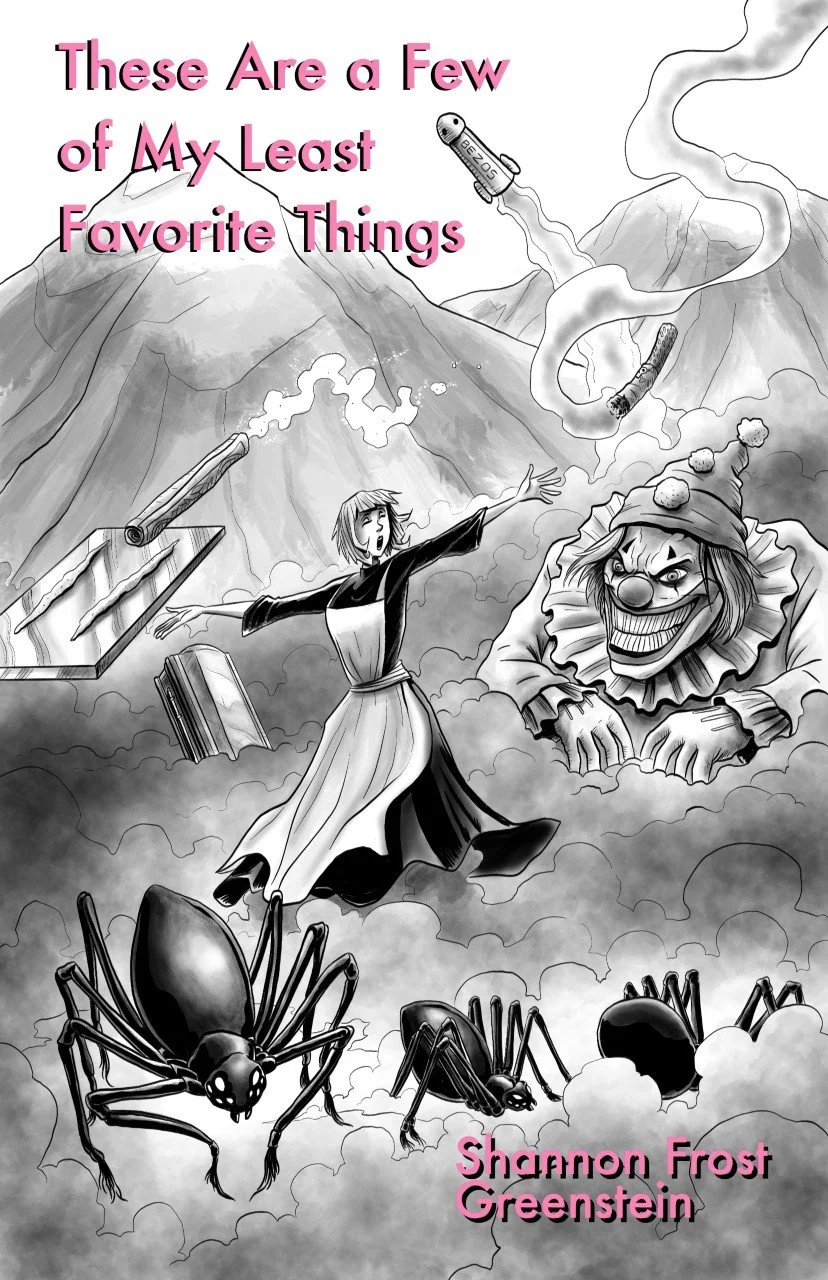
Most of my work can be found on my website, shannonfrostgreenstein.com. My debut poetry collection from Really Serious Literature, These Are a Few of My Least Favorite Things, can be preordered here, and I have a collection of short fiction entitled Pray for Us Sinners available from Alien Buddha Press on Amazon. I am also active on Twitter, Instagram, and Facebook.


Shannon Frost Greenstein (she/her) resides in Philadelphia with her children and soulmate. She is the author of These Are a Few of My Least Favorite Things, a full-length book of poetry available from Really Serious Literature, and An Oral History of One Day in Guyana, a fiction chapbook with Sledgehammer Lit due in 2022. Shannon is a former Ph.D. candidate in Continental Philosophy and a multi-time Pushcart Prize and BOTN nominee. Her work has appeared in McSweeney's Internet Tendency, Pithead Chapel, Bending Genres, and elsewhere. Follow Shannon on her website at shannonfrostgreenstein.com or on Twitter at @ShannonFrostGre.


John Wojtowicz grew up working on his family’s azalea and rhododendron nursery in the backwoods of what Ginsberg dubbed “nowhere Zen New Jersey.” Currently, he works as a licensed clinical social worker and adjunct professor. He has been featured on Rowan University’s Writer’s Roundtable on 89.7 WGLS-FM and several of his poems were chosen to be exhibited in Princeton University's 2021 Unique Minds: Creative Voices art show at the Lewis Center for the Arts. He has been nominated 3x for a Pushcart Prize and serves as the Local Lyrics contributor for The Mad Poets Society Blog. His debut chapbook Roadside Oddities: A Poetic Guide to American Oddities was released in early 2022 and can be purchased at www.johnwojtowicz.com. John lives with his wife and two children in Upper Deerfield, NJ.

Review of These Are a Few of My Least Favorite Things by Shannon Frost Greenstein

These Are a Few of My Least Favorite Things

Really Serious Literature

$20.00

You can purchase a copy here.

Reviewed by Pat Kelly


There is no telling where the act of self-reflection will lead you. Things usually hidden are pulled into the foreground, revealing connections. Underneath those connections are the systems that shape our worlds, both personally and communally. And systems, from the limbic to the capitalistic, are at the heart of These Are a Few of My Least Favorite Things, the complex and cathartic debut poetry collection from Shannon Frost Greenstein. 

As the title suggests, this is not to say that levity cannot also be found along the way. Often it is absolutely necessary to the process of emoting, defining, and questioning those experiences. When reading and re-reading these devastating, intelligent, brutally honest poems, flashes of comedy serve as release points from pain and anxiety. The back-sliding cigarette between dark moments. The search and failure of finding the right words between silence.  What it feels like to not look away when the bandages are removed from our bodies and the bodies of the ones we love. Whether those bandages cover scars, tattoos, or are just symbols for the internal and unseen, Greenstein does not blink.

There is another system that haunts this collection: epigenetics. How environmental factors can affect us without altering DNA and how these alterations can be inherited. In this way, a singular person or an entire culture’s worth of environmental experience can imbed itself deep within us. Greenstein’s poems are reflections on the awareness of this system and its inheritable traits. How we are left with the knowledge that we can regret our past decisions, but this regret does not retroactively change the present or future. In “I Fucked Up My Metabolism, and Now I Have Regrets,” she acerbically acknowledges that what she initially thought of as just an idea or ideal in her head was actually a series of active decisions over a period of time:

I wanted to be thin. 

But that’s a lie.
I didn’t want to be thin; I wanted to become thin.

The expanding of the word ‘be’ to ‘become’ suggests this agency. That it wasn’t just a way of thinking, but also a way of acting. Later in the poem she correlates her personal regrets with the potential threat that she has passed on these epigenetic traits to her children. In “USA Gymnastics,” she recontextualizes her childhood perception of heroics with newer knowledge that abusive systems were often behind such moments. She writes, “So we sacrifice our children / To the altar of the Olympiad / And wonder why they end up broken.” The poems as a whole are an intricate web of these kinds of connections. Singular and collective decisions are the silk that weaves a vast social pattern that both satiates and traps us. It is within this patchwork structure that our children experience life. 

Her poems also reflect heavily upon mortality. “Things to Say to Your Husband after his Cancer Comes Back,” is both beautifully intimate and devastating in its interchange between comfort language and inner monologue:

[...]your words like butterflies in a net, and when the sun streams through the honeycomb fibers like a fake promise, it will be almost like they’ve escaped, like they’re out and free and you know exactly what to say in this terrible moment of mortal terror, except they’re actually still caught in the net so instead you have to try again.

In “To the Med Student Whose Anatomy-Class Cadaver Is My Best Friend,” this intimacy shines as an elegy to a childhood friend who committed suicide. Greenstein expertly relates the tiny, singular moments that form a friendship and also offers a guide map for deriving understanding and empathy through the inspection of the physical: “Please see her tattoos. / Please see her journey.” 

This type of empathy is a key component to the funnier moments within the collection. A personal anecdote of realizing too late the mistake of eating mushrooms and watching Requiem for a Dream shows the trajectory of how these experiences are the origins of her understanding in “Ode to That Guy on the Interstate Going Fifteen MPH and Obviously Tripping Face.” There is a beauty to this type of relating, because it causes us to see the multi-faceted way our past decisions affect our current and future ones and that, yes it can be quite depressing, but it’s not all bad. There can be sincerity and comradery in our bad decisions. 

Greenstein also shows where this empathy can break down and turn you on your head in perhaps her most powerful poem, “My Body is a Coffin for Dead Children, and Other Things: For Kelly.” Here the collective themes throughout her poems are both affirmed and contradicted as a woman describes what it feels like to have suffered through eleven miscarriages. The realization that, though complete empathy is sometimes impossible, the poetics of language can bring us to the threshold of an understanding. The haunting line in the title is like a prism altering the refracting light of her prior reflections. That the anxiety of the way our past decisions are carried into the future through our children is overshadowed by the opportunity we get to remove these inherited things through our own nurturing. Epigenetic traits exist as growths on top of our genetic code, but they are reversible. The singular way we choose to live and relate echo into the collective, into our cities, our court systems, our children. 

We all have a list of things we hate about ourselves from our pasts. What Shannon Frost Greenstein has done in this collection is show, without pulling any punches, that there is beauty to be found here and, more often than not, it is how we best relate to our fellow humans:

and I return
to the machine
with gratitude
that I have been granted the privilege
to lean in
to sit with
to share
to be sad together
because it’s better than being sad alone. 


Pat Kelly is a writer from Harrisburg. He creates poetry and fiction that explores the dark fringes of humanity and its impact on time and memory. He is currently working on his first collection of poetry, Buried Litanies. He also occasionally rants in blog form for Raven Rabbit Ram.

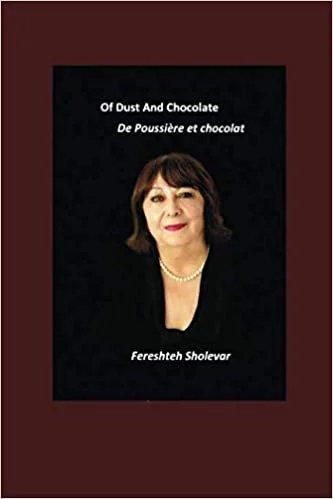
Review of Of Dust and Chocolate / De Poussière et chocolat by Fereshteh Sholevar

Of Dust and Chocolate / De Poussière et chocolat

Parnilis Media

$6.39

You can purchase a copy here.

Reviewed by Autumn Konopka


Fereshteh Sholevar’s Of Dust and Chocolate / De Poussière et chocolat is a collection of dual-language poems, presented side-by-side in French and English. Full of strong images and striking metaphors, these poems offer meditations on aging, loss, and relationships, as they honor the minute particulars of ordinary life that are often overlooked or unappreciated.

 While Sholevar’s verse exists in a world of conflict, devastation and sadness, it is not a world without light. In fact, one of the greatest strengths of this collection is the poet’s ability to balance joy and darkness. Take for instance “Pandora’s Box”:

…Let grief be grief.
There is no closure when lives are lost.
How can you close the door
when there’s none in the frame? …

…Let me also say that there is goodness and grandeur.
There is the sweet taste of chocolate
arms to embrace and smiles that promise.

 These lines are at once perfectly matter-of-fact and profoundly wise. The hope of “goodness and grandeur” is earned by the poet’s ability to confront loss without illusion or sentimentality.

The speaker of these poems knows herself – she understands the world that she inhabits – and she accepts and celebrates the multitude of contradictions. For instance, “On the Threshold of Light” finds the speaker meeting obstacles with appreciation and self-assurance: “I like the way deserts deny me, and deep waters / reject me and all of that is because of my own defiance. / I like the way dogs trust me.” Likewise, “A Bouquet of Sunshine” bemoans the ways that humans carelessly abuse the natural world: “Do you ever say sorry to a flower / when you slash its stem?” or “This summer butterflies / are not dancing on flower buds, / alas, someone has dried them / between the pages of his book.” Although these lines are gently confrontational, the speaker ends the poems asserting her commitment to be a positive example of change: “...sometimes I see myself as bait / on the hook of the Big Fisherman. / Then, love becomes a bouquet of sunshine / that I carry with me at all times.”

These are not the observations of a doe-eyed optimist. Rather, this is the insight of someone who has dwelt in dark places without allowing herself to be intimidated or overcome; this is the clear vision of one who continually seeks out the glimmers of light. Sholevar’s poems carry their share of death, war, misunderstanding, and rejection. However, they bear that weight with dignity, respect, and a keen “yes, and” perspective that encourages readers to recognize and celebrate life’s wonders even as we meet its horrors with open eyes. 

My only regret as I read this collection was not being able to understand the work in French. In her introduction, Sholevar explains that she composed some of the poems initially in English and some initially in French, adding that the translations, which she also composed herself, are sometimes exact and sometimes not. The fluidity of this process intrigues me. That along with Sholevar’s stunning skill with metaphor leave me feeling just a little deprived. I suspect these “translations” are far more than mere translations; and if I’m right – if they amplify the work’s meaning and beauty as I suspect they do – then that means I can’t really appreciate this collection to the fullest. 

 C'est la vie, I suppose.

 Regardless of your ability to read French, Of Dust and Chocolate is a collection that will simultaneously provoke and uplift.


Autumn Konopka is a writer and teaching artist who enjoys coffee, running, and reggaeton. She's currently working on her first novel, which she expects to publish in early 2023. Find her online: autumnkonopka.com.

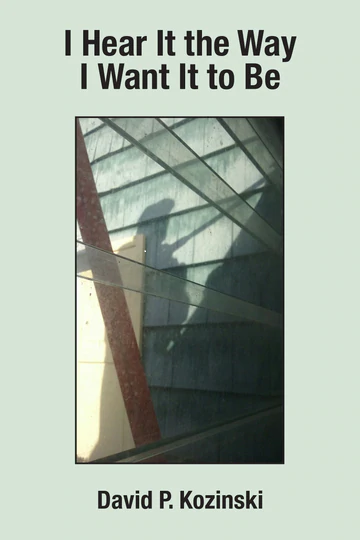
Review of I Hear It the Way I Want It to Be by David P. Kozinski

I Hear It the Way I Want It to Be

Kelsay Books

$16.50

You can purchase a copy here.

Reviewed by Katch Campbell


Unlike the double exposition, typical of classical concertos, in which the orchestra presents material while the soloist quietly waits to highlight theme; think Chopin Piano Concerto No. 1, David Kozinski’s I Hear It the Way I Want It to Be (Kelsay Books 2022) gives immediate voice to the narrator, his subject, and the readers undeniable journey through a life. Experienced as memoir, the book’s three sections are powerfully balanced. Built like a centrifugal “fly-ball” governor the two “ends” are attached to a central axel in section II. When reading front to back (or in the reverse,) Kozinski chooses his words and poetic order to intensify cadence and build momentum mimicking life. Just when we get our feet steadily under us, life gets going and then rarely slows down. What is delightful about this recreated momentum, is that the reader can allow themselves to be safely swept away, allowing the images (vivid, vulnerable, deliciously feral) and alliteration to current them along because, like the “fly-ball,” section II provides a governor. Kozinski seems to naturally employ his comprehension of cadence both inside each poem and in how he links them as a set.

Here is a stanza from “I Think That’s Where I Put Them.”

Time liquefies, stretches like light.
What’s left are forgetting and travel
And always peaks and glens
Cut into a world that can be water, gas or ice.
Unlocked, a channel reveals
An island monastery
Where I looked back from a great height.
Like everybody, I write what I remember;

 And, as mentioned above, last lines from section I poems skillfully link ideas and drive the reader deep into the narrative.

If you liked that you’re going to love this…” (from “And then”)

“I banged away at it as long as I could.” (from “Little Hunters”)

“a better strategy for knocking down kings.”  (from “I Hear It the Way I Want It to Be”)

 This linked end line technique is again seen in section III: “what I did with my hands.” (from “What to Do With Anything)”; “retrace my trespasses.” (from “Earthly Places”); “where every story runs in its own time.”( from “Theory of Relativity”); “where torchlight and shadow vie in the grizzled hills.” (from “November”).

 Section III drives the reader toward the final poem:

Planet of the Uncluttered Mind
There is a distant place
Where the one-word poem is highly valued.

It can describe a tangible thing
                A thought or emotion
Or comprise a combination of what words do.

It can take the poet years
                Sometimes a lifetime
While the word evolves.

 “I’m not going there.”

 The whimsical adolescence of section I is linked to the ken wisdom of Section III by, what Chopin would call, a Larghetto. Section II, one poem crafted over seven pages, is highly lyrical, and creates the calm relief of reverie. Kozinski still uses evocative language in this respite, it is by no means mundane but, it does allow the reader a breath to continue traveling. And the reader, depending on mood, may choose to travel time in either direction.

I Hear It the Way I Want It to Be is a book built on duality yet perfectly balanced. Highly complex though able to be enjoyed without lengthy analysis. The imagery is full of vigor and play yet poignant, and at times contemplative. While a sense of closure is offered, the reader is also left with a space to question their own story and ask, “what’s next?” This is a book for the open road.


Katch Campbell is a connector. With a master’s degree in Science and an MFA in poetry, she creates metaphors for her patients and others about the world around us. Her work is an inquiry on the atrocities we commit consciously and unconsciously against each other and the universe. Katch serves as Vice President and is a permanent faculty member at the River Pretty Writing Retreat, a bi-annual workshop in the Ozarks. She has co-led immersive poetry trips to Slovenia and Italy and used to edit for ZoMag.com.

Profession: Poet

Profession: Poet is a quarterly blog feature exploring craft and identity in poetry by Hanoch Guy, who writes poems in both English and Hebrew.

Letters to a Young Poet


 I am always on the lookout for advice by poets I admire.

Among the most famous and influential correspondences are the letters of Rainer Maria Rilke.

Rilke wrote about wisdom, honesty, and powerful directness as attributes of powerful poetry in letters to poet Franz Xaver Kappus.

These letters were written between 1903 to 1908. Much has been written about the letters, but I would like concentrate on the gifts bestowed upon Mr. Kappus.

It is remarkable that, after a hundred and ten years, Rilke’s suggestions are still relevant and fresh.

“After these prefatory remarks, let me only tell you further that your verses have no individual style, although they do show quiet and hidden beginnings of something personal.”

I admire the honesty and directness of Rilke’s response. As much as it is painful to read.

I am sure it helped Kappus to develop his personal style.

Rilke proceeds by advising Kappus not to rely on others’ opinions or editors’ rejections or comments from anybody.

Rilke does not respond to Kappus’ question if his poetry is good, with the exception of praising his sonnet for its simplicity and beauty.

“There is only one single way. Go into yourself. Search for the reason that bids you write; find out whether it is spreading out its roots in the deepest places of your heart, acknowledge to yourself whether you would have to die if it were denied you to write. Delve into yourself for a deep answer.”

In a letter to Kappus on October 29, 1903, Rilke suggests to him that he follow the process of the bees accumulating honey, to take the sweetness in everything and create it as impenetrable.

“Leave to your opinions their own quiet undisturbed development, which, like all progress, must come from deep within and cannot be pressed or hurried by anything. Everything is gestation and then bringing forth. To let each impression and each germ of a feeling come to completion wholly in itself, in the dark, in the inexpressible, the unconscious, beyond the reach of one’s own intelligence, and await with deep humility and patience the birth-hour of a new clarity: that alone is living the artist’s life: in understanding as in creating.”

I am sure you will enjoy reading this slim book, which is full of wisdom about life, loneliness, love, and death.

There are many books of advice written by poets.

In “A Psalm of Life,” Henry Wadsworth Longfellow advises us to live actively and not to embrace a cynical or nihilistic outlook on life. He specifically rebukes the idea that death itself makes life meaningless. He references the old adage of returning to dust.

The renowned May Sarton offers advice on writing in “A Poet’s Letter to a Beginner,” published in The Writer in April 1962, some of which is excerpted below.

The first draft of a poem comes easily. Some of these initial lines are “pure gold,” Sarton admits, but the majority will need to be reworked or tossed. Use these initial lines as the signs that will guide you to the ultimate destination of your poem.

She strongly advises to study other poets even the ones you hate or love and adds that studying these poets will help you to define and what you aim for.

May Sarton strongly suggests, “revise poems relentlessly and test each line and each word so you can discover the heart of your poem.”

Sarton tells the poet to suffer rejections and not be impressed by the success of an acceptance of a poem.

She emphasizes that you are writing poetry because it gives you joy.

Have you read any books of advice that have moved you? As usual, I welcome your comments.


Hanoch Guy Ph.D, Ed.D spent his childhood and youth in Israel. He is a bilingual poet in Hebrew and English. Hanoch has taught Jewish Hebrew literature at Temple University and poetry and mentoring at the Muse House Center. He won awards in the Mad Poets Society, Phila Poets, Poetry Super Highway and first prize in the Better than Starbucks haiku contest. His book, Terra Treblinka, is a finalist in the North Book Contest. Hanoch published poems in England, Wales, Israel, the U.S., and Greece. He is the author of nine poetry collections in English and one Hebrew book.

Mad Poet of the Year - R. G. Evans (April 2022)

The Mad Poet of the Year blog posts share the poetry of a long-time Mad Poet. This year-long appointment provides readers with a deep dive of the writer’s work and thoughts on poetry. We are thrilled to have R. G. Evans serve as the Mad Poet of the Year for 2022.


“The Fantastic End of America”
—Jack Kerouac

 by R.G. Evans

First the bang. Then the whimper. Now this.
Our Lady of the Highways hitching a ride west
where even she believes she’ll find the dream.

She ends up hoofing it, skulls like globes underfoot,
indigenous stepping stones across rivers
and arroyos, deserts and grassland plains.

All the ghosts along the way. The Pioneer Spirit
weeping on the edge of the trail. The Angel Moroni 
climbing his own golden spires, like Kong winged but doomed.

Manifest Destiny itself barely recognizable
among the fast food chain cholesterols plants.
Progress may have stalled, but Our Lady keeps on

 truckin’, pedal to the metal, balling the jack,
following the sun as it falls out of the sky
somewhere in the Pacific, gentle waves lapping

the Nevada shoreline. Our Lady hikes up her skirt
and cools her aching dogs in the breakers.
It’s there she sees it, washed up on the sand

like Charlton Heston’s fever dream, the sign
edited by entropy like everything else:
HO LYWOOD.


“The Fantastic End of America” is the final poem in my latest book, Imagine Sisyphus Happy. I remember reading Jack Kerouac’s On the Road when I was a much younger man—the age that book is supposed to inspire you! —but I just couldn’t get into it. When I reread it a few years ago, I was ready to receive it, and the book’s greatness became manifest. One line in particular stayed with me and became the title of this poem.

 As you drive southbound on I-95 out of Delaware and into my home state of Maryland, off to your left you can see a statue at the Oblates of Saint Francis De Sales seminary of the Virgin Mary, “Our Lady of the Highways.” I imagined her climbing down off her pedestal and hoofing it across America like R. Crumb’s Mr. Natural (“Keep on truckin’!”). The end of the poem is a visual pun based on the famous final scene in the original Planet of the Apes movie.

 Here's hoping the title and the poem’s final image remain in the realm of fiction.


R.G. Evans’s books include Overtipping the Ferryman (Aldrich Poetry Press Prize), The Holy Both, and Imagine Sisyphus Happy. His original songs were featured in the poetry documentaries All That Lies Between Us and Unburying Malcolm Miller, and his collection of original songs, Sweet Old Life, is available on most streaming platforms. Evans teaches creative writing at Rowan University. Website: www.rgevanswriter.com

Found in Translation

I’m excited to get to write for Mad Poets about poetry in translation. If you’ve attended a lot of the First Wednesday readings at the Community Arts Center in Wallingford, you’ll have noticed that translators of poetry (often also poets themselves) present their work from time to time. It’s a task that fascinates me: the verbal texture of a poem is so important, but every language has its own, even languages as close as French and Spanish, or German and Dutch. Every language has things it does better than any other, and you can bet those things wind up in poems. How then can a translator bring the poem into a new language, keeping it a poem instead of a prose retelling? 

And yet poetry has exerted huge influence through translation, from Classical Greek or Latin shaping the writing of the Renaissance—or Italian sonnets spurring Elizabethan writing—to the very spare form of haiku flowering in other languages, including American English. Look closely at any big literary movement, and you’ll find translation at its roots.

So I look forward to writing about this.

Pure Gold: A Review of Rumi

Rumi, Gold, translated by Haleh Liza Gafori (New York: New York Review Books, 2022)


Robert Frost famously said that poetry is what gets lost in translation, but that’s true only when it isn’t really a translation, when it’s just a prosy retelling. This book of Rumi’s work brings the poetry home alive. You may never have heard of Jalal ad-Din Mohammad Balkhy (1207-1273), but you have surely heard of Rumi. His famous nickname refers to a regional term for people from Asia Minor, which had until recently been a shrinking part of the Byzantine, formerly Roman, Empire. Rome à Rumi. 

I don’t know Farsi, but I’ve read a lot of Rumi in translation. Years ago I visited a friend who was working in a bookstore and reading a lot of Rumi. On her recommendation I went to the R shelf, picked up ten inches or so of Rumi, and gradually read it all over a summer—so nice to read something that isn’t for work, but there’s also the particular pleasure of Rumi, that favorite of spiritual questers. His writings blend humor and fierceness, a Zenlike emptying of the self and a down-to-earth attention to everyday things from everyday life. He is especially treasured by anyone interested in Sufism, a mystical strand of Islam. Rumi is considered a founder of the whirling dervishes (two words that are like their own little poem in English). Some poems in this collection too focus on the ecstatic experience of a spinning dance. The introduction offers more biographical information as well as an overview of Rumi’s impact.

New York Review Books deserve kudos: They publish simple yet beautiful editions from a range of interesting and important authors, nicely translated. Rumi’s single name has joined the list in the back of each of their books. He is important as a poet both for the direct impact of his writing and for his continuing influence on writers and thinkers of all kinds, as his poems spread out into different languages. (Example: bell hooks loved Rumi and spoke about reading him, as a door into Sufism and into joy.)

Earlier translations (judging by the ten inches I made it through) have sometimes been plodding or opaque in places, despite their good intentions; very often they adapted the earlier scholarly translations into English by A.J. Arberry (1961). Not that a prosy Rumi is completely ineffective, but this is so much better. First, Ms Gafori knows Persian (and can consult with family members who are even more fluent), so we can be confident of the accuracy of meaning that a scholar or a spiritual seeker requires. She balances this with literary quality to convey the interwoven aesthetic and spiritual message of this poet, whose intentions and teaching reach readers with their beauty as well as their unexpected turns of meaning.

I had a chance to speak with Ms Gafori, before a recent Zoom event at virtual Main Point Books (hooray!), and learned that she worked on these poems for six years before they were published. It makes sense, then, that they feel complete and finished, “cooked by love’s fire” in the poet’s own phrase. The poems work as poems, in a variety of shapes and tones, often recognizable as ghazals. It’s often haste in the process of moving between languages that loses the poetry, pace Mr. Frost, in an incompletely processed translation.

Here is one simple example (p. 24):

Where the water of life flows,
no illness remains.

In the garden of union,
no thorn remains.

They say there’s a door
between one heart and another.

How can there be a door
where no wall remains?

 It feels like a quintessential Rumi poem, simpler than many but with no slag or waste. Reading it in haste means skipping over the important parts—I intentionally chose an example that doesn’t have much literary flash.

 The poems are delicious in small bites too: here are a few lines that do have some flash:

 “Its hidden smile opens to a laugh that lasts a lifetime” (p. 11)—the repeating l sound links smile and laugh, with the sound repeating three times at the end of the line.

 “I am the seed in your beak” (p. 27)—Rumi using a simple image to surprising effect. (Will the seed be cracked or swallowed? Or flown up into the sky, perhaps to fall and sprout in fertile ground?)

“How can I ask how?
Every how drowned in an ocean of no how” (p. 29)—The anglophone reader knows the folksy term “nohow,” and the more standard term “knowhow,” but this is different: it’s “no how,” while nohow and knowhow glimmer behind it as what it is not; knowhow in particular is denied as the speaker sheds prior certainties.

 “Armor thinned to a silken scrim” (p. 34)—Notice the way the vowel sounds thin down, too, from open ahr to short i (“thinned,” “silken scrim”), trimmed by the tighter nasal sounds (n, m) and gathering clusters of consonants (lk, scr) on their boundaries. Rumi’s verse is very musical in the original, and the near-rhyme of “thinned” and “scrim” helps recall that.

The word “drunk” occurs many times in the book. A plain and clunky word, completely unpretentious: where it repeats in a poem it might recall dancing heels striking the ground. (The introduction explains the role of wine and drunkenness in Rumi’s path away from official religious status and the complexity in Islam of these references to alcohol.) Elsewhere, the Muse raises a ruckus—a wonderfully down-to-earth word, not one we are used to associating with the Muse.

Ms Gafori points out that Rumi’s language (13th century) feels less old-fashioned in Persian than Shakespeare’s (16th century) does in English. This may be in part because he is so important to the poetic tradition: his centrality keeps him familiar in the ongoing conversation of poetry in Farsi.

There came a moment when one of my students was interested in Rumi, so I gave away my stack of books. Now this slim volume, only 83 pages plus the brief, thoughtful introduction and an index of first lines, offers a delicious selection of his work, and I highly recommend it.


Poet and translator Sibelan Forrester has been hosting the Mad Poets Society's First Wednesday reading series since 2016. She has published translations of fiction, poetry and scholarly prose from Croatian, Russian and Serbian, and has co-translated poetry from Ukrainian; books include a selection of fairy tales about Baba Yaga and a bilingual edition of poetry by Serbian poet Marija Knezevic. She is fascinated by the way translation follows the inspirational paths of the original work. Her own book of poems, Second Hand Fates, was published by Parnilis Media. In her day job, she teaches at Swarthmore College.

Local Lyrics - Featuring Israel Colón

Icarus
by Israel Colón

Occasionally, 
the mind hosts
a dream

between sequences 
of
screaming nights.

Sweat fuels
restless sleep,
as

grinding teeth 
engine feet,
teasing flight.

Corneas scrape lids
while I cautiously 
scan the sky.

(Hoping I’m in bed)
I raise my chin
and fly.

Landing enters thought,
after opening 
sunburnt eyes.

Shaken by the inevitable,
unsure
if I took a risk and tried.

Now, I’ll count 
possibilities
I do deny.

A feel it is to be free, 
but am I
even alive?


How do you start a poem? Walk us through your process.
The birth of a poem really begins with the first line for me. It often happens when I’m deep into thought, exploring my emotions and suddenly an inner voice just kind of takes over and the first line comes. When this occurs I’m rarely seeking to write a poem, rather the inspiration just finds me and I’m forced to pull over or stop what I’m doing and write/type it down.

Your poems have a lot of rhythm which is really highlighted when you perform them. How does that cadence evolve? Do you start out with a tempo in your head?
The rhyme schemes/cadence very much come naturally to me. The aim of my poetry is catharsis and I believe using rhythmic patterns can help transform something that may be perceived as ugly (emotions/depictions of violent acts) into being more palatable. I find that rhyming, in some ways, distracts the audience/reader from the gravity of the content my poetry is touching upon. I also like using rhythm to set expectations with my readers so that I can ultimately break the pattern when there is a need to instill a sense of incompleteness which often aids in delivering the feeling I’m trying to instill.

The subjects of your poems seem to spring from the personal and reach for the universal. Why do you write poetry?
Poetry is church to me. It gives me the cathartic release that I have yet to find elsewhere. Growing up I very much felt alone in much of what I was experiencing, which lead to me feeling very isolated. Writing poetry with the intent of an audience provides me an opportunity to transfer my emotions to others, leaving me to feel less alone.

Tony Hoagland proposed that there are three poetic chakras: image, diction, and rhetoric. Which do you feel your poems emanate from?
I’d imagine my poems emanate from a mix of the three, however I believe image would be the most fitting.

What are you working on now? Are there other art forms you experiment with?
I’m always writing. I have several book in the works however no firm deadlines. I enjoying sketching, charcoal, and whatever my 5 year-old daughter is into on any particular day. I really just try to enjoy and partake in the art that is constantly around me.

Where can readers read more of your work/buy your book?  
My book, Icarus, is available on Amazon and at Barnes & Nobles in the Philly area. I also regularly post poetry and go live on my Instagram page @israel.e.colon.


Israel Colón is a Philadelphia-based poet. Known for his inspired rhyme schemes and use of poetic form, his work confronts his struggles with trauma, religion, and relationships. Through his mercilessly honest approach to writing, Colón shines a light on the experiences of a man barely keeping it together


John Wojtowicz grew up working on his family’s azalea and rhododendron nursery in the backwoods of what Ginsberg dubbed “nowhere Zen New Jersey.” Currently, he works as a licensed clinical social worker and adjunct professor. He has been featured on Rowan University’s Writer’s Roundtable on 89.7 WGLS-FM and several of his poems were chosen to be exhibited in Princeton University's 2021 Unique Minds: Creative Voices art show at the Lewis Center for the Arts. He has been nominated 3x for a Pushcart Prize and serves as the Local Lyrics contributor for The Mad Poets Society Blog. His debut chapbook Roadside Oddities: A Poetic Guide to American Oddities was released in early 2022 and can be purchased at www.johnwojtowicz.com. John lives with his wife and two children in Upper Deerfield, NJ.

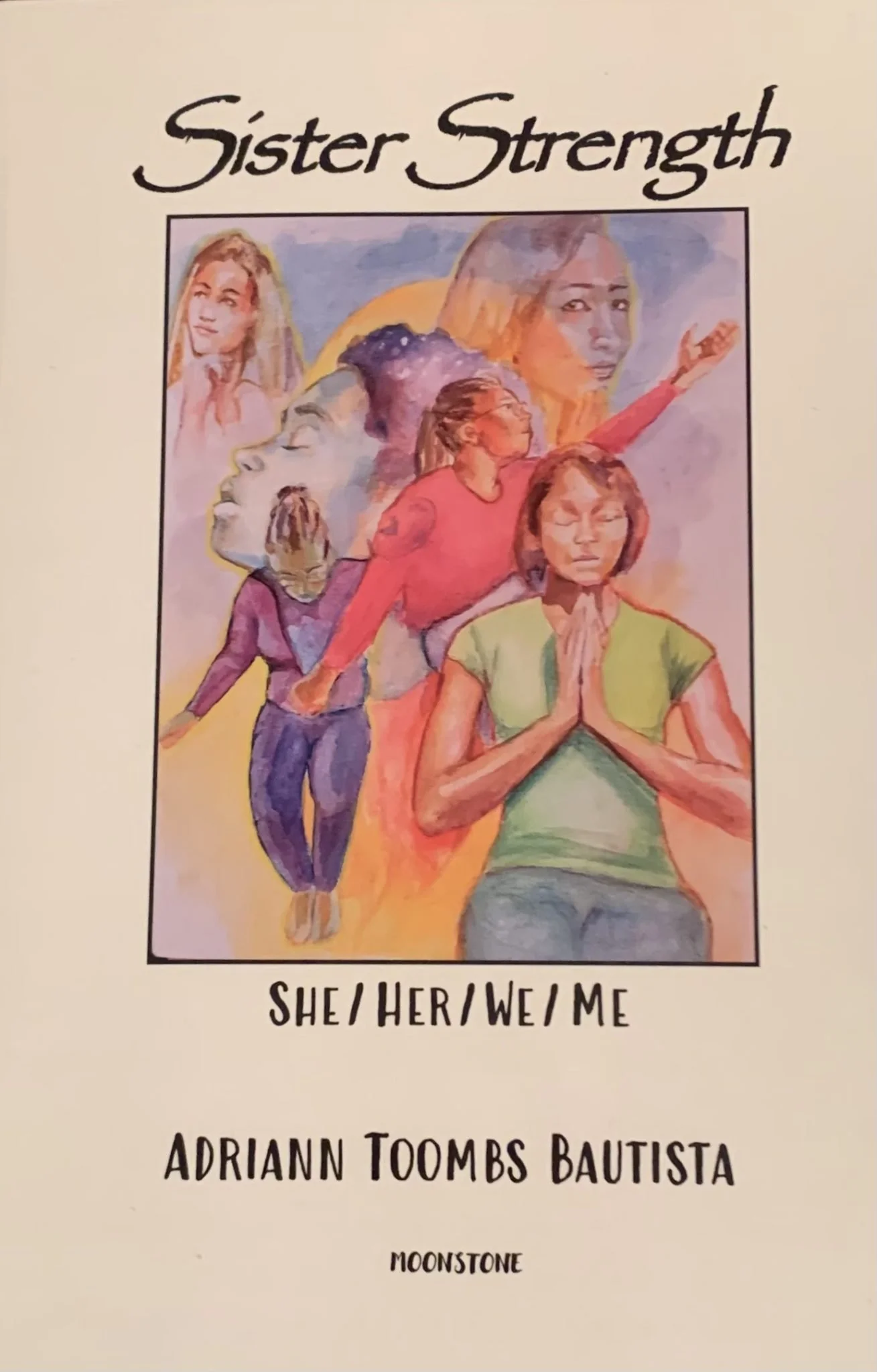
Review of Sister Strength by Adriann Toombs Bautista

Sister Strength

Moonstone Press

$20.00

You can purchase a copy here.

Reviewed by Sean Hanrahan


In Sister Strength, Adriann Toombs Bautista has penned a powerful full-length collection that succeeds in uplifting “Black girl magic and/ Brown woman courage.” She expertly interweaves the she/her/we/me of her subtitle to give testimony to the personal and collective experiences of womanhood. Through her expansive and compassionate heart, she gives voice to the stories of humanity summed up perfectly in the After Word by Bautista’s mentor, Elijah B. Pringle III, “This assemblage is for sisters, lovers of sisters, lovers of self, all are beneficiaries of this stunning accomplishment.”

Bautista’s inimitable capacity for empathy shines mightily through the poem, “The Flight of Her.” She observes a woman “sitting there full of trepidation and dissention.” In her capacity for kindness, the speaker wants to show the “sienna kissed sister” that she is loved, that she is beautiful in a world that can often make women feel unvalued and worthless. In her final, gorgeous stanza, Bautista writes,

I wanted to see her soar
Gliding across the universe without hesitation
Then I wanted to fall into V-formation
And fly right alongside her.

In the foreword to this collection, poet Lynn Blue aka Lady Blue writes that Bautista’s “acceptance of people ‘as is’ remains phenomenal and is manifested in the depths of her writings.” Nowhere is this proven more strongly than in the poem, “The Second Wait.” The speaker finds herself among “a sea of pink gowns” where all have different backgrounds, careers, ethnicities, religions, and sexual orientations, yet “Our breast telling a story/ the equalizer.” This poem celebrates the bonds between women and that the sharing of stories can lead to new understands and truths among “Strangers but familiar.”

Bautista’s empathy extends to “every mother who has lost a child to violence” in “My Sister’s Pain.” The speaker admits that the “reality is unfamiliar to me.” Yet, through searing imagery and precise diction, she creates a poetic space for these mothers exemplified in the stanza:

I see my sister’s pain
It is in the arch of her back
As she reaches for a can from the cupboard
Slowly distending as if trying to touch heaven
Where he now lives.

She develops the metaphor of grief until it becomes a “double knitted shawl” that the mother “[hopes] to stretch its power/ [and snap] it into oblivion.” In the heartbreaking final stanza, the speaker zooms out from this intense individual experience into a larger political one with the lines “And a nation cries/ But the sound of her tears will/ Soon be forgotten.”

Bautista celebrates famous Black women and elders in this book including Philadelphia Poet Laureates, Trapeta Mayson and Yolanda Wisher; Maya Angelou, and Nina Simone. In “On Becoming,” Bautista recollects her experience listing to Michelle Obama speak and in doing so comes to an epiphany that perfectly embodies the spirt of this collection. She begins the poem with the lines, “She had much to say/ Yet when she began to speak/ I could not hear her voice or my own.” She describes Obama and the sincerity of her words, but still hears neither Obama’s voice or her own until she realizes

The roads I have traveled
That led to this me…
Yet the same sense of ‘becoming’
I marveled at the symmetry
Then I understood why
I could not hear her voice
Or my own.

The bonds formed between the women in this book and between Bautista and the reader are akin to covalent bonds, and may even be stronger. Reading this collection, I reveled in Bautista’s search for and finding of human connection in a world that often finds ways to separate and compartmentalize people. Also in the foreword to this vital book, Lady Blue writes, “You will…experience…her desire for true sisterhood among women.” You will also experience the she/her/we/me of Bautista’s vision. Reading this collection, you will be empowered, soothed, and inspired. Sister Strength is a magical book and a welcomely unexpected balm.


Sean Hanrahan is a Philadelphian poet originally hailing from Dale City, Virginia. He is the author of the full-length collection Safer Behind Popcorn (2019 Cajun Mutt Press) and the chapbooks Hardened Eyes on the Scan (2018 Moonstone Press) and Gay Cake (2020 Toho). His work has also been included in several anthologies, including Moonstone Featured Poets, Queer Around the World, and Stonewall’s Legacy, and several journals, including Impossible Archetype, Mobius, Peculiar, Poetica Review, and Voicemail Poems. He has taught classes titled A Chapbook in 49 Days and Ekphrastic Poetry and hosted poetry events throughout Philadelphia.

POeT SHOTS - '"For Calling the Spirit Back from Wandering the Earth in Its Human Feet" by Joy Harjo

POeT SHOTS is a monthly series published on the third Tuesday of the month. It features work by established writers followed by commentary and insight by Ed Krizek.

For Calling the Spirit Back from Wandering the Earth in Its Human FeetHard Rain

by Joy Harjo

Put down that bag of potato chips, that white bread, that bottle of pop.
Turn off that cellphone, computer, and remote control.

Open the door, then close it behind you.

Take a breath offered by friendly winds. They travel the earth gathering essences of plants to clean.

Give it back with gratitude.

If you sing it will give your spirit lift to fly to the stars’ ears and back.

Acknowledge this earth who has cared for you since you were a dream planting itself precisely within your parents’ desire.

Let your moccasin feet take you to the encampment of the guardians who have known you before time, who will be there after time. They sit before the fire that has been there without time.

Let the earth stabilize your postcolonial insecure jitters.

Be respectful of the small insects, birds and animal people who accompany you.
Ask their forgiveness for the harm we humans have brought down upon them.

Don’t worry.
The heart knows the way though there may be high-rises, interstates, checkpoints, armed soldiers, massacres, wars, and those who will despise you because they despise themselves.

The journey might take you a few hours, a day, a year, a few years, a hundred, a thousand or even more.

Watch your mind. Without training it might run away and leave your heart for the immense human feast set by the thieves of time.

Do not hold regrets.

When you find your way to the circle, to the fire kept burning by the keepers of your soul, you will be welcomed.

You must clean yourself with cedar, sage, or other healing plant.

Cut the ties you have to failure and shame.

Let go the pain you are holding in your mind, your shoulders, your heart, all the way to your feet. Let go the pain of your ancestors to make way for those who are heading in our direction.

Ask for forgiveness.

Call upon the help of those who love you. These helpers take many forms: animal, element, bird, angel, saint, stone, or ancestor.

Call your spirit back. It may be caught in corners and creases of shame, judgment, and human abuse.

You must call in a way that your spirit will want to return.

Speak to it as you would to a beloved child.

Welcome your spirit back from its wandering. It may return in pieces, in tatters. Gather them together. They will be happy to be found after being lost for so long.

Your spirit will need to sleep awhile after it is bathed and given clean clothes.

Now you can have a party. Invite everyone you know who loves and supports you. Keep room for those who have no place else to go.

Make a giveaway, and remember, keep the speeches short.

Then, you must do this: help the next person find their way through the dark. 

To view Joy Harjo reading this poem, click here.


In this poem former poet laureate, Joy Harjo, writes from the perspective of a Native American whose heritage has been displaced by white consumer society.  (“Put down that bag of potato chips, that white bread, that bottle of pop.”).  She asks the reader to leave behind all the trappings of civilization and “[t]ake a breath offered by friendly winds.”.  Harjo asks us to let ourselves be free and “[l]et your moccasin feet take you to the encampment of the guardians …”    She encourages the reader to let nature, time and to “[l]et the earth stabilize your postcolonial insecure jitters.”  These ideas stem from her Native American heritage. However, the poem has a message for all of us.

In a civilization compartmentalized by technology and competition everyone needs to call their spirit back from wandering the earth in its human feet. As a society we need to “[c]all your (our) spirit(s) back. It may be caught in corners and creases of shame, judgment, and human abuse.”  The last statement is true for all, not just Native Americans.   As art, film, and literature often currently show dystopian images, it is important for those of us so inclined to find a more harmonious way of living with nature and ourselves. 

This calling back is more than being mindful which has become a popular catch phrase.  A person needs to take an active role in finding the way.  With the wisdom and inspiration found in the Native American perspective Harjo offers a universal imperative to everyone: “call your spirit back”!  Then, of course, help “the next person.”


Ed Krizek holds a BA and MS from University of Pennsylvania, and an MBA and MPH from Columbia University.  For over twenty years Ed has been studying and writing poetry.  He is the author of six books of poetry:  Threshold, Longwood Poems, What Lies Ahead, Swimming With Words, The Pure Land, and This Will Pass. All are available on Amazon.  Ed writes for the reader who is not necessarily an initiate into the poetry community.  He likes to connect with his readers on a personal level.

Source: POeT Shots:For Calling the Spirit Back ...

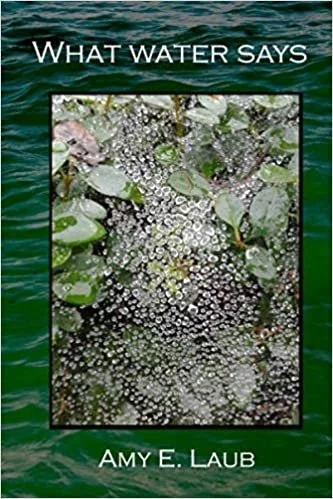
Review of What Water Says by Amy Laub

What Water Says

Parnilis Media

$10.00

You can purchase a copy here.

Reviewed by Abbey J. Porter


Amy E. Laub depicts, in delightful fashion, the complex and intimate relationships between humankind and Nature—especially water—in her recent collection, What Water Says.

In a straightforward and conversational voice, Laub explores the roles of the natural world in 75 pages of open verse poetry. Clearly attuned to her surroundings and with a keen eye for detail, she writes with the precision and authority of an astute observer. 

Laub introduces the premise of people being inextricably tied to Nature in “All Fall,” the collection’s opening poem, in which she says, “We all fall. We always do.” She likens the “falling” of humans to that of rain, caught in an inevitable cycle.

The narrator’s affinity—indeed, her intense need—for water is illustrated in “Thirsty,” in which she describes being outside when it starts to rain, and embracing the sensation:

a few rain drops
can keep me from dying
of thirst.

Nature appears as counterpoint to the world of indoor labor in “February Garden.” After working in her garden, Laub’s narrator proclaims, “Tomorrow in the office / my stained fingers will be proudly typing.” The contrast between natural and unnatural is further elucidated in “Driving Out to the State Park/ Instead of Going into the Office.” In an outdoor setting, Laub reflects,

The sunlight here
is not a square on the floor,
divided.

This understated yet effective observation suggests Nature as whole and authentic, in contrast to the fractured, removed quality of office life.

The collection sparkles with Laub’s creative, spot-on descriptions, in which she frequently personifies Nature. In “Storm Comes Slowly,”

Trees swish their skirts
flirting like mad…

Portulaca snap shut
their purple and yellow purses.

In “Stupid Spring,” during the sexual excess of the season of rebirth, “daffodils nod and nod/agreeing to anything, anywhere.” And in a favorite of mine, “Sun Down,” Laub refers to the sun as “that old arsonist” who “sets the snow on fire.”

The weather in Water tends toward tumultuous, unsettled. In “Tantrum,” a storm seems to express the narrator’s own turbulent feelings: “This storm came gladly /to do my bellowing.” Likewise, in “Creek in Shortridge Memorial Park,” one gets the sense that a stick marooned on creek rocks embodies the narrator’s own restless longing: “It stands tall above its prison/staring at the places it cannot go.”  

The relationship to Nature that Laub describes is mercurial. Sometimes she’s at one with it, as in “Creek at Spring Gulch,” in which the narrator feels compelled to sit by the water in the early morning “so it can wash through my heart.”

In another favorite poem, “A Flute Runs/Cool Hands,” Nature serves the role of instructor:

The fish in the creek
show the flute how to be

more silver

more air

less lung.

The notion that Nature holds answers and is worth emulating also emerges in “Guzzle” when the narrator addresses the trees:

How clever you are
to let everything go
for a season of rest
how smart, how sane.

Other times, however, the narrator reports feeling oppressed by the natural world. In “Too Hot,” she says, “The heat is awful this year…sweat runs down my face/my own salt burns my skin.”

Laub also gives readers a sense of the narrator’s domestic life—we glimpse her neighborhood and the stuff of her everyday existence. There’s the “always angry shrieking neighbor” in “Too Hot”—and the “squirm of little girls” that greets her when she arrives home in “Little Girls.” The latter poem showcases Laub’s gentle humor, which bubbles up here and there throughout the collection.

But something more serious lies beneath the surface of this book. In “Too Much,” Laub’s narrator describes embodying the rain, and watching people prepare for a flood:

I watch you fill sand bags,
admire your labor,
appreciate your panic.

However, she reveals that

I want this flood. 

Everything,
all, will be washed.

The poem conveys a trace of the ominous, a suggestion of apocalypse.

 At the end of the book, Laub invites us to recall our fundamental connection to water. “My hands remember being webbed,” she says in “Lap Swimming.” She goes on to describe the power of water to transform: “I grow smaller and lighter as the water deepens.” Laub continues, “The fluid of the cells/is separated only slightly from the fluid of the pool.” She gives us a sense of returning to something to which we belong—a notion punctuated by the collection’s final poem, “Water into Water”:

Only skin, that fragile border
wrapping lymph and spit and blood,

keeps us from disappearing
into howling wild water.

Like Nature itself, Laub’s book demonstrates multiple moods. It dances, storms and steams us, invites and dazzles us, and ultimately swirls us along on a triumphant and thoroughly enjoyable journey.

Abbey J. Porter writes poetry and memoir about people, relationships, and life struggles. She holds an MFA in creative writing from Queens University of Charlotte, an MA in liberal studies from Villanova University, and a BA in English from Gettysburg College. Abbey works in communications and lives in Cheltenham, Pa., with her two dogs.

Source: http://madpoetssociety.com/blog

Mad Poet of the Year - R. G. Evans (March 2022)

The Mad Poet of the Year blog posts share the poetry of a long-time Mad Poet. This year-long appointment provides readers with a deep dive of the writer’s work and thoughts on poetry. We are thrilled to have R. G. Evans serve as the Mad Poet of the Year for 2022.


Experts on Mortality

 by R.G. Evans

She makes her first announcement—I awake—
then springs out of her crib just like a toad.

Something in the trees, some movement,
some violence, makes it hard to forget

today. The chase is on. Daddy Death
rumbles down the stairs right behind his little

skeleton-in-waiting, out the door and into the wind—
she's gone. But no, she's there behind the hemlocks

giggling under branches that creak and groan
like everything alive. She points up in the air

says, Look! Look!—and there it is at the end
of her invisible string, the only thing she has,

all that he can give her:
a sky-blue kite in a kite-blue sky.


It’s truly an honor to be chosen as Mad Poet of the Year by the Mad Poets Society, a group I have followed and respected for years. My first poem contribution is from my first book, Overtipping the Ferryman.

When my daughter was very young, she would wake up before my wife and me, stand up in her crib and call out “I awake!” Such an adorable habit, and yet the poet in me saw an opportunity to turn it into something a little darker and more twisted. I remember reading an article in American Poetry Review in which the author mentioned “Dante, Shakespeare and other experts on mortality,” and when I read that, this poem cried out “I awake!” I’ll always be proud to remember reading this poem to an audience that included one of my clearest-eyed critics, and when I got to the image that closes the poem and heard her gasp, I knew, at least for that moment, that I had done my job as a poet.


R.G. Evans’s books include Overtipping the Ferryman (Aldrich Poetry Press Prize), The Holy Both, and Imagine Sisyphus Happy. His original songs were featured in the poetry documentaries All That Lies Between Us and Unburying Malcolm Miller, and his collection of original songs, Sweet Old Life, is available on most streaming platforms. Evans teaches creative writing at Rowan University. Website: www.rgevanswriter.com

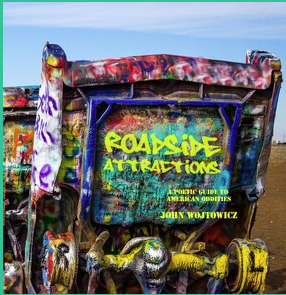
Review of Roadside Attractions: a Poetic Guide to American Oddities by John Wojtowicz

Roadside Attractions: a Poetic Guide to American Oddities

Parnilis Media

$20.00

You can purchase a copy here.

Reviewed by guest blogger, Anthony Palma


Have you ever been driving down the road, and seen something so outlandish, so out of place, that it made you stop and look? This type of experience is precisely what inspired Roadside Attractions: a Poetic Guide to American Oddities, the debut chapbook by Jersey native John Wojtowicz. This collection delicately balances absurd humor, emotion, and insight as it walks us through the real history of America. 

First of all, this book is gorgeous. It is full color, with pictures of the roadside attractions alongside each poem. As we read about a twelve-foot prairie dog, a dilapidated UFO, or a Montana field full of statues of the Buddha, we see what these places look like. The images, largely devoid of people, are at times funny, at times almost apocalyptic in their emptiness, but they always capture the tone of the poems that they accompany.  

The poems themselves are a blend of narrative and observation. Though they often describe the attraction, they focus on stories surrounding the objects or their creation. As we read about Cadillac Ranch in the poem of the same name, we experience it through the eyes of 3 teens “unload[ing] from a ’91 Chevy Starcraft,” as they walk amongst the cars and tag them with spray paint. This, like many poems in the collection, shows us a moment and place in time without judgment or insight. It paints the scene, and allows us to infer the meaning. I think that is one of the main things that stood out to me about these poems. They are almost Zen-like in their depiction of the real, presenting the art embedded in the world around us so that we can experience it on our own.

This belief about the nature of the poems was reinforced by a brief conversation I had with the author about the collection. I ran into John at a poetry reading in West Chester, and in our conversation he mentioned that he viewed the collection as a work of ekphrasis. Having read and pondered the collection myself, this assessment totally makes sense. These attractions are not viewed with ridicule or parody – that would be easy in such circumstances, but it also would belittle the true nature and meaning of these attractions. John’s poetry expertly paints them for what they are: homages to things we as humans care about. Nowhere in the book is this clearer than in “Blue Whale of Catoosa.” In this poem, we learn that this clownish, 80-foot long depiction of a blue whale with a sailor’s hat on its head was a 34th wedding anniversary gift, a year “a few past pearl and a year short of coral.” This knowledge, and the story that the poem tells, emphasizes the meaning of this statue. It was not done for attention, or for publicity. This, like many of the attractions discussed in this book, was made out of love.

Just like the attractions themselves, this book was made out of love: a love of history, a love of the individual stories that make up our collective consciousness as Americans. For most of us, the stories we are told in history books hold little meaning. This book reminds us that maybe a field full of old spray-painted Cadillacs might tell us more about ourselves than any war story or newsreel can.


Anthony Palma’s work attempts to bridge the gap between poetry and other forms while addressing issues of social justice, identity, and existence. His work has appeared in publications such as Rue Scribe, Oddball Magazine, and the Show Us Your Papers Anthology. His debut collection of poetry, flashes of light from the deep (Parnilis Media), is now available on Amazon. His latest project is Palmoetry, a YouTube channel of his poetry and performances that are sometimes enhanced with music. Be sure to look him up on social media at anthonypalmapoetry.

Local Lyrics - Featuring Bernadette McBride

Abiding
by Bernadette McBride

What best to give your loved ones over time,
express your devotion’s ever deepening?

You read ardor in the great poets and lyricists;
contemplate verve on canvas, pedestal, stage,

 screen, and city wall; in public choke back
the tremors these bouquets flood you with;

in private try your own puny hand at offerings,
not quite believing they’ll ever be enough,

your beloveds will ever apprehend your deep intent.
You wish you could pour yourself into them

like light; soft, like expanding clouds or cool,
as fresh water wells from a grotto spring;

fill them so full, they can’t mistake your fervor.
Or you want to be a circle of angels around them,

walk invisible along, sighing graces to their ears,
keeping them to good things only, a buffer

against slings and arrows they’ll never divine  
because of you. But knowing communion’s

persistent limits, that perfect love is so often
an abiding distance, a respect for space between

forms, you offer what you can: a subtle gesture,
a handful of words written on paper.

                        —With permission, from Everything Counts,
                             Aldrich Press/Kelsay Books, 2019


How would you describe your poetic aesthetic? What are you interested in as a writer?
When my first book was published, an artist friend called my poems “painterly.” I hadn’t set out to make them come across that way, but I think she noticed my natural leanings in seeing them that way. I love Art in all its genres, am also a visual artist myself, so I do work to portray beauty through imagery in my poems; beauty that can be found in the darker aspects of life as well as in our common notions of what makes things beautiful. I’ve also generally leaned toward narrative, though I’ve found in the last few years, I’m moving into a different style, more spare, for the new book I’m working on.

I’ve always been interested in the ways religion informs human lives all over the world —in our early learning about right and wrong, in our laws, private and public worship rituals, in world art, and in spirituality apart from prescriptions. I’m working from that instinct in my new poems. I also try to emulate John Keats’ view that poetry should “…strike the reader as a wording of his own highest thoughts, and appear almost a remembrance."

As a writing professor and poetry editor, what excites you about others’ work?
I’ve read some of the most remarkable poems from students —uninhibited yet generally measured to the subject’s reach, “clean, lean, and (golden) mean” styles, unexpected delights in experimentation. I had a student at Temple many years ago, who, in showing a group of friends stopped in their car at a railroad crossing, described the speed of the train as it passed in front of them by writing what was written on each car in one, unbroken line-length word. Such a great bow to “Show Don’t Tell.” That kind of ingenuity, surprising and effective use of language, whether connected to the extraordinary or quotidian events of life, excites me. And I was blessed to be able to read countless numbers of poems as editor of Schuylkill Valley Journal, where so many of the submissions did that; had me saying, “Oh, wow!”

In addition to being a poet, you sketch and paint. Do you find similarities/overlap in these creative processes? How do you decide what muse becomes a painting and what becomes a poem?
Oh, yes, yes. I find similarities among all the arts, really; the differences are simply in the execution of the message, the universality of which I think is summed up pretty well in the old mildly humorous adage, ’Were it not for love, loss, and death, there’d be no poetry.’ Well, there’d also be no music, no stage, sculpture, painting, choreography, film. I envision ideas as floating everywhere, infinite as the universe, seeking a carnate hand to reveal them. We reveal them through the gifts we’ve been given. I’m sure we all know artists who work in more than one genre, which speaks to your second point. I’m not sure I decide whether an inspiration becomes a painting or poem; I think it’s more about divining than deciding what the idea presents, an impulse. For example, I’ve painted a large body of Celtic-oriented art work and have also written many poems based on the same themes. I’m also drawn often to writing ekphrastic poems on paintings of artists from various cultures, so I think there’s an overlap there too.

Your poems are grounded in the everyday but have a sort of magical/mystical quality to them. I think some of this is achieved by sound and rhythm. What is your strategy for making music in your poems?
I take that as a compliment, so thank you, John. It’s interesting that you say this, both of the mystical (which I addressed above) and music. I come from a musical family. My father was a musician, my mother, a vocalist. We grew up in a house in which my father’s swing band rehearsed in our living room. All my siblings and I took various music lessons, and three of us have played in bands (not all in the same ones). So it seems apparent that my instinct for sound and rhythm comes from those experiences. As a child, I loved reading the poetry we learned in school and wrote little poems to the tunes of children’s songs and some of the swing standards, so I think I’ve carried that impulse probably more subconsciously than strategically into my poetry.

You recently stepped down as poetry editor for Schuylkill Valley Journal. What is next for you?
I’m currently teaching a poetry writing class, and I work as an editor of both poetry and other genres for private clients. On the poetry side of this, I work with poets on their individual poems, as well as those preparing chap- and full-length manuscripts, helping both fine-tune their poems and organizing them for submitting to publishers. I’m also a founding member of No River Twice (NRT), an interactive poetry improv troupe, in which the readings are never the same, being prompted by audience members. As far as art, I’ve been working on paintings of historic homes and buildings, along with other themes and private commissions.

Where can readers view your work and buy your books/prints? 
I welcome visits to my website, bernadettemcbridepoetry.com for books information and a number of samples of my artwork, as well as the Galleries/Literary Arts link at bucksarts.org, which is the website for the Arts and Cultural Council of Bucks County, of which I’m a member. My books can also be found on Amazon or purchased directly by contacting me at bernadette.mcbride@gmail.com.


 Bernadette McBride, author of four full-length poetry collections, was long-time poetry editor for the Schuylkill Valley Journal. She taught creative writing and literature at Temple University for many years and served as poet-in-residence for DeSales University’s MFA program launch

as well as on the advisory panel for the program’s forward vision. A founding member of the improv poetry troupe No River Twice, she also served as the 2009 Pennsylvania Poet Laureate for Bucks County. Her work has appeared in numerous journals and anthologies, including in the UK, Canada, and on PRI’s The Writer’s Almanac. (bernadettemcbridepoetry.com)


John Wojtowicz grew up working on his family’s azalea and rhododendron nursery in the backwoods of what Ginsberg dubbed “nowhere Zen New Jersey.” Currently, he works as a licensed clinical social worker and adjunct professor. He has been featured on Rowan University’s Writer’s Roundtable on 89.7 WGLS-FM and several of his poems were chosen to be exhibited in Princeton University's 2021 Unique Minds: Creative Voices art show at the Lewis Center for the Arts. He has been nominated 3x for a Pushcart Prize and serves as the Local Lyrics contributor for The Mad Poets Society Blog. His debut chapbook Roadside Oddities: A Poetic Guide to American Oddities was released in early 2022 and can be purchased at www.johnwojtowicz.com. John lives with his wife and two children in Upper Deerfield, NJ.

POeT SHOTS - '"Hard Rain" by Tony Hoagland

POeT SHOTS is a monthly series published on the third Tuesday of the month. It features work by established writers followed by commentary and insight by Ed Krizek.

Hard Rain

by Tony Hoagland

After I heard It's a Hard Rain's Gonna Fall
played softly by an accordion quartet
through the ceiling speakers at the Springdale Shopping Mall,
then I understood: there's nothing
we can't pluck the stinger from,

nothing we can't turn into a soft drink flavor or a t-shirt.
Even serenity can become something horrible
if you make a commercial about it
using smiling, white-haired people

quoting Thoreau to sell retirement homes
in the Everglades, where the swamp has been
drained and bulldozed into a nineteen hole golf course
with electrified alligator barriers.

You can't keep beating yourself up, Billy
I heard the therapist say on television
to the teenage murderer,
About all those people you killed—
You just have to be the best person you can be,
one day at a time -


and everybody in the audience claps and weeps a little,
because the level of deep feeling has been touched,
and they want to believe that
that the power of Forgiveness is greater
than the power of Consequence, or History.

Dear Abby:
My father is a businessman who travels.
Each time he returns from one of his trips,
his shoes and trousers
are covered with blood-
but he never forgets to bring me a nice present;
Should I say something?
Signed, America.


I used to think I was not part of this,
that I could mind my own business and get along,
but that was just another song
that had been taught to me since birth-
whose words I was humming under my breath,
as I was walking through the Springdale Mall.


Tony Hoagland’s “Hard Rain” is an indictment of US culture as it stood in the late 1900s, before his death and which still stands today.  Most of us are familiar with the Bob Dylan song “It’s A Hard Rain’s A Gonna Fall”.  Dylan’s version is also an indictment of US policy and culture.  Yet heating this emotionally charged piece reduced to Muzak makes Hoagland recoil (…there’s nothing/we can’t pluck the stinger from. /)  Hoagland goes on to continue to hold US America accountable for its actions. 

Whether it’s using Thoreau to sell retirement homes or trying to tap into the hearts of a TV audience (You can’t keep beating yourself up, Billy…/About all those people you killed---/You just have to be the best person you can be, /  one day at a time.)  Do any of us really forgive twenty-year old Adam Lanza for killing twenty-six people including twenty children in Sandy Hook? 

 Finally Hoagland switches from the specific to a general call to awareness (/his shoes and his trousers/are covered in blood-/but he never forgets to bring me a nice present;/ Should I say something? /  Signed America/)  The stanza which contains these lines is key to the poem.  Isn’t that what US America does?  We go into various countries to strip them of their natural resources (Oil, Minerals, Trees) and fight wars for “independence” in these countries, ultimately bringing back the booty to the US. 

 We are all part of this says Hoagland (I used to think I was not a part of this/…? but that was just another song/ that had been taught to me since birth-/).  Hoagland then includes himself in his indictment (…? Whose words I was humming under my breath,/ as I was walking through the Springdale Mall.)  Who among us is without blame?


Ed Krizek holds a BA and MS from University of Pennsylvania, and an MBA and MPH from Columbia University.  For over twenty years Ed has been studying and writing poetry.  He is the author of six books of poetry:  Threshold, Longwood Poems, What Lies Ahead, Swimming With Words, The Pure Land, and This Will Pass. All are available on Amazon.  Ed writes for the reader who is not necessarily an initiate into the poetry community.  He likes to connect with his readers on a personal level.

Source: POeT Shots: Hard Rain

Review of Open Source by Warren Longmire

Open Source

Radiator Press

$18.00

You can purchase a copy here.

Reviewed by Sean Hanrahan


Philadelphia poet, performance artist, and fixture, Warren Longmire has left his indelible mark on the local poetry scene. This mark is now perfectly encapsulated in his first full-length poetry collection, Open Source. In what may be a first for a poetry collection, Open Source contains QR codes for each of the five sections that takes you to a website where a reader can watch Longmire read selected poems in a local location important to him and his work. At the end of the book, Longmire curates a Notes section with additional QR codes of multimedia presentations that explain specific images, words, and topics. This collection is an innovative tour de force.


“Brotherly Love” contained in the first section titled Hooptie is one of the most memorable poems in the collection, both as written and recorded. Longmire begins with this memorable tercet: “Philly all the emo with none of the mosh pit. Philly free jazz in a trash bag. Philly’s a synthetic weave tumbleweed down 69th street.”

With a photographer’s eye, Longmire continues to capture the nuances of Philadelphia that any denizen can instantly recognize.

Philly looks at anything but you as intensely as it can.
Philly is dubstep-basement-rowhouse-hot-pagan-lightshow-for-no-one Philly.
Philly’s a café a bored New Jersey dreamed into existence.
Philly buck toothed street with caution tape floss.

The imagery, rhythm, and wordplay in this poem is staggering and a prime example of Longmire’s poetic gifts.


In the next section, Autoimmune, Longmire deploys undeniably powerful metaphors centered on health, the body, and violence to explore the situation of being a Black poet in America. The following stanza is taken from “Autoimmune 3:”

They laughed
at the writer’s conference of brown poets liking black men
as a thing to wear. More metaphors about
 black men as a thing to kill.


Earlier in the poem, Longmire describes his experience with asthma, a disease where “pesticides, genetics, and poverty are known factors,” as the joke of my hyperventilation writing itself.” This poem meticulously weaves different stands of asthma, same sex love, and racism into an exceptional confessional poem.


Another poem to check out both in the book and as a recording from the section, A Strange Place for Snow, is “Instructions for a Secret Handshake.” During one of his flaneur-style walks through the city, Longmire observes a complex handshake between a young Black couple that he has said at his readings he rushed home to write. Lines such as the following put the reader in Longmire’s shoes:

The one hand patty cake {right} into the backhand side.
A five finger ET The Extra Terrestrial Slide…
Grip like a bus pole. Twist. Lean back
like we ain’t never
gonna fall. Leap
in a semi-circle to the right. The Running Man. The Nae Nae. The Cabbage Patch with a one-two twist thing at the end that we mess up.

This poem is dance and a magical testament to a poetic observance of pure joy. It puts a smile each time I read it or hear Longmire read it himself.

In the eponymous poem from Section 4 No One Knows What They Are Doing at Microsoft, Longmire explores the shortcomings of modern technology where “No one knows what they are doing at the Disney subsidiary tucked in the zone 3 London exurb…creating a story of English war propaganda backed by the voice of Ricky Gervais.” Longmire’s wit and cultural criticism is on full display in a world where “No one knows what they’re doing in the incubator inside/the insurance company that owns a stake in Beyonce’s thighs.”

The final section, Basic Income Experiment, brings Longmire’s questing sensibility to bear on the COVID Epidemic. In “COVID-19 Dating Tips,” he writes for tip number five:

  Talk about black-owned gun clubs and what happens after grad school.
 There is a part of Philly so white they sell Frosé in a field beside brunch tables
 overflowing with Comcast. Go to the brewery with chalk art outside it
 instead and talk about your recent 90s RNB kit.

This section and this poem have a sharp sense of humor and melancholy mixed together with his astute commentary and his abundant love for Philadelphia.

If I were to be asked what I most admire about what is one of the most exciting poetry collections of this new decade, I would give three answers: 1. Longmire’s precise use of language—whether it is aching, humorous, sharp, witty. 2. Longmire’s enviable ability to take confessional and linguist risks. 3. The use of multimedia and URL codes to share his unique, timely, and important work with the world. Open Source will be one of those books that you will be able to answer when and where you savored it for the first time.


Sean Hanrahan is a Philadelphian poet originally hailing from Dale City, Virginia. He is the author of the full-length collection Safer Behind Popcorn (2019 Cajun Mutt Press) and the chapbooks Hardened Eyes on the Scan (2018 Moonstone Press) and Gay Cake (2020 Toho). His work has also been included in several anthologies, including Moonstone Featured Poets, Queer Around the World, and Stonewall’s Legacy, and several journals, including Impossible Archetype, Mobius, Peculiar, Poetica Review, and Voicemail Poems. He has taught classes titled A Chapbook in 49 Days and Ekphrastic Poetry and hosted poetry events throughout Philadelphia.

POeT SHOTS - '"From Blossoms" by Li-Young Lee

POeT SHOTS is a monthly series published on the third Tuesday of the month. It features work by established writers followed by commentary and insight by Ed Krizek.

From Blossoms

by Li-Young Lee

From blossoms comes
this brown paper bag of peaches
we bought from the boy
at the bend in the road where we turned toward   
signs painted Peaches.

From laden boughs, from hands,
from sweet fellowship in the bins,
comes nectar at the roadside, succulent
peaches we devour, dusty skin and all,
comes the familiar dust of summer, dust we eat.

O, to take what we love inside,
to carry within us an orchard, to eat
not only the skin, but the shade,
not only the sugar, but the days, to hold
the fruit in our hands, adore it, then bite into   
the round jubilance of peach.

There are days we live
as if death were nowhere
in the background; from joy
to joy to joy, from wing to wing,
from blossom to blossom to
impossible blossom, to sweet impossible blossom.


This is one of my favorite poems by Li Young Lee.   The poem has the understated beauty present in much of his work. In it, Lee takes us from a casual journey past an orchard (/at the bend in the road/ where we turned toward the sign painted peaches.) to the hands that picked the peaches (/from laden boughs, from hands,) to the human desire for immortality (/O, to take what we love inside /to carry within us an orchard to eat).  

Some days we take in all of life (/not only the skin but the shade,) We are exuberant and joyful at the prospect of living.  (There are days we live/ as if death were nowhere in the background;) We live with our happiness, our “impossible” happiness which is as fragile and beautiful as the blossoms.  These are times when one loves life and approaches a sense of the divine. 

Lee gives us a picture of what it feels like to touch our spirituality in an ordinary way.  This is the feeling one can get from walking in nature or at dinner with a significant other.  It is somewhat like what Zen Buddhists call “satori”, a moment of enlightenment that occurs without effort.  With Lee we are enlightened by the ordinary experience of eating a peach to the wonder that life exists at all.


Ed Krizek holds a BA and MS from University of Pennsylvania, and an MBA and MPH from Columbia University.  For over twenty years Ed has been studying and writing poetry.  He is the author of six books of poetry:  Threshold, Longwood Poems, What Lies Ahead, Swimming With Words, The Pure Land, and This Will Pass. All are available on Amazon.  Ed writes for the reader who is not necessarily an initiate into the poetry community.  He likes to connect with his readers on a personal level.

Source: POeT Shots: From Blossoms