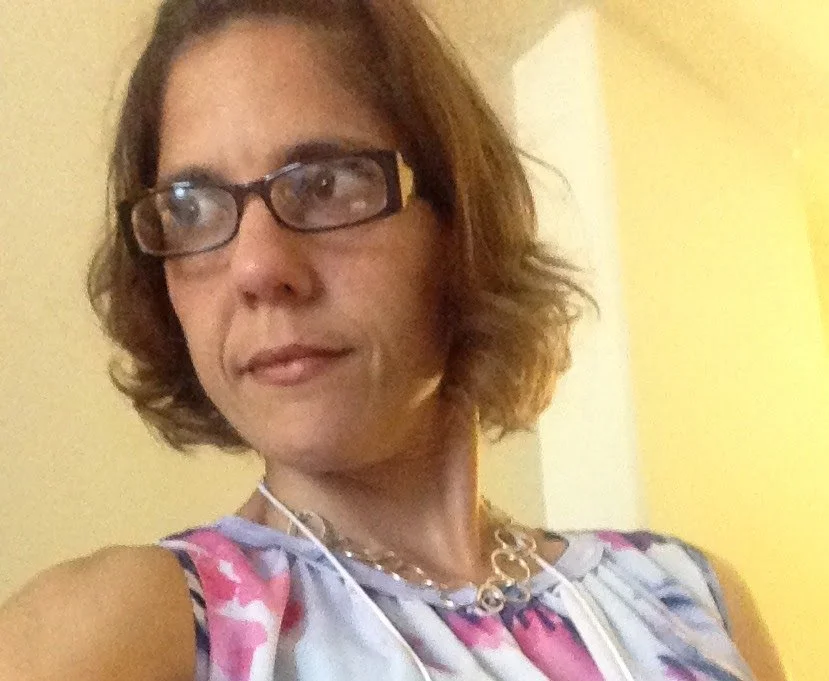
Local Lyrics - Featuring Florence-Susanne Reppert

Mass-Produced Love Story
by Florence-Susanne Reppert

It starts and ends the same way.
Old words, new formations.
The dog eared,
sugar-lipped,
mass-paperback of our own creations. We are novellas.
Dramas.
Lines and lines of dictionary variations. So go on.
Open me up.
Bookmark your favorite parts with something that smears,
trail your greasy fingers over the coffee stains on my thigh.
Break my spine.
Leave me out in the rain or tear me to shreds with your canines.
Put me back together with tape and glue,
promise you will never do it again,
You wouldn't dare hurt me anymore.
I won't be neglected by your leather-worn hands. Replace my cover with something more aesthetically beautiful and tell me lies.
Only read the first page of all I have to offer and put me back on the shelf with the rest of your ‘Do Not, Could Not Finish’ collection.
Tell me you love me if only to ruin me.
I promise it’s all I’ve ever known anyway
 

Why do you write poetry? What are your poetic muses?
My reasons for writing are extremely abundant. But the ‘why’ always trickles to two that stand in the forefront. The first being my Mother. When I was a teenager I was sitting in front of our huge boxy Dell computer and, being a nosey kid, I was rifling through papers. I happened upon a small folder filled with poetry written by my mom. I never knew she wrote and I don't think we ever spoke about it again. But she had written a piece about what it felt like to be a bird stuck in a cage. I took it, kept it in a notebook and must have copied it a dozen times to work it into my memory. She later was angry I took it, but as an adult I understand a lot more about her because of that poem. The second why, is because growing up and well into my adulthood I never felt like I had an outlet for all the things I struggled with. I never shared how I really felt with anyone but my journals. To this day I still struggle with being transparent in my emotions but my writing has helped immensely.

My poetic muses are simply my experiences. There are a few poets I’ve had the honor to meet that inspire me and helped me find my voice, but at the end of the day it’s what I've overcome that pushes me forward in my poetry.

There are a lot of cityscapes and industrial themes in your work. Is this a product of where you live or where you grew up?
I've always been fascinated with buildings and history. Architecture is such a huge part of our world, for better or worse. I grew up in the country, on a cul-de-sac with a farm at the beginning of the street. I dreamt of the city and looking out over the buildings. Now I live in a small city and dream of the country.

You have a new chapbook out. Tell us a little bit about Trigger Warning.
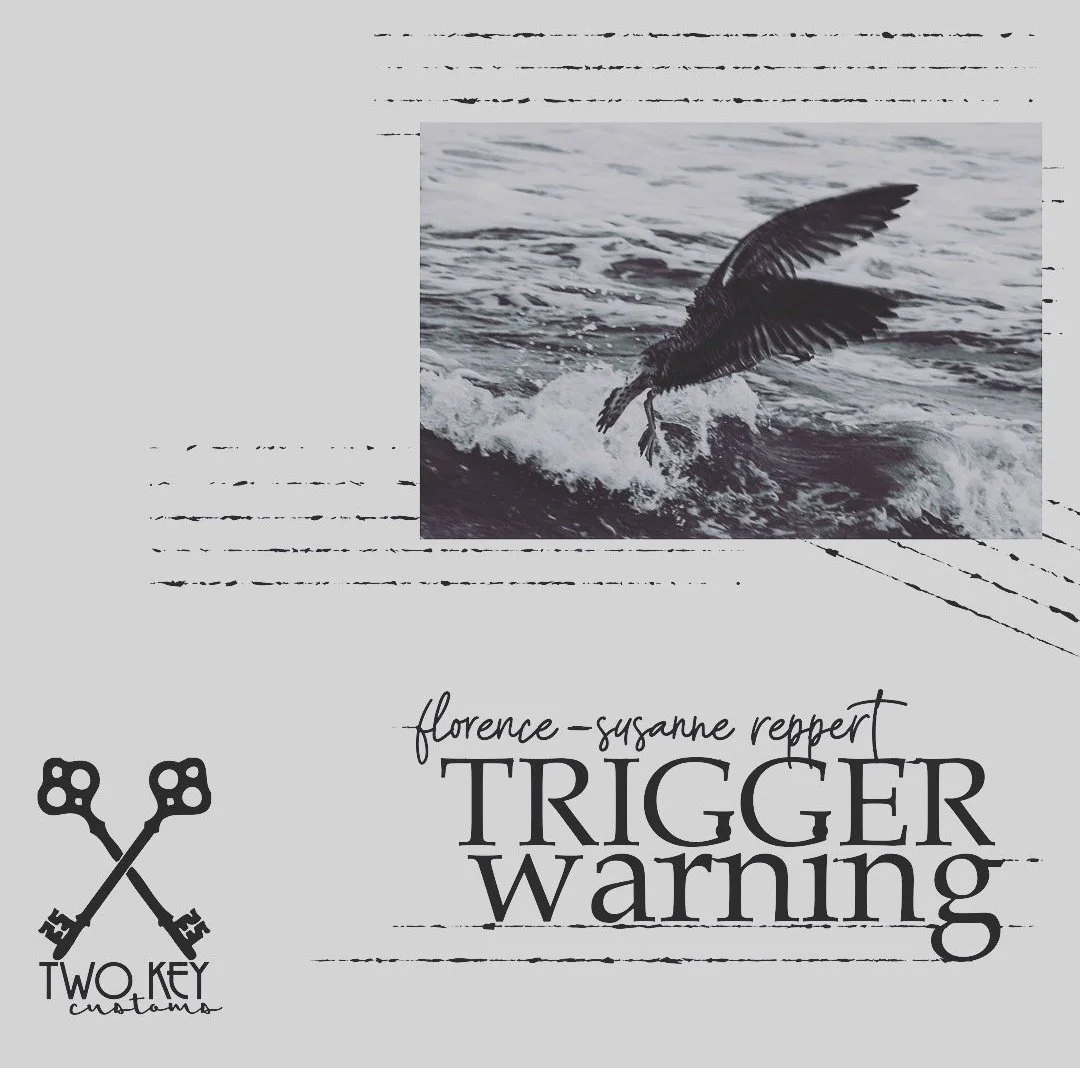
Trigger Warning (published by the incredible team over at Two Key Customs) actually started as a very different project. I hadn’t intended to write a book about my trauma and more harrowing experiences until Steve and Lindsay of TKC reached out to me about the manuscript I was tinkering with. At the time, I was dealing with a multitude of things from my past and struggling with my PTSD. So when they reached out I knew they were people I could trust with the heavy stuff. What started as 2 poems I had written about domestic abuse turned into 14 really heavy pieces that I never thought I would write about. I am horrible when it comes to describing my own work, so if you want a more eloquently worded review of the book go to @tinamariecox on Instagram and check out her blog. She recently reviewed my book and I am grateful for her!

I believe you are also a photographer. Does poetry influence your photography? Does photography influence your poetry?
My photography and my poetry kind of bounce off each other in my mind. I've been doing both since I was about 10 but I always felt more of a deeper love for my photography. I tend to write more pieces about my photography than take pictures to go with my writing. I’ve just always been fascinated about capturing moments in picture form, taking a memory and making it permanent. I’ve always felt like I had the capability to capture a feeling with my camera better than I could ever try with my words, and sometimes, words aren't always needed or necessary.

What do you find most fulfilling about the writing process. Do you have any writing habits or strategies that help in turning the blank page into an artform?
The one thing that is always helpful when I'm in a writing slump is going to an open mic or picking up a book of poetry or, honestly, any book. Inspiration is all around us, in the abandoned garages in an alleyway in the city, in the scents floating on the air that triggers a specific memory, even something as simple as watching your cat attempt to be graceful and somersaulting his chunky butt off the couch. I wish I could say I sit with my laptop and a cup of tea while writing. However, most times I'm surrounded by the chaos of toddlers, power chugging a Monster energy drink and hiding in my bathroom to get the thoughts into my notes app. The most fulfilling thing about my writing process is that once I'm done hacking away at a piece I feel lighter. Almost as if the final poem was a part of a bloodletting ritual.

Where can readers buy your books/read more of your work?
If you want to buy Trigger Warning, go over to @twokeycustoms on Instagram and click the link in the bio! Or go over to CatchsteveZ on Etsy! (and please also check out the other books they've published! They do fantastic work!) If you're interested in either of my self published books (Love Lust and Misery or Poems from a schizophrenic mind) I am not so sad to say that I have pulled them out of circulation. BUT I'm rewriting some of the poems from those books for another project I have in the works! You can find my poetry on Medium! My name there is under Florence-Susanne Reppert, and I think it would be also super cool if you checked out our literary magazine,

Poetry as Promised! On, basically, all platforms! My photography can be found on Facebook under Florence-Susanne Photography!

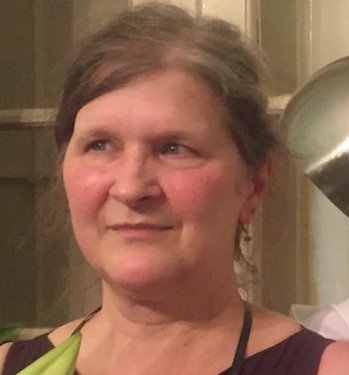
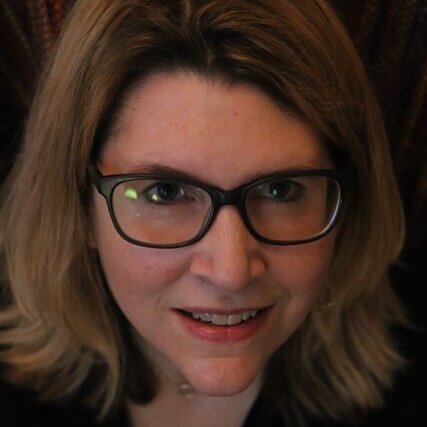
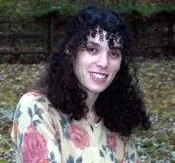
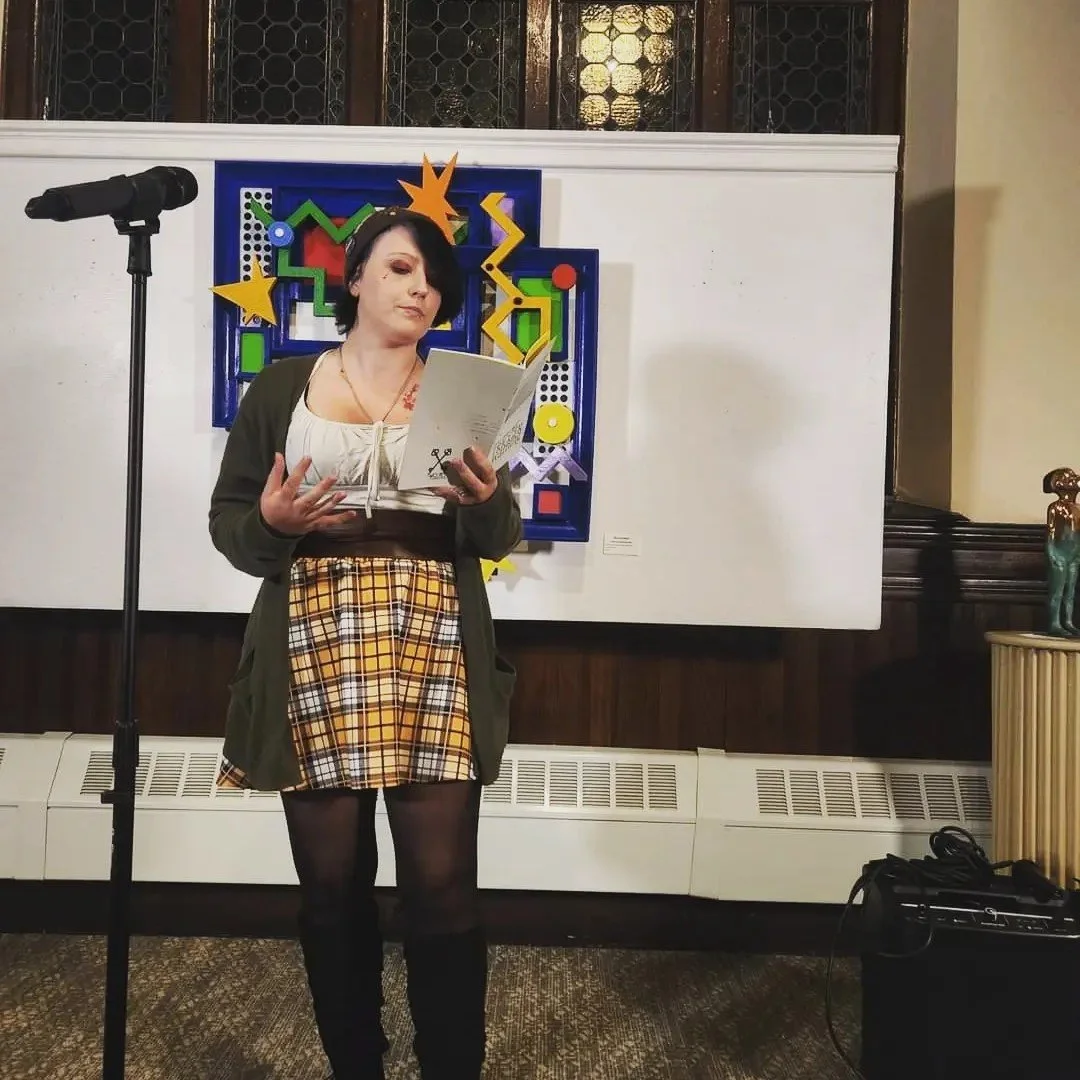
Florence-Susanne Reppert is a 25-year-old Poet from Allentown, Pennsylvania. Their first publication was at age 12 (Eber and Wein poetry contests) and they've been featured multiple times in the past year and half at open mics spanning the New Jersey and Pennsylvania poetry scenes. They also, more recently, were published in Viridian door magazine as well as Soupcan magazine. They also co-edit and co-founded Poetry as Promised Magazine and Nowhere as Promised Open Mic. You can find them online at IG- schizo_trash_poet.

And in real life crying over all the books they will never be able to read before they die
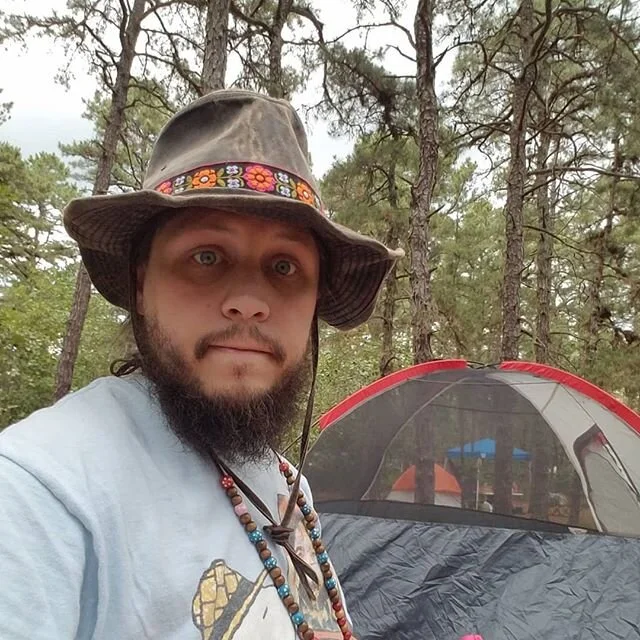

John Wojtowicz grew up working on his family’s azalea and rhododendron nursery in the backwoods of what Ginsberg dubbed “nowhere Zen New Jersey.” Currently, he works as a licensed clinical social worker and adjunct professor. He has been featured on Rowan University’s Writer’s Roundtable on 89.7 WGLS-FM and several of his poems were chosen to be exhibited in Princeton University's 2021 Unique Minds: Creative Voices art show at the Lewis Center for the Arts. He has been nominated 3x for a Pushcart Prize and serves as the Local Lyrics contributor for The Mad Poets Society Blog. His debut chapbook Roadside Oddities: A Poetic Guide to American Oddities was released in early 2022 and can be purchased at www.johnwojtowicz.com. John lives with his wife and two children in Upper Deerfield, NJ.


Fiction for Poets

Fiction for Poets


in which one poet writes to other poets about writing fiction


You know what you should always do? You should always ignore blanket advice about writing.


Have you ever written a poem – maybe it was a formal poem, maybe it rhymed – and had someone in a class or critique group respond with “There’s just no reason for a contemporary poet to write in form,” or “I don’t like poems that rhyme.” Perhaps you went the other way – did something loose or experimental – and got the “I’m not even sure this is a poem” response.

I’ve been workshopping my writing, mostly poems, for the better part of 30 years. I’ve also been working as a professional writer and/or writing instructor for 20 years (give or take a few). In that time, I’ve learned to be extremely skeptical of any critique presented as an absolute rule or overarching opinion because, in my experience, this feedback has less to do with my writing at all. It’s generally more about some rigid moral compass within the reader dictating what is always “right” or “wrong.” The thing is, I’m the kind of poet – nay, person – who believes there aren’t absolutes in writing. 

Even still, I wasn’t quite prepared for this kind of feedback when it came to my fiction. Confronted with editors who told me to “do a find and delete for the words that and feel,” “don’t use a lot of semicolons,” and “use repetition sparingly,” I fell into a serious crisis of confidence. You may recall, I spent about 20 years convinced that I was constitutionally incapable of writing fiction. Add to that my pre-existing anxieties and imposter syndrome, and you’ll see I was extra sensitive to vague, sweeping advice. Beyond that, however, I was also vulnerable because I didn’t know the tropes of fiction critique and editing.

To be clear: I’m not talking about the generalized advice and lessons of classrooms, workshops, or writing guides. You know what I mean, tips like: strive to use active, engaging verbs; find concrete, specific nouns; and (everyone’s favorite) show don’t tell (though, I think I may need to devote an entire blog post to the dangers of giving this advice to a poet writing prose). This advice in those contexts is like preventative medicine.

What I’m talking about here are the blanket platitudes presented in response to a particular piece by an editor (or anyone you’ve trusted to offer honest, critical feedback on your WIP[1]). Things like:

You should never use _______.

or

My biggest pet peeve is ________.

I’m used to how these sound in the context of poetry. I can suss out what’s valuable and what isn’t. But in the context of fiction, it took me a little longer to figure that out. First of all, I haven’t been in  a lot of fiction or prose workshops, so I didn’t recognize the kneejerk feedback – that automatic, almost mechanical advice some editors or publishers suggest to all writers, regardless of skill, experience, or the piece at hand. I’ve come to learn that “cut the word that” and “cut the word feel” are two such pieces of advice. I get it, there are times when “that” is implied and unnecessary. Likewise, I was told to avoid certain types of repetition: no need to say that someone nods their head; what else would they nod? likewise with shrugging shoulders. But as a poet, I sometimes include the “unnecessary” words because I prefer the cadence they lend to a sentence. Also, there are times when such words are necessary for clarity or context. My point is not that this advice isn’t helpful; rather, it’s not helpful to a particular piece without considering how the particular piece functions.

That brings me to “feel.” This one really burns me up. My novel is an especially emotional story; it’s got all of the feels. So I really took it to heart when an editor told me that “felt” is her “nemesis.” However, as I dug in, the advice became less and less useful as I realized her preconception and prejudice against that particular word meant she always read it the same way and failed to see how it might be useful or necessary.

Consider the sentence: I felt his body tense beside me. My editor suggested the straightforward change: His body tensed beside me. However, these two sentences are qualitatively different: The first is about the experience of the speaker; the second is an observation. The edit actually changes the meaning of the scene. So, applying a standard rubric – without even critically evaluating the context – means missing some of the subtleties of language, things that you don’t necessarily “know,” but you feel instead (oh crap, there it is again!).

Here is where I think I arrive at two of the fundamental challenges of being a poet writing fiction. First, poets (at least most of the poets I know) consider themselves artists. This is not to say that prose writers are not artists: I think many are. But I’m not sure how many of them see themselves that way. As artists, most of the poets I know (even those who love working in form) aren’t fans of absolute rules or rubrics. We see the purpose of our work somewhat differently than our fiction-writing counterparts. It’s not a simple binary, of course, but prose writers, especially writers of fiction, seem to be driven more by the bigger picture, the whole story, the arc. Poets, on the other hand, tend to focus more narrowly – individual moments, objects, and feelings. These two perspectives are not mutually exclusive; in fact, I’d wager the best of both fiction and poetry comes from their marriage.

The second challenge, in my opinion, stems from the first. Because of its smaller former and narrower focus, poetry uses words differently than fiction; it is concerned with beauty and musicality. Poetry is often about slowing to closely examine something. Fiction, on the other hand, is concerned with story and character and, by nature, requires more world building and development. Pragmatically, that means it also requires more words. Therefore, fiction can be (though it isn’t always) more concerned with efficiency and concision. Again, these aren’t binaries or mutually exclusive, but there is a tension in the space between the genres’ differing concerns.

Last fall, I went to an event at the Free Library of Philadelphia where two poets – Ross Gay and Major Jackson – were reading from and discussing their new books of prose. (It was magical, and I will be reviewing their books just as soon as I possibly can.) During the Q&A, someone asked how their poetry informed their prose, and they pointed to qualities like repetition, digression, and musicality. My heart sang when Ross Gay explained (and I’m totally paraphrasing from memory) he sometimes chose to write sentences in certain ways because the sounds of the words added a new, invisible layer of meaning. He said he might be the only one who even saw the layer or knew it was there, but it was still important and necessary.

I don’t know if prose writers think this way, but editors don’t seem to edit this way.  So as a poet, some of the automatic feedback for fiction – with its focus on speed and streamlining – has felt antithetical to my very approach to the written word. This has, of course, forced me to approach feedback in the same way I approach most language: slowly, contemplatively, examining all the minute particulars.

Ultimately, I won’t throw away any advice – not even when it feels oppressively generic. Nor will I do a find and replace for individual words or phrases because they happen to be on some “never use” list. Instead, I will read and revise my novel (all 110K words of it) with the careful precision I take with a 40-line poem. I will find the places where the generic advice is applicable, and I’ll challenge the places where even the most specific suggestion doesn’t feel quite right. That’s what I’d advise anyone to do when revising. Then again, I’d also suggest you take any advice with a giant grain of salt.


[1] WIP: Work in Progress. Maybe it’s obvious, but as a poet this was not ever how I referred to my ongoing projects. On the other hand, it’s super common lingo among prose writers, especially in the age of social media.

Autumn Konopka is a writer and teaching artist who enjoys coffee, running, and reggaeton. She's currently working on her first novel, which she expects to publish in early 2023. Find her online: autumnkonopka.com.

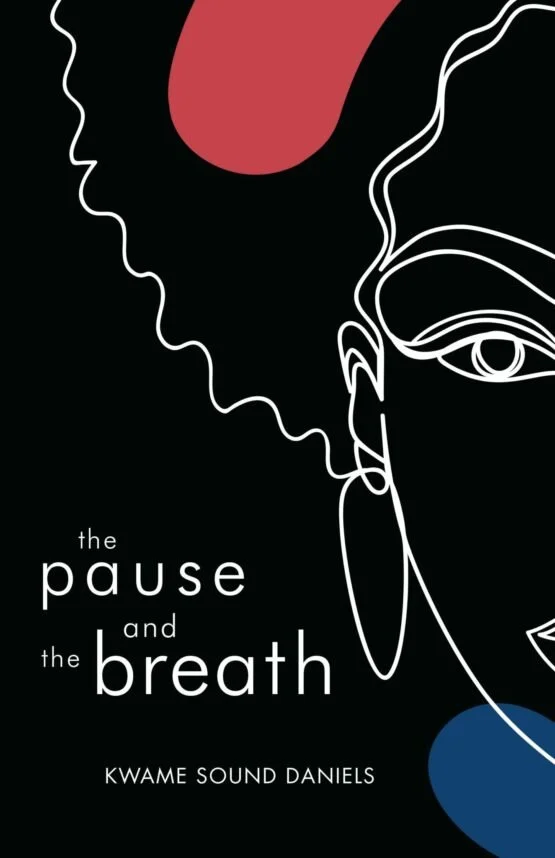
Review of the pause and the breath by Kwame Sound Daniels

the pause and the breath

Atmosphere Press

$15.99

You can purchase a copy here.

Reviewed by Katch Campbell


“Perception is not an act of Understanding.”
— Maurice Merleau-Ponty

The early 19th century artist Dante Gabriel Rossetti describes one of the most useful powers of the sonnet “as the ability to keep a moment, to hold a feeling or experience and turn it around in the light of our awareness until many facets are evident. This multifaceted quality gives the sonnet a paradoxical feeling of freedom and expanse within confines.” 

As humans we crave the known, but our brains are activated and more receptive to sensory input in the space of unknown. When blindfolded, our sense of hearing and smell is heightened. By utilizing the confines of sonnet structure, Kwame Sound Daniels provides the reader a safe space to sit next to, enter into, what is currently, less known.

Madness, Trans, Chronically Ill, and Black are the core ideas that drive the language and imagery of Kwame Sound Daniel’s, the pause and the breath, Atmosphere Press, 2023. Xir collection of forty poems utilizes the power of unrhymed sonnets to claim space for these ideas. In our conversation about xir intention, Kwame shared xir hope that we as reader might offer grace in the experience. An expansiveness that lends itself to look inside, self-examine, and ultimately see self in other.

But xe doesn’t ask the reader these things without having done the work xirself. Kwame, a painter, a poet, a student of Neo Slave Narratives, of Ancestral Foods, and of Herbalisim as worship and personal ceremony has scrutinized xirself as an act of self-connection and better understanding. Xe has grappled with self-ownership, the lack thereof in history, and its availability today. The reader can trust the journey through this collection as authentic and necessary. For example, Xe offers a universality of experience that quickly connects the reader to the speaker in the first quatrain of the book’s first sonnet. 

MORNING
You weigh yourself. Put on your jacket. You 
walk your dog. Drag her away from roadkill.
Pick up her shit. Put on a dress. Drive to
 the grocery store. Get a few donuts. Eat

The second quatrain provides the first mention of trans experience and psychic momentum, the third builds upon it and the final couplet a volta toward calm.

them. Wait for the cramping. Take a shit. Weigh
yourself again. Think about how much lessyou will weigh without your breasts. Think about
your decision to grow your hair out and
how it feminizes you. Decide that
you can’t afford to care. Your hair journey
is too important. Loving your routines
is too important. Caring for yourself
is too important. Don’t think about work.
Just write. Just breathe. The day has just begun.

Subsequent sonnets take a more direct path to these ideas /experiences such as “COCSA,” “Body,” and “Couldn’t leave,” while others give a sense of the madness and confusion, including “Pronouns” and “TIME.” But hope and empowerment are incorporated deftly, requiring a second and third reading of the collection out of respect, as witness, and from the beginnings of internalization.

Hunger
I taught myself I had to be hungry
for my own gender, that I had to carve
out a bowl to hold androgyny
that I could never achieve being fat.
I painted myself with emphatic oils,
I fired myself in my own fear. Not once
did I crack under the heat. My hunger
was well-made, developed. There was no
filling me. I became content with what
I knew. I kept myself starved because it
was safer than knowing. My truth was in
the absence. Falsehoods were the feminine,
until the feminine satisfied the
appetite I cultivated for love

Kwame Sound Daniels’ generosity of experience and expression thereof, is the power of vulnerability and of one human’s willingness to do the work. At the end of our hour-long conversation xe asked, “How would it (the world) be if I didn’t invite you?”.

I believe, we are the richer for it.


Katch Campbell is a connector. With a master’s degree in Science and an MFA in poetry, she creates metaphors for her patients and others about the world around us. Her work is an inquiry on the atrocities we commit consciously and unconsciously against each other and the universe. Katch serves as Vice President and is a permanent faculty member at the River Pretty Writing Retreat, a bi-annual workshop in the Ozarks. She has co-led immersive poetry trips to Slovenia and Italy and used to edit for ZoMag.com.

Mad Poet of the Year - R. G. Evans (February 2023)

The Mad Poet of the Year blog posts share the poetry of a long-time Mad Poet. This year-long appointment provides readers with a deep dive of the writer’s work and thoughts on poetry. We are thrilled to have R. G. Evans serve as the Mad Poet of the Year for 2022.


THE INVENTION OF THE HEART
 by R.G. Evans

God made a fist and that was that.
Watch this! He said to the archangels
and began pumping his fingers
the way a farmer might milk a cow
once He invented farmers and cows.
God marveled at how white his knuckles looked
when he squeezed them tight and trembling,
so He invented blood and filled his fist
with it like water in a balloon.
Soon God’s fist was pumping on its own.
It terrified Him the way it pulsed and throbbed,
so He threw it down into the dirt and covered it
the way He knew that cats would cover their waste.
Then, also like cats would do once He invented them,
He walked away disinterested.
But the fist kept right on throbbing,
and the dirt began to feel, to breathe,
to long for other piles of dirt
that did not pump in return.
God never looked back, leaving the dirt
to teach itself about the thumping it couldn’t prevent.
Soon God grew heavy bored, 
found Lucifer, His brightest angel,
stretched one hand out in a way
that reminded him to one day invent Michelangelo,
and said, Luci, bubala, pull my finger.


This month’s poem: something for Valentine’s Day, something for lovers.


R.G. Evans’s books include Overtipping the Ferryman (Aldrich Poetry Press Prize), The Holy Both, and Imagine Sisyphus Happy. His original songs were featured in the poetry documentaries All That Lies Between Us and Unburying Malcolm Miller, and his collection of original songs, Sweet Old Life, is available on most streaming platforms. Evans teaches creative writing at Rowan University. Website: www.rgevanswriter.com

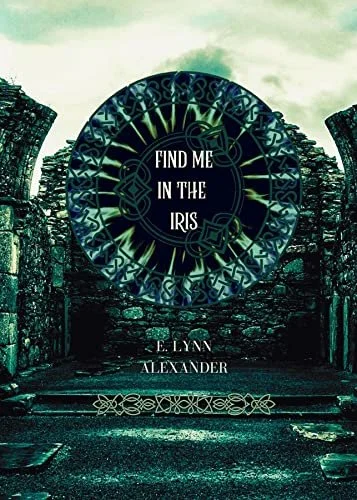
Review of Find Me in the Iris by E. Lynn Alexander

Find Me in the Iris

Collapse Press

$10.00

You can purchase a copy here.

Reviewed by Sean Hanrahan


E. Lynn Alexander begins her searing poetry collection with an epigraph comprising the first five lines of her powerful poem, “Bottles of ‘Were’”        

 Bottles of “Were”
Of regrets.
Something she said
That stuck with me.
What will the grief of me teach you?

With that haunting opening, Find Me in the Iris explores the relationships between mothers and daughter and the internal and external selves with laser-focused intensity. The speaker’s memory of motherhood and other women are contained in the lines:

Bottles. Corked. And closed.
Women. Mothers.
Suspended
In their ages,
Selves, the slurry sentiment
Their labels going brown.

One could readily imagine a trip to the Mütter Museum and seeing a specimen floating in a glass jar. The imagery contained in this poem is reminiscent of Edgar Allen Poe or Anne Sexton. The line length and rhythm illustrate a cutting precision, sharply contrasting with the peaceful sibilance that is also deployed. Alexander is a poet working at the height of her craft.

Specimen imagery continues in the evocative poem, “Frogs with Glowing Eggs in Their Bellies.”

Particle flecks, held up to the light
I see tadpoles
Larvae. Eggs. Algae.
Mother-moon
Alchemy

Once again in brief yet pregnant lines, Alexander can certainly pack a punch. The reader can visualize the mystery of nature, perfectly preserved in suspension. There is something haunting and visceral about lives that never were. She continues:

I see metals of industry
Poisons.
Run off from the lawns.
Toxins. Plastics. Bag Phantoms.
The ghosts
of Wants vs. Needs.

Alexander is such a strong poet that she can bring in a vast environmental awareness into a mostly confessional space. She can vividly illustrate for the reader the complex chain of events that led to the speaker witnessing a preserved wet specimen almost glowing with dead life. This poem is one of the strongest in the collection and once again queries, “What will the grief of me teach you”?

“Odd Jobs” is another tour de force in Find Me in the Iris. In this poem, she lists metaphorical jobs the speaker holds as a poet including chemist, doctor, artist, plastic surgeon, butcher, factory farmer, geologist, inspector, regulating entity, and priest:

I am a priest. Pin women
to my trays. I dissect them.
I display their hands
I verify stigmata
I name saints

She categorizes eyes: “Hazel/Brown/Blue.” Until finally, “I find my mother’s iris/And I hold it up to mine.”

Alexander ends this brilliant collection with the title poem. The speaker asks the reader, a lover, a dead mother, any sympathetic soul to

Find me in the iris
in the blue
in the storm’s eye
in the silence

What we find in Find Me in the Iris is a remarkably self-assured poet dazzling us with provocative language and exquisite poems. This collection will haunt me for a long time to come. For anyone who loves precise and surprising language, Alexander’s work is the perfect eye-opening treasure.


Sean Hanrahan is a Philadelphian poet originally hailing from Dale City, Virginia. He is the author of the full-length collection Safer Behind Popcorn (2019 Cajun Mutt Press) and the chapbooks Hardened Eyes on the Scan (2018 Moonstone Press) and Gay Cake (2020 Toho). His work has also been included in several anthologies, including Moonstone Featured Poets, Queer Around the World, and Stonewall’s Legacy, and several journals, including Impossible Archetype, Mobius, Peculiar, Poetica Review, and Voicemail Poems. He has taught classes titled A Chapbook in 49 Days and Ekphrastic Poetry and hosted poetry events throughout Philadelphia.

POeT SHOTS - "Fund Drive" by Terri Kirby Erickson

POeT SHOTS is a monthly series published on the third Tuesday of the month. It features work by established writers followed by commentary and insight by Ed Krizek.

Fund Drive

by Terri Kirby Erickson

She could be a Norman Rockwell painting,
the small girl on my front porch with her eager
face, her wind-burned cheeks red as cherries.
Her father waits by the curb, ready to rescue
his child should danger threaten, his shadow
reaching halfway across the yard. I take the
booklet from the girl's outstretched hand,
peruse the color photos of candy bars and
caramel-coated popcorn, pretend to read it.
I have no use for what she's selling, but I
can count the freckles on her nose, the scars
like fat worms on knobby knees that ought
to be covered on a cold day like this, when
the wind is blowing and the trees are losing
their grip on the last of their leaves. I'll take
two of these and one of those, I say, pointing,
thinking I won't eat them, but I probably will.
It's worth the coming calories to see her joy,
how hard she works to spell my name right,
taking down my information. Then she turns
and gives a thumbs-up sign to her father, who
grins like an outfielder to whom the ball has
finally come—his heart like a glove, opening.


This poem is a vignette about hope, youth and love.  Many of us can relate to hawking a bit of nonsense for our causes as young people. But it is the spirit of the girl and her hopefulness as she prospects for a customer that punctuates various points in the poem.: “/She could be a Norman Rockwell painting/.  “…Eager/ face, her-wind burned cheeks read as cherries?”  /I have no use for s selling, But I/ can count the freckles on her nose, the scars/ like fat worms on her knobby knees…/. “. This child is a beautiful symbol of the hope all of us have for the future.

The girl’s father “waits by the curb, ready to rescue / his child should danger threaten…/ He is watching his child grow and learn with hope.”  The poet thinks to herself she won’t eat the confections she buys although she knows she will.  And she doesn’t care because the image of this child with her father is so poignant that she cannot say no.  After getting the thumbs up sign from his daughter the father”/grins like an outfielder to whom the ball has/ finally come---his heart like a glove opening.”  What more can one say about love?


Ed Krizek holds a BA and MS from University of Pennsylvania, and an MBA and MPH from Columbia University.  For over twenty years Ed has been studying and writing poetry.  He is the author of six books of poetry:  Threshold, Longwood Poems, What Lies Ahead, Swimming With Words, The Pure Land, and This Will Pass. All are available on Amazon.  Ed writes for the reader who is not necessarily an initiate into the poetry community.  He likes to connect with his readers on a personal level.

Mad Poet of the Year - R. G. Evans (January 2023)

The Mad Poet of the Year blog posts share the poetry of a long-time Mad Poet. This year-long appointment provides readers with a deep dive of the writer’s work and thoughts on poetry. We are thrilled to have R. G. Evans serve as the Mad Poet of the Year for 2022.


THE YEAR IN GOODBYES
 by R.G. Evans

Poor Father Time. Every year kicks his ass.
He comes in fresh with his little sash
like a Best Baby Contest winner,
but leaves broken and bearded,
turning his hunched back
on the babe sent in to take his place.
That’s all we ever see. 
The coming. The going.
The geezer and the babe.
What of the rest of the year?
The toddler in February
playing catch with Cupid’s darts.
The “whining schoolboy” of March,
praying the longest month will end.
The horny lad of spring,
flirting with April and May.
But he’s more than just the calendar.
Like us, all his lives are different.
He can feel a month’s headlines
in his arthritic knees.
Global news gives him lumbago.
Oh, and what some elections
do to his hemorrhoids.
When the whole thing winds down--
top 10 lists, the year in review and in goodbyes--
he looks back as well 
at that apple-cheeked cherub 
born in ignorance and hope, still
able to dream without meds.
There’s a knock at Father’s door.
On the other side, the new babe is waiting.
Some tongues,he knows, 
have the same word for hello and goodbye
How easily, he thinks, that sash
could become a garotte. 
He and the innocent exchange a glance,
one of them suddenly lost in translation.


The media uses New Year’s Eve/Day to provide retrospectives of the past year’s events. Several years ago, I read of the year’s celebrity obituaries under the headline “The Year in Goodbyes.” That headline combined with a little tinkering with the figures of Father Time and Baby New Year, and voila!, this poem, which appears in my book Imagine Sisyphus Happy, was born.


R.G. Evans’s books include Overtipping the Ferryman (Aldrich Poetry Press Prize), The Holy Both, and Imagine Sisyphus Happy. His original songs were featured in the poetry documentaries All That Lies Between Us and Unburying Malcolm Miller, and his collection of original songs, Sweet Old Life, is available on most streaming platforms. Evans teaches creative writing at Rowan University. Website: www.rgevanswriter.com

POeT SHOTS - "When Giving Is All We Have" by Alberto Ríos

POeT SHOTS is a monthly series published on the third Tuesday of the month. It features work by established writers followed by commentary and insight by Ed Krizek.

When Giving Is All We Have

byAlberto Ríos

One river gives
Its journey to the next.

We give because someone gave to us.
We give because nobody gave to us.

We give because giving has changed us.
We give because giving could have changed us.

We have been better for it,
We have been wounded by it—

Giving has many faces: It is loud and quiet,
Big, though small, diamond in wood-nails.

Its story is old, the plot worn and the pages too,
But we read this book, anyway, over and again:

Giving is, first and every time, hand to hand,
Mine to yours, yours to mine.

You gave me blue and I gave you yellow.
Together we are simple green. You gave me

What you did not have, and I gave you
What I had to give—together, we made

Something greater from the difference.


We are in the season of giving and receiving.  This poem by Alberto Rios captures for me the essence of that spirit.  Rather than analyze the poem and try to break down its components.  I prefer just to read the poem and let sit with the spirit of it.  Remember to give all the time, not just during the holidays.  You will make “something greater”…” than yourself. 

Happy Holidays!


Ed Krizek holds a BA and MS from University of Pennsylvania, and an MBA and MPH from Columbia University.  For over twenty years Ed has been studying and writing poetry.  He is the author of six books of poetry:  Threshold, Longwood Poems, What Lies Ahead, Swimming With Words, The Pure Land, and This Will Pass. All are available on Amazon.  Ed writes for the reader who is not necessarily an initiate into the poetry community.  He likes to connect with his readers on a personal level.

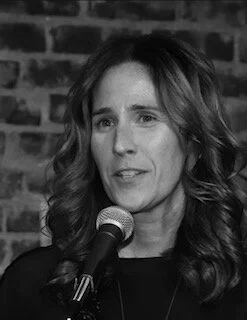
Local Lyrics - Featuring Katie Budris

How to Survive a Blizzard
(first published in Mid-Bloom)
by Katie Budris

Outside, snow buries this Midwest winter,
the only remaining inhabitants a family
of cardinals, the ones who have been living
in the tree beside the window.

As the wind wages war,
biting through skin and feathers,
the bold red cardinals belly down
beneath the snow. They know

the best protection from a blizzard is not
to fly, but to burrow, escaping
the elements by surrounding themselves
in a cave to keep warm, wait out the storm.


How do you approach your writing? What are you interested in as a poet?
I’ve always been a “write when I feel moved to write” kind of person, for better or for worse. Sometimes that means I don’t write much for long periods of time, and then I write a lot at once. When I do write, it’s always by hand first and always in paragraph form. I like to get the words and ideas down on paper and then when I type them up I can start crafting it as a poem—putting in line breaks, trimming down for concision, playing with syntax and rhythm. That, to me, is really the fun part. 

I’m primarily interested in writing narrative poetry, and almost always write from my own experiences. I’m not so self-centered that I think readers are all that interested in me. Rather, I think as people we have more shared experiences that we often realize, and I think narrative poetry can help us tap into those aspects of life that connect us, those experiences that remind us we’re more alike than different. I hope my poems can do even a little bit of that for others.

You recently published your second chapbook. Tell us a little about Mid-Bloom.
The poems in Mid-Bloom are a combination of poems about losing my mom to cancer when I was in high school, and then poems about facing my own cancer diagnosis at age 38. I’ve been trying to write about my mom for many years (with varying success) and so this chapbook came together pretty organically.

While I was undergoing chemotherapy, I really wanted to try writing a series of “Dear Cancer” poems, but the only thing I ever came up with was “Dear Cancer, F you.” So as I emerged from the haze of treatment, I realized what I really needed to write about was how the experience made me feel so connected to my mom even though she’d been gone for so long. It’s a really strange and surreal kind of grief and comfort all at once to suddenly feel so close to someone who’s not actually here, and for that to come through such a traumatic shared experience. The topics in the book are pretty heavy, but I think I’ve approached them in a way that is delicate and reflective while hopefully still giving an honest expression of what it’s like to lose a parent and what it’s like to face your own mortality through cancer.

You are a professor at Rowan University in the Writing Arts Department and Editor-In-Chief of Glassworks magazine. Does teaching writing to college students and editing a student-run literary journal influence your writing or writing style?
Absolutely! I am a better writer because of my students. There’s nothing like reading a line or a poem one of your students has written and thinking “why didn’t I come up with that?” They amaze me all the time. And they’re so eager to learn and inspired to write. Just the other day, they were doing a revision exercise in class, so I pulled a poem of my own up on my laptop and made some revisions myself. They push me to spend more time on my writing and to keep striving to write better lines, to come up with stronger metaphors.

Working with Glassworks also helps keep me immersed in the wider literary community. I love being able to publish so many talented writers, and exposing my students to the wonderful world of lit mags is truly the best part of my job. It’s always easier to see what’s working and what’s not in someone else’s writing, so I think being an editor gives me that unique perspective. And if I can take even a little of that back to my own work, that’s just a bonus.

What do you find most helpful to get yourself and your students actually writing?
I’m a big fan of prompts, actually. Not always a subject matter prompt, because we all have different obsessions and experiences to write about. But anything to get the juices flowing. We do a lot of brainstorming in my creative writing classes—make a list of emotions, then make a list of places you’ve been, now pick one from each list that don’t seem to go together and write about it—broad, open-ended prompts like that. I think trying to write within different forms and constraints can be helpful too, even if we ultimately abandon those constraints in revision. Interesting things come out when you try to write a sestina for the first time, or limit yourself to a specific word count.

In addition to a poet, you are also a tap dancer and Director of The Lady Hoofers Tap Ensemble. Do these creative pursuits influence each other? Do you find there are similarities between directing a dance troupe and editing a literary journal?
I don’t know how much they directly influence one another in my daily practice, but I do think the genres I’ve pursued are related. Poetry and tap dance are both very much centered on rhythm. I love to play with line breaks to create a varied rhythm in my poems, and maybe that’s not all that different from the ways I use syncopation in my tap dancing. Running the two organizations is very different logistically, but in both cases the goal is to give the audience a satisfying experience using rhythm, tone, imagery, storytelling . . . The more I think about this question, the more connected the two artforms seem to be!

Where can readers find more of your work? Buy your books?

I try to keep up with posting newly published work on my website at katiebudris.com and I’m also on Instagram and Twitter @ktb8482 and have a Facebook Page - Katie Budris Writer.

Readers can contact me through any of those sites to purchase my books through me directly. Mid-Bloom is also available at Finishing Line Press or on Amazon, and my previous chapbook Prague in Synthetics is on Amazon.


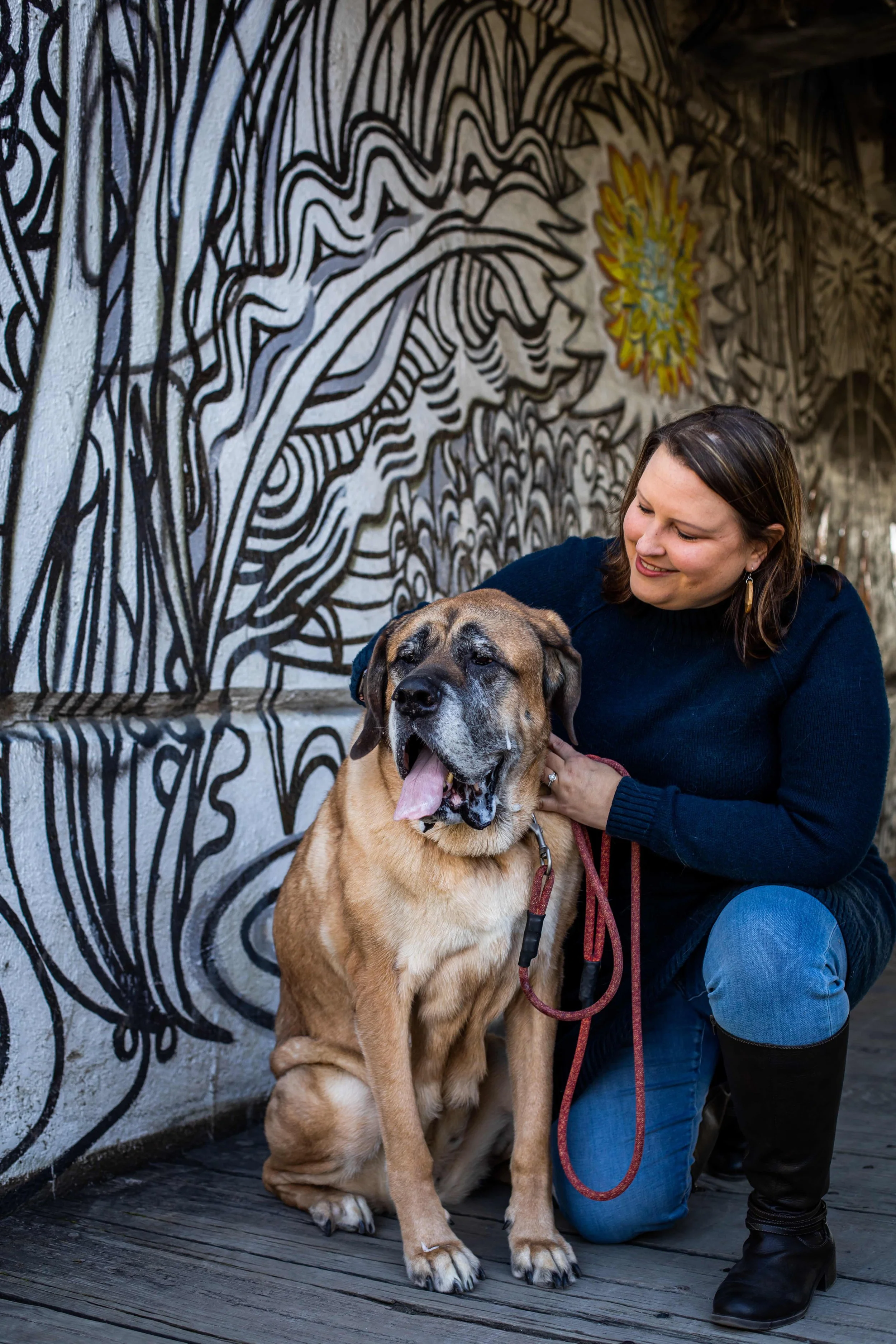
Katie Budris is a Senior Lecturer in the Writing Arts Department at Rowan University where she serves as Program Coordinator for the Master of Arts in Writing and as Editor-in-Chief of Glassworks literary magazine. She has published two chapbooks with Finishing Line Press: Mid-Bloom (2021) and Prague in Synthetics (2015). Katie holds an MFA in Creative Writing from Roosevelt University and her poems have appeared in over a dozen journals, most recently Deep Wild Journal, River and South Review, Philadelphia Stories, Border Crossing, Temenos Journal, and the anthology Crossing Lines (Main Street Rag). She is a breast cancer survivor living in South Jersey with her husband, Chris, and their English Mastiffs, Harper and Winnie.


John Wojtowicz grew up working on his family’s azalea and rhododendron nursery in the backwoods of what Ginsberg dubbed “nowhere Zen New Jersey.” Currently, he works as a licensed clinical social worker and adjunct professor. He has been featured on Rowan University’s Writer’s Roundtable on 89.7 WGLS-FM and several of his poems were chosen to be exhibited in Princeton University's 2021 Unique Minds: Creative Voices art show at the Lewis Center for the Arts. He has been nominated 3x for a Pushcart Prize and serves as the Local Lyrics contributor for The Mad Poets Society Blog. His debut chapbook Roadside Oddities: A Poetic Guide to American Oddities was released in early 2022 and can be purchased at www.johnwojtowicz.com. John lives with his wife and two children in Upper Deerfield, NJ.

Ekphrasis: Poems and Art (December 2022)

Ekphrasis: Poems and Art

Image Credit: Cathleen Cohen

Welcome to a new Mad Poets blog, to be offered every two months.  

It’s a pleasure to write about the relationship between poetry and other art forms, to examine ways that a various creative arts relate to each other.

The term ekphrasis can be defined narrowly as writing that describes a work of art in another medium-- paintings, music, photography sculpture and the like.  It can also refer more broadly to the alchemy that happens when one medium tries to define and relate to another. This could refer to poems inspired by the visual arts or music -- and also the reverse! To my mind, ekphrasis can also encompass hybrid works, like artists’ books, author/illustrator collaborations and graphic poems.

Many scholars have written about ekphrasis and there are great resources online. Though not scholar of the topic, I have had a practice of writing poetry and painting for many years. Both are essential to my creative life. These art forms interact, challenge each other and open up many questions and tensions.

My aim in this blog is to feature the work of various poets and artists, to let you know of interesting viewing opportunities and to provide some angles that might prompt your own writing.


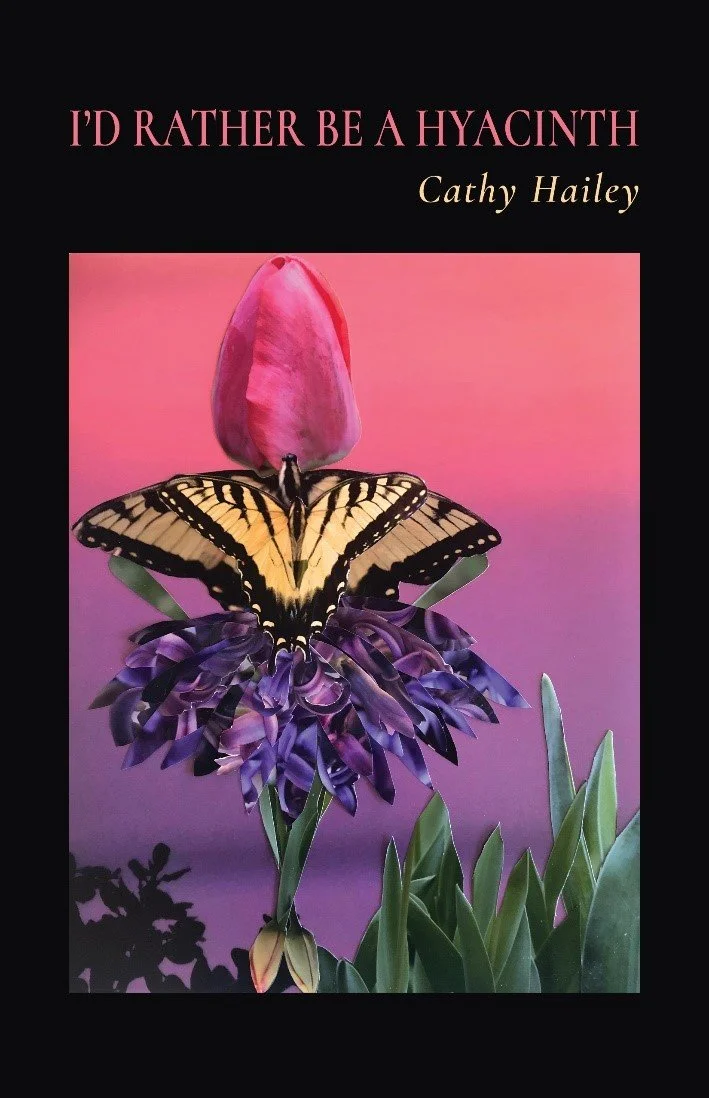
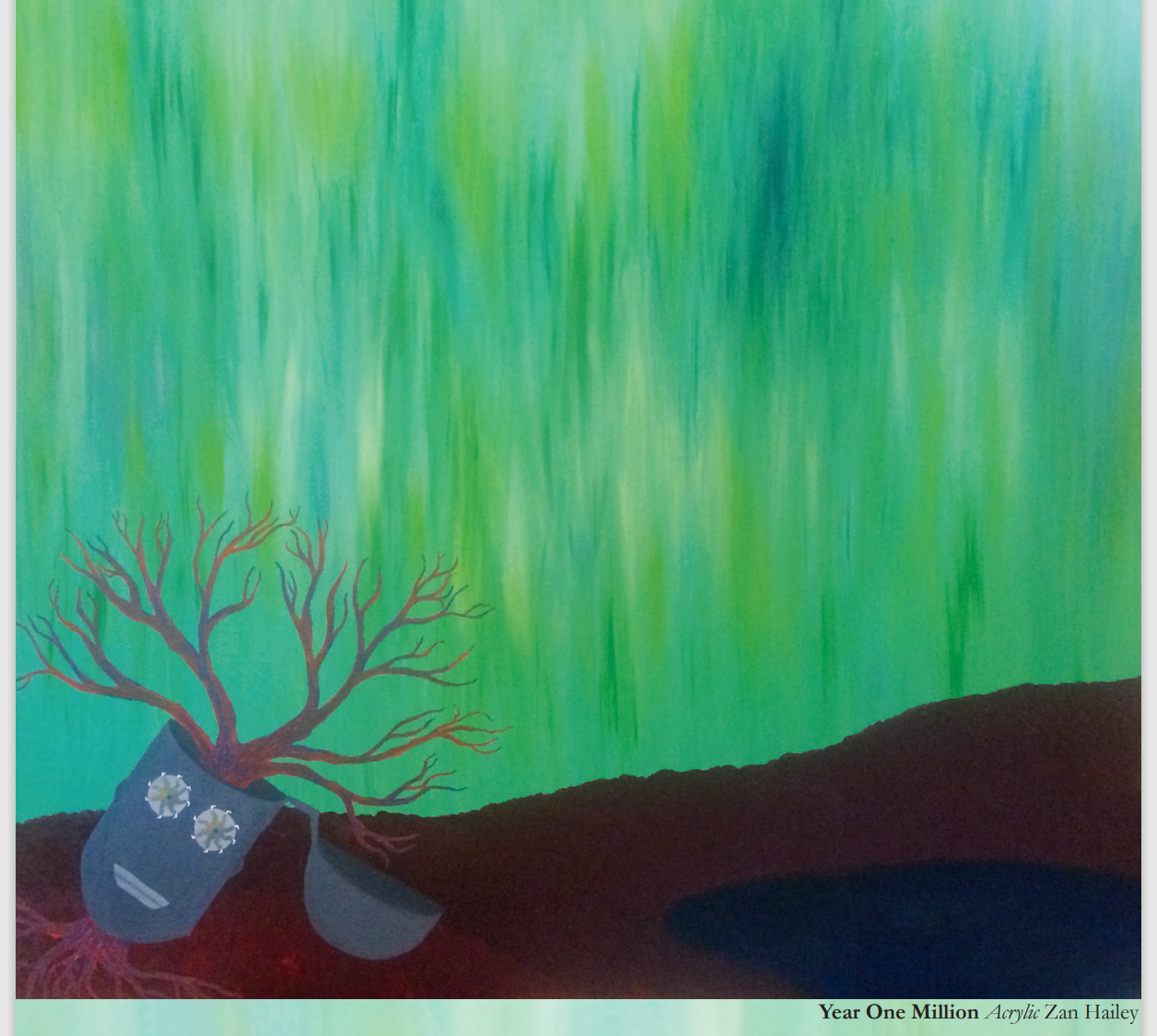
I’d Rather Be a Hyacinth: The Ekphrastic Poems of Cathy and Alexandra Hailey


Cathy Hailey has a long and impressive career teaching English and creative writing in Prince William County, Virginia schools, Johns Hopkins University and other institutions. Her teaching and writing has garnered many awards and prizes. I admire not only her work, but also the generosity and passion she brings to the poetry community. (https://advanced.jhu.edu/directory/cathy-hailey/ and https://cathyhailey.com).  

This year, the Poetry Society of Virginia celebrates its centennial. As vice president of its Northern Region, Cathy recently organized an excellent online series of readings based on ekphrasis, “Where Art Meets the Line” (links below). Cathy experiments with ekphrasis, inspired by others’ paintings and photographs as well as her own, as can be sampled in her recent collection, I’d Rather Be a Hyacinth. Its vibrant cover displays one of her own images and this book is dedicated to another talented artist and poet, her late daughter, Alexandra “Zan” Delaine Hailey.

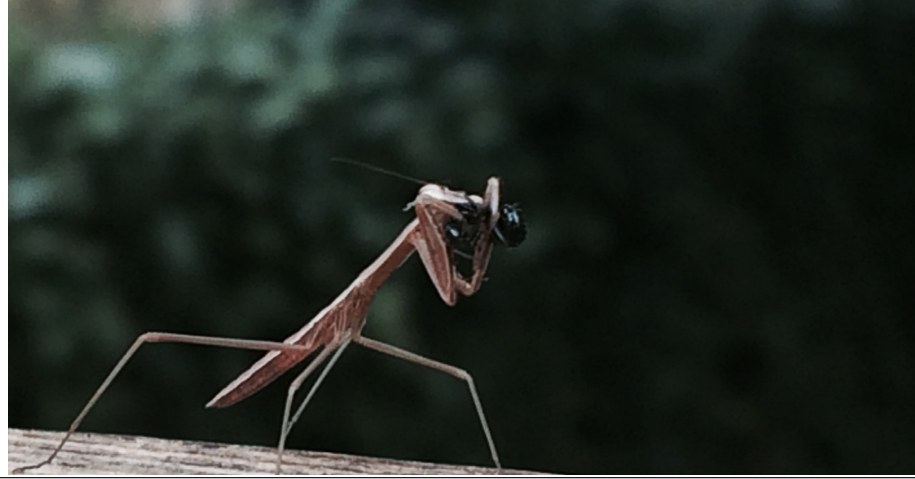
The poems of both Cathy and Alexandra display a fine sensitivity and lyricism in observing and sharing the natural world. Alexandra’s poem is paired with her own photograph and Cathy’s, with her own painting.

PRAYING MANTIS
Ridges ladder a slender 
back perpendicularly lined 
in burnt orange—he sways, 
swinging forearms like a jazz 

man on keys before stopping 
to stare at a file folder
reflecting his delicate lime- 
green structure; sweet sax 
radiates through radio

before purifying white walls
with a touch of liveliness
right out of Robinson’s back
lily garden: tips dripping

orange neon from golden
nectar breasts. Mantis’ serrated
limbs climb to the ceiling
exploring spackled foam-core
that holds fluorescents in place—

the withered gleam, never 
as warm as lamp light, works 
for now, just as a picture speaks 
so many words but never 

does the moment justice,
relative to presence. A triangular 
face waits patiently for clocks 
to strike release—freedom 
from stone walls that fracture 

each passing day. Ink-crossed 
calendar blocks roll, finding 
fresh cycles endearing 
and repetition swelling. See, 

it isn’t time that changes 
people; people change time.

Alexandra “Zan” Delaine Hailey

Ardea Herodias

Tribute to a Tall Friend

Oh Heron, where art thou?
I heard a tale of your trajectory across Burke Lake,
the glide path of your blue majestic wings.
In past years, I remember you standing statuesque—
the tallest bird on stage—towering over
a gaggle of green-necked geese
and a paddling of white-winged ducks
like those I see today choreographing dainty steps
as they glissade across slick glass surfaces.

I search for you in the canopy of trees,
along log-littered shorelines,
among swaying reeds circled by dragonflies.
Though I long to see you in your natural habitat,
I discover you only within me as I recall
snapshots of summer sojourns,
awe-inspiring recitations, scenes of influence
over a siege of admiring apprentices
eager to share a laugh, a skit, a song.

Oh Heron, where art thou
in the prophecy of our future?
Our retreats already too infrequent,
I will miss your grace and noble stature,
your wisdom, curiosity, strength,
and perpetual creation of light.
When I no longer find you in a familiar place
on our lake, on a campus home we share,
you will still be memorialized in art and word.

Cathy Hailey

Integrating poetry and art is one of Cathy’s favorite topics and processes.  She shared that she has used different kinds of art throughout her life. Lacking expertise in drawing when young, she turned to other arts and crafts, especially jewelry making and gem cutting. She learned to cut cabochons and facet amethysts. Using sterling silver wire and sheets, she grew skilled in constructing pendants, rings, bracelets and earrings. These talents she continued growing at the Crafts Center at Duke University, adding new skills using a potter’s wheel to make ceramic cups, bowls, vases, and other art pieces. Clearly a lifelong learner, Cathy also loves working with weaving and hopes in the near future to get her table loom and other homemade looms out of storage.

Cathy shares with pride about her talented daughter, Alexandra, to quote:

Alexandra was an English/Creative Writing major at VCU and credits Gary Sange, Gregory Donovan, and David Wojahn with helping her hone her craft. Alexandra also took courses in the Fine Arts Department, talking her way into upper-level classes without the prerequisites. She took photography and a course that allowed her to paint and create sculpture, even design and produce furniture.  She took a business art course that was very helpful for developing skills in marketing and entrepreneurship. She took other courses in the Communications Department that inspired creativity (including a Band-Aid project based on Noah Scalin’s Skull-A-Day project, and she frequently incorporated art and poetry in portfolios she designed whenever a professor would consider a more creative approach rather than the standard analysis paper. She learned and grew so much from these opportunities.

“Darwin’s law does not apply.
She lived as a butterfly.” 
– Cathy Hailey, from “Flying High”

 Cathy has taken advantage of prompts from several sources as a springboard for writing. She recommends: Rattle Ekphrastic prompts(https://www.rattle.com/ekphrastic/), The Ekphrastic Review (https://www.ekphrastic.net/the-ekphrastic-challenges) and the Passagers Journal’s monthly ekphrastic poetry challenge (https://www.passengersjournal.com/ekphrastic-poetry-contest).


Cathleen Cohen was the 2019 Poet Laureate of Montgomery County, PA. A painter and teacher, she founded the We the Poets program at ArtWell, an arts education non-profit in Philadelphia (www.theartwell.org). Her poems appear in journals such as Apiary, Baltimore Review, Cagibi, East Coast Ink, 6ix, North of Oxford, One Art, Passager, Philadelphia Stories, Rockvale Review and Rogue Agent. Camera Obscura (chapbook, Moonstone Press), appeared in 2017 and Etching the Ghost (Atmosphere Press), was published in 2021. She received the Interfaith Relations Award from the Montgomery County PA Human Rights Commission and the Public Service Award from National Association of Poetry Therapy. Her paintings are on view at Cerulean Arts Gallery. To learn more about her work, visit www.cathleencohenart.com.


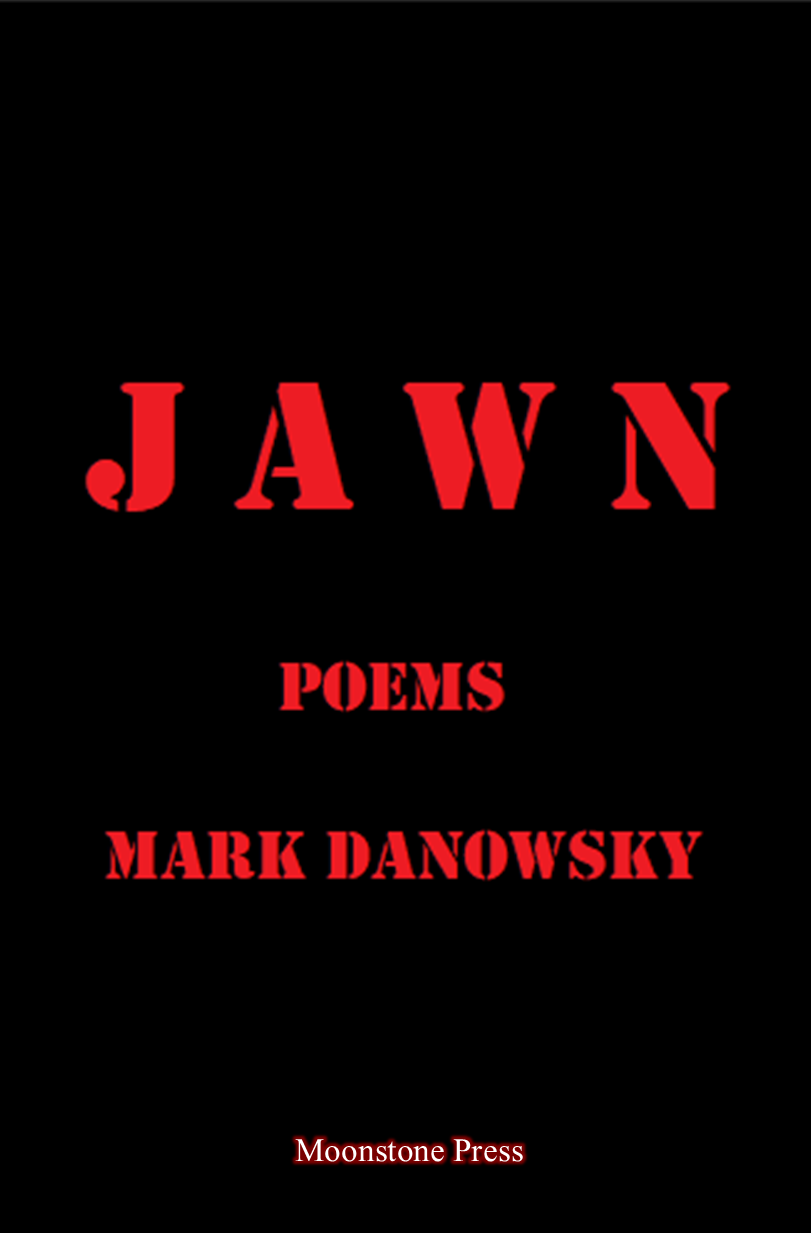
Review of JAWN by Mark Danowsky

JAWN

Moonstone Press

$14.99

You can purchase a copy here.

Reviewed by Katch Campbell


The etymology of the word JAWN is a JAWN.

Full of descriptions of everyday life in the city that birthed and holds captive use of its title, JAWN by Mark Danowsky, Moonstone Press 2022, is a collective rendering of qualia.

Simplistically, qualia can be described as the nature of what an individual experiences when they see, taste, hear, touch, or smell. Qualia is the content of one’s subjective experience. In other words, qualia are a JAWN, and Danowsky has invited us to enter his.

Danowsky wastes no time setting the scene and tone with a perfunctory comparison of Philadelphia in his initial poem. It is one stanza and compares Philadelphia, a city whose culture is difficult for even the deeply entrenched to describe, to Bangladesh. Crumbling buildings. Poor blameless victims. Trapped.
This initial poem’s mood heightens the readers readiness for this elemental depravity which continues to build in angst and emotive momentum through the third poem. “Sleep Deprived” juxtaposes scenes of homelessness with those of affluence which adds to the emotional dissonance.

Danowsky takes advantage of this tug-of-war like imbalance and places his longest poem, Snapshots, in the middle of the collection. This three sectioned poem re-builds the reader's hope with the infusion of Spring, bright colors, and the sounds of a community that retains small moments of innocence. While this isn’t the last offering of hope the collection provides, it is tempered by two nostalgic poems; one about Danowsky’s youth the other a musing:

and I double-take
wondering what kind of kid
he used to be
& what kind still dwells within

Danowsky’s JAWN is a conversation about the state of being in Philadelphia and gives voice to the unspoken traumas that equate to poverty, violence, and homelessness. It provides a prescient warning and is necessary reading for those who may prefer to look the other way.


Katch Campbell is a connector. With a master’s degree in Science and an MFA in poetry, she creates metaphors for her patients and others about the world around us. Her work is an inquiry on the atrocities we commit consciously and unconsciously against each other and the universe. Katch serves as Vice President and is a permanent faculty member at the River Pretty Writing Retreat, a bi-annual workshop in the Ozarks. She has co-led immersive poetry trips to Slovenia and Italy and used to edit for ZoMag.com.

Found in Translation

FOUND IN TRANSLATION

I’m excited to get to write for Mad Poets about poetry in translation. If you’ve attended a lot of the First Wednesday readings at the Community Arts Center in Wallingford, you’ll have noticed that translators of poetry (often also poets themselves) present their work from time to time. It’s a task that fascinates me: the verbal texture of a poem is so important, but every language has its own, even languages as close as French and Spanish, or German and Dutch. Every language has things it does better than any other, and you can bet those things wind up in poems. How then can a translator bring the poem into a new language, keeping it a poem instead of a prose retelling? 

And yet poetry has exerted huge influence through translation, from Classical Greek or Latin shaping the writing of the Renaissance—or Italian sonnets spurring Elizabethan writing—to the very spare form of haiku flowering in other languages, including American English. Look closely at any big literary movement, and you’ll find translation at its roots.


Jerzy Ficowski, Everything I Don’t Know: Selected Poems, translated from the Polish by Jennifer Grotz and Piotr Sommer (Storrs, CT: World Poetry Books, 2021).

I hadn’t ever heard of Jerzy Ficowski (1924-2006)until this fall—unlike a lot of other important Polish poets of the 20th century, until recently he hadn’t been much translated into English. His translators, credited above, did a tour of readings, I got a copy of this book, and even though I don’t want to harp on Eastern European poets as I’m reviewing poetry in translation I need to bring it to your attention. I might also note that one of the blurbs on the back of the handsome paperback volume (the front has a striking picture of Ficowski, hand covering half his serious, aged face) is written by Ilya Kaminsky—a Deaf American poet originally from Odesa.

The translators felt that Ficowski has remained relatively unknown in the Anglophone world because that great tastemaker of Polish literature, Czesław Miłosz, did not include him in the canon he suggested to Anglophone readers. Ficowski’s creative and personal biography is certainly catchy: he took part in the Warsaw Uprising; after WWII and some university study he wandered with Polish Roma and wrote a study of their lives and culture, compiled an anthology of Polish Jewish folk poetry, translated poetry from multiple languages, and collected materials by and about Bruno Schulz, on whom he published a biography in 1967. You would expect a life of such event to produce poetry on important themes, and it does, but some of the best work in this volume is quite individual and not bound to time and place. The volume does not include any poetry in the original Polish, so as you read there is no need to skip things to see the translation. On the other hand, if you do know Polish you’ll have to find Ficowski’s work elsewhere to compare it to the translations.

Here is the beginning of one:

          O Drawer!

 Shelter for the sinful world,
o drawer, odyssey so vast,
made of oak, Homeric!
You will be the coffin
that once served as a cradle,
sinister imagination’s respite,
a hollow for words
written in whisper […]. (p. 15)

The poem’s deeper meaning becomes clearer if we imagine Ficowski, unable to publish his poetry for many years in Communist Poland, writing poems that went into the desk drawer since they had no chance of appearing in print. The phrase “written in whisper” suggests that “whisper” is its own language, not the pitch of sound that “a whisper” would mean. Since Polish does not distinguish between “a” and “the,” this is clearly added value from the translators.

Another example, this one in the cycle “from the Mythological Encyclopedia,” and numbered “i”:

Burners
The aureoles of stovetops.
The kitchen’s rings of hell.
The trained hoops of fire.
Red-hot bagels
eaten by rust.
Horseshoes of galloping pots.
The poker’s lovers
grinding in the fire of damnation.
And we cook our roast on their fervor. (p. 27)

Every single line here, funny and yet also dark with hints of hellfire, describes the burners on my stove!—Or this poem, its original published in 1968: like many of Ficowski’s poems, it refers back to the Holocaust and all of the Second World War, both especially bitter in Poland, as well as the general tragedy that the past cannot be changed or redeemed:

           Today a Long Time Ago

I’m opening the door now
thirty years ago

Today I found the key

I meet you by the window
thirty years ago
You haven’t been waiting long
You’re just now young

I must prevent
everything that’s happened

Only the future
can’t be undone (p. 51)

But then a moment of vivid impersonal observation in the first two stanzas of “The Bird Beyond the Bird”:

 Look
the bird is escaping from itself
by flapping
it’s bursting out of the nest of being
it wants to take a break from feathers
to slip out of being a bird

But it’s unable
to outpace itself
by even a bird’s beak (p. 68)

Another, later poem also and more explicitly refers to the losses of the Holocaust and the desire of survivors to remember and treasure the lost:

          A Gathering of Stones

                                                For Bronisław Anlen

The stones are gathering
And who was to come here
When there is stone upon stone
it means they’re acquainted

Here a stone says
kaddish
with its weight
its multitude
and stones the place
in the painless grass

The stones are gathering

Here sometimes an old man
will lug inside him
feldspar quartz and burden
and a wisp of green
bloodied with a rose

he will place it exactly
anywhere knowing

that he’s put it right into the hands
of his daughter Rachel
because everywhere are the hands
of his daughter Rachel

And even if it’s Miriam who gets the flower
so be it she also deserves
a petal of memory
even by mistake

The old man goes away
A stone stands up (pp. 82-83)

 And last but not least in my selection, I have to share this one that reminds me of some of our Mad Poet Amy Laub’s water poems:

           Incantation

 o water that takes your own
shape
when you are very small
o single-celled
your name is a drop
you persist from high to low
not knowing a vessel
o closed-within-yourself
you perish when you open
and you’ll give birth to the sea
and be greeted
by salt and dolphin and columbus
and by susanna wallowing
her hair in rainwater
o droplet with nothing
to differ you from droplet
hollower of stone (p. 107)


Jennifer Grotz teaches at the University of Rochester and also directs the Bread Loaf Writers’ Conferences, which include sessions for translators as well as all the other good stuff. She was still something of a beginner in studying Polish when Warsaw poet, essayist and translator Piotr Sommer showed up as a visiting colleague, and they began working together on translations of Ficowski. Learning the subtleties of a language by working through translations (always “the closest reading”) sounds wonderful, and the results in this volume are generally excellent. Collaborative translation at its best sharpens the results, removing errors of understanding and drawing on twice the verbal inspiration. This book is highly recommended; I imagine that reading it would serve to inspire a poet as well.


Poet and translator Sibelan Forrester has been hosting the Mad Poets Society's First Wednesday reading series since 2016. She has published translations of fiction, poetry and scholarly prose from Croatian, Russian and Serbian, and has co-translated poetry from Ukrainian; books include a selection of fairy tales about Baba Yaga and a bilingual edition of poetry by Serbian poet Marija Knezevic. She is fascinated by the way translation follows the inspirational paths of the original work. Her own book of poems, Second Hand Fates, was published by Parnilis Media. In her day job, she teaches at Swarthmore College.

Mad Poet of the Year - R. G. Evans (December 2022)

The Mad Poet of the Year blog posts share the poetry of a long-time Mad Poet. This year-long appointment provides readers with a deep dive of the writer’s work and thoughts on poetry. We are thrilled to have R. G. Evans serve as the Mad Poet of the Year for 2022.


GOOD GRIEF
 by R.G. Evans

At the high school’s winter concert,
the frowning old man across the aisle
starts bopping his head and smiles
when the band begins to play
A Charlie Brown Christmas.
Sweet.  A little miracle. But then
I see he’s not that old--my age,
I’d say--and my own foot is tapping, too.
The band hits the jazzy little piano riff
and my chest opens like a silver dish,
a magician producing a dove. Ta-DA!
It flaps white wings and I’m back
belly-down on the ratty brown carpet
in my parents’ living room.
Our first color TV has only three channels
and on one of them, that round-headed
sad sack is mourning his pathetic tree.
Good grief. Behind me sit my parents.
I feel them more than see them. They are alive
and I am young, so many years to go
before time strips all greenery from our tree.
Linus with his blanket. Schroeder’s piano.
Lucy selling therapy at five cents a pop.
The frowning man with a smile on his face
closes his eyes and I know
he's in his own childhood's house.
It's good, this grief, these wings
lifting us both toward the light.
Good grief, bless old men
as they wander cartoon pasts
on the melodies of beautiful children.
Grief, be good to young musicians
when so many years transpose their keys to minor.
Let a white dove light in the saddest of trees.
Let us always remember this song. 


This poem from my latest book, Imagine Sisyphus Happy, originally appeared in Tiferet. Uplifting poems rarely present themselves in my writing, perhaps as rare as passing moments of joy such as the one in this poem. Who knows when such joy will arise? Luckily sometimes we recognize that moments such as this deserve to be memorialized in poems.


R.G. Evans’s books include Overtipping the Ferryman (Aldrich Poetry Press Prize), The Holy Both, and Imagine Sisyphus Happy. His original songs were featured in the poetry documentaries All That Lies Between Us and Unburying Malcolm Miller, and his collection of original songs, Sweet Old Life, is available on most streaming platforms. Evans teaches creative writing at Rowan University. Website: www.rgevanswriter.com

POeT SHOTS - "Sally's Hair" by John Koethe

POeT SHOTS is a monthly series published on the third Tuesday of the month. It features work by established writers followed by commentary and insight by Ed Krizek.

Sally’s Hair

by John Koethe

It's like living in a light bulb, with the leaves
Like filaments and the sky a shell of thin, transparent glass
Enclosing the late heaven of a summer day, a canopy
Of incandescent blue above the dappled sunlight golden on the grass.

I took the train back from Poughkeepsie to New York
And in the Port Authority, there at the Suburban Transit window,
She asked, "Is this the bus to Princeton?"—which it was.
"Do you know Geoffrey Love?" I said I did. She had the blondest hair,

Which fell across her shoulders, and a dress of almost phosphorescent blue.
She liked Ayn Rand. We went down to the Village for a drink,
Where I contrived to miss the last bus to New Jersey, and at 3 a.m. we
Walked around and found a cheap hotel I hadn't enough money for

And fooled around on its dilapidated couch. An early morning bus
(She'd come to see her brother), dinner plans and missed connections
And a message on his door about the Jersey shore. Next day
A summer dormitory room, my roommates gone: "Are you," she asked,

"A hedonist?" I guessed so. Then she had to catch her plane.
Sally—Sally Roche. She called that night from Florida,
And then I never heard from her again. I wonder where she is now,
Who she is now. That was thirty-seven years ago.

And I'm too old to be surprised again. The days are open,
Life conceals no depths, no mysteries, the sky is everywhere,
The leaves are all ablaze with light, the blond light
Of a summer afternoon that made me think again of Sally's hair.


Sally’s Hair opens with a stanza declaring the fragility and a memory:  “/It’s like living in a light bulb, with the leaves/ like filaments and the sky a shell of thin transparent glass”.   The poem goes on in a reverie of remembrance that brings the reader right into the experiences of the poet.

One key statement is the “Are you,” she asked/” A hedonist?”.  Many of us who have lived past middle age and even younger can remember a time when we had the kind of encounter described in the poem.  Everyone has memories.

This poem appears in John Koethe’s book of the same title.  It is a poem of wistful nostalgia which is not overly sentimental yet still sad.  It states, “I am too old to be surprised again.  The days are open”. Koethe feels he has lived life to the point where all he has are memories, where “life conceals no hidden depths, no mysteries…” Although I have not yet reached that point I can understand how the poet feels.


Ed Krizek holds a BA and MS from University of Pennsylvania, and an MBA and MPH from Columbia University.  For over twenty years Ed has been studying and writing poetry.  He is the author of six books of poetry:  Threshold, Longwood Poems, What Lies Ahead, Swimming With Words, The Pure Land, and This Will Pass. All are available on Amazon.  Ed writes for the reader who is not necessarily an initiate into the poetry community.  He likes to connect with his readers on a personal level.

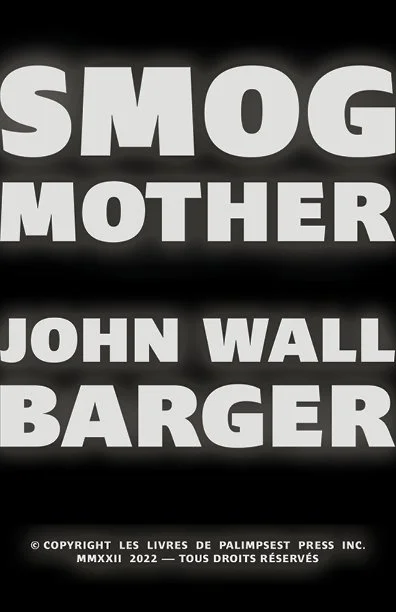
Review of Smog Mother by John Wall Barger

Smog Mother

Palimpsest Press

$19.95

You can purchase a copy here.

Reviewed by Sean Hanrahan


The first thing that may strike a potential reader of John Wall Barger’s sixth full-length collection, Smog Mother, is the evocative title. The word smog implies an intensity and is itself a portmanteau. The provocative and exciting poems in this collection unpack themselves slowly in the manner of a tightly packed overpacked suitcase. Barger begins the book with an apt epigraph from Margaret Dumas’ Hiroshima Mon Amor screenplay: “The illusion, it’s quite simple, the illusion is so perfect that tourists cry./ One can always scoff, but what else can a tourist do, really, but cry”? “Tourist” can connate a surface-level visitation by a disinterested party, but Barger’s poems suggest a rich interior and exterior travelogue. The more appropriate word for his persona is journeyer.

The poem begins with the eponymous, tripartite poem “Smog Mother,” co-winner of the Malahat Review Long Poem Prize. With it vivid, crystalline diction, “Smog Mother” reads like an overarching camera shot of the 2014 junta in Thailand:

Smog Mother your one broken heel
Smog Mother walking the edges of Bangkok at dusk
Smog Mother at the edges of the property
You chew gum on the edges of praise
You drag eyeliner along the banks of the river
Your fake leather purse is filled with burning bodies.

Nestled in the descriptive is a clever critique of consumerism: “The 7-Elevens glitter within you.” A common concept in poems of witness, such as this excellent example of the genre, is the announcement of the narrator’s own culpability. This poem forces the reader to examine their own culpability in the expansion of American hegemony. Like the best poems, “Smog Mother” reveals one poem inside the other as the layers fall away with each successive rereading.

Not only comfortable writing epic poems of witness, Barger can also expertly capture the intimate moments that can occur during routine journeys. “Woman on a Hong Kong Bus at Night” is an exquisite distillation of such an intimate encounter when a passenger falls asleep on the narrator’s shoulder:

Through my shirt
I feel teeth grinding, lips
forming ghosts of words, a trickle
of drool on my hand…

This moment of connection borders on the erotic: “Any wetness/ on the skin and we long/ for the first shores.” Vast stores of empathy are required of the narrator to experience such a moment with a stranger who first looked askance at him on the bus as he sat down next to her. This empathy is exemplified in the lines:

I wish this was a different world—
one where we can lean on a stranger
without shame.

“Samovar” is another impressive epic poem in this collection. The narrator and his wife, Tiina, are aboard the Trans-Mongolian Railway “bracing each other with laughter/ and sex against the cruel/ and absolute white nullity of Russia.” The poem starts in a cozy cabin and ventures outward through the train where “Russian mothers/ [are] playing mahjong on suitcases/ laughing without shame.” Through the course of the poem, the samovar comes to represent the narrator’s relationship with the important women of his life as a young husband, and even as a baby “afloat in a shopping cart.” The warm comfort of the samovar is another iteration of the mysterious, yet accessible, smog mother.

Barger’s remarkable capacity for empathy is evident in his heartbreaking portrait of a mother’s grief in “Parking Lot, Tibetan Parliament-in-Exile, Noon.”

A Tibetan woman in a striped apron
feeds a donkey
watermelon slices…
It is not essential to know
that this woman
(she who now pets
the straw mane of the donkey
making his brown eyes
go sleepy and soft)
had a son named Chaku
 who at fifteen
 soaked himself in petrol
 lit a match and held it

In his notes to this poem, Barger writes that self-immolation is a common form of protest against the Chinese occupation of Tibet. In his poems, the narrator moves beyond the mere tourist into a journeyer or a sole witness. The inessential knowledge is the essence of this poem. In his way, Barger is critiquing humanity’s (especially the West’s) too common indifference to tragedy.

He bravely asks the question, what can we do in the preface? But unlike many poets who pose such questions, he has an answer: show and tell their stories with a well-developed empathy. For anyone who feels disconnected from life and its myriad experiences, reading Smog Mother can reconnect you to the spirit of humanity. In these troubled times, Barger has penned a much-needed, and sure to be beloved, gift.


Sean Hanrahan is a Philadelphian poet originally hailing from Dale City, Virginia. He is the author of the full-length collection Safer Behind Popcorn (2019 Cajun Mutt Press) and the chapbooks Hardened Eyes on the Scan (2018 Moonstone Press) and Gay Cake (2020 Toho). His work has also been included in several anthologies, including Moonstone Featured Poets, Queer Around the World, and Stonewall’s Legacy, and several journals, including Impossible Archetype, Mobius, Peculiar, Poetica Review, and Voicemail Poems. He has taught classes titled A Chapbook in 49 Days and Ekphrastic Poetry and hosted poetry events throughout Philadelphia.

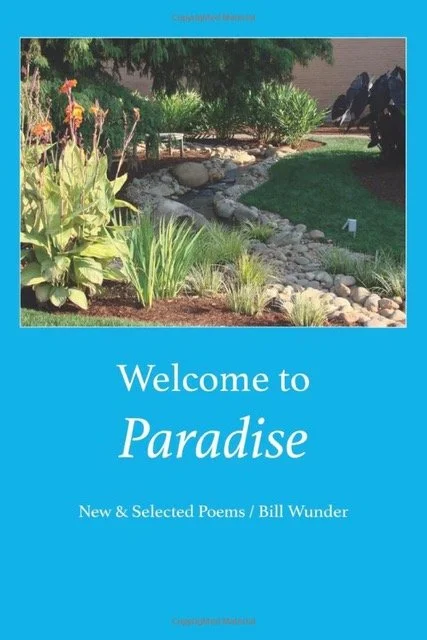
Review of Welcome to Paradise by Bill Wunder

Welcome to Paradise

WordTech Editions

$20.00

You can purchase a copy here.

Reviewed by Abbey J. Porter


Bill Wunder covers a lot of territory in Welcome to Paradise: New and Selected Poems, from the jungles of Vietnam to interpersonal relationships, and from to nature and its minions to the very cosmos.

Poems about the narrator’s experience in the Vietnam War are the hard-hitting, darkly shining stars of this fine collection. A Vietnam veteran, Wunder gives us an unvarnished look at the hard and horrifying realities of jungle warfare. In “Sniper,” the narrator is haunted by the memory of a dead combatant:

the sniper’s face, mouth
wide open, trying to


breathe back
his last gasp.

The narrator describes the deaths of one comrade after another. There’s Owens, who’s found tied to a tree with his throat cut in “Fireworks,” and Ignacio, who steps on a booby trap and has a moment to contemplate his inevitable fate before succumbing to it in “Ignacio Knew.”

In “Fireflies,” the narrator says,

I can’t figure out
how two VC emptied their clips at me
on the banks of the Ban Khe
and completely missed; why Madison, a big
quiet kid from Milwaukee, drowned
going for a swim in that same muddy river.

The poem articulates a question that winds its way through the book: “why/one man lives and another dies.”

Meanwhile, the narrator evinces deep doubt about the war. In “Dien Cai Dau,” he describes “Mama-san,” who “says we are crazy-in-the-head.” After saying “Tonight we leave base camp,” he adds:

Some of us will dull
our fear with dope. Some of us will never
be right again. Some will never come back.
We must be crazy to go out there each night.
He concludes, “Mama-san is right, we’re all Dien Cai Dau.”

Wunder eloquently illustrates the transformative effect of warfare on soldiers in “Replacements,” in which he describes young men newly arrived in Vietnam. They “think we are winning,” he says, and “have yet to slice off enemy ears/make them into a necklace.” Finally, he says, they “think they’ll make it out of here.”

The images and ideas of Paradise—which Wunder illustrates so effectively—haunt the reader as surely as the war haunts Wunder’s narrator. Even 40 years after leaving the battlefield, he grapples with the war’s unending aftermath and the unanswerable questions that linger about its losses.

In “Memorial Day, 2002,” Wunder describes a moment standing at the door of his attic, seeing what’s stored there (“fragments of fatigues/love beads we wore under them”) and reliving the sights, sounds and smells of Vietnam. And “Inheritance” describes another, cruel aspect of the war’s legacy: The narrator learns he’s at greater risk for serious diseases because of his exposure to defoliants. Wunder revisits this topic later in the book with the poem, “Dear Parkinson’s,” in which he writes, “Thanks for not stealing my sense of balance all at once/so I could get used to falling.”

War is the thread that winds through this collection, as integral to the book as it is to the narrator. But Wunder demonstrates a sure hand at writing about other topics, as well. The collection includes a number of what might be considered nature poems, though Wunder tends to bring the pieces back to a point of human importance. An excellent example is “Moose Sighting at Sunrise,” in which he describes a cow moose and her calf making their way in the woods. The poem takes a personal turn at the end: “If you hadn’t given up/on us, you’d have seen it too.”

Relationships also surface in other poems. An apparent mate struggles with cancer in “Burning Down the Village.” Childhood chums appear in multiple poems. And Wunder concludes the book with several poems about his father, including “Why I Didn’t Deliver My Father’s Graveside Eulogy.” In that piece, after the funeral, the family lights a candle of remembrance.

He’d be that breeze sneaking through
the kitchen window, trying
to blow out the skinny taper.
What light, so reliable
could ever be extinguished?

It seems that Wunder’s narrator may look outside himself for a source of meaning and order—especially in light of the seemingly chaotic losses he has witnessed. Astronomical bodies are recurring elements throughout the book—specifically, the moon and stars, which seem to stand in contrast to earthly realities. One notable poem is “Pointing at the Moon,” in which the narrator describes being in the jungle with a comrade and looking up to see “innumerable stars painted on/a Pollock sky.”

Miller thought that if he aimed right,
and if the drugs were pure enough,
one night his finger would touch the moon.


He never counted on that booby trap
blowing both his legs off, turning
the rice paddy around him a dull red.

Wunder demonstrates vast versatility in his subject matter, writing as eloquently about daffodils and songbirds as he does about heavier topics. His poems are highly accessible, their language almost deceptively simple.

This collection is both delicate and devastating, searing and stunning. Just as Wunder’s narrator appears irrevocably altered by his experiences, this book will leave a deep and indelible mark on its reader.

Abbey J. Porter writes poetry and memoir about people, relationships, and life struggles. She holds an MFA in creative writing from Queens University of Charlotte, an MA in liberal studies from Villanova University, and a BA in English from Gettysburg College. Abbey works in communications and lives in Cheltenham, Pa., with her two dogs.

Source: http://madpoetssociety.com/blog

Mad Poet of the Year - R. G. Evans (November 2022)

The Mad Poet of the Year blog posts share the poetry of a long-time Mad Poet. This year-long appointment provides readers with a deep dive of the writer’s work and thoughts on poetry. We are thrilled to have R. G. Evans serve as the Mad Poet of the Year for 2022.


WHEN A ROOM BECOMES LONELY
 by R.G. Evans

it feels its walls closing in,
the sad, steady movement of plaster
pressing around its empty-hearted air.
A room becomes lonely despite the other rooms,
their closeness no solace, their warmth uncomforting.
A lonely room is never empty,
but filled with echoes and ancient exhalations.
No one inhales inside a lonely room.
Loneliness makes a room aware of its lathe,
the bones that hold it up when it just wants to fall.
Its windows might just as well be doors,
its doors walls, its walls bereft of ceiling and floor.
When a room becomes lonely,
the house knows something is wrong,
but it has its own crowded attic to deal with,
mice in its basement, a pipe about to blow.


Q: How do you turn a Mad Poet into a glad poet?

A: Nominate his poem for the Pushcart Prize!

What better way to celebrate than to share the poem on the Mad Poets Blog? Many thanks to Heather Lang-Cassera and the editorial staff at 300 Days of Sun, the literary magazine for Nevada State College (luckily this time what happened in Vegas didn’t stay there!) and to Maria Mazziotti Gillan and Kevin Carey for providing the prompt and nourishment which inspired the poem. The room may still be lonely, but at least it knows it’s not alone.


R.G. Evans’s books include Overtipping the Ferryman (Aldrich Poetry Press Prize), The Holy Both, and Imagine Sisyphus Happy. His original songs were featured in the poetry documentaries All That Lies Between Us and Unburying Malcolm Miller, and his collection of original songs, Sweet Old Life, is available on most streaming platforms. Evans teaches creative writing at Rowan University. Website: www.rgevanswriter.com

Review of Casualty Reports by Martha Collins

Casualty Reports

University of Pittsburgh Press

$18.00

You can purchase a copy here.

Reviewed by Jennifer Schneider


In a world that doesn’t stop spinning amidst cycles of news (violence.loss.violence.loss) that don’t stop churning, sometimes memory is all we have. Both an anchor and a source of well-documented, research-based action, Casualty Reports grounds while simultaneously promoting change. The collection is both historical and future focused. The work prompts moments of pause amidst constant punctures of news (loss.violence.loss.violence). In a five-part collection that cycles through time, location, eras, and compounded casualties, Collins carves out space to reflect on the past and provides a toolbox that inspire future change. 

I first read the collection about a week after the passing of Loretta Lynn. The film, Coal Miner’s Daughter, was still fresh in my mind. In a 2000 interview, Loretta Lynn said "I didn't think anybody'd be interested in my life". Lynn continued, "I know everybody's got a life, and they all have something to say. Everybody has a story about their life. It wasn't just me. I guess I was just the one that told it." 

While Lynn may have been surprised at the interest others had in her life (Coal Miner’s Daughter was a hit, reaching number one on the Billboard country chart), she knew everybody has a story. In Casualty Reports, Martha Collins gives voice to stories too often silenced. She does so in varied forms, with a mix of stylistic variations that both personalize and distinguish the collection. Collins engages in story and takes on social issues across time and topic. Pieces offer commentary on coal mining (the collection’s two-part Legacy pieces), as well as gun violence, war, racism, and other social ills and ails. 

Pieces are expertly researched and carefully detailed. From “first European sightings of coal” (A History of American Coal Through the Lens of Illinois 7) to the moment “when all the coal in the mine where it works will be exhausted” (Now That’s Big 37), the poems inform (resist urges to conform) and engage (sometimes enrage). The collection laments loss (physical, personal, emotional, geological) and, somehow amidst the plentiful layers of such loss, leaves readers hopeful that, perhaps, there is still time and a way to change the course of the future. 

 Often referred to as a “premiere lyricist”, Loretta Lynn “wasn’t afraid to … write about what she truly felt” (Vaughn 2022). Nor is Collins. Like Lynn’s lyrics, Collins’s words linger – in layers of Legacy (Parts I and III), Reports (Parts II and IV), “And Also” (Part V). Collins, like a coal miner’s daughter, crafts a revealing narrative on the history of coal while also mining a collection that moves far beyond coal and remains grounded in love and a commitment to the pursuit of justice for those we love.

 My father’s father’s    father owned the
had a share in the   Enterprise mine the
Enterprise Coal & Coke   Company 1871” 
”(In Illinois”)

driving home from the grocery store with his girlfriend facing the cop with his hands up, stop don’t shoot
(“Four”)

 In the child’s book, on the same page, it’s bedtime in one house, breakfast time in another. Stars here, sun there. There’s more and then there’s less again. Then more, if not so much. Not the end.
(“And Bright Stars”)

Collins pulls back curtains, layers language in a variety of compass directions, and reveals interactions, experiences, and sentiments that are sometimes infrequently recalled. The work, completed shortly before the first death due to COVID-19 occurred in the United States and dedicated (in part) to the virus’s many casualties, is simultaneously reflective and forward-focused. In addition to COVID-19, Collins dedicates the work “to the casualties of racism inflicted by the police and others; in the United States and throughout the world” as well as to the memory of her father, William E. Collins, and her friend, Lee Sharkey. 

 Just as memorable as the narratives are Collins’s careful research and varied use of space. All aspects of the collection are infused with both intentionality and originality. Many of the pieces – from the collection’s first piece (“In Illinois”) to its final (“Of Late”) – play with form and space as if to prompt proactive pause, reflection, and contemplation in contrast to what is often only reactive in the event of casualties. The collection’s pieces and the intimate narratives they reveal (“Du Quoin” and “Two Little Miners”), two of many examples) convey and reiterate a memorable truth. Ultimately, we all carry stories both original and universally relatable. 

The collection is as much a repository as a reflection. From the origins, observations, and revelations of youth (One, Two, Three, Four, Five 25-29) to the finalities and questions of death (“For Gaza”). From the physical realities of latitude and longitude (“Cambridge 2019” and “L’Ultimo Viaggio”, two examples) to the recollections and connections of generations past (“Grave 33”). Casualty Reports digs deep and engages, then reengages, with life in its many dimensions. Of its multiple cycles. Of its never-ending questions. And, of course, its relentless casualties.

The collection is simultaneously personal and anonymous. Simultaneously of the past and the present. While many of the pieces celebrate the life of coal miners in Illinois (with many inspired by Collins’s family), one need not be from the region nor have any prior personal connection to coal mining to appreciate the power of the poems. 

It’s deeply satisfying to read a work that inspires while simultaneously and consistently inciting fury – a work that prompts reflective melancholy and sentimentality while promoting action amidst agitation. Casualty Reports, by Martha Collins, is such a work. The work is honest, raw, and real. It is as informative (and carefully researched) as it is instructive (many of the pieces adopt unique forms). Readers will be moved on multiple levels - societal, literary, personal. Read it, then reread it – perhaps while listening to “Coal Miner’s Daughter” on replay. It’s a deeply worthwhile way to spend a day. 


Jen Schneider is an educator who lives, writes, and works in small spaces throughout Pennsylvania. She loves words, experimental poetry, and the change of seasons. She’s also a fan of late nights, crossword puzzles, and compelling underdogs. She has authored several chapbooks and full-length poetry collections, with stories, poems, and essays published in a variety of literary and scholarly journals. Sample works include Invisible Ink, On Habits & Habitats, On Daily Puzzles: (Un)locking Invisibility, A Collection of Recollections, and Blindfolds, Bruises, and Breakups. She is currently working on her first series, which (not surprisingly) includes a novel in verse. She is the 2022-2023 Montgomery County PA Poet Laureate.

Fiction for Poets

Fiction for Poets


in which one poet writes to other poets about writing fiction


Plot for Poets

Plot – or more accurately lack of plot – is probably one of the main reasons why I write poetry. Action is not the point. A poet is rarely asked: “So… what happens in your poem?”

Sure, we get: “What is your poem about?” or “What does it mean?” And then we have to wrestle with an appropriately “poetic” sounding response: It’s about the time I narrowly avoided hitting a fox on my way to work. Or …the bond between humans and animals. Or …the existential angst of young motherhood. Or my personal favorite: I could tell you what it means to me, but I’m more interested in hearing what it means to you. In other words: I have absolutely no idea what it’s about.

The point is: when I write a poem, I don’t have to think about things like rising action or falling action, the three act structure, or (god help me!) the arc (at least not consciously… but that’s a conversation for another day). As far as I’m concerned, that’s a very, very good thing – because, of all the overwhelming, slippery aspects of fiction, for me plot is the most overwhelming and slipperiest. In fact, until a year and a half ago, I was pretty sure I couldn’t successfully plot a story about crossing a room.

But when I found myself writing a novel, I realized I was going to have to reckon with my fear of my plot, and I’ve done that by approaching it in the most simplified terms. To be clear: “Simplified terms” does not equal simplified stories. Rather I’ve found three approaches that seem to apply to almost every good story while also demystifying some of the circumspect, lit-speak that can be mysterious and intimidating.

So, here they are…

Three basic ways that I like to think about plot.

Individually and together, the three ideas below have expanded my understanding of plot –  not just what plot is or how you do it, but why it’s important. I believe they’re analogous to the various camera perspectives in film – moving from the widest, long shot that takes in the whole thing without a lot of granular detail; to the medium shot that moves in closer, but is still focused on mostly broad strokes; to finally the zoomed in close up that really starts to hone in on details. I find this helpful in terms of thinking about whether a story is working overall and then considering how to refine and strengthen the way it works.

1. Energy transfer.

George Saunders describes plot as a transfer of energy. In A Swim in a Pond in the Rain (recommended in my first post), he writes:

We might think of a story as a system for the transfer of energy. Energy, hopefully, gets made in the early pages and the trick, in later pages, is to use that energy. (p. 35)

and

Energy made in the early pages gets transferred along through the story, passed from section to section, like a bucket of water headed for a fire, and the hope is that not a drop gets lost. (p. 54)

I love the idea of the energy transfer because it is something that we naturally sense – especially poets. As both a and a reader, I can usually feel when something has energy and is moving; I can also feel when it is losing energy (maybe going off course or becoming less interesting). Saunders’ explanation gives us the freedom to trust our writerly instincts without applying some rigid external rubric, model, or structure.

So... as you write, ask yourself: Is there energy here? Is it moving? Am I losing any of it? How do you know if there's energy in a story? Well, it’s not much different than knowing if there’s energy in your poem. Do you feel compelled to keep reading? Do you feel propelled forward? Does each line make you want to read the next?

As poets, we do this all the time – not necessarily in the same way, but we do it. The moment I realized that, I knew I had within me the power to make a plot work in my own way.

 2. The Main Moves

A few years ago, I asked a friend of mine, a fiction writer, to explain plot to me. This was her response:

3. Story Beats: But... Therefore...

Everyone’s seen South Park, right? If you haven't, stop what you’re doing and go watch an episode – any episode will do. It’s an incredible show (however crass or offensive it may be at times), and it’s been around forever, partly because Matt Stone & Trey Parker know how to put together a solid story.

Check out this two-minute video in which they offer some of the most simple and useful advice available for thinking about and moving through a story.

"But... Therefore..." Matt Stone and Trey Parker (South Park) Plotting Advice

I find this helpful for both planning and evaluating. If you’re the kind of person who outlines, you can think about your bullet points as being strung together by but’s and therefore’s. Or, if you’re reading through something you’ve already written, ask yourself if it’s being held together by but’s, therefore’s, or and then’s. If we go back to Saunders’s idea of energy transfer being like “a bucket of water headed for a fire, and the hope is that not a drop gets lost,” we can see that these are the places in our stories where water is tipped from one bucket into the next. Every “and then” is a place where the water spills a little, the momentum is lost; those are opportunities for  more causality, consequence, and ultimately tension.

As I said, poets are rarely taken to task about what “happens” in our poems, yet I believe most of us have a greater capacity for plot than we know. So much of poetry is a meditation on how and why things happen around us. As such, poets are keenly attuned to those moments in life where the energy transfers happen. If we take the time to try, I think many of us could plot – not just successfully but beautifully.


Autumn Konopka is a writer and teaching artist who enjoys coffee, running, and reggaeton. She's currently working on her first novel, which she expects to publish in early 2023. Find her online: autumnkonopka.com.

Local Lyrics - Featuring George Schaefer

CLEAR PATHWAY HOME
by George Schaefer

Quietly nursing a beer
anxiously awaiting a cup of chili
listening to two young ladies
that somehow lost their way—
couldn’t rent a car
couldn’t get a hotel,
missed a concert, had a 5 AM flight

a lot of porno flicks start out like that
but I’m not qualified to direct or star
I come up short
in both categories
no skill with a camera
and well, you know
we don’t need to go there
It’s not common decency
keeps me from posting dick pics

I wish I had words of wisdom
or at least some witty repartee
but I sit quietly sipping beer
a game is played by God knows who
airing on a flat screen TV
I feign interest in the action
It’s fucking baseball
I’d have a better chance popping a boner

watching paint dry on a fence

the two young ladies converse
with an elegant elderly woman
they’re having a good time
in spite their run of bad luck
I can see I’m not needed here
but the chili is warming
and I have a clear pathway home
and a dog waiting there
that actually does think I’m special


What calls you to write poetry? Why is it the medium for you?
I started out as a shy, lonely kid in high school.  I started writing poetry in a desperate attempt to attract girls.  Of course, it didn’t work.  It probably made me even weirder than I already was.  The girls still ignored me.  That rejection did give me a lot of time to work on honing my craft and hopefully I’ve improved a little over the past 41 years.

Poetry has largely become my medium due to laziness.  I tried my hand at writing novellas and longer prose works.  I don’t have the attention span.  Also, 90% of my writing is originally done longhand.  Shorter works are less likely to induce carpal tunnel syndrome.  I need my wrists healthy for other ends—but let’s not go there.

I really enjoy the haiku-style travel/journal logs you post on social media. Do you write everyday? How do you decide what to mold into poetry?
Do I write everyday?  Fuck, No!  I don’t even try.  I’ll ride a hot streak while it lasts but it’s okay to take days or even weeks off.  Americans don’t value vacations and relaxation.  You need vacations from work to recharge your batteries.  Personal days and vacation days away from the is also a pleasant respite.

Iridescent jewels lay buried deep within the soul waiting to be excavated.  I struggle for the pure stream of consciousness as twisted ideas rampage through my mind.  I recklessly splatter and sprinkle words across the page in mock rhythmic cadence.  It’s been suggested in some circles that I am a poet.

Now when inspiration strikes, I usually let the words and images take over.  They start writing themselves.  I start listening to the words in my mind and that starts the decision on how it will take shape.  I envision myself reading the words out loud as I write it on the page.  Sometimes it can be a senryu or a tanka.  Some works come out as haibun or free verse.  Revisions are possible if I wake up the next afternoon thinking WTAF!

Many of your poems reference The Grateful Dead and the beat lifestyle that goes along with going on tour. How has the band influenced you?
There was a point in my life when I started to notice that as I was traveling around the country there was this band called the Grateful Dead that was following me around the country.  But the adventures on the road were paramount and as G.G. Allin once noted, “The Dead are the true punks.  All the punks were conformists getting tattoos and mohawks to assert their individuality by being like everyone else.  The Dead did their own thing if was cool or uncool.  It was their thing.”  That’s just a paraphrase and not the exact quote from G,G but I think it speaks volumes about their influence and range of influence.   It’s okay to be different than everyone else.  There were many crazy moments in many cities across the country.  What I remember gets committed to the page.  I don’t fully trust my memory of said events but I’m not entirely sure how much it matters.

 You live in Philadelphia. Does the city seep into your poems?

Don’t know what youze people are talking about.  I drink wooder from a crick.  I am quite fond of this town although I never booed Santa Claus,  I still feel guilty about consorting with his wife.  I don’t know if Philly seeped into my writing but I’d like to think that my writing seeped into Philly.  I love when I can write something about Philly.  Philly is rough around the edges and a bit funky at times, but it has its own pulse.  I try to throw out props to many fine watering holes and restaurants and other city institutions.  If I ever get outed on my love affair with Gritty, that could end up being a whole volume unto itself.  I shall take the high road and say nothing about a city that rhymes with Alice.

Simple experiences seem to drive a lot of your writing (one of my favorites is Chicken Vindaloo from Thru Peripheral Vision). Do you consider yourself a practitioner of mindfulness?
I try to base my writing on my experiences-both real and imagined.  The poetry is really a hybrid of fact and fiction.  I’m not always sure where one ends and the other begins.  I wouldn’t tell you if I did.  As for mindfulness.  Does dropping acid count?  But seriously, I try to maintain an awareness of everything going on around me and finding ways to work it into my writing.  I listen and observe. I warn people to copyright their life.  I bloody well might steal it if you don’t.

As for the poem you cite, that one got rejected 4 times, but now I find out I was sending it to the wrong editors.  Glad you like it.  I try to write about my experiences and anyone sees me will know that I do enjoy food.  I tend to just include everything since I’m the worst judge of my own work.  Poems I think are throwaways get good commentary and resonate with different people.  The stuff I really love and feel proud of is often ignored.

Where can readers check out more of work work/buy your books? 
There are 8 titles available on amazon.  More to come.  I have nearly 3,000 poems and prose pieces on a website called postpoems.org.  That site includes most of my published works.  There are poems all over social media and other writing sites.   There are also a bunch of chapbooks that I put together in my apartment when I get bored.  They are available to anyone that visits my apartment or if I carry some in my backpack on my ventures.


George Schaefer is a would be raconteur born in the City of Brotherly Love.  This poet, philosopher and prankster has been writing for over 40 years.  He started out in an ill fated attempt to attract girls.  He keeps writing since he doesn’t know what else to do with his mind.  There have been various chapbooks and poetry titles published.  Among poetry titles are Thru Peripheral Vision, Just When You Thought It Was Safe to Do Poetry Again and Choke the Chicken (Or Auto-Erotic Asphyxiation Gone Horribly Wrong.  There is also a series of short poetry forms called Not So Fancy Tanshi.  The first in the Not So Fancy Tanshi series is called Delightfully Weird.


John Wojtowicz grew up working on his family’s azalea and rhododendron nursery in the backwoods of what Ginsberg dubbed “nowhere Zen New Jersey.” Currently, he works as a licensed clinical social worker and adjunct professor. He has been featured on Rowan University’s Writer’s Roundtable on 89.7 WGLS-FM and several of his poems were chosen to be exhibited in Princeton University's 2021 Unique Minds: Creative Voices art show at the Lewis Center for the Arts. He has been nominated 3x for a Pushcart Prize and serves as the Local Lyrics contributor for The Mad Poets Society Blog. His debut chapbook Roadside Oddities: A Poetic Guide to American Oddities was released in early 2022 and can be purchased at www.johnwojtowicz.com. John lives with his wife and two children in Upper Deerfield, NJ.