Local Lyrics - Featuring Brit Marshay

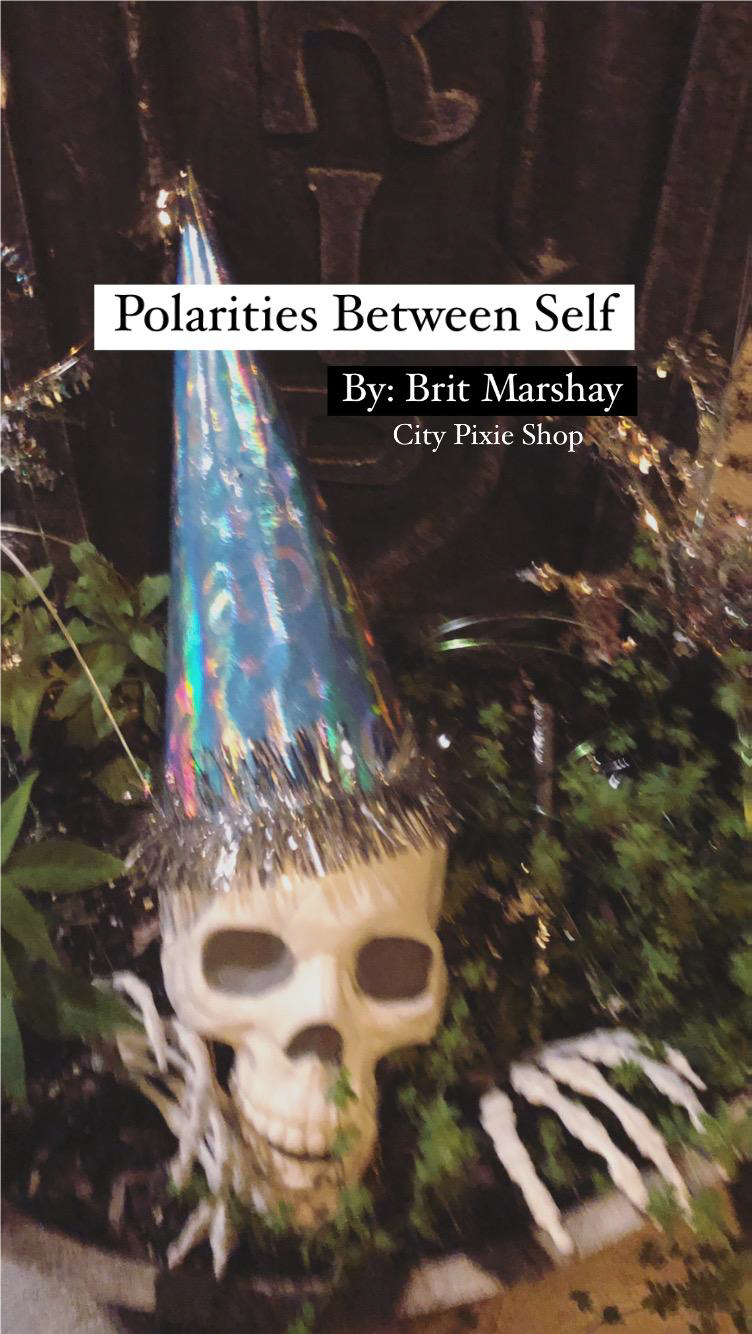
Polarities between self
by Brit Marshay

I’ve been wondering the difference between you and I, the distance between us..

The difference between us is when I see a fallen tree in the middle of my path, it becomes a table for two, a footstool for giant forest dwelling trolls and refuge for frogs to safely sing their evening tune, a home for fairies to roam between the hollow wood and fabric of time.

You see that same tree as rotting rubbish, blocking you from a fragmented finish line desperately seeking a “good job” in the end.

Lately, I’ve been wondering about the distance between you and I..

It has become apparent that the distance between us is aching to be understood.

I come back to that fallen tree deep in the wood behind my ribs and I remember,

I am exactly where I need to be.
 
polarities between self.png

What are your muses? What gets you revved up as an artist?
This is a great question, I often find inspiration in nature, the beauty as well as the destruction. Death, rebirth, the challenges that cycle can bring forward. I am passionate about creative expression. Oftentimes, the idea of clowns and uncomfortable spaces provoke my inspiration as well as painting my face and dancing to avant-pop or anti-music. A few of my favorite artists, The Space Lady and the great Daniel Johnson influence my naivety. I often pull from my own life experiences such as losing my parents at the age of 15, surviving cancer and living and navigating those losses on my own.

Much like the first question, what really brings me to life is pulling deep from the core of painful experience. Bringing forth unspoken emotions and translating that into art, that’s my jam. I love the duality of life. I consider myself a maker and so collaborations of all sorts whether that’s in conversation, singing, dancing, working on a project with others, that really gets me going. I strongly believe we are all artists so what really turns me on to the arts is when it’s accessible to everyone.

Your poems have strong emotional cores and often feature the fantastic. What’s your relationship like with fairies and other woodland creatures?
I have always used escapism to cope with my life, I am a dreamer, it’s in my blood. I found mystic beasts and folklore later on in life and immediately felt connected to the stories and creatures that I’ve welcomed into my world. The thing with fairies is they are tricky little things, they’re quick and mischievous, they can be bribed with treats, and they play on their terms.

Those are qualities of mine that I have also embraced over the years. We can learn a lot about ourselves by diving into other worlds and admiring the mysterious.

In addition to writing poetry, you have a traveling boutique and Etsy shop called City Pixie Shop. Are there similarities between making jewelry and writing poems?
You know, City Pixie Shop is a passion of mine for several different reasons. just like poetry. It’s sort of a reclamation and celebration of my life lived. When I decided to get sober, City Pixie Shop was my way of working through years of neglect, using my hands to create has helped me work through so much mentally. Similar to poetry, when I write, my goal is to express my rawness, to really be in the moment, it’s meant to give hope and shed light on dark places in hopes to influence others to express and honor their pain/creativity.

What is your process like when that all possible blank page is in front of you?
I love this question, my process is a bit scattered when it comes to creation and writing. There isn’t much thinking when I’m in my flow. I find that I write best when I’m full of unprocessed emotion or if I’m pulling from past experience. I write to heal myself.

If I’m feeling romantic, love, genuine connection, or sensual the words seem to flow out onto my page.. when I’m angry, frustrated, full of fire, these are the moments I can go to my blank page and spill my guts.

Where can readers find more of your work? Check out City Pixie Shop?
I would love to start a website and blog this winter to compile the likes of all my creative outlets for City Pixie Shop and my personal writings. For now, you can check out my instagram @Citypixie_shop and my etsy for jewelry. I occasionally post poetry on my personal page @S.oftdust on instagram as well.


brit.png

Brit Marshay is a Philly based artist/maker. She has been creating and writing all her life from making earrings out of paper clips and staples in grade school to now owning and operating an online jewelry store based out of her downtown studio apartment. Mixed media and the power of spoken word have healed her in many ways. Art and free form writing are two of her favorite ways to celebrate creative expression and to honor the life she’s lived.

“Catfish” John Wojtowicz grew up working on his family’s azalea and rhododendron nursery in the backwoods of what Ginsberg dubbed “nowhere Zen New Jersey.” Currently, he works as a licensed social worker and adjunct professor. He has been featured in the Philadelphia based Moonstone Poetry series, West-Chester based Livin’ on Luck, Mad Poets Society, and Rowan University’s Writer’s Roundtable on 89.7 WGLS-FM. Find out more at: www.catfishjohnpoetry.com.
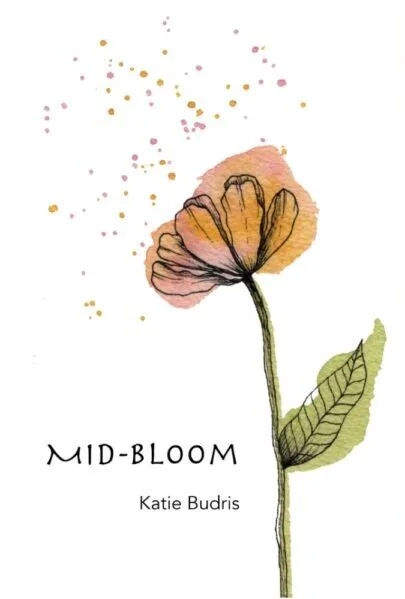



Review of Katie Budris’ Mid-Bloom

Review of Katie Budris’ Mid-Bloom

BUDRIS-KATIE-WEB-600x600.jpg

Mid-Bloom

Finishing Line Press

$14.99

You can purchase a copy here (pre-orders ship August 13, 2021).

Reviewed by Abbey J. Porter


Katie Budris’ recent chapbook, Mid-Bloom, is about survival—survival of the narrator when, as a young teen, she loses her mother to cancer, and survival of the narrator herself when she too faces a cancer diagnosis.

In this 19-poem collection, South Jersey resident Budris explores the shape of loss and change brought about by disease, in part by looking to the natural world.

Budris opens the collection with “5:00pm, Weeknight,” a glimpse of the narrator’s life at 13—presumably, before her mother became ill. In this world, the narrator’s biggest concern is dealing with pre-algebra. Her mother, a piano instructor, taps out time in another room—an unseen but nonetheless comforting presence. Here, we can count on small pleasures and rituals:

Dad will mash the potatoes
just the way I like them, serve dinner on
Mom’s floral china, placemats, oak table, grace.

Budris introduces the frailty of life in “Keeping Things Alive,” in which she describes the plants lining her window ledge—"bamboo shoots, devil’s ivy, an elephant bush,/two cacti, one orange, one yellow.” She details the efforts made to meet the plants’ needs: new pots, different windows. But among the stems and leaves, Budris finds her blue Betta floating dead in his fishbowl—a discovery that shakes her. She scribbles a note for her sleeping partner: I’m afraid all the plants are dying. Her sentiment suggests that the Betta’s death heralds a larger, systemic failure.

In perhaps the most baldly confessional, unabashedly grief-shocked poem of the collection, Budris shares the immediate aftermath of her mother’s death in “The First Morning.” Her voice is frank and vulnerable:

I know it’s almost noon,
but I don’t want to get out of bed.
You are not here…

I’ve never done this
before. Said goodbye
forever.

Nature is a recurring theme in Budris’ poetry. In “How to Survive a Blizzard,” she observes how a family of cardinals reacts to a winter storm:

They know
the best protection from a blizzard
is not to fly, but to burrow, escaping
the elements by surrounding themselves
in a cave to keep warm, wait out the storm.

One feels these lines speak also to the “storm” Budris weathers, and that the birds’ method of sheltering in place applies to her as well.

“Mid-Bloom” is another poem that looks to the natural world. Budris reflects that “My whole adult life, I have failed to keep/ a plant alive beyond a few months.” She goes on to reminisce about planting flowers with her mother when she was a child.

I’m not sure where in the last thirty years I lost
my green thumb. But there
in the backyard, my mother knew
I was capable, nurturing, and strong. As if
she knew I would be on my own
much too young when she left this world
much too soon, a flower mid-bloom

The poet also writes of her own experience with breast cancer, from diagnosis to hair loss. In “If Things Were Otherwise,” this experience brings her closer to her mother as she imagines an alternate reality in which her mother still lives. She contemplates the effects of the disease that she shares with her mother, to whom she has “never felt closer,/connected by cancer.” She concludes, “This time, we’re both cancer patients./This time, I’d understand.” Ironically, the disease that took her mother’s life also binds the two women.

A poem that stands out to me is “Waiting for the Blue Line, Chicago.” Budris describes toeing and leaning out over the colored stripe running along the platform, meant to warn passengers to keep back. 

She wonders whether
she could see the train coming better from down there—
white cyclops barreling
out of the darkness

The narrator balances, literally and figuratively, pulled by an impulse that reminds me of Poe’s “Imp of the Perverse”: “There is no passion in nature so demoniacally impatient, as that of him who, shuddering upon the edge of a precipice, thus meditates a Plunge.” I admire the subtlety and shiver-inducing quality of the poem. In addition, “Waiting” strikes at the heart of the survival issue, asking whether the narrator can withstand the most dangerous force of all—the one that vacillates within her.

These accessible poems share the writer’s pain and hard-won wisdom with a quiet ferocity, and their impact lingers like the scent of a summer bloom.


Abbey J. Porter writes poetry and memoir about people, relationships, and life struggles. She holds an MFA in creative writing from Queens University of Charlotte, an MA in liberal studies from Villanova University, and a BA in English from Gettysburg College. Abbey works in communications and lives in Cheltenham, Pa., with her two dogs.

Source: http://madpoetssociety.com/blog

Profession: Poet

Profession: Poet is a new monthly blog feature exploring craft and identity in poetry by Hanoch Guy, who writes poems in both English and Hebrew.


The “Law and Order” brain


In this blog post, I examine the neocortex/new brain, which is the new kid on the block.

The origin of the neocortex is surprisingly recent, evolutionarily speaking. It dates back to reptiles of the Carboniferous Period, about 359 million years ago. It emerged then as “a uniform, six-layered sheet consisting of radially deployed neurons” in the first small mammals who appeared during the transition of the Triassic and Jurassic periods. (Mental Floss: November 17, 2016. Read this article here.)

The cortex comprises two-thirds of the brain. It sits over and around most of the brain. It is highly developed and responsible for thinking, perceiving, producing and understanding language. The new brain has six thin layers of gray matter, folded like a wig. Familiar with Hercules Poirot and his little gray cells?

The two hemispheres of the neocortex work in concert, so for clarity, I will write about the left hemisphere first.

It should be emphasized that the capacities should be viewed as metaphors, as many actions and capacities are present in the different parts of the brain.

For now, let’s talk about the left hemisphere. 

From a long list of attributes of the left hemisphere’s functions and capabilities, here are a few:

  • Linear

  • Rational

  • Objective

  • Precise

  • Concrete

  • Exact

  • Punctual

  • Sequential

  • Mother language

  • Rules

  • Judge

  • Order

  • Cause and effect

  • Counting

This is quite a list and it is incomplete!

So the main question we can think about is, what do any of the traits on the list have to do with poetry?

Inspiration and spontaneous ideas are part of the writing process, and it can also be beneficial to be aware of how the previously mentioned capacities strengthen planning, organizing, and mapping while editing a poem.

 Take a look at the list and pick some of the left-brain skills you can use more consciously to enhance your poetry.

Sonnets, sestinas, and ghazals require application of a specific order, counting, and sequencing.

Putting together a manuscript is not a haphazard process. You need to evaluate, arrange in order, choose which poems to include according to a theme.

All of this is a call to action using many left-brain capacities.

Can you come up with more examples of the use of left-brain capacities in poetry?

Next month, we will talk about utilizing the magnificent and expansive right hemisphere to enhance our poetry.


Hanoch Guy Ph.D, Ed.D spent his childhood and youth in Israel. He is a bilingual poet in Hebrew and English. Hanoch has taught Jewish Hebrew literature at Temple University and poetry and mentoring at the Muse House Center. He won awards in the Mad Poets Society, Phila Poets, Poetry Super Highway and first prize in the Better than Starbucks haiku contest. His book, Terra Treblinka, is a finalist in the North Book Contest. Hanoch published poems in England, Wales, Israel, the U.S., and Greece. He is the author of nine poetry collections in English and one Hebrew book.

Mad Poet of the Year - Ray Greenblatt (July 2021)

The Mad Poet of the Year blog posts share the poetry of a long-time Mad Poet. This year-long appointment provides readers with a deep dive of the writer’s work and thoughts on poetry. We are thrilled to have Ray Greenblatt serve as the inaugural Mad Poet of the Year for 2021.


unsplash-image-8fqOgrrw9eI.jpg
 

ON THE PARIZSKA

 by Ray Greenblatt

It is close and threatening today,
I feel as if I must push
through the crowds of ectoplasm
in dark robes and cloaks
gold circle on the breast
or high gilt hat perched,
on what is now a fashionable
avenue of upscale stores
once the dirt-rich street of
kosher butchers, bakers, cobblers
a Ghetto surrounded by walls.

          In the Prague cemetery
          moss-draped
          pock-marked
          lightning-split
sometime cedar fused with rock
the gravestones lean
together for balance
huddle for comfort.

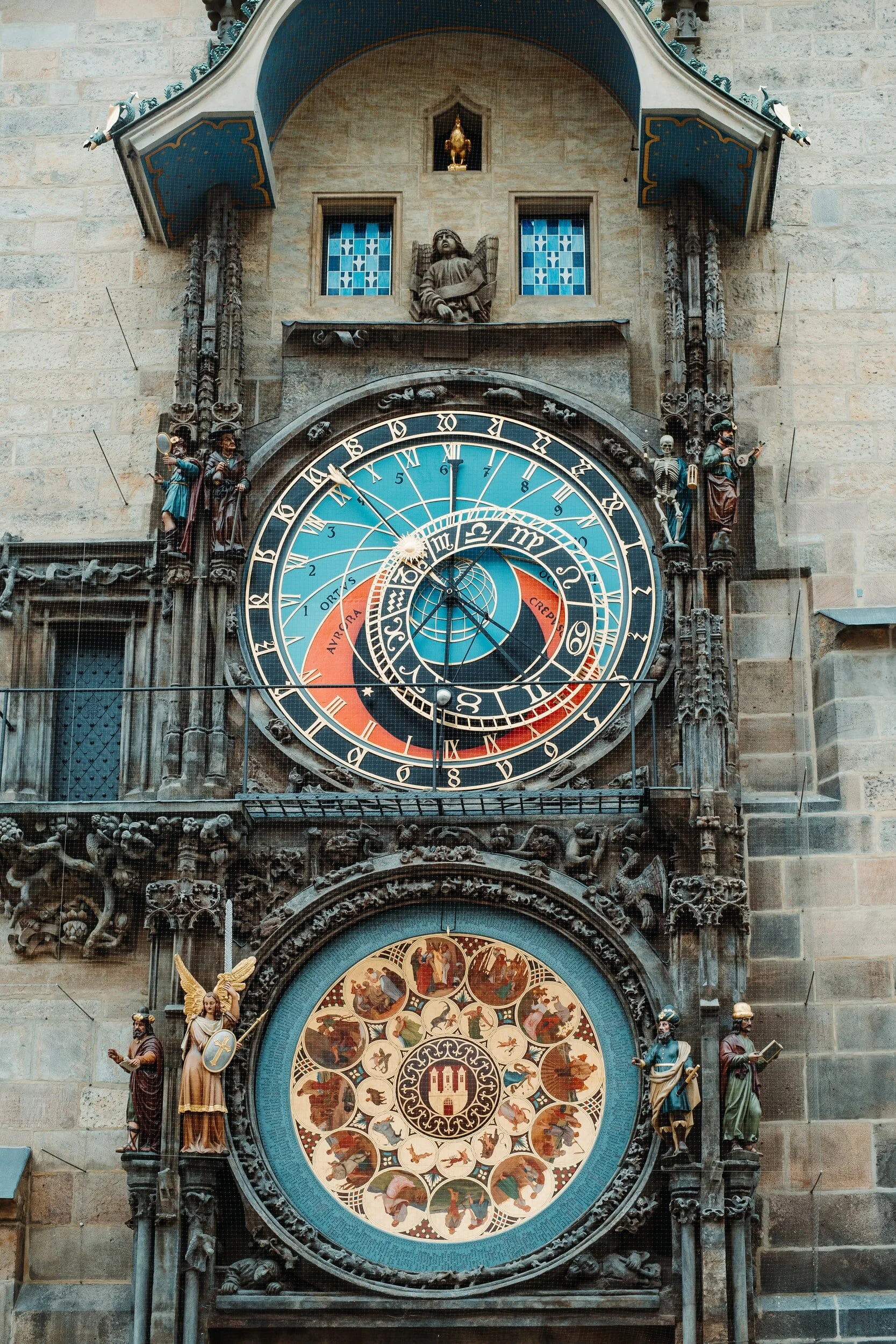
When the clock tower tolls the hour
the astrological signs
suggest the future,
through an opened window
one-at-a-time pass
the Disciples looking down
indifferently or
with a scowl prickling beards,
into the town square where throngs
of tourists are lectured in
Czech, French, Chinese
among many others
the babble of the world.

          And I in my high-tech hotel
          in my spacious suite
          of paneled rosewood
bath of Carrara marble
in full weight cannot
hold down history
vitality, the wailing.


A mere eighty years ago, most of Europe looked away as the Nazis attempted to wipe the Jewish people off the face of the earth! Ironically now in recent years all over the continent, certain tourist destinations are fashionable: Jewish synagogues, Jewish cemeteries, Jewish streets or neighborhoods, any piece of Jewish history— now have shiny brass plaques attached. Where was humanity when it was most needed?


Ray Greenblatt has been a poet for forty years and an English teacher longer than that. He was an editor of General Eclectic, a board member of the Philadelphia Writers Conference, and is presently on the staff of the Schuylkill Valley Journal. He has won the Full Moon Poetry Contest, the Mad Poets Annual Contest, and twice won the Anthony Byrne Annual Contest for Irish Poetry sponsored by The Irish Edition. His poetry has been translated into Gaelic, Polish, Greek and Japanese.

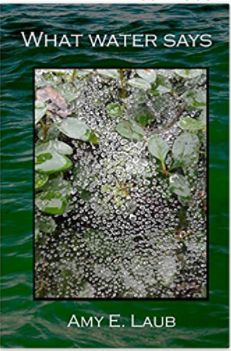
Review of Amy Laub's What Water Says by guest blogger Anthony Palma

what water says.PNG

What Water Says

Parnilis Media

$10.00

You can purchase a copy here.

Reviewed by Anthony Palma


At first glance, Amy Laub's What Water Says is a collection of poems that explores the theme of water, but beneath the surface it is a lot more than that. From the first standalone poem, from which the collection gets its name, we see that this book is a meditation on a lifelong elemental love affair. Laub examines water in all its forms, with each section of the book dedicated to one of its different manifestations. Water comes in the form of a storm, one that a young Laub experiences as the bringer of days off. It comes as a pool enjoyed by young girls that Laub witnesses as an adult. It departs as the casualty of a broken marriage, and then returns as a quiet creek of peace enshrouded by a forest and its trees.

In less able hands, a collection like this would be nostalgic and cliché. However, Laub's deft pen and singular voice make this collection a masterclass in control and craft. Each poem seems to have just enough language to leave us intrigued yet satisfied. We are shown what things and emotions are there, and we are left to fill our heads with the wonders of what Laub delicately presents to us. This book may be about the relationship between the author and water, but I am thoroughly in love with this book.


20200902_073011.jpg

Anthony Palma’s work attempts to bridge the gap between poetry and other forms while addressing issues of social justice, identity, and existence. His work has appeared in publications such as Rue Scribe, Oddball Magazine, and the Show Us Your Papers Anthology. His debut collection of poetry, flashes of light from the deep (Parnilis Media), is now available on Amazon. Be sure to look him up on social media at anthonypalmapoetry.

Local Lyrics - Featuring Kailey Tedesco

nursery rhyme
originally published in The Journal
by Kailey Tedesco

there is loss in the haus of loss—all of us
            embroidered in horror, twigs coming up 

from the back of our throats. i don’t want to know
            what is on the other end of the telephone. all of my parents          

become motherships. my favorite mother UFOs
            to me from her haus of tea—cups & saucers, hand-painted, 

gable her a-frame. i wake bruised in crop-circle, all 
            my flesh a runway of inexplicable. there are woods

in the haus of wood. all the trees woozy, teasing 
            a fall. when the murderer comes from the grave

with matchsticks, we will tell him to take everything
            he wants, but only if we are not there to see or hear him. 

there are dreams in the haus of dreams. i fight 
            sleep & wake to find myself sheared, stuffed

with stones. my gut fauna surrounds me in a vigil, 
            all my sweet demons. there is a flood in the haus of flooding. 

the lake waltzes, but doesn’t wave. i wake when my body
            won’t, scarleted in nightmare, pins & needles  

in my ears. there is sleep in the haus of sleep, 
            but so little. 

 
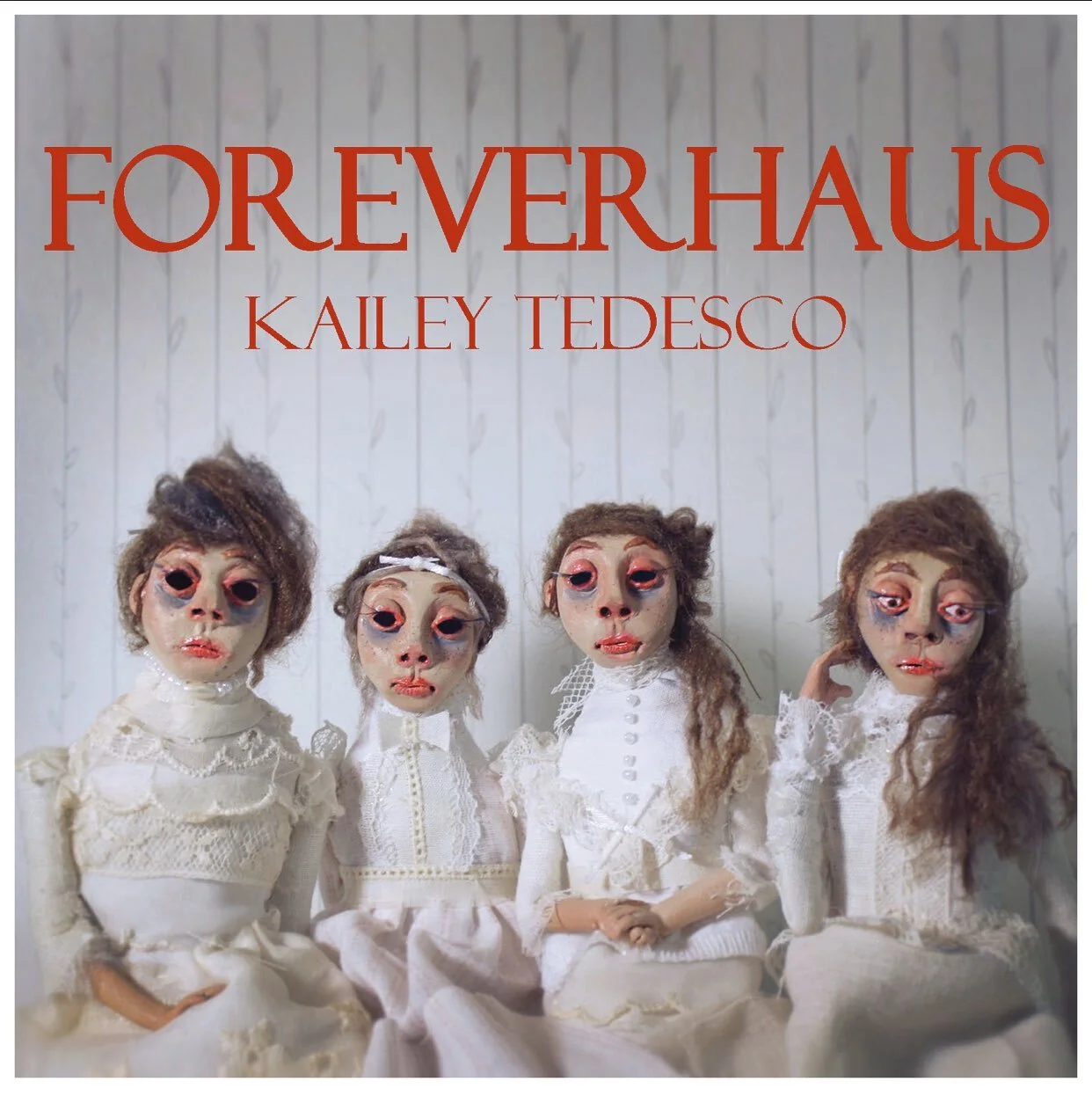
Cover.2020.jpg

Your poems have a gothic/horror/occult flavor to them. As popular as Edgar Allen Poe’s work is, there surprisingly aren’t a lot of poets working in this genre. What drew you to it?
My favorite thing about these genres are that they often are based upon a truth that is difficult to explain, and then through the lens of horror or the occult, the creator can seek to explain something that may, in the end, actually be unexplainable. That’s the magic in it all. This journey is often what I seek in my own writing, but in my reading and other media as well. Nearly all of my poems begin as straightforward confessionals based on something personal or truthful happening, and then they sprawl into something more illogical or fantastical or gothic as I crack them open wider and wider. For example, I’m in my second trimester of pregnancy now and at the same time working through some serious mental health issues for the first time. I’m absolutely nowhere near the first writer to explore pregnancy and mental health through the lens of horror, but I found myself surprised, nonetheless, by how easily these real life experiences lent themselves to these genres. My baby’s tiny hand running down my abdomen is beautiful and real, yes, but also the more I think about my body not being totally my own at the moment, the more disturbed I get. I strive for my poems to exist in these moments of disturbance and bewilderment, where things are both very beautiful but also very frightening.

One of the qualities of your work I really appreciate is that the worlds you create are breathable. They have that strange but hauntingly familiar quality. What are your strategies for grounding your poems?
Thank you! I teach a first-year writing course at Moravian College called Folklore and Legends: The Narratives we Choose to Believe, and one of the first things we look at when examining folktales as a genre is how these stories often begin in the realm of truth and then expand into the make believe. I like to apply that general narration style to poetry which is why I often begin with a more straightforward confessional or something very matter-of-fact. I love hauntings—the word haunting, the experience of being haunted, hauntings as a genre trope, a haunting cup or tea or bottle of perfume—the whole entire deal. And I think the coolest thing about hauntings is that they are, in all of their forms, so palpable and ubiquitous. I’ve never not been haunted, and the most unsettling thing about that feeling is that it’s already grounded in everyday experiences more than we might initially think. This is what makes authors like Shirley Jackson so fantastic—she writes about how ghosts and the occult mingle with the rigamarole of the everyday. A jar of jam can be haunted just as easily as a Victorian murder house can be. Those familiar hauntings are more or less what I hope to explore in my own writing.

How do you humor and explore poetic fascinations and preoccupations without getting too self-indulgent?
I think I’d say that I’m of the mind that self-indulgence in poetry is okay. I’m going to be careful with this statement because I’m certain there are exceptions, but I tend to be all about indulgences in poetry. There’s a line between arrogance and self-indulgence though, and I think this is usually pretty easy to detect. But I usually crave gaudy and gem-dripping and lush and wordy and excessive and sometimes even campy. And that especially applies when I find myself fascinated by something. I want to explore every facet and attempt understand how each of those facets applies to my own lived experiences. I’m also of the mind that the self is often the most important part of the poem, even if the poem isn’t “about” the self at all. It’s what gives poetry originality. I spent so many of my younger years trying to write and live like so many other authors, and I think that, more than self-indulgence, this showed up in and hindered my writing. If I’m into something and it is meaningful to me, I’m absolutely going to milk it.

I saw on your website you practice automatic writing. Can you describe this process and your experiences with it? Did this practice inspire Lizzie, Speak?
Yes, definitely! While in my MFA program at Arcadia University, I kept trying to work off of assigned prompts or set deadlines for myself to try to be more organized and studious about my writing. When I did this, everything felt extremely forced. I didn’t enjoy writing this way and my cohort was also picking up on how contrived my poems felt, because they truly were. I distinctly remember sitting down one day with the phrase “she used to be on a milk carton” playing over and over in my mind (which later became the title of my first book), and from that phrase, more words just oozed. I didn’t stop or question it—I just let the poem pour. This was the first time I felt energized by and connected to my writing in a very specific way, and so I kept exploring the feelings and environments that led me to this experience. I started reading about automatic writing practices, and later I attended a psychic retreat where I learned about working with the vibrations of names. This is what I do with a lot of my poetry; I begin with a word or phrase or image and then let the associations pour in while more or less in a trance state. This isn’t always easy to achieve and it’s not something I can plan, but it’s the method of writing that I find the most magical and enjoyable. I wrote a pseudo-craft essay about this exact thing over at Luna Luna Magazine for anyone else who might be interested in how this process works for me!

By the time I was writing Lizzie, Speak, I knew that I wanted to step outside of my own consciousness as much as I could and into Lizzie Borden’s. I used various divination techniques throughout this book to achieve this, including the IOS text predictive which strangely ended up being the most fruitful. I wrote this book faster than any of my others and I think a lot of that is because of how tapped into automatic writing and divination I was throughout the process. I loved the experience of stepping outside of myself, and I’m hoping to do something similar with my next project.

In addition to being a writer, you are an editor at Luna Luna Magazine. What excites you in others work? Are there qualities you see as quintessential to a successful poem?
Before I was on the staff at Luna Luna Magazine, it was already one of my very favorite publications. I would literally refresh the page over and over until new work popped up. So, it is such a huge honor to be able to contribute to and curate for the mag now. My aesthetic was already so aligned with LL’s, but I think the cool thing about that is how open our aesthetic actually is. I have such a hard time articulating what I find exciting in poetry, but I think that’s because I’m often most excited by what I didn’t previously know a poem could do. I love invention and I love strangeness. I also love poetry that is illogical, in the general sense of the word. I don’t want my favorite poems to “make sense” or operate under the realm of rationality. I think this ties to my philosophy on self-indulgence and just indulgence in general. My favorite poems indulge completely, and they’re totally unapologetic about it.

Where can readers find more of your work? Buy your books?
I’m finally getting into the habit of updating my website somewhat regularly, so readers can always check out my list of publications on kaileytedesco.com. My first book, She Used to be on a Milk Carton, is available for purchase on April Gloaming’s website. Lizzie, Speak and FOREVERHAUS can both be purchased on White Stag Publishing’s site as well as independent bookstores like The Spiral Bookcase and A Novel Idea, both based in Philly. My editor also created and curated some beautiful goods inspired by the poems in FOREVERHAUS like candles (made by Marvel + Moon), corn husk dolls, teas, and more. All of this can also be found on White Stag’s site.

One day, I hope to begin a newsletter, but in the meantime the best way to keep up with any of my goings on is on Instagram: @kaileytedesco. I post a lot of my writing here, but not anywhere near as often as I post pictures of my dog.


Author Photo (2).png

Kailey Tedesco lives in the Lehigh Valley with her husband and many pets. She is the author of She Used to be on a Milk Carton (April Gloaming Publishing), Lizzie, Speak (White Stag Publishing), and FOREVERHAUS (White Stag Publishing). She is a senior editor for Luna Luna Magazine and a co-curator for Philly's A Witch's Craft reading series. Currently, she teaches courses on literature and writing at Moravian College and Northampton Community College.


“Catfish” John Wojtowicz grew up working on his family’s azalea and rhododendron nursery in the backwoods of what Ginsberg dubbed “nowhere Zen New Jersey.” Currently, he works as a licensed social worker and adjunct professor. He has been featured in the Philadelphia based Moonstone Poetry series, West-Chester based Livin’ on Luck, Mad Poets Society, and Rowan University’s Writer’s Roundtable on 89.7 WGLS-FM. Find out more at: www.catfishjohnpoetry.com.


Profession: Poet

Profession: Poet is a new monthly blog feature exploring craft and identity in poetry by Hanoch Guy, who writes poems in both English and Hebrew.


The Limbic System Has Got Me Figured Out

I speak of fear, sheer limbic,
Reptilian fear, and there’s the rub:
Obliterate thought and all that’s left is fear…

- from “Sheer Limbic Fear” by Giuseppi Martino Buonaiuto (2015)


**The title of this blog post is taken from a
poem, published in 2016, by Arlo Disarray.**


After the demise of the giant reptiles, mammals started to populate the planet. They developed a new brain, named the limbic brain, about three hundred million years ago.

Mammals took care of their young, contrary to most reptiles who did not.

For me, the limbic system is the most fascinating one. It is a treasure trove, a housing of major critical life functions. Reviewing the different centers, we can be amazed at the variety and powers of this brain. 

Talking about the limbic system, “the cold world of reality formed into a bubbling cauldron of  human feeling, the forces of fear, elation, anger, and lust arising from this primitive region of the brain.” (Time-Life, Washington, D.C. (1980: 91))

It looks like two half-moons floating in brain fluid. It is also called the emotional feeling brain. It may also be called the poetic brain. It holds quite a few pathways to poetry.

 As other brains, the following centers can be viewed as metaphors, as brain capacities. Sometimes these are in different parts or are migrating.

Among other centers, the limbic brain contains:

  • our pain and pleasure center

  • the hippocampus, which controls long-term memory and breathing

  • the olfactory bulbs - very potent and rapid activators of memory

  • the thalamus or the affection center   

  • the autonomic nervous system

  • activators of hunger and thirst

  • control of the intestinal and digestive system

  • control of the immune system

  • control of the lungs

 Here are some ways to connect with the limbic system capacities:

  •  Write down the first feeling of pleasure you think of.

  • Write another sentence.

    • What comes up when you think of pain?

    • What else comes up about pain?

    • What is the first smell you remember?

 I am going to expand on the limbic system, memory, and poetry in a future blog.

 If you want to read an extensive analysis, check out The Limbic Brain by Andrew L. Lautin.


Hanoch Guy Ph.D, Ed.D spent his childhood and youth in Israel. He is a bilingual poet in Hebrew and English. Hanoch has taught Jewish Hebrew literature at Temple University and poetry and mentoring at the Muse House Center. He won awards in the Mad Poets Society, Phila Poets, Poetry Super Highway and first prize in the Better than Starbucks haiku contest. His book, Terra Treblinka, is a finalist in the North Book Contest. Hanoch published poems in England, Wales, Israel, the U.S., and Greece. He is the author of nine poetry collections in English and one Hebrew book.

Mad Poet of the Year - Ray Greenblatt (June 2021)

The Mad Poet of the Year blog posts share the poetry of a long-time Mad Poet. This year-long appointment provides readers with a deep dive of the writer’s work and thoughts on poetry. We are thrilled to have Ray Greenblatt serve as the inaugural Mad Poet of the Year for 2021.


unsplash-image-2gK9pP9b-Mo.jpg
 

WHAT IS FRENCH?

 by Ray Greenblatt

 It’s the lips!

 Brigitte Bardot                     B . . .   B . . .
Moi . . . Moi . . . Moi . . .
She stretched her lips around the world
spurring every cosmetologist
every plastic surgeon,
want to be more hippy
          which Mother Time would provide for free,
reconfigure your boring navel
          into a mandala,
but Botox became as common
          as Bromo-seltzer . . .

 It’s the lips!

Bent toad of a man
Monsieur Hercule Poirot,
spats and monocle
gleaming gold watch chain a yard long
with a sapphire fob like a third eye,
mumbling beneath his moustache
          mysterious mantras . . .
magnifying glass
          and pursed line of lip
to discover recherché clues . . .

It’s the lips!

To read Marcel Proust aloud
“A La Recherche Du Temps Perdu” . . .
inside a cork-lined study
          and at the same time
inside a white chateau
surrounded by a bright black spiked
          fence of wrought iron,
Swann reading
”Les Trois Mousquetaires” . . .
while the elite munch madeleines
          lisp café au lait . . .

It’s the lips!

Baguette on the back of a bicyclette . . .
to break the warm, crisp bread
          and taste fresh, pure, fragrant softness;
brie warm in the sun
dribbling over the table
          a la Dali;
blood of the vine
          bloodline of the country
tasters sloshing Malbec, Muscadet
to measure vintage, body, je ne sais quoi . . .

fois . . . bois . . . foie gras . . .
It’s the lips!


I have been fond of France and things French from the time I was a youth. I like the literature (Camus, Daudet, Montherlant), food (especially the wine and cheese), cinema (Truffaut, Chabrol, Malle), classical music (Ravel, Debussy, Milhaud), art (Monet, Braque, Vuillard), Paris, the lush countryside, etc. I studied French throughout high school and took a minor in French literature in college. But I especially like the sound of French; I frankly admit that I love to watch a woman’s lips when she speaks French!


Ray Greenblatt has been a poet for forty years and an English teacher longer than that. He was an editor of General Eclectic, a board member of the Philadelphia Writers Conference, and is presently on the staff of the Schuylkill Valley Journal. He has won the Full Moon Poetry Contest, the Mad Poets Annual Contest, and twice won the Anthony Byrne Annual Contest for Irish Poetry sponsored by The Irish Edition. His poetry has been translated into Gaelic, Polish, Greek and Japanese.

Mad Poet of the Year - Ray Greenblatt (May 2021)

The Mad Poet of the Year blog posts share the poetry of a long-time Mad Poet. This year-long appointment provides readers with a deep dive of the writer’s work and thoughts on poetry. We are thrilled to have Ray Greenblatt serve as the inaugural Mad Poet of the Year for 2021.


unsplash-image-mC0413G04Ww.jpg
 

SPACE AND TIME

 by Ray Greenblatt

 SPACE I

He sits at a metal table
trying to imagine
mesons at play in the box
dreaming of things so miniscule
and unpredictable
beside the plasticized salami-on-rye,
then he mounts the steel circular stairs
tartan scarf flying
cracked briar puffing
rings round his cranium
in frosted air,
the dome begins to split
like God’s eye opening
or a monster’s maw yawning
while he squints through the telescope
at helixed galaxies
brown dwarves, imagining
gravitational tides, black holes.

SPACE II

          The wall stands thick and tall
with bunkers and pillboxes
every few yards.
Sentries stare down
at the long valley
where mountain slopes are still umber
even shadows the shade of ashes
even though it’s fecund spring.
The females are distinguished from males
only by the way their contoured hair
flips out from under the helmets.
The young soldiers giggle together
now passing cigarettes and whispers
sometimes asleep while at attention.
Longitude merely stops at the Pole,
they stand on a parallel which turns
round and round the world,
degrees measured to the enth
invisible beneath their feet.

TIME I

          Starter’s gun glistens and sparks,
cinders kicking up
and nipping like no-see-ums
heat but a shrug
opponents phantoms,
as she traces her ovate route
past the sand pit
stacked hurdles
row of 12-pound shots
all milestones,
javelins stuck in the ground
as those flung by Achilles
against Trojan walls—
then before her
in the final stretch
a band of fog above the brook
a white tape along the horizon.

 TIME II

           Calendar pages flip
as if caught in a dirty breeze,
he has become a legal autodidact
an unofficial barrister
(he knows that word too).
No longer necessary to chew
the chip of balsa wood,
listen to sighs down the hall,
reread news clippings
about the murdered family.
But all the TV’s, computers, iPods
don’t add up to jack.
He can feel the vaulted corridor
with dim recessed lights
gray damp stone
doors clanking shut
odor of baking or a roast.
His epitaph: Monday, 8 A.M.
the eternal day.


Space and time can be relative, as Einstein posited; space and time can be eternal, as seen in an observatory. However, at the other end of the spectrum, a certain space—say, crossing a nation’s border—can mean war or peace. And a split second can mean the win or loss of a race—or life.


Ray Greenblatt has been a poet for forty years and an English teacher longer than that. He was an editor of General Eclectic, a board member of the Philadelphia Writers Conference, and is presently on the staff of the Schuylkill Valley Journal. He has won the Full Moon Poetry Contest, the Mad Poets Annual Contest, and twice won the Anthony Byrne Annual Contest for Irish Poetry sponsored by The Irish Edition. His poetry has been translated into Gaelic, Polish, Greek and Japanese.

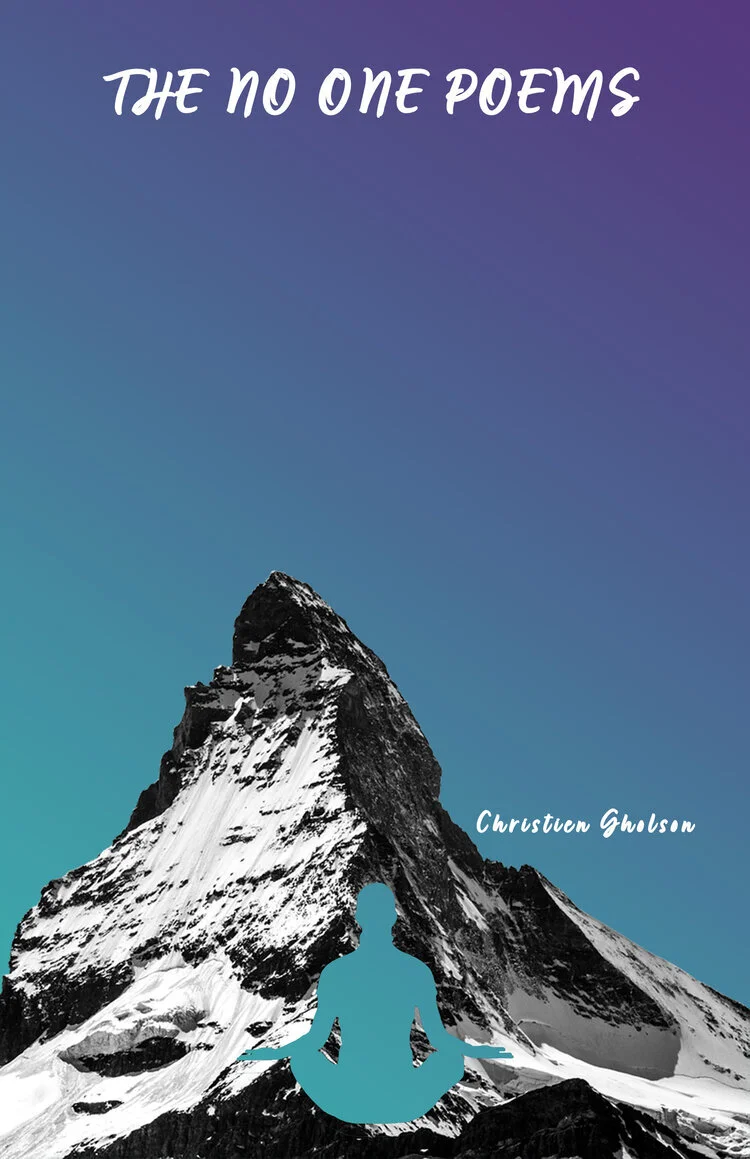
Review of Christien Gholson’s The No One Poems

Review of Christien Gholson’s The No One Poems

May 26, 2021

CGholson_The+No+One+Poems_Cover+1.jpg

The No One Poems

Thirty West Publishing

$11.99

You can purchase a copy here. A limited edition with alternate cover, sewn with 100% hemp or bamboo cord, is also available.

Reviewed by Chris Kaiser


The No One Poems, the newest chapbook from Christien Gholson, is at times an homage to the four greatest poets of the Tang Dynasty (618-907): Han Shan, Li Bai, Wang Wei and Du Fu. These poets are known for their focus on nature and friendship, but also politics, everyday events and humor. Gholson follows their example, with the poems exuding a kind of bleak enlightenment.  

In the opening poem, “No One’s at the Cash Register” (After Han Shan), a poem in 10 sections, we find the titular character working the cash register at a convenience store. In his first line, he boldly states: “If you’re looking for a / peaceful place, this is not it.” He then ticks off a litany of indignities he is subject to on a daily basis from his boss and the customers, including:

They say: smile more,
you’re scaring the customers.
They say: smile less,
you’re scaring the customers.

Han Shan was also known as Cold Mountain, a place where he supposedly lived (historians are not entirely certain he actually existed) and wrote about. In the poem, No One says:

No
use for words on Cold Mountain.
So, why come down? The moon
asked me to pick up some
bananas for her. And cash. I
needed the cash.

I laugh every time I read those lines.

No One came down from the mountain 20 years ago and has worked at the store ever since, which I guess goes to show you, stay in your comfort zone.

Gholson has many beautiful images and lines in this collection of 13 poems. In the second poem, “Shadows, Wandering” (After Li Bai), for example, the narrator hears news of a death. He wonders when the last time he had talked with the deceased was. Ghosts of the unknown haunt every nook and cranny. He says: “Everything, absolutely everything tonight, is porous. / My fingers touch the cold, the reflected light, other shadows.”

Even when the poet writes about shootings, he does so in a way that is stark as well as gentle. In “Seven Songs Sung at Reservoir No. 4” (After Du Fu), a poem in seven sections, the narrator notes: “One dead, two dead, a dragonfly’s / wing-song leads me to my first song sung here.” But his anger also comes out when he says: “Fuck your Prayers is my third song sung, to drown out the dead who feed on the dead…”

No One also comments on the doublespeak of politicians whose endless words “tumble out of [their] mouths. Insects / sucked dry” (“No One Watches the Men Talk Behind Podiums”). For his sanity, No One has to leave the press conference, and “watches the hummingbird / moths in the lavender.” This only soothes him momentarily, for “When the moths speed / off” he “feels the dead words stir the air… / the dead words stir and stir…”

Gholson is the author of two poetry books, several chapbooks, and a novel. It is obvious that an experienced hand wrote The No One Poems. He dances between heaven and Earth, goes deep inside the flesh, reminisces about the amorphous past and contemplates the undefined future.

In the last poem, titled “No One,” the narrator tells us, “Becoming No One is not a choice.” I think Gholson wants us to believe that it happens when you let go of limiting beliefs:

When did he finally let go
of being someone else’s no one
and choose to be his own?

I highly recommend “letting go” and including this chapbook in your poetry collection. You will gain a sense of righteous rage and quiet awe—two of my favorite states of mind.

Chris Kaiser’s poetry has been published in four anthologies by Moonstone Press, including a tribute to Lawrence Ferlinghetti (2021), as well as in Eastern Iowa Review, The Scriblerus, and Better Than Starbucks, including “Black Bamboo: Better Than Starbucks Haiku Anthology 2020.” His poetry has also appeared in Action Moves People United, a music and spoken word project partnered with the United Nations. He’s won awards for journalism and erotic writing, holds an MA in theatre, and lives in suburban Philadelphia.

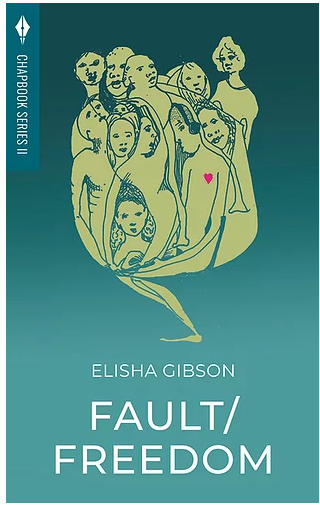
Review of Fault/Freedom by Elisha Gibson

May 19, 2021

Capture.PNG

Fault/Freedom

Toho Publishing

$12.00

You can purchase a copy here.

Reviewed by Sean Hanrahan


Unique. Confident. Lyrical. These are just three of the words that can be used to describe Elisha Gibson’s sterling debut chapbook, Fault/Freedom. This collection beautifully, painfully, yet, amazingly, also joyfully captures the vicissitudes of life.

In the engrossing poem, “A Little Thing,” Gibson writes about the speaker’s painful and formative childhood experience in almost cinematic detail:

I never asked why that man didn’t want our hands
on his window
My eyes were shining!
Lights of gold shone through bottles of green
and blue just out of reach,
a reach I never considered.

 The store owner confronts the narrator and their three siblings, calls them “Dirty,” and uses his relative size and position to threaten them just for touching his window: “See, this man was tall, strong, and white.” Expertly deploying an apt comic book/film metaphor, Gibson effectively deploys a modern-day deus ex machina, “My pops swooped in,/ all superman, no cape.” The children are removed from the painful situation and their dad “started a game when just talking was enough,/I played, had fun, and tried to let this little thing go./ But if it is so little… why didn’t he want our hands on his window?” The narrator comes to a painful realization about American life, and Gibson captures that moment with a perfectly precise lyricism.

This vibrant chapbook also captures the feeling of radiant joy, especially in one of the standout poems in this collection, “Big Band Beach.” Gibson thrills with jazzy lines such as:

Piano play, discordant way, while I soak in azure sky.
Sun was high, his halo hung,
faint green,
round brilliant white,
round canary yellow,
that would bind you with delight.

“So Benign” is a haunting poem that also discusses music and its inherent power, specifically the heartbreaking protest song, “Strange Fruit.” In the right-hand margin, the word “lullaby” textually hangs suspended with one letter per line as it makes a political comment on the controlled, rhythmic language of this poem: “I’ve got strange fruit on my mind./ Bitter copper juice runs through hemp spun vine./ No words pierce my lips as they sway wind picked lines. Their feet bob and dip, ripened past their time.” In this collection, Gibson confronts the terrible legacy of racism as well as celebrates Billy Holiday’s groundbreaking song. It takes a true poet and visionary to craft a poem that tackles so much in ten perfect lines.

Another ekphrastic poem to be found in this collection is “Jerry, Know Tom.” In this poem, the speaker returns to their childhood watching cartoons, a favorite former pastime for many of us I am sure. Gibson repeats a refrain that almost becomes a mantra: “Lampshade overhead, the clumsy cat’s disguise. Cartoon and corn flakes for my youthful eyes.” Gibson jolts us out of this idyllic scene into the present reality of life in America: “You’d think we riot or get vest for the guns.” Gibson’s poetry keeps the reader on their literary toes.

This chapbook collection is an assured debut from a poet who has found their voice and undoubtedly has more to say as we wend our way through the twenty-first century. We, the American readers, will need a visionary like Gibson to show us life in all of its beauty and pain. With their precise, enviable wordcraft, Gibson will be that poet. Fault/Freedom is an exciting first step on their sure-to-be-incredible poetic journey.                                    


Sean Hanrahan is a Philadelphian poet originally hailing from Dale City, Virginia. He is the author of the full-length collection Safer Behind Popcorn (read review here) (2019 Cajun Mutt Press) and the chapbooks Hardened Eyes on the Scan (2018 Moonstone Press) and Gay Cake (2020 Toho). He is currently at work on several literary projects as well as teaching a chapbook class. He currently serves on the Moonstone Press Editorial Board, is head poetry editor for Toho, and is workshop instructor for Green Street Poetry.

Local Lyrics - Featuring Mark Danowsky

Danowsky bio photo 3.jpg

What Is Lost, What Will Never Be Known
by Mark Danowsky

 The pileated woodpecker returns to the dead white walnut.

 I am reminded we keep the dead with us
in memory, we replay their highlights.

When a person dies, we say we lost more
than their life. What does the pileated mourn?
My memory fails to serve and I mourn what I will never know.


There’s a mindful almost meditative quality to your work. Where do you find inspiration? What is the creative process like for you?
I cherry pick from my experience as well as from what I witness and read. What I mean is that I take what I want, sometimes out of context. I’ve always found this to be a fun way to learn and engage with texts and the general acquisition of knowledge. Poets need to stay curious, receptive. We need a touch of Peter Pan syndrome. Not everyone likes the cherry-picking concept. I’m not thrilled that I’m inclined to even mention Trump but he’s become a part our lives and we have to live with his legacy now. There was that time tweeted a Mussolini quote and, in defense, said, “I want to be associated with interesting quotes.” Taking material out of context is an easy way to get yourself in trouble, no question. A lot of people have had a lot of bad ideas. Some not so great people have had some pretty good ideas. This isn’t all that surprising. We contain multitudes – yada, yada, yada. I don’t know that poets necessarily want to be associated with the material they cherry pick from. It’s like when someone puts in their Twitter bio, “Retweets do not equal endorsements.” They do and they don’t. It’s important that, as famous thinkers have discussed, we learn to hold irreconcilable ideas in our head at the same time. We cannot default to black and white thinking. This is my permission, I suppose, to take quotes from unsavory figures and use them as you wish in your poetry. A good poet can spin anything into gold.

In addition to being a poet, you are the founder/editor of ONE ART: a journal of poetry and senior editor of Schuylkill Valley Journal. You also write a blog and have an editing service. What is your experience of being enmeshed in a literary life?
I’m in a state of constantly evaluating and reevaluating my situation. All artist types need to do this. It’s essential for time management. In recent years, it’s become increasingly important to me to become a good steward of the arts. My identity as a poet still matters a great deal to me; that being said, I feel it matters less to the greater literary community. This is understandable. As an editor, I seem to provide a more desired, more impactful service to the community. From where I am now, I can say that I’m good with focusing my energy on what I can do for the community. I don’t want to sound like a martyr or anything though. My life path has a lot to do with my choices. I would prefer to see most working poets/writers/artists focus on their personal work.

I once had the idea to create a writing schedule like a workout routine: Mondays and Fridays for editing. Tuesday and Thursday for composing new work. Wednesday for haikus. It did not end up working out. How do you juggle all the demands of being a writer? How do you find time to actually write?
This comes down to the type of person you are. Previously, I was the type of poet who wrote well on so-called “stolen time.” That is, I would be supposed to be working or editing and then a thought would pop in my head and I’d run with it on the page. This still happens from time to time. I’m not the sort of poet who is terrific at blocking off time to “be creative.” I’m not a big believer in the flow state for poets. Or, let me rephrase that, I’m not a big believer in the flow state as a required headspace for poets writing an individual poem. If you’re sitting down to assemble a collection, that’s a whole different skillset and you need to be able to hold a lot of the material in your head at once while uninterrupted. I’ve been interested in residencies and writer’s retreats for years, but I feel like most poets need something much different than, for example, longform prose writers. Poets who work on projects that require a great deal of research can probably benefit from a more traditional residency. I’m more of the type that just needs to be put in random places for little chunks of time to respond to whatever is happening to me. Not to pigeonhole myself but it feels like a form of neo-confessionalism.

Do you notice common themes emerging in your work? What are your muses?
Poets perseverate on the same themes. That’s an unusual use of that term, perseverate, but it feels accurate. We all have our special interests. Lots of poets who probably do not describe themselves as “nature poets” or “eco-poets” write about the natural world. We all have our favorite words and turns of phrase. James Longenbach once said that it takes a long time for poets to sound like themselves on the page. It sounds straight-forward but it’s not. It’s putting in your 10,000 hours. It’s incredibly difficult to sound like yourself on the page. Our voice(s), of course, evolve over time. That’s totally natural and fine. No one has to write pastiches of themselves to please some theoretical audience.

In your book, As Falls Trees, the poems in the collection center around the lives of trees. How did this collection come about?
Where can readers find more of your work? Buy your books?
When I lived in a particular space in West Virginia, there was a back porch that looked out on a forested area on a mountainside (because everything in West Virginia is on a mountainside). It would have been almost difficult not to write about the birds and trees because I was in such close proximity with the natural world. My personal life was very difficult at the time but I was also surrounded by a great deal of natural beauty. I think that, in part, explains how As Falls Trees happened.

If you’re interested in buying a copy of As Falls Trees you can contact me directly. I’m also available to field any questions about ONE ART: a journal of poetry, Schuylkill Valley Journal, and my editing service VRS CRFT.


Danowsky bio photo (1).jpg

Mark Danowsky is Editor-in-Chief of ONE ART: a journal of poetry and Senior Editor for Schuylkill Valley Journal. He is author of the poetry collection As Falls Trees (NightBallet Press). His work has appeared in Bird Watcher’s Digest, Cleaver Magazine, Gargoyle, The Healing Muse, and elsewhere.


“Catfish” John Wojtowicz grew up working on his family’s azalea and rhododendron nursery in the backwoods of what Ginsberg dubbed “nowhere Zen New Jersey.” Currently, he works as a licensed social worker and adjunct professor. He has been featured in the Philadelphia based Moonstone Poetry series, West-Chester based Livin’ on Luck, Mad Poets Society, and Rowan University’s Writer’s Roundtable on 89.7 WGLS-FM. Find out more at: www.catfishjohnpoetry.com.



Review of Hayden Saunier’s A Cartography of Home

Review of Hayden Saunier’s A Cartography of Home

May 12, 2021

thumbnail_Cartography.jpg

A Cartography of Home

Terrapin Books

$16.00

You can purchase a copy here.

Reviewed by Abbey J. Porter


In her new book, A Cartography of Home, Hayden Saunier turns an inquisitive, appraising eye on the landscape around her, along with its human and nonhuman inhabitants. In vivid, concrete language, she investigates the phenomena she encounters, sharing with us a rich and subtle tapestry in which natural and unnatural, past and present, intermingle.

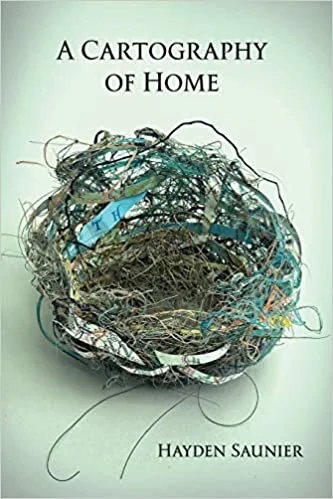
“Cartography” refers to map-making, but the image on the book’s cover turns the idea of conventional way-finding on its head: Cut-up strips of map, along with variously colored pieces of string and other material, intertwine into what might be a bird’s nest. The image is apt—that of human and nature, wildly woven together, as they are in this book.

Saunier introduces us to her 78-page collection with “Kitchen Table,” a poem that heralds many of the book’s themes. The past weighs heavy as she describes a table made of walls “that held /A family of six before typhoid took/Both parents and fostered out the children.” Nature enters the picture, too—a nature negatively affected by humans: “Our table’s made of old growth forests no longer forests.” She concludes with the table’s gritty imperfection—and an invitation:

Our table’s wood
Is spalted through with hard luck, grease,
disease, fat streaks of amber jam.
Our table’s make of all of it.
It’s us and ours. Sit down and eat.

The natural world takes center stage in Cartography. Saunier seems intrinsically tied to it; her poems are full of bodies of water, animals, trees. But nature here is not gentle—and perhaps not trustworthy. In “Cold Morning with New Catastrophes,” Saunier describes walking

To the still-flowing creek,

That may well be poisoned,
or maybe not poisoned, or maybe,
This morning, not yet.


There is harshness in this world, to be sure. Bitterness, too—which, when it comes to “under-ripened, overfed strawberries,” Saunier slices “into smaller bits of bitterness.”

Nonetheless, nature is also capable of offering respite. “Dirt’s/the only thing that’s telling truth today” Saunier’s narrator says as she sinks her hands into the earth in “After the Press Conference.” And even in the case of a creek that pounds and roils after a downpour, Saunier finds “enough to steady me today.”

Uncertainty stirs in these poems; there lurks at times a sense of ominous threat. “Mad fury all around,” declares Saunier in “A Brief Inventory of Now.” She goes on to say, “It’s possible this house/won’t hold … Wind raises its pitch. This could go/either way any moment, and no telling which.”

Part of Saunier’s connection to the natural world is her awareness of death. People who have died populate and inform her poems. She muses about those who have gone before, and the fact that she will follow them. In “Locks,” she contemplates the notion of ghosts having keys, “As though we, the living, are locks.” In “Inhabitant,” she thinks about the person who lived in her dwelling before her. She finds an oriole’s nest with

your hair spun
in swirls for a bed.
As, someday, I know,
so will mine.

The past is alive in these poems; past, present, and future are a continuum. Saunier seems to respect and perhaps accept the transitory nature of life. In “Making Hay,” she refers to “my momentary body.”

As grounded in nature as these poems are, something else is afoot as well, something … otherworldly. In “Forecast,” she says:

Something swift
            and slender crosses the path.

Let’s pretend
it’s only animal, not sign.

Saunier often turns a critical gaze on society—subtly, as in her description of pink tags fluttering from “a grandstand full” of condemned trees in “Solo Act.” Or more brazenly in “Confirmation Bias at the Minimarket,” when the narrator and her friend—who’s “behaving/ like a walking example of organic/food privilege”—regard the store’s clerk, with her “eyes dead/ of anything but the lethal stare she sports.”

While Saunier’s narrator usually appears as a solitary character, the poet also writes movingly about human connection. In “Pantomime,” the narrator—alone in a hotel room, watching the moon—mutely communicates with another woman, outside, who’s doing the same: “I jab my finger wildly at the rising moon/and she nods and jabs her finger wildly at it too.” In “Ode to Customer Support,” she declares, “I swear, dear voice, I love you.”

Perhaps most strikingly, though, Saunier reaches out directly to her reader, drawing her into a collaborative journey. She opens “Already” with the lines, “This is not what you thought you would be reading/ and honestly it’s not what I thought I would be writing.” She talks of creating “bread to pass between us” and concludes with finding

A table where we sit down 

together, take out our hidden knives, use them to spread
the slices, smooth the sweet jam, share the bread.

Thus, Saunier makes explicit the experience one has in reading this book: that of journeying with her through a process of investigation and discovery, observation and reflection. As the book’s cover perhaps warns us, our trip is not neatly plotted. Rather, it is full of unexpected turns and discoveries. The result is a flavorful and satisfying meal.


Abbey J. Porter writes poetry and memoir about people, relationships, and life struggles. She holds an MFA in creative writing from Queens University of Charlotte, an MA in liberal studies from Villanova University, and a BA in English from Gettysburg College. Abbey works in communications and lives in Cheltenham, Pa., with her two dogs.

Source: http://madpoetssociety.com/blog

Profession: Poet

Profession: Poet is a new monthly blog feature exploring craft and identity in poetry by Hanoch Guy, who writes poems in both English and Hebrew.


Do Reptiles Write Poetry?


Welcome to the blog.  

I always like to explore ways to expand the paths to poetry.

This time, I’d like to introduce the three brain model, called the triune brain.

A couple clarifications about the triune brain: The three brain model does not indicate that specific capacities are located only in these brains. Many activities are executed in different locations and migrate.

We can look at this model as an expansive metaphor.

 The model was introduced by physician and neuroscientist Paul D. MacLean, M.D., whose main research was on Komodo dragons, the feared fierce huge lizards in Indonesia. MacLean discovered that the main capacities of what he called the reptilian brain, which is located on top of the brain stem, are the following:

  • imitation of patterns

  • repetition

  • rituals and habits

  • focus

  • territory

  • competitiveness

It’s doubtful that reptiles write poems, but you will be amazed how understanding the reptilian brain will enhance your writing.

 When Dr. MacLean returned to Washington from his research trip in Indonesia, he was amazed to discover that his colleagues and students displayed the same behaviors as the Komodo dragon. 

One important gift of the reptiles is imitation. It is sometimes given a bad rap, but it is the foundation for learning processes. We do not pull a poem like a magician pulls a rabbit out of a hat. Writing emerges from what we’ve read and what we’ve learned from previous authors. Imitation is essential to poetry, provided we not go all the way and take the time to develop our own style.

The next trait that reptiles have bequeathed to us is repetition. It is a major feature in poetry and is used many forms. While it is essential, overusing it may be boring or inefficient, so discernment is important.

Ritual is a cornerstone of cultures, narratives, and poetry. Ritualistic behaviors started with reptiles. Most poets I talk to tell me they have specific rituals for sitting down to write that help them to get deeper into the zone of writing.

Reptiles have sharp focus when carrying out the actions of hunting prey, mating, and competition. We inherited this characteristic and elevated focus for use in our modern human lives. And we can utilize it in poetry. Sustained periods of focus are necessary to write quality poetry.

 Okay, one part of the brain is enough for one blog.

Next month, I’ll write about the limbic emotional poetic brain.


Hanoch Guy Ph.D, Ed.D spent his childhood and youth in Israel. He is a bilingual poet in Hebrew and English. Hanoch has taught Jewish Hebrew literature at Temple University and poetry and mentoring at the Muse House Center. He won awards in the Mad Poets Society, Phila Poets, Poetry Super Highway and first prize in the Better than Starbucks haiku contest. His book, Terra Treblinka, is a finalist in the North Book Contest. Hanoch published poems in England, Wales, Israel, the U.S., and Greece. He is the author of nine poetry collections in English and one Hebrew book.

Review of Cathleen Cohen's Etching the Ghost

Review of Cathleen Cohen’s Etching the Ghost

May 5, 2021

Etching the Ghost.PNG

Etching the Ghost

Atmosphere Press

$15.99

You can purchase a copy here.

Reviewed by Philip Dykhouse


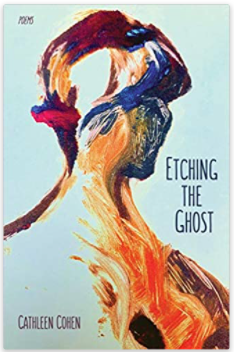
When I write a review, I often use the phrase “paints a picture” to describe how an author uses their poetry to convey specific imagery and/or feelings. Never has this turn of phrase rung truer than when I use it to describe the poetry found in Cathleen Cohen’s newest book, Etching the Ghost. You see, in addition to being a published poet, Cohen is also an extremely talented and accomplished painter. In fact, the cover art for Etching the Ghost was painted by the author herself. And much like her paintings, Cohen’s poetry is as colorful as it is concise. Every word is a precise brush stroke that builds towards a beautiful and affecting vision of how the artist draws inspiration from not only the world around her, but from the world inside of her as well. Cohen uses everything from color and shape, to joy and pain to turn the pages of Etching the Ghost into a gripping poetic canvas.

Etching the Ghost is a 65-page collection that is divided into 4 sections. In the first section, “If Released, Magnificent”, we find Cohen grappling with not only her art, but her voice as well. The poetry in this section hints there is something she is unable to express, something looming just under the surface. A great example of this can be found in the first poem, “Some Tide,” with the lines:

This flower looks carved in quartz,
Says my son, frowning,
Tilting up to light.
Where’s this from?

A garden
               I can’t name…

The poem “Glaze” further enforces this notion:

Into landscapes I scratch
messages
so faint

no one detects clots of umber, bruise blue
below shimmer.

It’s not until we come upon the poem “Green” that we discover what the artist has buried underneath all those layers of paint and pain. A true highlight of Etching the Ghost, “Green” is a raw and honest poem in which Cohen describes being raped as a young girl. We follow her through the moments before and after. In the beginning, we see her innocence as she describes herself as a “green girl”. She soon becomes trapped in a horrifying moment from which she can not escape. That “green girl” is now gone. The poem finishes with the poet describing the immense shame she feels. The cathartic words she puts to page here appear to be what she has struggled to capture with her painting for so long. Cohen's technique of using the early work of the section to build to this moment is masterful. By the time we reach the final poem of this section, “Every Room”, you see how this traumatic event has truly changed the author's life.

With the second section, “Weight Of The Press”, the intensity of the previous section gives way to a more contemplative tone. The poems in this section find the artist challenging herself to discover what it means to be a true artist. In the books namesake “Etching the Ghost”, it seems as though Cohen realizes that she can not focus all of her inspiration on her pain because eventually the proverbial “ink” will run dry:

But the plate, though degraded
will hold enough ink in its teeth
to print a ghost.

This ghost is changed,
an imprint not true
to the image...

There are quite a few poems in this section that take place during art classes where the author learns lessons not only in painting, but in human behavior. The poem “Night Flowers” serves as an empathetic ode to aging:

There’s swelling in his knuckles,
cobalt blue shadows.
His could be boxers’ hands or
painters hands, like mine,
which tire and twitch.

The poems “Paper” and “Painting With Color-Blind Son” focus on balancing her life as a painter with her life as a mother. This section does a great job showing Cohen’s growth as a person and as an artist.

The next section, “No Mistakes In Art”, the author takes what she’s learned so far and ventures out to define her life on her own terms. She now finds great purpose in passing on her knowledge. The first few poems focus on her time as a teacher for troubled children. She relates to them. She knows how important it is for them to learn ways to express their emotions the way she has. In “Girl On Fire” she says, “Beautiful, pierced child, / Spark this room with your burning tongue.” From here she moves on to a moment where she paints with her granddaughter in the poem “Two Artists”: There are no mistakes in art, she declares / As I place more paper before her.”

Much of the themes of these poems seem to suggest that Cohen herself has learned a great deal about the importance of art from these children. Towards the latter half of the section we find the poet growing older but not so content. She still seeks out meaning in her life and in her work. In the poem “Velocity”, she ponders: “Don’t I know all this, / how instinct works?”.

The final section, “As Witness, As Echo”, centers on a later stage of Cohen’s life. In the poems “Bluer Than Sky” and “Portrait At 87,” she describes having to watch her parents grow old. When we arrive at the poem “Full Weight,” we see the toll their eventual deaths have taken on her:

Their souls loll about
ankle deep,
tripping me up
as I move through their apartment. 

With the poem “Plein Air” we find Cohen beginning to reflect on her own mortality and the legacy of her art: “How long will we last / as witness, as echo?”.

 The final poem “The Trouble with Self Portrait” is a perfect finale to an amazing journey that I wouldn’t dare to spoil by quoting it. To me, it represents that moment when a painter applies the final touch, puts down their brush, steps back to look at what they’ve created and smiles, knowing that they have created true art.

Upon finishing Etching the Ghost, I felt like I had stood and watched as the author painted me a picture of her life. In the beginning, the image was unfinished and perhaps unsure of what it wanted to be. Yet, through layers upon layers of experience and understanding, mistakes and edits, the artist’s vision came into focus. Like all great painters and poets, Cohen has presented her audience with art that makes you think and feel. It makes you want to peel back it’ layers. It wants you to find that mirror that they’ve hidden within. Etching the Ghost is a gallery of poetry that I recommend everyone go see.


Philip Dykhouse lives in Philadelphia. His chapbook, Bury Me Here, was published and released by Toho Publishing in early 2020. His work has appeared in Toho Journal, Moonstone Press, everseradio.com, and Spiral Poetry. He was the featured reader for the Dead Bards of Philadelphia at the 2018 Philadelphia Poetry Festival. 

Source: Review of Cathleen Cohen's Etching the ...

Mad Poet of the Year - Ray Greenblatt (April 2021)

The Mad Poet of the Year blog posts share the poetry of a long-time Mad Poet. This year-long appointment provides readers with a deep dive of the writer’s work and thoughts on poetry. We are thrilled to have Ray Greenblatt serve as the inaugural Mad Poet of the Year for 2021.


unsplash-image-CXv8nrYJKz0.jpg
 

ALONG IN LIFE

 by Ray Greenblatt

 We have slid beyond rivalry
                                        hostility
                                        hate

into old age.
Middle age was crammed
                       with bestial instincts
                       animal energy

we raked the walls
                           with nails of jealousy
gurgled excuses
acid tainting the air
we slung back & forth
                   discuses of lies
did the bear hug shuffle
               of one-upmanship
with strong arm raised swords
           to clang harsh upon arch
we spun nightmares of
                  the slaughterhouse
                   or lime pit
a shallow depression
                    beneath the rosebushes
                    behind the coal shed.

Then
              an earthquake night
              pried up a piece of roof
              to let some light in.
Now we fumble
              in the bean field
slowly wielding mattock and trowel
              for its own sack
letting natural heat
              help the vineyard
we slump on the verendah
not even an elixir as buffer
we creak our heads
              in disbelief
look up more often
no more the truffle pig
letting glare water our eyes
we peer into
              each other’s pinched face
clasping hoof
              in horny hoof
emit a soundless chortle
              a sigh.


My wise father-in-law—who lived until 90 and played tennis nearly to his demise—stated that middle age is ten years older than you are. By middle age we have traveled quite a long path in life. As we grow, we change; recognizing who we are at times can be challenging. Literary and social references speckle this poetic path: “slaughterhouse…lime pit…rosebushes…coal shed…bean field…vineyard.” When we near our end, we have to resolve all that we have done.


Ray Greenblatt.jpeg

Ray Greenblatt has been a poet for forty years and an English teacher longer than that. He was an editor of General Eclectic, a board member of the Philadelphia Writers Conference, and is presently on the staff of the Schuylkill Valley Journal. He has won the Full Moon Poetry Contest, the Mad Poets Annual Contest, and twice won the Anthony Byrne Annual Contest for Irish Poetry sponsored by The Irish Edition. His poetry has been translated into Gaelic, Polish, Greek and Japanese.

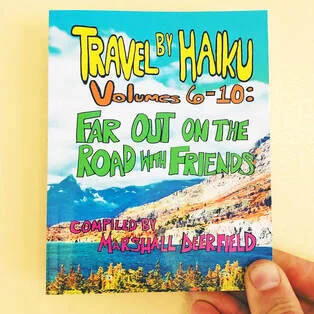
Review of Travel by Haiku Volumes 6-10: Far Out on the Road with Friends (compiled by Marshall Deerfield)

April 21, 2021

handheldcover-small.jpg

Travel by Haiku Volumes 6-10: Far Out on the Road with Friends

A Freedom Books

$10.00

You can purchase a copy here.

Reviewed by Brooke Palma


“There was nowhere to go but everywhere, so just keep on rolling under the stars.”
 – Jack Kerouac, On the Road

Travel by Haiku Volumes 6-10: Far Out on the Road with Friends continues Marshall Deerfield’s (aka Marshall James Kavanaugh) poetic journey with friends across the Western half of the U.S. The collection uses haiku as a means of describing not only the road trips themselves, but the metaphysical experience of interacting with nature and the new friends we meet on the road in an attempt to transcend the self.

The poems in this collection use the haiku form to great effect. They employ the form’s brief structure to offer wry observations on nature, philosophy, and human connection. Indeed, the idea of human connection actually informed the creative process that formed the poems. Throughout the three trips that make up the collection, Deerfield and his traveling partners employed a unique collaborative process where one person would contribute a line to start the haiku and the others would provide the second and third lines, lending the poems a shared viewpoint that honors the friendship of the writers traveling together.

Inspired by other traveling writers like Basho and Kerouac, this collection shines with moments of real beauty. The beauty described is almost exclusively tied to nature, and that’s where these poems excel. What surprised me the most was the way the real and surreal are interwoven throughout the collection of haiku. The poems focus on concrete moments of the travelers’ experience in nature that transports the reader to places where “the high basin drains/at sunset light floods purple/overflowing with bats.” The poems use plain language and a conversational tone to share the awe-inspiring natural magnificence of the American West. When describing the ephemeral nature of a “pastel pink” Western sunset, the writers are struck by the sunset’s passing, while noticing that “the beauts remain.” The writers use the haiku form’s short lines to infuse their poems with wry observations told with a great sense of humor. Upon encountering a lone aspen tree, Deerfield and company happily describe it as “one tough cowboy!”.

While attempting to describe nature’s profound beauty, the writers are quick to note that the power of words is sometimes inadequate. Poems, such as this one, acknowledge the ineffability of such stunning beauty and power: “Night eclipses thought/overwhelmed by the moon’s rays/words no longer serve.” The humility in this collection that attempts to honor nature but realizes that mere human words are limited in the face of such magnificence is refreshing and provides further praise to our beautiful natural world.

Make no mistake – this is not a collection that seeks to simply describe the sublimity of nature. The collection is a call to action that documents the negative impact humans have on the earth, namely through climate change. Deerfield and his companions are forced to confront “whole forests depleted” on their way to the Rockies. In the prose introduction to the poems reckoning with the loss of these forests, Deerfield explains that Pine Bark beetles are responsible for the destruction. The beetles are part of the forest ecosystem and formerly lived in harmony with the trees they now demolish, but rising temperatures in the forest allow them to live longer than before, leaving the Ponderosa pine trees ”standing like zombies amidst their dying relatives.” The poignancy of this section stands in sharp contrast to the beautiful descriptions in the rest of the collection and mourns the loss of natural beauty in which we humans are complicit.

Travel by Haiku Volumes 6-10: Far Out on the Road with Friends takes the reader on quite the trip through the American West. We’re invited along for the ride through the friends’ consciousness while they encounter moments of natural beauty and the best of human connection. I am grateful to have joined them and enjoyed the journey while reading these poems. I look forward to our next trip!


Brooke+Palma+headshot.jpg

Brooke Palma grew up in Philadelphia and currently lives in West Chester, Pennsylvania. Many of her poems focus on the connections between culture and identity and finding beauty in the everyday. Her work has been published in The Mad Poets’ Review, Moonstone Arts, Toho Journal, and E-Verse Radio (online), and work is forthcoming in Unbearables: A Global Anthology.  Her chapbook, Conversations Unfinished, was published by Moonstone Press in August 2019. She hosts the Livin’ on Luck Poetry Series at Barnaby’s West Chester. 

Local Lyrics - Featuring Octavia McBride-Ahebee

Octavia 1 jpg.jpg

Nina in Liberia
for Nina Simone
By Octavia McBride-Ahebee


she arrived at the end of the rainy season
with abundance still in bloom
with the Nimba flycatchers and fishing owls
crooning a welcome dance for her
-America’s champion singer-
but to me, a girl of 10, who still amused herself
in the creases of cotton trees and looked
for Mamy Wata in the gloom of the Atlantic,
she was simply Nina,
who taught me Bach and Beethoven and Chopin,
on my grandfather’s cherished baby grand
weather-beaten by the lovers harmattan and rain
polished daily by a near emptied-belly
she taught me how to position my fingers in protest
to the hissing accompaniment of giant fans
meant to tame the heat of Liberia’s fortune
but to avail

-the end_


Many of your poems share a theme of giving voice to the voiceless. How did you find your poetic voice?
I certainly don’t claim to speak on behalf of others nor am I interested in doing so. What I do share in my creative work is how the world impacts me through my interactions with people and how those connections inform my understanding of what is happening around me and on a larger world stage.  It is from these personal experiences that I create my narrative poetry.  

When I move throughout the world and through my city of Philadelphia, I am inevitably impacted and transformed by the relationships I actively nurture with community members who have left their birth countries for a myriad of reasons. I am always intrigued by the parallels between my own history as an American descendant of enslaved people and the experiences of my brothers and sisters who have fled similar terrors throughout the world.   

The impetus for a decent life is a natural human aspiration; Voltaire said to give ourselves the gift of living well- a quality life. I am mesmerized by people who dare to give themselves the gift of living well.  These are the kinds of people you will find in my poetry like the women who braid my hair in West Philly.

An excerpt from “Aminata Holds Us All”

…Aminata whispered as she greased the sorrows of my scalp
how she fled with her escorts, ambition and purpose,
-they- dressed to the nines in voluminous clarity
trimmed with Venetian trading beads
she fled the old order of her world
that just kept breathing
while all the time barren
she fled in grace, in henna-stained feet,
in a pair of flip-flops open to the world…

You served as a fourth-grade teacher at the International Community School of Abidjan for almost a decade. How does teaching, especially internationally, influence your writing?
I wrote a poem, “Oasis,” many years ago for one of my 4th grade classes at the International Community School of Abidjan, which is located in Cote d’Ivoire, in West Africa. It begins with the lines, “I come each day to the whole of the world …”. 

During my tenure at I.C.S.A, it had a student body of more than 500 students, who represented more than 70 nationalities. Our school courtyard flew the flags of students’ countries, making it look like a United Nations hotspot of sorts.  In my classroom of 15 students, I could have 30 nationalities represented.  One student’s mother might be Swedish and their father Ethiopian, or their mother Congolese and Rwandan and their father American. The school served mainly the children of parents who were part of the diplomatic community and international aid and corporate organizations.  My students were multilingual, well-traveled, and had a burgeoning sense of the complexity of the world. Also, Ivoirians, like most Africans, are polyglots and well-traveled and certainly knew the dynamics of global politics.  I was surrounded by this whirlwind of culture, and history, and politics.   Both I.C.S.A. and Cote d’Ivoire itself were concentrated oases of inspiration that allowed me to open my writing to the world.    

I’m a fan of the folksinger Arlo Guthrie and he has a song about the Chilean musician and political activist, Victor Jara, that goes, “He grew up to be a fighter against the people’s wrongs. He listened to their grief and joy and turned them into song.” In Praise Songs for the Gravediggers, what was the process of turning the grief and joy of your muses into poetic song?
I am primarily guided by one muse; that’s Clio, the muse of history, and her mom, Mnemosyne,  the goddess of memory.   So, this combination of my own outrage meshed with history and memory drive a lot of my work.  There is a poem, for example, I wrote a while ago entitled, “Raise Your Head and Try, Again.”  This poem is especially pertinent given we are now living through this COVID pandemic and in search of the vaccines that will crush it.  Well, this particular poem challenges the singular narrative of the Democratic Republic of the Congo (my beloved Zaire), of just being this culture of rape. Is rape used as a weapon of war in most armed conflicts? …most definitely.  Should such tactics be revealed and condemned? Most definitely.

This poem is about how certain places, like the DRC, are destabilized and dehumanized for centuries by various interests in the so-called West and then presented to the world as barbaric, through corporate media, as if these systematic assaults against them never happened.  What is now the vast DRC used to be the private colony of Belgium’s King Leopold and most are familiar with the gross atrocities that occurred under his reign of terror. 

The largest human vaccine trials for polio happened in the Congo, organized by the University of Penn’s Wistar Institute under the leadership of Hilary Koprowski.

This poem references how the uranium used in the atomic bombs that were dropped on Japan came from the DRC and how the extraction of this uranium devastated surrounding communities. Western interests, namely the U.S., were complicit in the assassination of the democratically elected leader Patrice Lumumba.  The metallic ores like Coltan, needed for cellphones, are primarily mined in the DRC.

The world is growingly ahistorical and when we meet a people or country, through the dominant, corporate media representing a financial agenda, it is without the context and usually gross in nature.  

An excerpt From “Raise Your Head and Try Again”

the way you enter me from the cellar of your imagination
presenting me to the world as a singular vision of ripped vulvas
standing on two feet with womb wide open
and It hauling its own memories

I will raise another narrative and its antagonist is you

here are my handless limbs hacksawed by your henchman   
the pope, leopold, mobutu, ike, even the brown messiah

here is my plowed vagina held hostage for rubber quotas and ivory tusks

raise from the dead with your memory and mouth                                                     

my grandmothers’ heads pitched on crosses of blood bars
hair coiffed and stunned – prepared to receive a returning lover…

While we are on the subject, how do you cultivate rhythm and sound into your poems. Do your international experiences influence the cadence of your work?
The rhythm and cadence of my work are influenced by a sense of urgency and need for the reader, listener and orator to give pause and consider the magnitude of the ideas or information being presented.  I find that powerful images, short lines and lots of alliteration are effective in keeping my poems moving at my desired pace.

An excerpt from “Ode to an Ordained Stutterer; For Sonia Sanchez”

…these sage-femmes saw the feet of your ideas first
toe-tied, luminous, promising a packed kick
Holy
and in the wisdom of their birthing protocol
informed by the cravings of warrior girls
on the move without shields and charms
crisscrossing landscapes choked in bereavement
your words were pulled with delicate intent
clinging to afterbirth and relief and pummeled alliteration
-Holy bloomed-
your words were ready to take aim.

Your work focuses a lot on resilience. I believe most periods of history are tumultuous, but how are you navigating this one? Have you been writing?
I am a 3rd grade teacher, so I am so blessed to meet with young energy and youthful ideas each school day. My students have kept me buoyed during these difficult times. I continue to write and I write a lot about my students and I share my writing with them. I value their feedback.

Where can readers find more of your work? Buy your books?
Do check out my website for this information. https://omcbrideahebee.squarespace.com/


Octavia #3.jpg

Octavia McBride-Ahebee’s work is informed by the convergence of cultures and the many ways people move throughout the world. Her poems present human relationships within the context of global inequality.


wojto.jpg

“Catfish” John Wojtowicz grew up working on his family’s azalea and rhododendron nursery in the backwoods of what Ginsberg dubbed “nowhere Zen New Jersey.” Currently, he works as a licensed social worker and adjunct professor. He has been featured in the Philadelphia based Moonstone Poetry series, West-Chester based Livin’ on Luck, Mad Poets Society, and Rowan University’s Writer’s Roundtable on 89.7 WGLS-FM. Find out more at: www.catfishjohnpoetry.com.



Review of Joseph Cilluffo’s Always in the Wrong Season by guest blogger Eileen D'Angelo

cover.PNG

Always in the Wrong Season

Kelsay Books/Aldrich Press

$17.00

You can purchase a copy here.

Reviewed by Eileen D’Angelo


1986

Here, where it is always 1986
I can still kiss your cheek, Dad
and marvel at the stubble grown men grow.
Tender, I can still shave with a whisper.
Our hand is the piece of iron
worried fingers hold to keep evil at bay.
The bird we saw? The one
you said was an osprey
and I thought was a peregrine.
It’s still flying. It hasn’t yet dropped
the thick grey fist of the clam
onto the dock to crack open its shell,
prize out the pulpy flesh. Our amazement
at that is still ahead of us.
Couldn’t I have come to this place
from somewhere else?  My words
are unholy, or at least unwise.
But here, I am still a child
and permitted to be a fool.
It’s 1986.  Those cries
are just the dog barking.
He hears the garage door opening.
It’s you, coming home.

There is such a clarity and tenderness in Joseph’s Cilluffo’s poem, “1986”, an excerpt from his first collection of poems, Always in the Wrong Season.  The poems in this book are closer to invocation and meditation than most prayers.  Cilluffo is alert, always present in his surroundings, tuned into the nature of earth and the nature of humanity.  Did the incident with the bird dropping the clam on the dock actually happen—or is it a strong metaphoric image offered by the poet to describe something he wants us to understand? Either way, it is genius to put the lines into this poem, because it works perfectly and it can mean so many things.  Cilluffo skillfully freezes time in this poem to tell his story, chooses a moment to remember, and colors it with his current perceptions and the resulting truth.  The bird is a catalyst here, showing unique intelligence and ingenuity in finding a way to crack open the clam’s shell, amazing the onlookers.  What does a clam do?  It holds itself tightly closed.  What is its gift?  To take a small grain of sand and layer upon layer create a pearl, to protect itself from the rough grit.  Isn’t that what we all try to do, and what the poet has done in this poem: take the rough patches and difficult moments in his life and turn them into lessons or valuable life experiences?  Transform them into something other than setbacks? 

Whether the objects in this poem are real or imaginary, they speak to the relationship, how communication between a father and son can be as tightly held within as the clam inside its shell.  And what if we could transcend the struggle?  Would we?  The poet’s words ring so true and so familiar:  “Couldn’t I have come to this place/ from somewhere else?”  It is such a universal thought, phrased simply, but eloquently, a question that everyone asks themselves at least once in their own lives.  Did I have to experience the hard and difficult times to fully comprehend, or to come to a place of understanding?  Why must a certain level of pain precede insight? And if it was possible to slip past those challenging moments, would we do it? The ultimate question follows:  if we did it—would the subsequent feelings of acceptance and peace lose their meaning?  This is one example of the moving poems in his collection, woven with religious references and spirituality, and at the very same time, brimming with an understated sensuality.  Poems that are heart-breaking and uplifting, sometimes all at once, within a few lines.


Eileen resize.jpg

 Eileen M. D’Angelo is Founder/Executive Director of the Mad Poets Society, and Founder/Managing Editor of the literary magazine, Mad Poets Review (1990-2010). Since 1987, she produced over 1,500 special events, including readings, slams, conferences, workshops, bonfires and literary festivals in the Delaware Valley.  In 2018, she was the subject of an anthology and tribute by Philadelphia’s Moonstone Arts Center.  Twice nominated for a PA Governor’s Award in the Arts, D’Angelo received two Pushcart Prize nominations from Verse Magazine and Schuylkill Valley Journal.  Poetry, op-eds, and book reviews have been published or forthcoming in The Philadelphia Inquirer, News of Delaware County, Rattle, and other publications.

Profession: Poet

Profession: Poet is a new monthly blog feature exploring craft and identity in poetry by Hanoch Guy, who writes poems in both English and Hebrew.


“Without poetry, we lose our way.”

— Joy Harjo, U.S. Poet Laureate & Academy of American Poets Chancellor


Just imagine:

You get up in the morning. An excellent poem pops into your head. You send it to a magazine and it is accepted the next day. Within a week, it is published. You have a wondrous and generous muse, and she constantly inspires you with new poems.

You may be scratching your head, asking, what are you talking about?

We wish it was that simple.

Let me suggest ways that may open the doors of poetry and insight for you, for the times when you are feeling stuck or uninspired.

Here are some practices for cultivating and inviting profound poems.

Widen your awareness of everything around you and inside of you.

We absorb and experience the world through our senses, feelings, and thoughts.

Let the sensations and vibrations wash over you. The process of writing is complex, and many times, the gateways of the senses are efficient and immediate.

Open to your five senses and more.

There is a multitude of ways to write poems. Consider:

  • Sight: nature, colors, shapes, movement

  • Sounds: background, outside and inside, the sounds of your breath, of humming

  • Tastes

  • Touch, texture

  • Smell

  • Feel

Here is an example of the senses and experience of sensations in poetry:

your forehead crowned
with black gold

– Avraham Halfi (translated from the Hebrew)

 And, here are some lines inspired by Halfi’s poem:

The forest, a symphony of yellow-brown leaves.
Purple, red, green patches.
*
Your tongue salty sweet.
*
Soft intimate wind
surrounds you.
*
Your skin burns my hand, lips.
Fingers dance across forehead.
*
Tingling.

Trunk knocks me down.
Triangle within circles, within my eyes’ whites.

*

If you want to immerse yourself in sensual poetry, try these:

Here’s a challenge:

Find a poem that offers the most of the experience of the five senses.

More paths to poetry next month!        


Hanoch+Guy.jpg

Hanoch Guy Ph.D, Ed.D spent his childhood and youth in Israel. He is a bilingual poet in Hebrew and English. Hanoch has taught Jewish Hebrew literature at Temple University and poetry and mentoring at the Muse House Center. He won awards in the Mad Poets Society, Phila Poets, Poetry Super Highway and first prize in the Better than Starbucks haiku contest. His book, Terra Treblinka, is a finalist in the North Book Contest. Hanoch published poems in England, Wales, Israel, the U.S., and Greece. He is the author of nine poetry collections in English and one Hebrew book.