
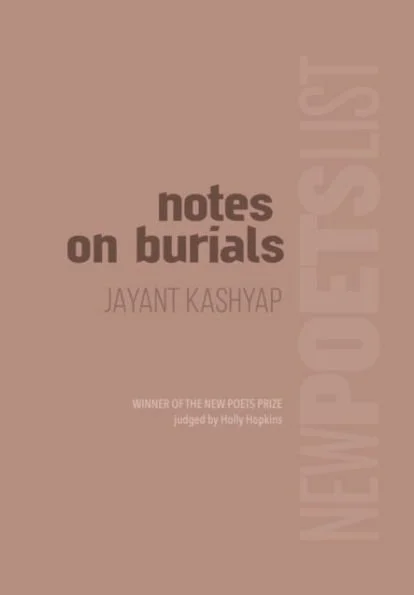
Jayant Kashyap’s Notes on Burials, winner of the 2024 New Poets Prize and published by New Poets List, The Poetry Business in 2025, is a compact, beautifully deliberate collection that approaches grief as both ritual and vocabulary. Kashyap frames grief as both process and object, as something we do, something we inherit, and something we try, continuously, in and of cycles, to name. Rather than offering a single, linear arc of mourning, the collection works by circling: returning to images, sounds, and fragments of knowledge the way a mind returns to what it cannot quite identify, explain and/or put to rest. The result is quietly immersive. You won’t “finish” these poems so much as you will carry them with you and, perhaps like me, later finding yourself thinking back into and of them later.
One of the pamphlet’s most striking strengths is Kashyap’s control of tone. The poems can feel spare and exacting, as if they’re assembling a field guide to loss, and then, quietly shift, becoming intimate, luminous, and tender. That tonal movement is part of the book’s emotional intelligence: grief is not one temperature. It includes the coolness of trying to understand, the heat of memory, the blankness of shock, and the softening that comes with repetition and, sometimes, time. Kashyap writes in a way that is timeless and that respects those changes rather than forcing them into a neat emotional lesson so contrary to grief and mourning.
Language itself becomes a kind of burial ground in the collection’s pages. The pieces are layered, unsettled, and full of meanings that surface when disturbed. Kashyap’s attention to etymology, definition, and the textures of words presents as honest as any record of how people mourn: by searching, by testing phrases, by turning ideas over (and over) until they reveal a new edge. The collection suggests that grief is often an act of translation: between past and present, between private feeling and public ritual, and between what transpired and what can be transcribed or spoken.
For example,
Language itself becomes a kind of burial ground in the collection’s pages. The pieces are layered, unsettled, and full of meanings that surface when disturbed. Kashyap’s attention to etymology, definition, and the textures of words presents as honest as any record of how people mourn: by searching, by testing phrases, by turning ideas over (and over) until they reveal a new edge. The collection suggests that grief is often an act of translation: between past and present, between private feeling and public ritual, and between what transpired and what can be transcribed or spoken.
For example,
consider “London, Upon Your Arrival”
I.
We shall meet again, in London this time. I’m writing this in a letter meant
for you. I no longer know your address; you left in a frenzy as if there would
be no tomorrow. We shall meet again, but how will this promise hold?
and “Prayer for My Mother as a Child”
Let me carry myself like a quiet emptiness in her school bag,
watch over her from inside a pocket I zipped up earlier
from the inside – ‘inside’, say ‘her heart’: that I’ll talk to her
The collection’s imagery is equally attentive. Earth, water, ground, flame, and air appear, and reappear, as working elements and forces that shape what burial means across place and culture.
Consider “Pyre”
To dissolve a body of its past, we use incense, we use flame and flowers,
or shovels and soil. And prayers, and pieces of wood. Birds peck at worms in
the logs before fire
embraces the logs of wood.
Kashyap’s poems understand that death is never purely personal: it happens in landscapes, within customs, alongside histories, under weather, and of languages that carry their own rites and limitations. That broader awareness gives the collection a sense of scale. Even when a poem feels inward focused and close to the body or a single memory, it still gestures outward, suggesting how individual loss participates in collective patterns of disappearance and remembrance.
Another pleasure of sitting with Notes on Burials is its variety in style and form. Kashyap doesn’t rely on one signature style or effect; instead, the book (and its 19 pieces) feels like a set of carefully chosen approaches, each suited to a particular kind of attention. Some pieces read like notes, some like incantations, some like quiet arguments with the self.
Examples include dig (n), the collection’s opening piece, and Notes on Burials, both framed as definitions, but dogs don’t want their puppies buried – and Oak, presented as short reflections and lists, and elements of history, a longer piece of two pages and thirteen stanzas.
This range prevents the subject from becoming repetitive or monotone and also mirrors the reality the book keeps returning to: grief changes shape. So, the poems change shape, too. Still, the pamphlet is cohesive, with cohesion emanating from the work’s ethical stance: the poems refuse to sentimentalize the dead or rush toward consolation. Instead, they offer presence, both practical and practiced, and an insistence that what is buried continues to exert pressure on the living. Notes on Burials trusts the reader to sit with that pressure. It does not dilute loss into a moral, nor does it turn mourning into performance. Rather, the work honors both the intensity and the strangeness (sometimes stillness) of bereavement: the way it can make the world feel sharper, older, more permeable.
Notes on Burials is a memorable work that can be read in one sitting, but which one will return to again, and then again. It’s a collection for readers who value poems that think as they feel, and that feel as they think: poems that treat language as a living site where love, history, and absence meet. Kashyap’s gift is not only in making grief and the ongoing act of burial and return, palpable and speakable, but in showing how speaking, reading, and writing itself can be a form of tending, loving and care. Enjoy the warmth of Kashyap’s tender words.
Jen Schneider is an educator who lives, writes, and works in small spaces throughout Pennsylvania. She loves words, experimental poetry, and the change of seasons. She’s also a fan of late nights, crossword puzzles, and compelling underdogs. She has authored several chapbooks and full-length poetry collections, with stories, poems, and essays published in a variety of literary and scholarly journals. Sample works include Invisible Ink, On Habits & Habitats, On Daily Puzzles: (Un)locking Invisibility, A Collection of Recollections, and Blindfolds, Bruises, and Breakups. She is currently working on her first series, which (not surprisingly) includes a novel in verse. She is the 2022-2023 Montgomery County PA Poet Laureate.
