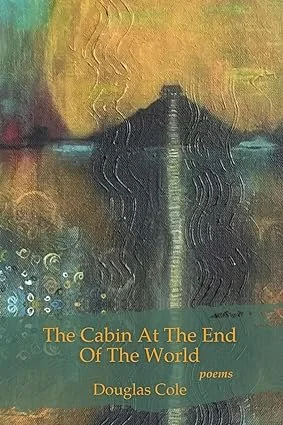
The Cabin at the End of the World
Unsolicited Press
$16.95
You can purchase a copy here.
Reviewed by Jennifer Schneider
The Cabin at the End Of the World, poems by Douglas Cole is a collection worthy of multiple walks through woods and worlds and even more readings. It’s both camera and image, working tool and work product, storm and rainbow. It’s all those things, in their precision as well as their ambiguity, and more.
Opening with a distinctly fitting epigraph –
“A gold-feathered bird
Sings in the palm…”
- Wallace Stevens
the collection is both song and shelter ensconced in words that embrace the unknowns of flight amidst surreal imagery as well as the satisfying familiarity of clear and direct prose. Cole masterfully weaves rich, evocative imagery alongside simple wants, needs, and longings. Emerging themes embrace and cross the natural world, origins, gritty realities, and unknown tomorrows.
The collection offers an experience layered atop experiences. The poems are crisp, visual, and memorable. Cole relies heavily on imagery that evokes a universe of emotions. Both relatable and deeply responsive to life in its many mountains, hills, and valleys, the poems in The Cabin at the End Of the World offer both shelter and sustenance. The collection curates memories while evoking memorable experiences. It’s a work in which one can disappear and stay for extended periods. It is, indeed, reminiscent of a walk around the lake –
“Perhaps the truth depends on a walk around the lake.”
- Wallace Stevens
― Wallace Stevens
Perhaps. Perhaps as well, truths are found in walks through books and collections like The Cabin at the End of the World.
The collection is divided into four sections: Block 23, American Dharma, The Talking Stone, and The Windows of the Sea with fifteen poems in each of the first three sections and two poems in the final section. This is a cabin fully stocked– of soul-nourishing prose poetry in a variety of themes, sizes, flavors, and takes on the intersection of moments where the present meets the future. Themes, which extend across coming of age, exploratory travels, lands unknown, and bonds of childhood, morph like limbs that grow as they crystallize on the page and form threads that grow stronger throughout the collection.
From trains in “A Game of Chicken”, dirt roads in “Revisiting Erskine Way”, city streets in “Mind Blank as a Room”, and “pigeons huddled in an alcove off Broadway” (“Pigeon Man”), Cole builds Block 23 and the collection’s extended building blocks with prose that is simultaneously surreal, lyrical, and unforgettable in its eclectic blend of imaginative imagery and relatable realities. From open to close, Cole never ceases to delight with language and layers of meaning. Reading the world (and fresh words) as expressed in the collection is as much a journey across physical landscapes as it is an emotional arc and trasformative reading experience.
Work and the work of actors in all phases and spaces of life come to life in Cole’s pages. Highway patrolmen (“Patrolman” ), shredder trucks (“Tuesday’s Purge” ), butchers (“Boethius Said” ), and people in “smocks and masks” (“Into the Zone” ) share pages with secret doors (“Dear Reader”), abandoned weather stations (“The Desert Motel”), and “old tomes stacked high and rare collectibles in the back rooms I haven’t the lives to explore” (“Dark Carnival”). The work of the day meets the work of the mind in extraordinary writing that captures the layered complexity of daily life.
Cole never shies away from experimenting and tackling tough topics with poignant prose that is, page after page in this 89-page collection published by Unsolicited Press, delightfully surprising. The collection is fitting for anyone seeking truths, solace wrapped in evocative vignettes and lived experiences, and satisfying walks through gorgeous language amidst the ever-changing complexity of present-day society. Whether seeking comfort while “walking home from Charlie and Yumi’s house after one” (“Getting Yourself Home”) or contemplating the brightness of the end of a dream (“The End of the World”), I encourage all readers to explore Cole’s work. You won’t be disappointed by all that welcomes you in the cabin and the world– both beginnings and endings, in which the work lingers.

Jen Schneider is an educator who lives, writes, and works in small spaces throughout Pennsylvania. She loves words, experimental poetry, and the change of seasons. She’s also a fan of late nights, crossword puzzles, and compelling underdogs. She has authored several chapbooks and full-length poetry collections, with stories, poems, and essays published in a variety of literary and scholarly journals. Sample works include Invisible Ink, On Habits & Habitats, On Daily Puzzles: (Un)locking Invisibility, A Collection of Recollections, and Blindfolds, Bruises, and Breakups. She is currently working on her first series, which (not surprisingly) includes a novel in verse. She is the 2022-2023 Montgomery County PA Poet Laureate.