Ekphrasis: Poems and Art

Image Credit: Cathleen Cohen
Welcome to a new Mad Poets blog, to be offered every two months.
It’s a pleasure to write about the relationship between poetry and other art forms, to examine ways that a various creative arts relate to each other.
The term ekphrasis can be defined narrowly as writing that describes a work of art in another medium-- paintings, music, photography sculpture and the like. It can also refer more broadly to the alchemy that happens when one medium tries to define and relate to another. This could refer to poems inspired by the visual arts or music -- and also the reverse! To my mind, ekphrasis can also encompass hybrid works, like artists’ books, author/illustrator collaborations and graphic poems.
Many scholars have written about ekphrasis and there are great resources online. Though not scholar of the topic, I have had a practice of writing poetry and painting for many years. Both are essential to my creative life. These art forms interact, challenge each other and open up many questions and tensions.
My aim in this blog is to feature the work of various poets and artists, to let you know of interesting viewing opportunities and to provide some angles that might prompt your own writing.
The Poetry and Mosaics of Rabbi Gila Colman Ruskin
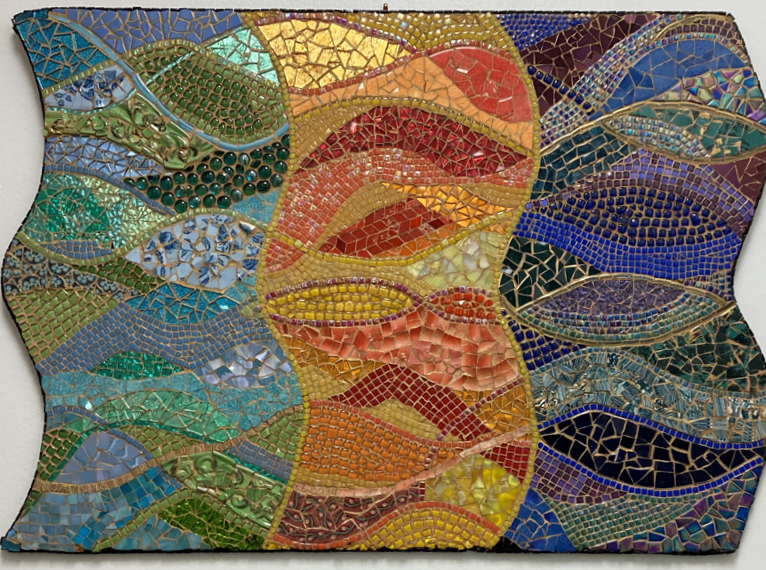
Modim (Gratitude)
This August I attended a writing workshop centered around the work of poet, mosaic artist and rabbi, Gila Colman Ruskin. Gila is talented in many modalities and combines her experience as a rabbi and teacher with writing and art making. Her process embodies ekphrasis as she moves between traditional texts, imagery and her own words.
Her mosaics are stunning. A sampling of her work created over a number of years is currently exhibited on the walls of Mekor Habracha/Center City, a synagogue nestled in a Center City office building. Complex and arresting, these pieces have appeal for a wide variety of viewers, no matter their faith background.
Gila terms her approach “mosaic midrash”. Midrash has deep traditional roots and offers a way to interact with a formal text, for example, a line of a psalm or a passage in the Torah (or Bible). To create a midrash is a personal and interpretive act, a way to “add to the text,” Gila explains. A painting, collage or mosaic can be a midrash, likewise a poem.
This next mosaic of Gila’s incorporates a broken teacup once owned by a friend’s mother. It’s paired with one of her poems. The source of inspiration is “You are the portion in my cup”, a line from a Jewish prayer (Adon Olam).
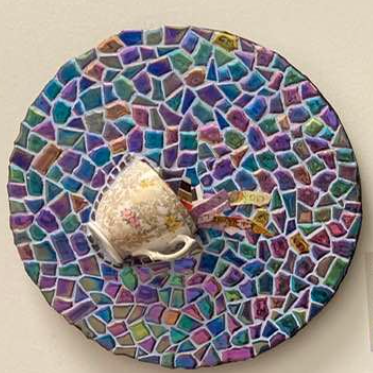
You Are the Portion in My Cup
Tessarae
Shards
careening across the kitchen
where we were just eating our Tuesday night pasta
Fragments of aqua and tiny pink flowers
now splashed and splintered with tomato and basil
Sighing, I grab the broom
Brusquely sweep up Nana’s china now a gory mess
I feel the eyes of the perpetrator upon me he sighs too waiting for rebuke
The soundtrack pulsates as the plot pivots
around this Milestone Mom Moment
So, I roll back my shoulders, face the kids and say:
“Tomorrow we can mosaic!”
Rabbi Gila Colman Ruskin

Min Hametzar (Out of the Narrow Place)
To view Gila’s artwork is not a passive encounter. Mosaics glitter on the walls, combining tiles, broken ceramics and found objects. The energy is palpable. Her images invite us to discover wholeness in the world’s brokenness. Walls are littered with prayers and texts -- an invitation for us to respond deeply, to write responses and share our own poems.
Gila mentioned to me that a viewer once told her he had never thought of his prayers as having a visual component before seeing this exhibit. For her, “It’s a moment of pure ecstasy if someone has a deep resonance with my work and with a text.” Indeed, she often shares the following poem to those who come see her work. It’s her own ars poetica about ekphrasis.
It Wasn’t Enough
It wasn’t enough to break the plates
And mix the adhesive
To assemble the palette
To find the pearl earring at the bottom of the bin.
It wasn’t enough to mold the hills
And modge-podge the sky
To attach fruit to the tree
To paint the dove’s wings with sparkling dew.
It wasn’t enough to form ancient letters
Of soul-comfort prayers
To clean off stray grout
To frame and to label and mount on the wall.
Don’t say: “what pretty colors”
Or ask me “how long did this take you?”
Or “did you sell many pieces?”
That’s not why you’re here!
You’re integral to the process,
Co-creator of midrash
Co-seeker of truth
Mining layers of meaning.
To me, you’re the essential
Co-repairer of the world
L’taken ha-olam
With shards and with words.
Rabbi Gila Colman Ruskin
I highly recommend viewing Gila’s wonderful exhibit in person or online and adding your own poems to the growing body of work that her imagery has inspired.
For more information or to contact Gila: https://www.facebook.com/mosaicmidrash or rabbigilaruskin@gmail.com.
Her poems can be viewed at https://ritualwell.org/?s=Gila+colman+ruskin.

Cathleen Cohen was the 2019 Poet Laureate of Montgomery County, PA. A painter and teacher, she founded the We the Poets program at ArtWell, an arts education non-profit in Philadelphia (www.theartwell.org). Her poems appear in journals such as Apiary, Baltimore Review, Cagibi, East Coast Ink, 6ix, North of Oxford, One Art, Passager, Philadelphia Stories, Rockvale Review and Rogue Agent. Camera Obscura (chapbook, Moonstone Press), appeared in 2017 and Etching the Ghost (Atmosphere Press), was published in 2021. She received the Interfaith Relations Award from the Montgomery County PA Human Rights Commission and the Public Service Award from National Association of Poetry Therapy. Her paintings are on view at Cerulean Arts Gallery. To learn more about her work, visit www.cathleencohenart.com.
