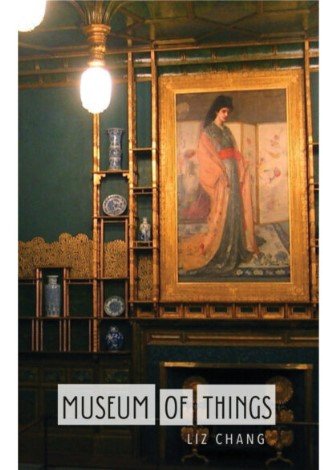
It is inevitable as we move through our lives that we collect and dust off memorabilia that remind us of other people and other times. In Liz Chang’s riveting chapbook, she documents her Museum of Things. Each talismanic object, including a Peanuts lamp, wooden display shelves, and a children’s book, contains an art gallery tag listing the artist, active years, title, media, dimensions, provenance, and catalog number. By utilizing this format, Chang invites the reader to view her exquisitely rendered poems as pieces of art. Objects and lived experience fuse together in an distilled, intimate, and vital essence.
Chang begins with the poem, “It’s a Lamp, Charlie Brown.” Not just an ordinary lamp, this lamp of Peanuts characters symbolize her grandparents’ wishes “that I might always be/ uncomplicated, docile, faithful.” The lamp also serves as a magical vessel for her sorrows:
I do remember
gazing at the balloons that never rose
while my mother recounted how my classmate
in the hospital might die from third degree burns…
feeling grief
flow out of me and into
the balloons’ empty chambers.
As the narrator grows older, the lamp also carries scars in the form of shattered balloons:
My father claims he bumped the lamp
one night while we were “disagreeing”
but what echoes inside my head
my fault, my fault, my fault
Conveying a poet’s mastery, this poem takes you through early childhood to its end. Chang’s poem captures the worldly, whimsical, and melancholy wisdom of Peanuts characters perfectly.
In “She Couldn’t Quite Explain It/ [It] Had Always Just Been There,” Chang describes the history of a relationship through a wooden display shelf found in the West Village “scouring the sidewalks on springtime Tuesday evenings,/ picking through the well-off’s castoffs, their casual/ disregard, rather than face our own crumbling.” As the narrator picks up the worn shelves, her partner makes his disapproval known, yet she realizes “Everything permanent he’d let me bring/ into our space was earthtoned—it [mint green shelves] was defiantly wrong,/ too loud and odd like me.” In this poem, the abandoned shelves mirror the cooling of the relationship. The narrator’s partner is ecstatic to buy a used copy of Crash Test Dummies’ God Shuffled His Feet. “I accepted his token mournfully, thinking/ this is a gift you give your middle school carpool lead/ or a lab partner—not someone who’s carried and lost your child.” The power of this poem is how naturally and subtly Chang builds up to this line. It took my breath away and made me reexamine everything I had read before. She confesses to the reader “I lost that CD long ago,” but the shelves “hang in the only room that’s mine.”
Chang concludes her brilliant collection with the poem, “The Moon and the Sun.” This poem beautifully extols the necessity for a diverse representation in children’s literature:
My father read to me from his passed down library
of Golden Books—books for little American children—
and I learned that stories weren’t about people who looked
like us. I felt my Asian-ness a secret, one
that the authors did not know or understand.
The narrator discovers The Weaving of a Dream, a Chinese fairy tale featuring three sons, that does reflect her experience, or more accurately, her father’s.
Of course, it is the youngest son who stays the longest,
remains loyal and courageous. My father is the youngest,
and when his mother faltered, he did not hesitate
to knock out his front teeth, swallow his cries,
as he flew over fire, stifle screams as he lolled in a vast sea of grief.
At the end of her father’s/the youngest son’s journey following his mother, he discovers “a palace of fairies and monsters. At night,/ the most beautiful fairy hangs a pearl to work by as a lamp./ It is elemental as the moon, this love of art and beauty.” As a child, the narrator would always help her father replace their “moon,” or the streetlamp. When they moved and as an act of love for the narrator and her grandchildren, he “took down the globe” and
He fashioned a lamp base from a bottomless bowl,
rewired the moon so it would not glow too hot,
gifted it to me many years later so I can read
to my daughters at night
by its light.
Rich, evocative, it is hard to believe Museum of Things is only a chapbook, since it contains so much, like the Louvre. The reader could spend many happy and fulfilled hours wandering its rooms and viewing its contents. For fans of pop culture, object art, and poetry, I would very highly recommend Liz Chang’s Museum of Things. It is a stirring work of art.

Sean Hanrahan is a Philadelphian poet originally hailing from Dale City, Virginia. He is the author of the full-length collection Safer Behind Popcorn (2019 Cajun Mutt Press) and the chapbooks Hardened Eyes on the Scan (2018 Moonstone Press) and Gay Cake (2020 Toho). His work has also been included in several anthologies, including Moonstone Featured Poets, Queer Around the World, and Stonewall’s Legacy, and several journals, including Impossible Archetype, Mobius, Peculiar, Poetica Review, and Voicemail Poems. He has taught classes titled A Chapbook in 49 Days and Ekphrastic Poetry and hosted poetry events throughout Philadelphia.