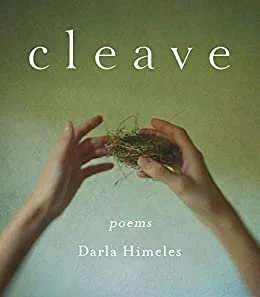
Cleave
Get Fresh Books
$18.00
You can purchase a copy at Get Fresh Books or Amazon
Reviewed by Autumn Konopka
I’ve got to be honest: I’m not even sure how to begin reviewing Cleave, Darla Himeles’ 2021 full-length collection of poetry.
It’s not just the book’s expansiveness, which ranges from the speaker’s early childhood and moves through to her own experiences conceiving and raising a child. And it’s not the breadth of the speaker’s vulnerability as she explores family relationships, romantic and sexual encounters, marriage, motherhood, and social and political connections. It’s not even the unflinching honesty of these poems, which dare to present enduring love and hope even in the aftermath of excruciating violence.
The power of this collection lies in Himeles’ ability to bind (cleave) all of this together with freshness and beauty. The poet’s gift for precise, concrete images and unique turns of phrase make uncommon, almost unimaginable, experiences come viscerally alive. At the same, she can also transform even the most ordinary event into something brand new. As I read the book, pencil in hand, preparing for this review, I found myself repeatedly writing in the margins Damn! She’s so good! It was hard to come up with much more than that.
Take, for instance, “What It Felt Like” – the second poem in the book and one of the most brutal, which recounts a truly horrific act of violence, as witnessed by a four-year-old, with descriptions that are, at times, nothing short of stunning. I don’t necessarily want to call this poem “beautiful”; yet, with lines like “Mom’s bloody screech,—elongated/ purple ribbons of her breath” and “her pink body whisked up like paper,” how can I not?
It is not that the poet is trying to make a brutal experience anything other than what it was by blunting it with “poetic” language. No. Himeles is keenly aware of the weight borne by her descriptions as she makes clear in the poem “Philadelphia.” Another poem with graphic images of abuse, “Philadelphia” begins:
I don’t know anymore the line between witness
and cruelty, whether you should see what I will
show you, the black magic of a shadow
gaining contour in the flickering streetlight,
The poem clearly intimates the violence to come and, yet, entrances the reader with the “black magic of a shadow.”
Himeles is a poet who understands that the world is full of shadows – things are not black and white, good or evil. As such, terrible things might appear beautiful – at least for a moment, at least from certain angles. This is rendered with honesty and vulnerability in the poems “Marriott Hotel, Marina del Rey” and “Among the Things I Haven’t Asked My Father Because I Love Him.” The two poems appear on facing pages later in the book and find the speaker, now an adult, interacting with her abusive father – affording him a deeper level of consideration and kindness even than most probably would. For instance, in “Among the Things…” the speaker poses nine questions to her father. The first eight convey an act of cruelty he had committed, but the last asks: “What made you love us with such radiant eyes? Who taught you to treasure us like that?” This simple list poem is one of the most dangerous and moving in the collection because of the poet’s willingness to show tenderness and see light in someone who has hurt her in the most awful ways possible.
This book is not beginning-to-end pain, however. One of the most delightful aspects of Cleave is the way Himeles uses humor, especially when confronting topics that are potentially uncomfortable. “Insemination 12” takes an awkward, clinical experience – an intrauterine insemination procedure – and makes it sexy and funny. Then there’s “GODildo” – part ode/part anti-ode to, you guessed it, a dildo. One of my favorite poems in this vein is “For the FedEx Guy,” which recounts the arrival of frozen sperm and considers the full journey of those “millions of motile swimmers.”
Overall, Cleave takes readers on a journey of surprising resilience. Himeles demonstrates the myriad responses possible – perhaps necessary – to move through life’s most challenging and traumatic experiences. Humor and beauty, as I’ve explained – but also desire, passion, and persistence. All of that is here. I was repeatedly surprised and inspired by the way this collection – no matter how dark – refuses to simplify or demonize. Instead, again and again, the poems here turn toward light and redefine hope.
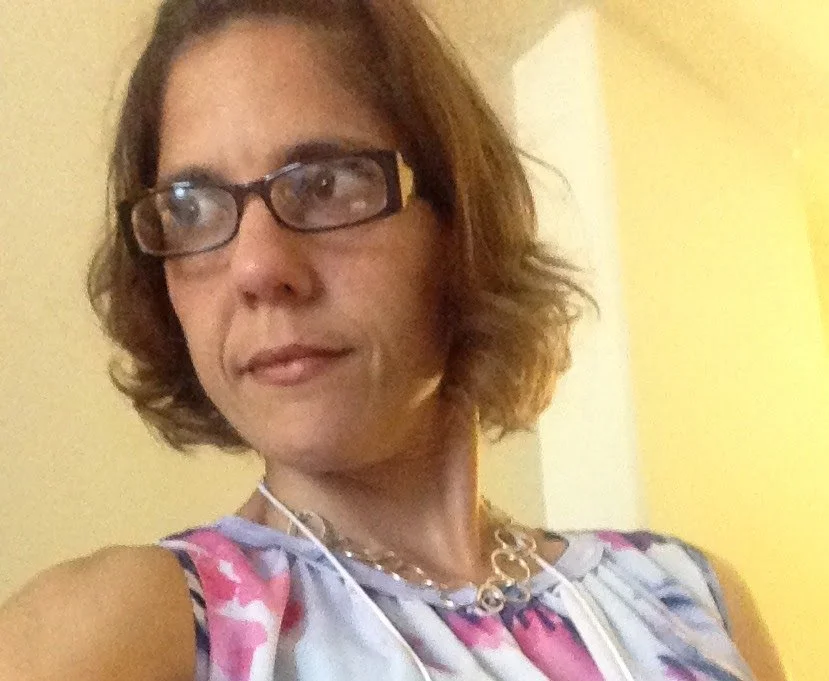
Autumn Konopka is a writer and teaching artist who enjoys coffee, running, and reggaeton. She's currently working on her first novel, which she expects to publish in early 2023. Find her online: autumnkonopka.com.
