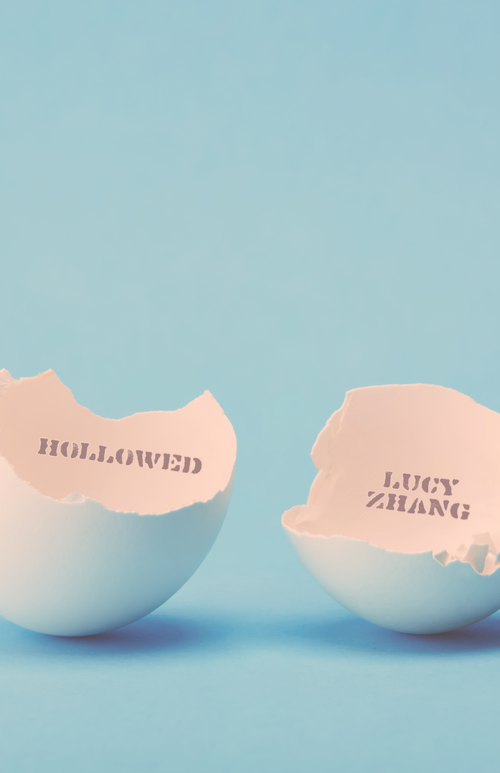
Hollowed
Thirty West Publishing House
$10.99
You can purchase a copy here.
Reviewed by Jennifer Schneider
Welcome to Hollowed, a perfectly sized and memorably seasoned platter of fresh poems guaranteed to delight readers and satisfy anyone with an appetite for an original take on identity, relationships, and reality.
Throughout Hollowed’s thirty pages, Lucy Zhang manages to recreate and reimagine the entirety of the egg (origins, opulence, forms of being) and associated concepts of life and life-cycles (beginnings, arcs, complementary pairings, expected arrangements, endings), in ways that crack all prior notions of what it means to be (alive, a daughter, a partner, a parent, a patient, a human being, and more). The collection’s poems number fewer than a dozen with a compact nine egg (eggscellent) pieces, each reflective of varying life stages and cycles. Despite (or, perhaps, in spite of) the thematic egg, the work’s subject matter extends far beyond the home and its perennial heart (the beat of a kitchen) to include worlds both real and imagined. Zhang cracks open questions of family, tradition, diet, and identity, and then whips, whisks, and fries (often upside down and in entirely original and unexpected ways) new visions of what it means to exist in a world that is ripe with tension and constant change. Zhang, though, does more than simply crack open history and questions of identity. The author creates entirely original ways of navigating the same, both known and inspired.
Throughout the entirety of the work, Zhang generously shares and provides access to possible answers (and newly prompted questions) on long-shared inquiries through original and unexpected descriptions (SOFT-SHELLED TURTLE: “The fairies play mahjong while I shower” 4) and explicit ponderings on tradition (CRACKED: “My parents send me dried bird’s nests, produced from a swallow’s solidified saliva” 13). The work blends introspection and instruction while also serving as a how-to guide of sorts on a range of topics. Equal parts explanatory and commentary, Zhang makes the hard work of crafting magic on the page appear light.
The pieces are highly descriptive and thought provoking. Themes include body, heart, and mind. The collection weaves tradition (CENTURY EGG: “Mother won’t let me eat century eggs because she says there’s lead in them” 6) and a hearty dose of history (ROOM TOUR: “My mom used to say that I had no ‘living standards’ because I don’t buy shrimp” 24) with both imaginative speculation (ROOM TOUR: “My lover from the future says I am dead in his time” 22) and reflective introspection (HOW TO MAKE ME ORGASM: “Close your eyes. When they’re open, I’m reminded of the head left on the plate of roast duck: bill opened wide enough to see down its throat, eyes bulging against the crisped skin.… You hear better with your eyes closed” 8). The prose is punctuated with surprise (lines of code in CODE BABY: “Uncaught exception: object cannot be nil” 17) and whimsy (STONE GIRL: “(Something else) Before the sculptor carves into her, he knocks off her limbs, positioning the point of a chisel against her elbow” 9). Each element is both delightful and daring. Pieces are a mix of coded prose and commentary both social and cultural.
Zhang does not hold back. The author mixes the mundane (shower) with the magical (fairies) and the familial (babies and births) with the fantastical (future lovers), Zhang masterfully engages audiences of all backgrounds, ages, and life stages, while weaving a complex web of mythology, customs, and cultural expectation in ways that are both gripping and memorable.
The work’s nine pieces span topics as varied as how to carry (then cook) a soft-shell turtle and how to maintain life (succulents, dogs, embryos). Following the collection’s theme of eggs, delicate shells, and life cycles, Zhang takes readers on a tour of tradition and timelines. Simultaneously touring the persistence of both tradition and expectation, Zhang masterfully balances past and future. Original interior graphics add to the work’s deeply personal feel. The collection explores the complex and cyclical nature of life. Topics include traditions passed down through generations, game making, and menstrual (as well as life) cycles.
Pieces bounce from birthing and engineering (CODE BABY: “I initialized constants for your name, variables for your height and weight, buffer sizes for your capacity to learn” 17) to egg-dropping (HATCHLING: “When the egg popped out of her vagina, the woman recalled their old chicken, Little Red, who’d lay one egg every two days” 19). Food, remedies (both evidenced- and culinary-based), and fantastic (also fantastical) imagery populate the work. With toggles between the traditional and the imagined, Hollowed digs deep and balances worlds (both personal and personified) and multiple origins.
The collection is as imaginative as it is inspiring. In Hollowed, Zhang has coded and crafted a work of admirable execution (with no identifiable or observable bugs). Never again will I think of an egg (or carton of eggs) in the same way. Hollowed simultaneously satisfies while leaving the reader hungry for more poetic bites. Add Zhang’s remarkable work to the top of your shopping (and reading list). You won’t be disappointed. It’s a darn good egg.
Jen Schneider is an educator who lives, writes, and works in small spaces throughout Pennsylvania. She loves words, experimental poetry, and the change of seasons. She’s also a fan of late nights, crossword puzzles, and compelling underdogs. She has authored several chapbooks and full-length poetry collections, with stories, poems, and essays published in a variety of literary and scholarly journals. Sample works include Invisible Ink, On Habits & Habitats, On Daily Puzzles: (Un)locking Invisibility, A Collection of Recollections, and Blindfolds, Bruises, and Breakups. She is currently working on her first series, which (not surprisingly) includes a novel in verse. She is the 2022-2023 Montgomery County PA Poet Laureate.
