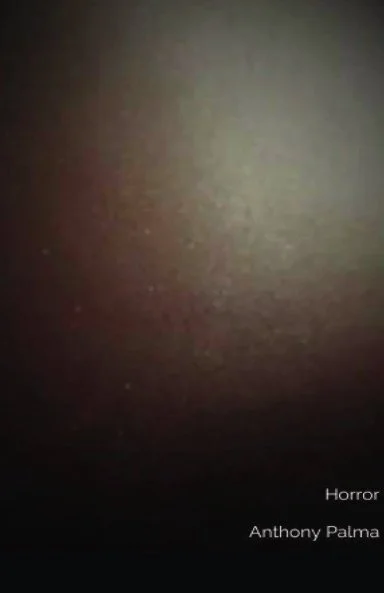
Given the title of Anthony Palma’s new chapbook, I was braced for poems screaming with gape-mouthed terror. This “horror,” I discovered, consists of subtler stuff, of a deep disquiet that sneaks in and accumulates in layers, like cosmic dust.
Writing in a spare, minimalist style, Palma reflects on big topics: connection and grief, life and death and the spaces in between. Most of these poems are short, some fewer than a dozen lines—but their brevity doesn’t detract from their impact. Consider, for example, the haunting “The Astronaut in the Abyss,” quoted here in its entirety:
How long
until
the air runs out?
How long
until
I float into
unknown
wonders,
gasping.
“We talk like we matter,” Palma says in “The Rose.” But the truth of “Horror” is that people exist amid, and at the mercy of, forces beyond their control, including death. Ceasing to exist is a recurring theme. In “Annihilation,” Palma writes,
Who I was
will fade
like a fever dream
along a backroad curve.
Palma’s view is clear-eyed and unblinking. In “Cosmic Horror,” he reflects,
In the sky,
there are no gems that twinkle-
only rocks and reflections.
“Horror” is as much about absence—what isn’t there—as anything else. In “In the Ruins of the Old World,” the narrator describes being in what once was a mall:
I look on as the life fades from this place,
searching for nostalgia,
but feeling mostly nothing.
His dearth of feeling suggests both a numbness on his part and a lack of anything to feel: It could be that what’s been lost does not rise to the level of longing.
Palma uses simple, straightforward language to consider not-so-simple subjects. In “Meeting the Beast,” one of my favorite poems, he tells his reader,
If you look hard enough
at the space between
the sea
and the clouds…
something’s there.
Something was always there.
In some ways, this poem epitomizes “Horror”: Palma points to the in-between, the nuanced, the not seen. Such is the case with “The Cathedral of Now,” in which “The evening echoes/ through an empty intersection” and a traffic light guards the silence. The poet is a lone observer, seeing what no one else does.
Palma opens “Empty Spaces Part IV,” another favorite, with a reference to a death. One can feel the impact of the loss in his description of sitting outside in the cold with his friend,
drinking whiskey
and watching
the puddles
ice over.
Like others in the collection, this poem offers a comment on the power of connection, in this case in the form of the friend who shares a drink and moment of mourning. Palma closes the poem with
Voices from down the block proclaim
the new king has come,
and the old lie
things happen
for a reason.
The poet thus evinces a certain disillusionment with life. Likewise, he suggests throughout the collection that things are not always what they appear. In “Things Gone,” he describes “slipping into the light/ we perceive as golden”—as if the underlying reality is different.
Despite the unadorned somberness of many of the poems, this chapbook offers spots of brightness and hope. That’s especially true of the last poem, “Getting Up.”
The night and darkness
will always be there.
Hope is the thing
slipping through our fingers,
pooling at our feet,
but never evaporating completely.
In “Horror,” Palma is unafraid to stare some of our deepest fears in the face. The result is a thoughtful, probing work of considerable beauty.

Abbey J. Porter writes poetry and memoir about people, relationships, and life struggles. She holds an MFA in creative writing from Queens University of Charlotte, an MA in liberal studies from Villanova University, and a BA in English from Gettysburg College. Abbey works in communications and lives in Cheltenham, Pa., with her two dogs.
