
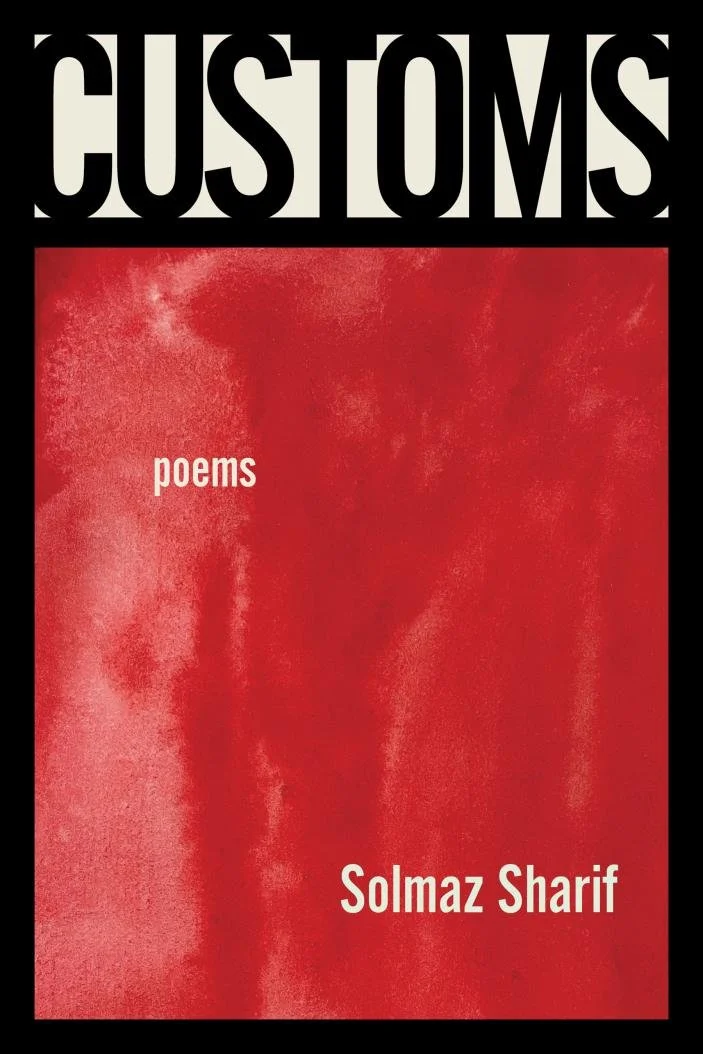
Solmaz Sharif’s Customs is a remarkable collection that engages with the notion of homelands and travel in ways both deeply personal and undeniably profound. The work is of the moment and of every moment. At a time of forced displacements, migrations, and unfamiliar and, for many, unprecedented limitations on travel, the question of what happens in the time and space between origination and destination is especially timely. Equally so is the question of what it means to flee, beyond the physical act of migration, and what the consequences are, both short and long term, of doing so. Customs takes on these questions and many more, primarily through the lens of the customs area in international airport terminals and the sometimes clouds, cloaks, and conceptions that linger long after processing.
Exploring migration, borders, and war alongside associated concepts of belonging, mobility, and customs processing from multi-layered perspectives, Customs both transports and transforms readers. Some books take us places we long to see. Other books take us places we need to see. Customs simultaneously does both. The work travels through and among locations of long-lingering revelations, including airport terminals (“Visa” 14), Ohio hotels (“Now What” 17), Oakland potholes (“Without Which” 53), and landscapes of “small and sharp stone … lined with cypresses” (“Does yours have a landscape?” 63), all while never journeying far from a carefully constructed examination of what it means to belong and to be subject to rules, often arbitrary, with life altering implications, often equally arbitrary and uncertain. The work engages with concepts both timely and timeless, all while presenting traditional conceptions of those same concepts in untraditional and unambiguously brilliant ways. The pieces are as varied in form and structure as their themes are similar.
Customs explores the complicated act of being (un)welcomed and (un)welcoming. Customs also prompts reflection on what it means to exist within and without perimeters and according to whose rules. Sharif zeroes in on what it means to belong, and at what cost, while inviting readers into the repeated conduct and rituals of airport terminals, guarded exchanges with customs officials, and the ever-present “The Master’s House” (59). As a guard on shift makes decisions “by blood sugar, last blow job received, and relative level of disdain for vermin” (“Visa” 14), Sharif simultaneously welcomes readers to do the same. Themes of perpetually conditional states of being, belonging, and otherness, alongside equally arbitrary rules and recommendations thread the work. Together the poems present a memorable, often harrowing, commentary that binds and reminds readers that welcomes and welcomings take many forms.
The collection opens with America but its themes extend far beyond United States borders.
America stands alone, outside of the collection’s three formal parts. Acting as not a gatekeeper but a reminder that gates are often neither open nor friendly, the opening poem serves, as well, as a reminder that often that which purports to welcome does much more to exclude. America is a compact poem of eighteen lines, two words per line, and remarkable breadth. The piece is one of reflections and mirrors, opening and closing with “I had to” (3) as if to invite readers to see their own reflection in and through the experiences of others.
Part I includes sixteen pieces, including an epistolary (“Dear, Aleph”) that presents as three poems. Throughout the section, the speaker explores and wrestles with prejudices both self-imposed and imposed upon oneself as they present before, during, after travel to and from homelands. The section explores concepts of home (“He, Too” 21), exile (“The End of Exile” 31), and language (“Learning Persian” 24; “Into English” 29) both apart and as an equally complex whole.
Sharif examines what it means to be a spectator in one’s own land
To watch play out around me as theatre – (“The End of Exile” 31)
and an outsider in others
This will be the last I write of it directly, I say each time.
This is a light that lights everything and dimly.
All my waiting at this railing.
All my writing is this squint (“Visa” 14)
Part II includes two poems, “Without Which” and “The Master’s House”. “Without Which” appears to continue with the speaker’s return to a changed land. Sharif uses repetitive brackets and white space in ways that are both memorable and masterful. “Without Which” spans twenty-two pages of the eighty-six page work and represents, perhaps, the emptiness, confusion, and inexplicable ]] of exile in lands with which souls worldwide struggle.
A blank page divides “Without Which” from Part II’s second piece - “The Master’s House”, a list poem that moves from empty space to spaces heavy with actions (customs and compromises, often repeated, often relentless, often reluctant) taken to survive in contradictory lands of new and never homes and of relentlessly inhospitable masters.
To revel in face serums (59)
To disrobe when the agent asks you to (60)
To do this in order to do the other thing, the wild thing, though you’ve forgotten what it was (60)
Part III contains two pieces, “Does yours have a landscape?” and an extended poem - “An Otherwise” (22 pages). While “An Otherwise” is the collection’s final piece, the poem is much more a beginning than an ending.
I tried to say it was dead, the song,
But then it came, my mother singing
of cypress – (80)
At one gate, my mother is waving. (84)
Customs is a standout by a standout poet. Readers not only gain a deeper appreciation for a poet at her best but also a deeper appreciation for Sharif’s ability to masterfully engage with language both constructed and consumed as a tool for understanding the impact of rules, expectations (“Wave, girls, the teacher says” (65)) and customs that extend far beyond their utterance. Readers also gain a deeper understanding of what it means to exist in a world of forced migration and simultaneously persistent isolation. The work is for anyone (everyone) who has come from somewhere (elsewhere) and wrestles with what it means to belong (and by whom). I hope you enjoy it as much as I did.

Jen Schneider is an educator who lives, writes, and works in small spaces throughout Pennsylvania. She loves words, experimental poetry, and the change of seasons. She’s also a fan of late nights, crossword puzzles, and compelling underdogs. She has authored several chapbooks and full-length poetry collections, with stories, poems, and essays published in a variety of literary and scholarly journals. Sample works include Invisible Ink, On Habits & Habitats, On Daily Puzzles: (Un)locking Invisibility, A Collection of Recollections, and Blindfolds, Bruises, and Breakups. She is currently working on her first series, which (not surprisingly) includes a novel in verse. She is the 2022-2023 Montgomery County PA Poet Laureate.
