
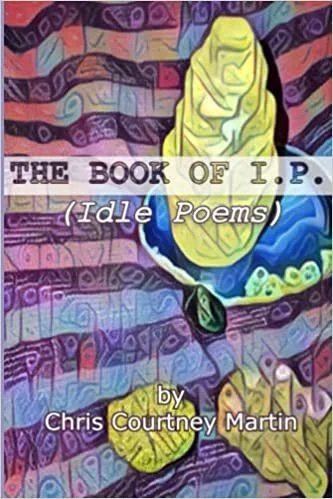
The Book of I.P (Idle Poems)
Alien Buddha Press
$10.44
You can purchase a copy here.
Reviewed by guest blogger, Anthony Palma
When most people think of being idle, things such as relaxation or inertia come to mind. These words don’t even begin to describe Chris Courtney Martin’s The Book of I.P. (Idle Poems) (Alien Buddha Press, 2022). This is a book full of dynamism and observation, wit and sorrow. At once funny and sad, it chronicles Martin’s search for discovery and understanding in a world that is tragic, absurd, and beautiful.
First of all, this book makes good use of pop culture references and nods. A number of poems make use of songs, ranging from The Beatles to Earth Wind and Fire. There are callouts to Shakespeare, Disney, and the MCU. What is really impressive, though, is the way that these references are used. They aren’t merely there for name recognition or to impress us. Rather, they are woven into the meaning and the concept of the poems in which they are found. A perfect example of this comes in “American Juju,” where in the first lines Martin makes a play on the famed line, “Go do that Voodoo that you do so well,” by saying, “There are no words for/that hoodoo that you do.” The rest of the poem then deftly riffs on the theme of Voodoo, using it to seemingly address a relationship before circling back to the image of the first stanza near the end. This creates a whole, unified poem that utilizes a theme to heighten its meaning while never feeling forced or unnatural in flow.
The above poem works in part because of Martin’s firm understanding of how the form and structure of a poem works. These are overall not formal poems, but all poems have form, and these play on that concept. The poem “A Yuletide Carol” has a physical numeric list that is intentionally unfinished. “Carpe Diem” plays with the concept of lines of poetry. And then there are poems such as “Love, Superduke,” and “Me, Myself and -Eye-“ that experiment with rhyme. Despite the experimental nature of these poems, though, they never fell haphazard or gratuitous. Martin writes them with a controlled certainty, showing us that they know exactly what they’re doing. Bruce Lee famously said that, we must first understand the rules in order to be able to break them, and that is exactly what this book does.
The Book of I.P. is not just about form and cultural awareness. It is in its social awareness and commentary where it really shines. The book’s description confirms that it hearkens back to the author’s attempt to get ideas ‘greenlit’ as a screenwriter, but this is not a mere industry book. It explores themes of identity, social stratification, and the biases endemic in American society. “Kira and the Fly King” touches on the unreachability of so many of our dreams, seemingly the result of classism. Poems like “Les Immigrés” address colonialism and gender, while others such as “Sadness, Sex, and Hector Rex” deal with the misogyny so prevalent in the both the entertainment industry and in our society overall. While acknowledging the problems, the poems are mature enough to recognize the difficulties in addressing them. The poems show their presence, mark them with disdain, and accept them – for better or worse - as part of the American landscape.
Were they written by lesser hands, it would be hard to get through these poems, but the ironic and at times funny tone of Martin’s work makes the ride interesting and enjoyable. After spending the first half of the poem “A Yuletide Carol” railing against the culture surrounding Christmas, Martin interjects, “Yes. / I am EXACTLY this fun at parties. / And at church.” Then, at the end of the poem lists the
REAL sins of this day--
1. Blood Blackmail
2. Unabashed Capitalism
3. “Grandma Got Run Over By a Reindeer”
...
Often throughout this book I found myself somewhere between laughter and tears. These poems skate on the thin ice that covers a river of vinegar and bitterness.
Overall, though, these poems are about coming to terms with these, society’s flaws, and finding meaning in our struggles with them. In the words of Martin, the book “expresses the freedom of shrugging creative restrictions after tapping into the voice of the Universe.” This is something that poets, artists, musicians, and all types of creatives need to consider. But we all as humans need to heed the message Martin offers, that in a world where conformity is legion, carving your own path is a form of resistance, a small, quiet rebellion that undermines all that is wrong with our society. And if you are to pursue that revolution inside yourself, let The Book of I.P. serve as a very worthy, crucial manifesto.

Anthony Palma’s work attempts to bridge the gap between poetry and other forms while addressing issues of social justice, identity, and existence. His work has appeared in publications such as Rue Scribe, Oddball Magazine, and the Show Us Your Papers Anthology. His debut collection of poetry, flashes of light from the deep (Parnilis Media), is now available on Amazon. He recently published Horror, a chapbook. His latest project is Palmoetry, a YouTube channel of his poetry and performances that are sometimes enhanced with music. Be sure to look him up on social media at anthonypalmapoetry.
