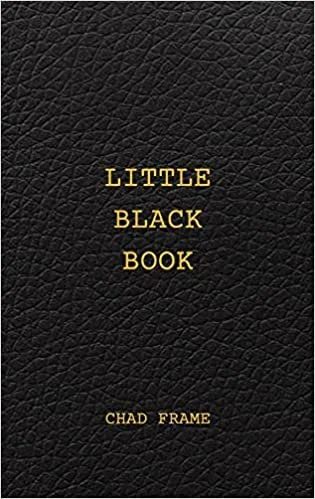
As readers, we sometimes come to poetry to find a perspective outside of our own—new experiences, new voices, and new worlds. Other times, we like to see our experience reflected through a different mirror—similar life experiences captured with courage, grace, heartbreaking honesty, and linguistic ingenuity. Chad Frame’s tour de force, Little Black Book, is the second category of book for me. Anyone interested in a revitalization of the confessional poetry genre and queer literature must read this debut volume from the Poet Laureate Emeritus of Montgomery County.
In “Andrea,” the narrator describes in taut couplets the senselessness of a gay eight grader (yes, DeSantis, gay eighth graders exist) forcing himself to be heterosexual like the other boys in his class.
Alone in my room, just me and the two—
by-three wallet of you, attempting
over and over, my hands desperate,
my efforts futile, your wide eyes
unblinking, as if desire is a puzzle
that can simply be hammered to fit
This poem becomes its own visual and visceral snapshot of a wasted moment in time. As an eighth grader questioning my own sexuality, I attempted to fantasize over my own “Andrea.” I think the realization that you are not like the other boys who “use their IQs to describe in detail/all they’ll do when they get you alone” is the first step on the long road to self-acceptance as a gay man.
As a fellow teenager in the ‘90s, I remember the murder of Matthew Shepard. It was a touchstone for all queer youth at that time. As a queer poet, and from this poem I assume Frame feels the same way, I feel it is vital to record LGBTQ historical events and our reactions to them—the good, the bad, the indifferent—so future queer people have a record. A record that for so many people of our and earlier generations had lacked since so much of our literature had been consigned to a dusty closet corner. In “Shepard,” a powerful poem with (again) taut couplets envisions Shepard’s beatified martyrdom as
slumped, arms raised, tied
to a buck rail,
and left to watch
over his flock.
While mourning this national tragedy, the narrator also wonders in light of Shepard’s murder how accepting would his friends be “thinking maybe/I could just tell someone, a friend/what I’m feeling.” At the time of Shepard’s murder, I contemplated coming out, but then decided that in a 1998 Virginia it was just not safe. The narrator does see a way forward with a hope I did not possess myself with the lines: “Matthew, I wish/I could show you/what you’ve achieved.” I think we all wish that somehow Matthew Shepard could see the more tolerant country (although America still has a far way to go) he never lived to see.
Another poem I can unfortunately relate to is “Nick,” a hard-hitting and an accurate description of an unpleasant situation that most queer people face. It starts innocently enough with Nick and the narrator “running and singing…just like any two people in love/might do on a Spring day.” The romantic jollity ends with a truck that “hurls cruelties out the window/easy as a flicked cigarette.” Frame’s poem than lists other horrific possibilities that could be tossed out at them—” a used condom” or “a Gatorade bottle/filled with two hundred miles/of warm piss.” The cruelty is not a physical object, but a slur. A slur queer people know well. As the popular meme and tweet says almost every gay man has been called it from a moving car. It is true.
Apart from life experiences and national tragedies, Frame’s collection addresses or mentions a panoply of queer men including Mark Doty, James Dean, Marlon Brando, Rock Hudson, Oscar Wilde, and Walt Whitman. In “Reading Myself to Sleep,” Frame writes “I want to fall asleep with two great men/pressed on top of me, the weight of their years/leather-bound on my chest.” Many queer poets turn to Oscar and Walt for inspiration and sustenance since they are a few of our queer forebearers who are not lost to us. As Frame beautifully exclaims as the narrator sees himself in their lineage, “Three generations/of men and poems, no apologies.”
Frame certainly has nothing to apologize for in this haunting, lovely, and vital collection. He is the perfect Bridge (to allude to one of my favorite queer poets Hart Crane) between the gay literature of the past and the gay literature to come. One of the best debut collections I have read, Little Black Book will be a signpost for queer poets for generations to come and is a reminder that Pride is a year-long affair.

Sean Hanrahan is a Philadelphian poet originally hailing from Dale City, Virginia. He is the author of the full-length collection Safer Behind Popcorn (2019 Cajun Mutt Press) and the chapbooks Hardened Eyes on the Scan (2018 Moonstone Press) and Gay Cake (2020 Toho). His work has also been included in several anthologies, including Moonstone Featured Poets, Queer Around the World, and Stonewall’s Legacy, and several journals, including Impossible Archetype, Mobius, Peculiar, Poetica Review, and Voicemail Poems. He has taught classes titled A Chapbook in 49 Days and Ekphrastic Poetry and hosted poetry events throughout Philadelphia.
